
A Victorian house in Cambridge undergoes a California-style renovation

It is a truism that the most successful projects are ones in which the designer or architect and their client have a clear understanding and appreciation of where the other is coming from. Sadly, this is not always the case. But for the London-based, South African-born architect Neil Dusheiko, it is an essential part of his firm’s modus operandi. ‘We just got on very well,’ Neil says of the husband and wife who commissioned him to renovate their Victorian semi-detached house in Cambridge. ‘From the beginning, we involved the clients in the process quite openly. We would often be on the phone discussing ideas. I would listen, then sketch and build physical models to show them.’ This was exactly what the owners wanted. They were as drawn to Neil’s use of light (more on that later) as they were to the fact that he encouraged them to join him on every step of the journey.
The initial brief was heavy on restoration but with modern elements, with the work of Frank Lloyd Wright and John Pawson serving as two sources of inspiration. The owners wanted to pay homage to the house, regarding themselves as custodians of a building that had seen better days. This meant adding 21st-century thermal insulation, restoring the windows and rebuilding the roof. Inside, however, there were not many original features left to save – but this can sometimes be a boon to architects and clients alike.
Neil and the owners bonded over a mutual love of the mid-century Case Study Houses in California, designed by the likes of Wright, Neutra and Eames as models of efficient, affordable housing that responded to their sites; today these are considered icons of domestic architecture. And, in a sense, this project could be seen as a pre-pandemic case study for how a family home could perform the multiple functions we have required of our living spaces for the past couple of years: somewhere to relax, work, learn and – in the darkest days of lockdown – offer a sense of escape. Spaces that are flexible.
It was not a case of prescience, but rather to suit the lifestyle the owners envisaged when they commissioned Neil at the start of 2017. The couple both work from home, so an office for two was created in one of the two main rooms on the ground floor at the front of the house. On the other side of the central entrance hall is a small sitting room – more of a snug really, with an original Victorian fireplace.
You can reach the back of the house from this room without having to return to the hall. An opening leads through to a vestibule space, which is lined with bookshelves and has a piano. This is linked to an area that serves as both television room and thoroughfare leading to the new rear extension. There is a pleasing circularity to the layout, as the other side of the extension reconnects to the original hallway.
One thing this country is not short of is Victorian houses with contemporary extensions tacked onto the back. What is rare, however, is to find one that is so well thought out. The footprint of the addition is a simple rectangle that creeps round the free side of the semi-detached house. But it is the shape of its roof – all angled and vaulted and cut through with skylights – that hints at something more unusual at play here. The back of the house faces north and, through a series of solar studies, daylight-analysis software and physical models, Neil and his team devised a structure that maximised the amount of daylight entering the home. The angles of the roof and positioning of the skylights allow shafts of light to move around the space like a clock throughout the day. This idea gave the building its name: Sun Slice House.
Huge sliding glass doors onto the garden form the rear of the extension, which serves as a kitchen and dining area. And, on one side, a wall of cupboards conceals three individual study areas for the children, who are homeschooled.
MAY WE SUGGEST: A bold of use colour and pattern enlivens a Victorian terrace in London
At the end of the garden, a companion outbuilding was created: a very different space that is part gym and spa, part guest accommodation. The Yorkstone terrace at the back of the house leads to a gravel path running along one side of the garden, which bypasses a lawn, greenhouse and raised vegetable and flower beds on the way to the spa building. The crunch of gravel underfoot is meant to reinforce the idea of transitioning to a different zone while the same handmade brick used on the façade of the extension appears as stepping stones along the path to tie the landscape to the main house.
The Dark Spa, as this structure has been named, is clad in the wonderfully textured Shou Sugi Ban, or charred cedar, traditionally used in Japan for weatherproofing. It sets the scene for an interior that is richer and darker than that of the house. The walls are lined with sapele, an African hardwood that retains its slightly spiced timber scent and rich red tones, which work beautifully with the granite floor. There is a gym, yoga room and sauna here, and a spare room that opens out onto a small private garden, planted to obscure the view of the house. It is a wonderful place to escape to.
Back in the main house, the side return of the extension allowed the creation of a boot-room entrance, which leads back to the main hallway. Oak floors and panelling, and crisp white walls combine to define these spaces, which meet at the foot of the refurbished staircase. The stairs were overclad with oak and refined with a contemporary oak handrail and bronze spindles. There is less radical reinvention on the upper floors, which accommodate four bedrooms and two bathrooms. One notable exception is the first floor landing, where a section at the front of the house was removed to form a double-height atrium from the entrance below – an effective way of creating a sense of drama for anyone entering by the front door, with just a few underused square feet of floor space sacrificed.
One of the achievements of the house is the balance that Neil and the owners found in preserving the integrity of a Victorian house while implementing significant changes. It has been rationalised and added to, rather than completely reinvented. More importantly, it has been designed to suit the specific needs of the family who live there, with just the right amount of added flair.
Neil Dusheiko Architects: neildusheiko.com
 Paul Massey1/13
The honey-coloured façade is complemented by the Petersen Tegl ‘Kolumba’ brickwork of the extension, which hugs the side of the house
 Paul Massey2/13
The addition is north facing, yet Neil Dusheiko’s innovative design – with its overhead skylights and huge sliding glass doors – ensures the open-plan kitchen and dining area receive plenty of light throughout the day.
 Paul Massey3/13
Designed by the architect and built by the main contractor, Sygnet Style, in ‘Multiply’ oak ply from TinTab – which tones with the new brickwork – the cabinets are finished with sleek, stain-resistant worktops in pale Dekton ‘Zenith’
 Paul Massey4/13
A table from Made.com (which has subsequently been replaced by a design from Kristalia with a Dekton surface to match the kitchen worktops) is paired with Stua’s ‘Globus’ chairs in orange. Three sleek ‘Annular’ pendant lights from Woud hang above it


 Paul Massey5/13
Doors fold back to reveal three workspaces, with shelves above. The blue ‘Tripp Trapp’ chair is by Stokke.
 Paul Massey6/13
Below the skylight are ‘Coral’ pendant lights by David Trubridge, which cast interesting shadows at certain times of day. The shelving unit is Skagerak’s ‘DO’ system.
 Paul Massey7/13
The desk is built to a design by the architect in the same TinTab oak ply as the kitchen.
 Paul Massey8/13
The core of the house holds the utility and laundry area and a guest bathroom, all concealed behind beautifully detailed oak veneered cladding. This blends into the engineered oak floor, while Vitra’s ‘Vegetal’ chair echoes the organic form of the ‘Coral’ pendants


 Paul Massey9/13
A ‘Mags’ sofa from Hay is covered in Kvadrat’s ‘Hallingdal 65’ wool mix.
 Paul Massey10/13
Vibrant’ turquoise tiles from CDS Tiles form a bold backdrop.
 Paul Massey11/13
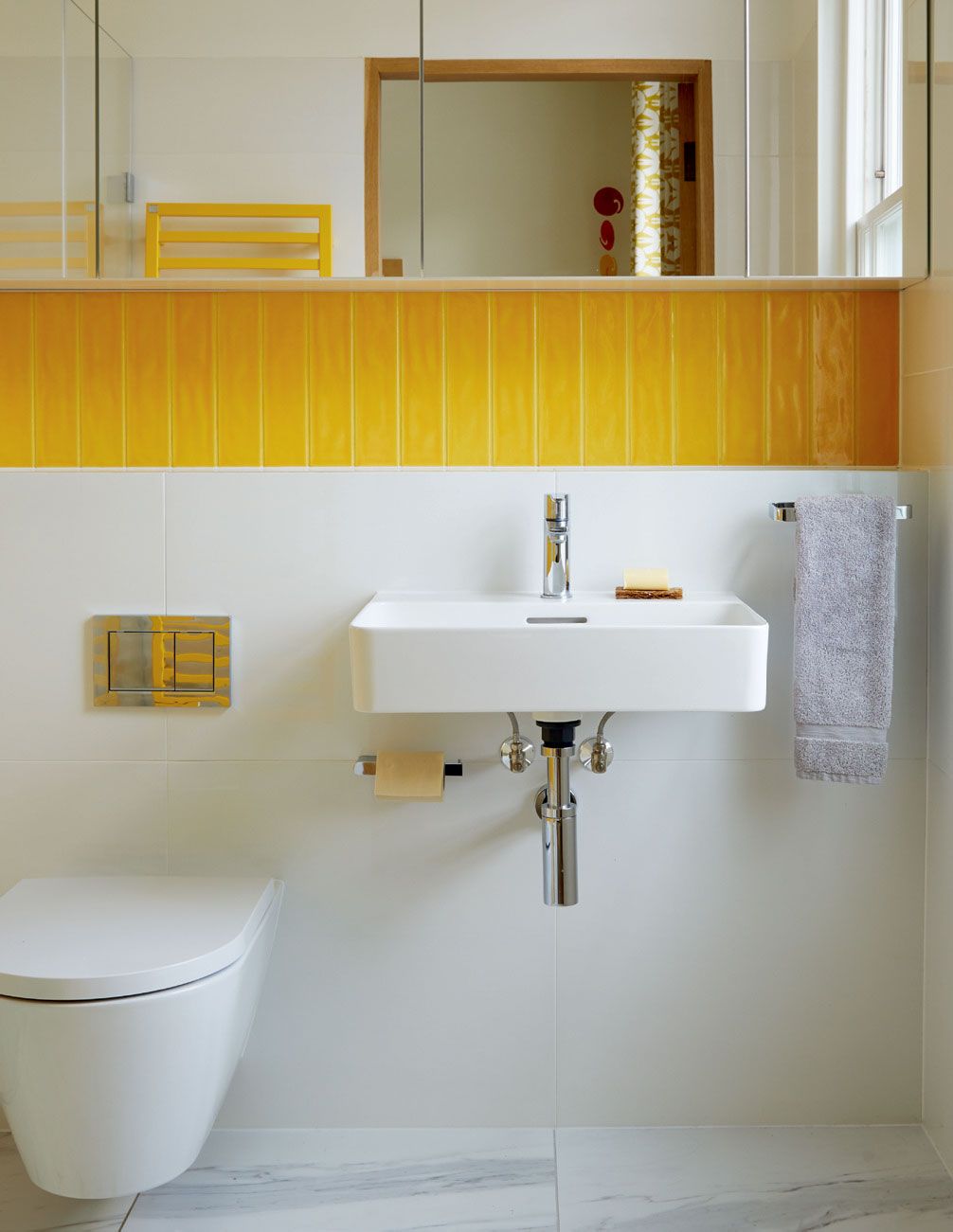
‘Vibrant’ tiles in yellow match the Laufen towel rail.
 Paul Massey12/13
Bespoke joinery has created ample storage


 Paul Massey13/13
Housed in the garden building, the walls are clad in rich red sapele hardwood, a section of which folds down into a custom bed. A wooden ‘Geo Deep’ soaking tub from William Garvey and large slate floor tiles from Blueprint Ceramics enhance the serene, spa-like feel


