
A palazzo on Venice's Grand Canal decorated by Jacques Grange

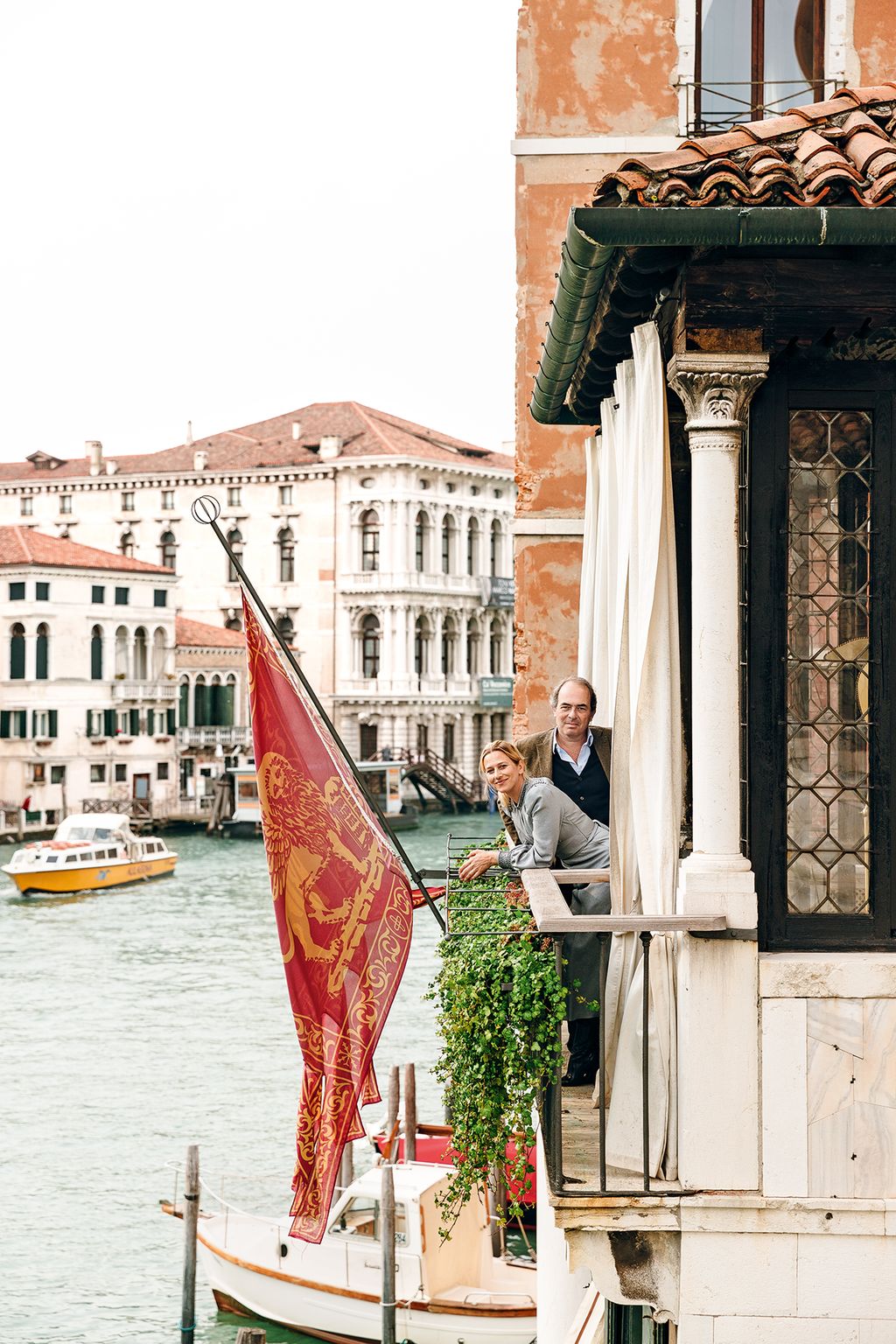
To live in a palazzo on the Grand Canal is to live at the grandest address in the world. And Palazzo Falier is one of the loveliest palaces: two leaded-glass porches add character to the 14th-century façade and covered balconies allow views of passing gondolas and all the pageantry of La Serenissima’s many regattas.
Its pivotal position, near the Accademia Bridge, reflects the importance of the Faliers, with three doges in the family’s history. One of these, Doge Marin Falier, notoriously attempted a coup against the patriarchs in 1355. He was beheaded in the monumental staircase of the Doge’s Palace, instead of the usual execution area between the two columns of St Mark’s Square. ‘And no Venetian walks through those columns to this day,’ says Giovanni Giol, the current owner of Palazzo Falier. It has been home for his family since the Wehrmacht requisitioned their villa on the mainland in 1940. He works in venture capital and real estate, and is also president of the Conservatorio di Musica Benedetto Marcello.
‘I inherited my father’s passion for both music and restoration,’ says Giovanni, who lived in the top floor apartment, with his wife Servane and their children, Ambra, 19, Leonardo, 18, Amerigo, 14 and Gregorio, 10, until 2017, when they decided to restore the piano nobile. This principal floor had been used as a gallery to host art shows for the city’s Biennale. ‘It would have been far easier to just stay put, but I wanted to embark on this project with Servane, who added her French touch. And it is a duty, as a Venetian, to preserve our heritage,’ he adds.
Servane grew up between Paris and the Far East and her oriental family furniture works well with the palazzo’s French and Ven-etian pieces. She chose her friend Jacques Grange as their decorator because of his sense of history: ‘I didn’t want to make it too modern,’ she says. ‘The first phase of the project was the most difficult, as I couldn’t find any plans of the original layout. So we brought in Alberto Torsello, a Venetian architect with specialist knowledge of historical palazzos, to help us redefine all the empty spaces. It was liberating to be able to design it entirely how we wanted.’ They began by dividing up the large, high-ceilinged space. ‘We needed more bedrooms and a family kitchen – as well as a room large enough to stage piano recitals or the children’s theatrical performances,’ explains Servane.
Jacques knows Venice of old and is familiar with the city’s idiosyncracies and quirky maritime climate. For the balcony windows, he hung cream canvas curtains on the outside of the building, as at the Procuratie in St Mark’s Square, to protect the marble of the façade. ‘We love to go swimming at the Lido and always come back with sandy feet, so the original terrazzo floors were left bare, as they have been for centuries,’ says Servane. ‘We kept colours pale as the light is so strong.’
It is the perfect setting for the lunches she hosts regularly for her circle of talented friends, including Giberto Arrivabene, whose Giberto drinking glasses are particular favourites, and Gaby Wagner, who designed several of the distinctive glass lamps in the palazzo. Many of the paintings on the walls – beside some Old Masters – are also works by friends.

When her children began school, Servane was surprised to find that, although lessons stop at midday, there are few afternoon activities and no school play. ‘I was brought up with a love of theatre – so I started my own theatre school, called Laboratorio Falier,’ she says. ‘I had no formal training. We began with eight children and have grown so much. Giovanna Cordova, who has a theatre school in Treviso, is our teacher and the director of eour adult company, Compania Falier. We stage a play in Venice and tour once a year. I don’t really think of us as amateur and some of our actors have turned professional.’ Any profit is divided among local and national charities. ‘It is a beautiful way to work for a good cause,’ she says. ‘Venice has brilliant artists, musicians and costume designers like Catherine Buyse Dian, as well as period costume makers Nicolao Atelier. Thanks to our artisan heritage and the tradition of Carnival, we have all we need for our productions right here.’
This is a home filled with fun, laughter, and music – the whole family plays the piano. Every morning, Giovanni walks to the Conservatorio nearby. ‘Even before I was appointed president, I loved this temple of music – I feel happy every time I enter the building.’ The conservatory is housed in Palazzo Pisani a Santo Stefano, one of the tallest and, until now, most shabby public buildings in Venice, which was sold to the state in the 19th century. ‘Few Venetians even knew the place. But I asked the right people, and all I had to do was to open its doors for them to respond to its beauty and want to help,’ he says. ‘I’ve been amazed by the generosity.’ Funds so far have helped restore the main reception rooms, with Venetian textile company Rubelli providing fabric for the walls and Alberto Cavalier, a small artisan shop on the campo, doing much of the gilding. ‘We are now earning money through our concerts – not just raising it,’ says a delighted Giovanni. ‘Its museum of musical instruments will be finished in November.’
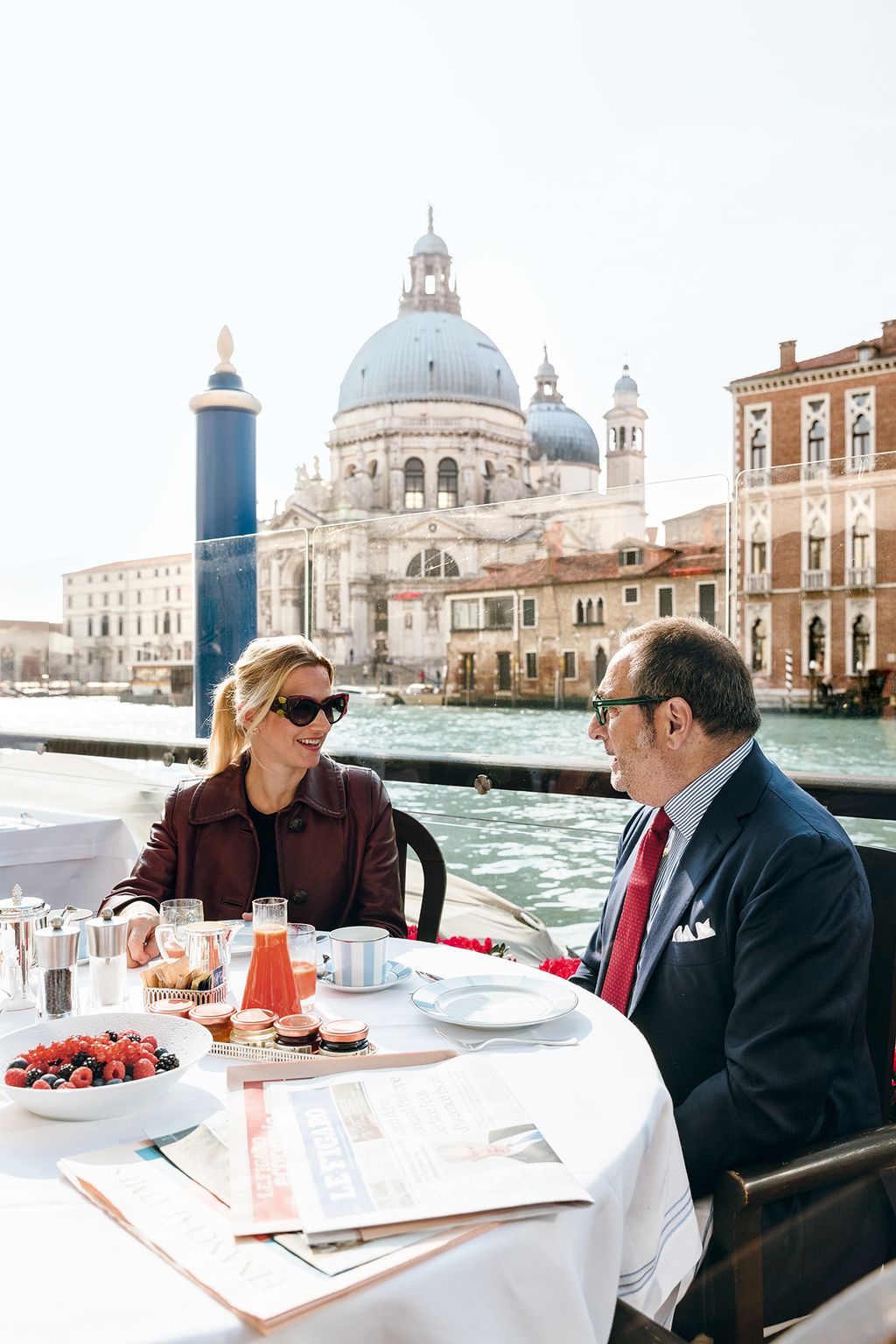
On the day I spent with her, Servane had a breakfast meeting on the terrace of The Gritti Palace hotel with Paolo Lorenzoni, its general manager. A staunch supporter of local causes, Paolo assists Servane with theatre fundraising events. ‘I like to make this hotel a home for artistic locals and visitors alike.’
One of these is Marie-Rose Kahane, who moved here from London and set up her company Yali, which makes beautiful glassware, and now supplies exclusive venues around the world. ‘We are all working towards keeping this little city of 55,000 or so inhabitants alive,’ she says. Her husband, David Landau, is a founder of Le Stanze del Vetro glass museum and of The Venice Glass Week, held in September, which is now in its third year.
For Servane, it is impossible when out walking in Venice not to run into friends. On one of the bridges, she encounters Silvia Reznik, of Venetian brand Dellaluna, which makes luxury leather goods, jewellery and perfumes. And, in Salizzada San Samuele, she bumps into Pierre Rosenberg, president of the Alliance Française di Venezia (of which she is a board member), wearing his familiar red scarf. At Chiarastella – the shop of local fabric designer Stella Cattana – she sees Jane da Mosto of We Are Here Venice, an activist group leading the fight against the presence of big cruise ships on the Giudecca Canal, which pollute the atmosphere and endanger the city and its lagoon.
She then returns home to have lunch with friends before a young theatre group arrives after school to rehearse in the palazzo’s garden. In the early evening, she heads for the Schiavi, a popular bar in Rio di San Trovaso, home to one of the last remaining gondola-making yards. Sitting on the wall outside, she nibbles cicchetti, sips prosecco and discusses theatre plans with costume designer Catherine Buyse Dian and fellow performers, Roberto De Feo and Orsola Foscari, whose dog Cantina inevitably joins in. It’s the perfect way to end another rather perfect day.
For information on concerts at Conservatorio di Musica Benedetto Marcello, go to conservatoriovenezia.net
 Dean Hearne1/16
Giovanni and Servane on their balcony
 Dean Hearne2/16
An antique glass pagoda chandelier catches the light in the loggia. A chandelier by Venetia Studium hangs above an antique opium table.
 Dean Hearne3/16
The deerskin armchairs and sofa and a large wooden bibliothèque were designed by Jacques.
 Dean Hearne4/16
A sofa and armchairs made bespoke by interior designer Jacques Grange for the piano nobile complement the original Venetian terrazzo floor.


 Dean Hearne5/16
Giovanni inherited a passion for music from his father, which he has passed on to his children.
 Dean Hearne6/16
Servane (centre) enjoys lunch with friends, (from left) Anna Lombardo of Giberto glassware, Astrict Lorenzo from Roberto Coin jewellery and lamp maker Gaby Wagner, in the formal dining room.
 Dean Hearne7/16
Giovanni and Servane in the magnificent piano nobile of Palazzo Pisani. This building houses the Conservatorio di Musica Benedetto Marcello, of which he is president. The paintings and windows were restored by private donations.
 Dean Hearne8/16
Servane with members of her Compania Falier theatre group – Roberto De Feo, Catherine Buyse Dian and Orsola Foscari with her dog Cantina.


 Dean Hearne9/16
Servane tries on sunglasses from the eye-catching selection at Ottica Manuela.
 Dean Hearne10/16
Servane enjoys breakfast on the terrace of The Gritti Palace with general manager Paolo Lorenzoni.
 Dean Hearne11/16
In the Yali shop, Servane chats with the glassware company’s founder Marie-Rose Kahane (right) and Felicity Menadue.
 Dean Hearne12/16
Giovanni in front of the door to his office at the Conservatorio.


 Dean Hearne13/16
Giovanna Cordova, the teacher and director at Servane’s theatre school, helps a local schoolgirl with her costume in the garden of Palazzo Falier, which is used for rehearsals.
 Dean Hearne14/16
Theatre-school pupils practise the piano.
 Dean Hearne15/16
Servane and Ulysses, the Giols’ spaniel, with Alberto Cavalier, who did much of the gilding in the restoration of the reception rooms at Palazzo Pisani.
 Dean Hearne16/16
Giovanni and Servane in a vintage topetta, a typically Venetian boat, on the Giudecca Canal with the church of Santa Maria della Salute in the background.


