The joyfully creative house and studio of textile artist Pauline Caulfield

Just north of Regent’s Park is a small courtyard of artists’ studios, built in Queen Anne style in the late 19th century. Previous tenants include the Pre-Raphaelite painter John William Waterhouse and illustrator Arthur Rackham. Miraculously, creative spirit has survived as the dominant force even among today’s occupants, one of whom is the textile artist Pauline Caulfield, whose large, vivid-hued, abstract and illusionistic silk-screen printed works tread a fine line between art and design. Pauline has rented this particular studio, like those other artists before her, for almost fifty years, fifteen of them with her former husband, the Pop Art-associated painter and printmaker Patrick Caulfield. Bright strong colours, clean lines and elliptical shapes distinguish rooms layered with the effects of a fascinating and creative life, and that carry within them stories from a particular period in 20th century British art.
Pauline and Patrick (who died in 2005) married in 1968, the same week Pauline graduated from the Royal College of Art. They arrived here in 1975 with two small children, and a third swiftly followed. The house is uneven, as you might expect from its described function: the kitchen and two upstairs bedrooms - “there was a lot of swapping around and bunk beds” – are modest in comparison to what is referred to as ‘the big room’, which is double-height, with vast windows and access to the garden. A mezzanine bedroom at one end – where Pauline sleeps – tops a sitting room area with sofas arranged around a fireplace. The other, larger half simultaneously performs as dining room, party room, exhibition space and, of course, studio - first to Patrick and, since he left in the late 1980s - to Pauline. This was when she returned to the artistic practise she’d paused while her children were little, initially combining it with a job as a librarian and archivist until, ten years ago – aged 70 or thereabouts – she finally became an artist full-time.

The set up means that there is now little escape from her art; even her bedroom overlooks her printing table. But, ‘living with it helps, I catch glimpses of what I’m doing, ideas form, and I’m drawn back in,’ says Pauline. Whether that’s to the wall hangings-come-curtains that she makes to commission, extraordinary ecclesiastical vestments, or – her latest pieces – wall-mounted, silk-screen printed fans of considerable size, where her mastery of trompe l’oeil is such that you can’t quite believe they’re not real.
An attitude of life/work integration prevails: while two of the studio walls are given over to print screens and shelves of brushes, books, pigments and paints, the third holds a large canvas by John Hoyland. ‘It was John who told us about this house. He was then living in one of the other studios,’ says Pauline. Further works by friends continue around the room: an early Howard Hodgkin - ‘Patrick rescued that – Howard was about to burn it’ - is adjacent to a sculpture by Nicholas Monro. A small painting by Patrick hangs opposite one of his drawings. It was he who designed the white cupboards along the back wall of the studio, found the Art Deco sconces over the fireplace, and chose the red-checked gingham sofas. They’ve recently been recovered but, ‘the fabric is almost identical to the original,’ says Pauline. She tells a faintly alarming story of her children, when little, jumping onto them from her bedroom window. The circular table, that hosts both work and dinners, was Hodgkin’s. Pauline painted the top in, ‘layers and layers of Anthraquinone Blue,’ an acrylic paint, giving it a semi-opaque midnight finish.

Patrick designed the kitchen, too, though tweaks have been made in the intervening years; most recently, Pauline painted it a Pepto-Bismol pink - Dulux Trade’s ‘Rose Trellis 3’ - carefully circling the fruit bowl mural on the wall. ‘It was started by Patrick after he’d left; I’d bought some tester pots, and I suppose that they were sitting around,’ recounts Pauline. ‘Then our middle son added to it, painting in fruit, and then Patrick did more.’ A copy of Patrick's Red, White and Black Still Life, by a restorer who had previously worked on his paintings hangs above a table painted in marble effect painted, again, by Patrick. ‘It’s not that I’m hanging on to the past,’ says Pauline, ‘but Patrick and I had similar ideas and taste, and I love it.’
There is a valuable lesson in this perspective: when it comes to our homes, there can be comfort and delight in continuity, and we should allow ourselves to lean into it. Good design lasts, and change can come in other ways. Via grandchildren for instance, whose presence here is felt through their own artistic contributions. Or by recommitting to passions. Pauline’s success is proof that it is never too late. Alongside is the notable point, for those that marvel at the length of time Pauline has successfully stayed put in rented accommodation, of her position as a pre-1989 ‘regulated tenant’, protected from either eviction or sizeable rent increase. It is a compelling argument for the necessity of reform in this area, particularly if artists and creatives are to continue to live and work in London, as the idealists of the past intended.
 Mark Anthony Fox1/19
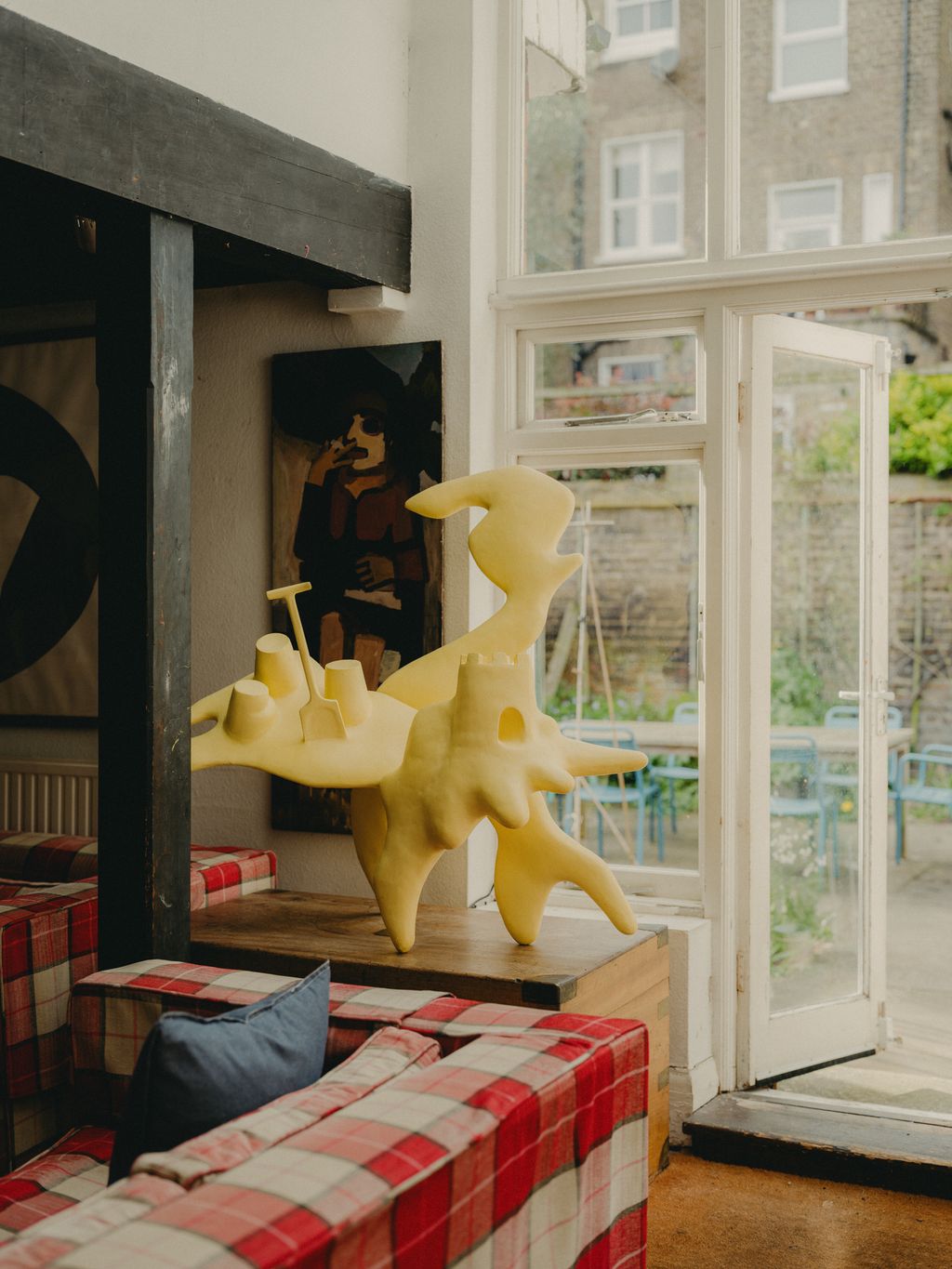
A sculpture by Nicholas Monro stands in front of the Howard Hodgkin that Patrick rescued from being burned (by Howard). The red checked sofas were bought from Kingcombe Sofas in the 1970s; the door leads out to the private garden.
 Mark Anthony Fox2/19
 Mark Anthony Fox3/19
The sitting room end of the big room; Patrick painted the fireplace black, and found the Art Deco sconces. To the left of the fireplace is a portrait of Pauline by one of the junior members of her family. The coffee table is a normal table that Patrick sawed the legs off. On the right of the fireplace, the angel is by Julie Westbury
 Mark Anthony Fox4/19
The light was inherited from Pauline’s aunt.


 Mark Anthony Fox5/19
The large canvas on the wall is by John Hoyland, who told Pauline and Patrick about this house; he was living in one of the other studios at the time.
 Mark Anthony Fox6/19
Pauline unwrapping one of her silk screen wall hangings on her printing table; the blanket stitching is printed on, but looks completely real.
 Mark Anthony Fox7/19
Pauline reviewing print samples.
 Mark Anthony Fox8/19
A collection of screens stored underneath the printing table.


 Mark Anthony Fox9/19
 Mark Anthony Fox10/19
 Mark Anthony Fox11/19
A view through the kitchen window into the courtyard.
 Mark Anthony Fox12/19
One of Patrick’s works is propped on the side.


 Mark Anthony Fox13/19
The kitchen was designed by Patrick and has recently been painted pink by Pauline in Dulux Trade ‘Rose Trellis 3’ - who framed the mural Patrick painted on the walls with input from their middle son. Pauline has since added to it, by way of a circular card cut out; along with the overhead light, ‘the mirroring of shapes as you come into the room is very pleasing,’ she says. The table was marble-effect painted by Patrick, and the red bentwood chairs were bought from Cherry Monro, the wife of the artist Nicholas Monro whose sculpture is the big room.
 Mark Anthony Fox14/19
A copy of Patrick’s Red, White and Black Still Life, by a restorer who had previously worked on his paintings, in the kitchen.
 Mark Anthony Fox15/19
The staircase up to Pauline’s mezzanine bedroom, with more works by Julie Westbury, and a Papua New Guinean sculpture that Patrick brought back from a trip to Australia with John Hoyland.
 Mark Anthony Fox16/19
Above Pauline’s bed. To the left is a painting that Patrick bought from a student.


 Mark Anthony Fox17/19
Pauline’s mezzanine bedroom is above the sitting room and looks down over her studio. Pauline’s children used to jump from the mezzanine onto the sofas below. The paper lanterns were put up for an exhibition of her work that she staged there.
 Mark Anthony Fox18/19
The pinboard next to Pauline’s desk in her bedroom is hung with drawings by her grandchildren.
 Mark Anthony Fox19/19
The chest of drawers was inherited, and sculpture is of her eldest son, Luke, done by Livia Rolandini, who was at the Royal College of Art at the same time as Patrick. Behind it are various drawings; one is by Patrick, another is by Pauline’s father, who was an architect.