
Inside a 17th-century farmhouse inhabited by the seventh great-grandson of the man who built it

"This is the house I have wanted since I was 16 years old,” says Tim Whittaker of his home in the Cumbrian village of Newbiggin. “It was built in 1695 by my seventh great-grandfather, it stayed in my family until the mid-19th century, and I first saw it in 1976.” It is hard to resist such a long history, the kind of profound connection to a place and a building that few families can claim in the 21st century. For Tim, whose career as a conservation architect arose from a fascination with historic buildings, it was perhaps inevitable that the house would draw him back.
Tim grew up not far from the house, and first found out about it when a great-aunt gave him a collection of family papers stretching back centuries. These aged legal documents, some written on vellum, contained information about the Newbiggin property, and the teenage Tim took it upon himself to cycle over and have a look. The house had passed from his family into the hands of the largest local estate in the 1840s, and through various twists and turns was now owned by the church commission, and lived in by two bachelor brothers who worked the land as tenant farmers. When one of the brothers offered to show him round, Tim saw for the first time its astonishing, practically untouched interiors: the original panelling and staircase, the early lime ash floors, and a carved fitted spice cupboard built upon the house’s completion in 1696.
Other remarkable houses were to occupy the next four decades of his life, as his job took Tim to the National Trust and then to the Spitalfields Historic Buildings Trust, where he was a leading light in the restoration of the beautiful 18th-century weavers’ houses that are now so highly sought after. It was on a May Bank Holiday two years ago, driving around the area with his partner Harvey Cabaniss, that he saw a ‘For Sale’ sign on the Newbiggin house, and serendipitously ended up having tea with the father of the man then selling the house. Although it was already under offer from another prospective buyer, Tim’s powers of persuasion came to the rescue, and the house finally ended up back where it belonged: with the seventh great grandson of its builder.
“I’ve never lived in a modern house,” says Tim, “and I have no desire to.” His approach to the interiors is the approach of a conservationist, embracing the house’s age, its history, and the romance of the family connection. Fortunately, despite various alterations in the 18th, 19th and 20th centuries, much of its original beauty survives. “The house was in a basic, raw, farmhouse state, not derelict, but not modernised. The panelling, the plasterwork, and the flag floor in the kitchen were all intact when we moved in, along with the wonderful 18th-century stone pantry. It had been my great fear that someone would buy it and rip it to bits.”
The alterations were minimal: the couple put in two bathrooms and insulated the roof, opening it up so that its structure is visible. The cruck frame of the house, with its two great timbers meeting to form an arch, would have been the remnant of an earlier medieval house and would originally have sat on the ground, whence it was pushed up in the 17th century to form a second storey. Tim was careful to preserve and restore the original gypsum floors and plastered walls on the first floor; these are unusual even by the standards of their age. “That undulating floor gives the house a very ancient feel,” he explains. Another major project is the windows: the original mullioned glass was replaced by the ubiquitous PVC-framed numbers in the 1980s, but Tim is bringing back the leaded lights with the aid of the photographs he took on his first visits in the 1970s.
The bathrooms and the kitchen are particularly good showcases for Tim and Harvey’s approach to conservation. Obviously these rooms cannot be faithful to any 17th-century original, but they retain a strong sense of history nonetheless. That the kitchen has resisted modernisation, despite Harvey’s profession as a chef, is especially impressive. It is designed in the tradition of a country house kitchen, and to Harvey’s own specifications. He is a man peculiarly tolerant of unusual cooking arrangements, it seems. “When we first met 20 years ago he used to cook in a flower pot in the garden of my first house in Whitechapel,” recalls Tim. “Later I built him an 18th-century-style cooking fireplace in the garden, and now we have the same sort of thing here. He does have a microwave and hotplates in a back room, along with the Aga in the main kitchen, and he keeps saying one day he’ll buy an oven and put it out of sight.”
“We’re not crazy old fogeys,” emphasises Tim. “We like heating, we like the internet, we have a washing machine, and there are three TVs in the house.” There’s no aura of off-putting puritanism about this house, but rather a considerable sense of fun and an evident enjoyment in reconciling modern life with the aesthetics of the past. “I put sockets on the sides of the chimney breast,” he notes, “because no-one can see them there. When anybody comes to stay it can be a tricky thing for them to find them. We’ve also had great fun with the toilet flush. It’s a perfectly modern push button but it’s on the side of the cistern high up on the wall… Obviously we tell people before they go in.”

The house is filled with a series of beautiful antiques collected over decades, set against a pared-back, minimal interior that shows off the layers of history ingrained in its walls and floors. “To the people in the village it looks like we live in a museum,” says Tim. “But I’ve always lived in interiors like this. I grew up in a 17th-century farmhouse much like this one, and my father filled it with antiques, so we lived in his museum. It feels perfectly natural to me.” Friends who are antique dealers are a natural consequence of a life spent in historic buildings, and Tim and Harvey also like to spend time pottering around the manor houses and small estates of Cumbria, picking up furniture and plants along the way. Is there anything this remarkable collection is missing? “What I’d really like is a 17th-century verdure tapestry,” muses Tim. “I think I’ll get one when we sell our London house. It’s just what we need.”
 Mark Fox1/28
The house was built in the local red sandstone. The style is known as a longhouse, a purpose-built structure intended to house animals and a granary at the northern end and human inhabitants at the southern end.
 Mark Fox2/28
The stone above the door registers the date the house was built, along with the three initials that would usually be recorded on stones of this type, the husband's forename and surname: T and P for Thomas Parke, Tim's ancestor, and A for his wife Anne.
 Mark Fox3/28
This sitting room is referred to as the firehouse, the traditional name for the main room of a yeoman's house. The oak beams are original to the house, as is the spice cupboard built in on the right. This has the initials ‘LP’ and the date 1696, and was installed by Thomas Parke's son Leonard after the former's death. There are only two initials as opposed to the usual three as Leonard was unmarried when he inherited the house.
 Mark Fox4/28
Tim sits at a mid-18th-century walnut padfoot gate-leg table in the firehouse, with a Gothic bookcase behind full of his father's old books. An early 18th-century lacquer longcase clock also belonged to his father. The floor is covered in rush matting by Waveney Rush, hand-woven in Suffolk according to traditional methods.


 Mark Fox5/28
The firehouse opens back into the parlour, which was the principal bedroom of the house in the 18th century.
 6/28
6/28A view from the firehouse to the staircase, where the original red sandstone stairs, worn down to a beautiful bow shape, were discovered under a later timber version. At the top of these stairs is a section of 17th-century oak panelling, where a 17th-century oil painting depicting the Hebrew Bible story of Hagar and the angel hangs in a distressed gilt frame. On the wall next to the door is a mezzotint of the Zoffany portrait of George III.
 Mark Fox7/28
A 19th century bust of Socrates from Leiden University sits by the window seat in the parlour.
 Mark Fox8/28
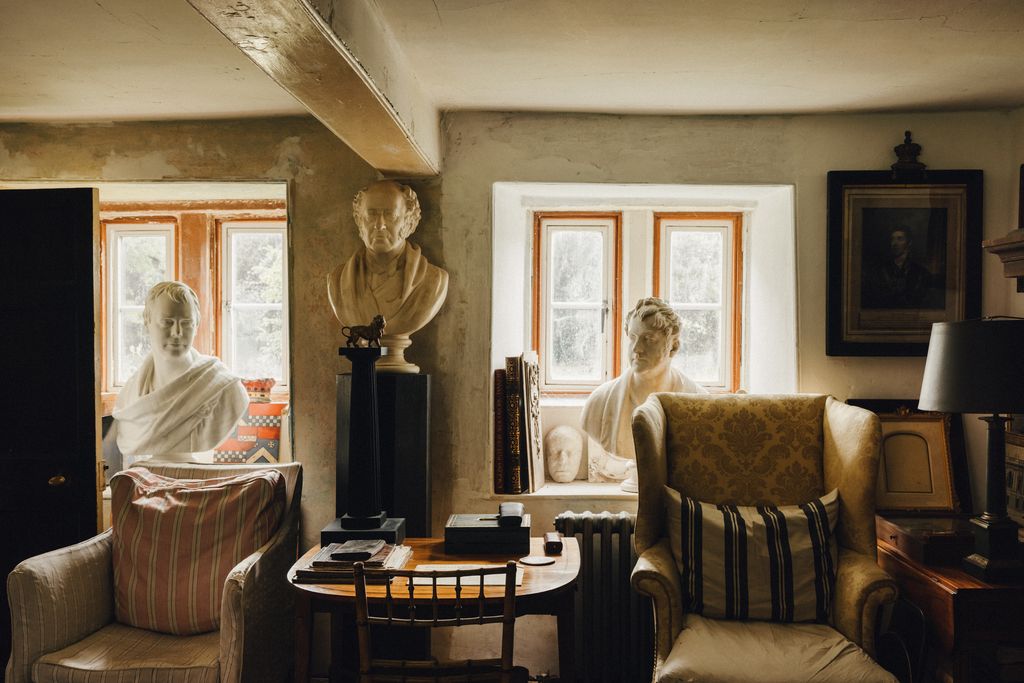
On the left, a bust of Sir Walter Scott sits in the window of the parlour; the other busts are of unknown subjects. On the left is a Regency bergère chair, and an early 19th-century wing chair stands on the left; behind it hangs a print of the the Duke of Wellington, with a gilded crown set on top by Tim.


 Mark Fox9/28
Another Gothic bookcase in the parlour with a bust of Napoleon over an oval portrait of a Northumbrian gentleman.
 10/28
10/28On the other side of the bookcase is a 19th-century German plaster cast of an Ionic column from the Erechtheion temple on the Parthenon, bought in Alfie's Antique Market.
 Mark Fox11/28
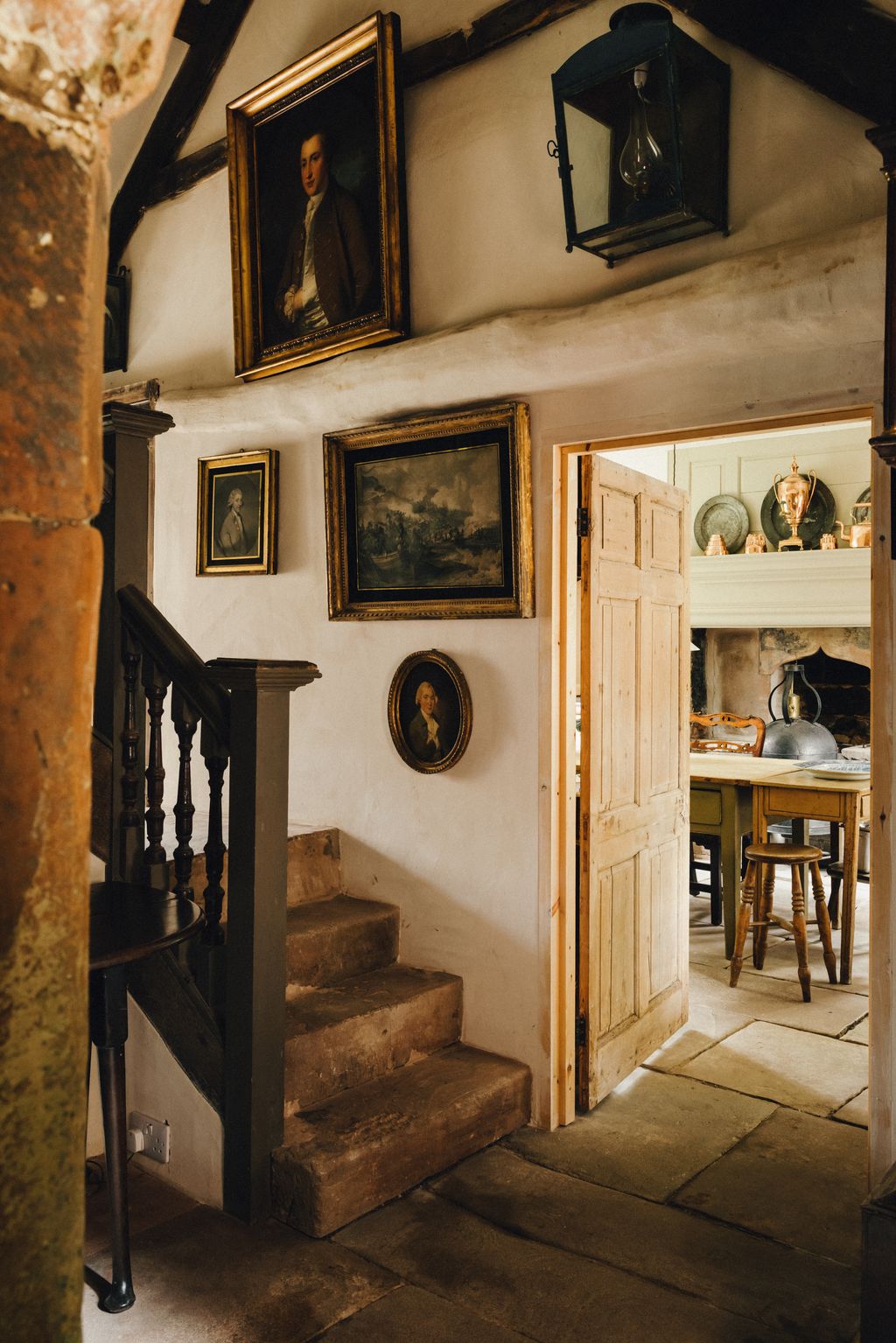
The staircase and flagstone floor are original to the house. An early nineteenth-century lantern is fixed above the doorway.
 12/28
12/28The focal point of the kitchen is an early nineteenth-century cooking fireplace with a panelled overmantel. On top of the mantel stands a series of copper jelly moulds, a tea urn and a Sunderland pottery pink lusterware jug. On the right an early 19th-century washstand stands underneath the plate rack, which Harvey uses as a drinks table.


 Mark Fox13/28
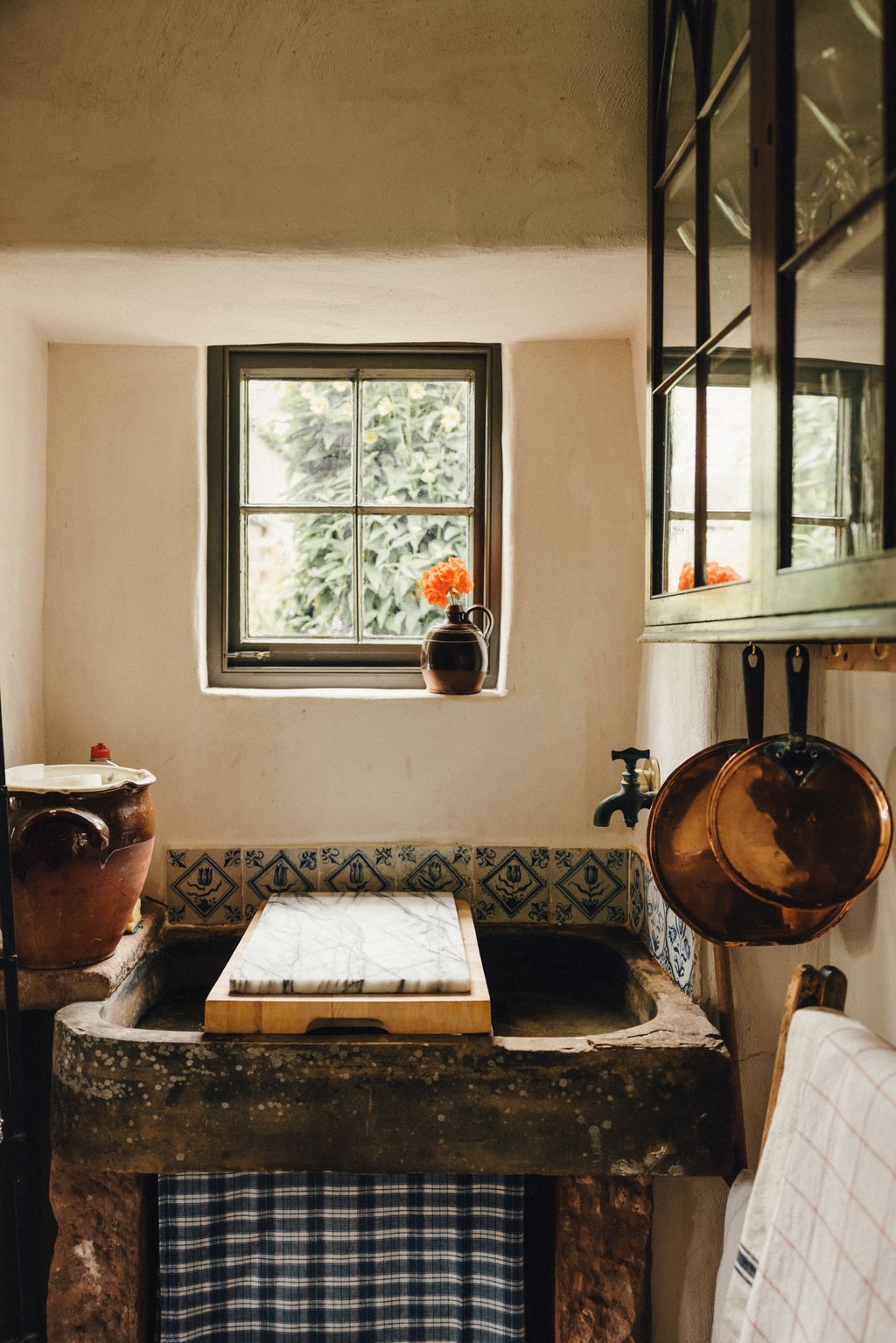
The sandstone sink, surrounded by 17th-century Delft tiles, looks out into the kitchen garden.
 14/28
14/28The kitchen, with its scrubbed wooden table, look outs into the yard. Next to the fireplace is an iron hastener, a rare 18th/19th century piece that was used to speed up the cooking of meat on the fire. Harvey had wanted one for years, and Tim found this one via Instagram. Harvey's battery de cuisine of copper pots is scattered around the kitchen.
 Mark Fox15/28
Originally this room was the stable of the house, but it was turned into a pantry in the late 18th century, with limewashed walls and sandstone salting shelves.
.jpg) 16/28
16/28An early 19th-century oak plate rack stands on top of a salting shelf in the pantry, holding a collection of late 18th-century feather-edged plates. An early 19th-century mahogany hall chair from Lancashire is on the left.


.jpg)
 Mark Fox17/28
Early 19th-century ladderback chairs stand in the pantry underneath a French comtoise clock from around 1820.
 18/28
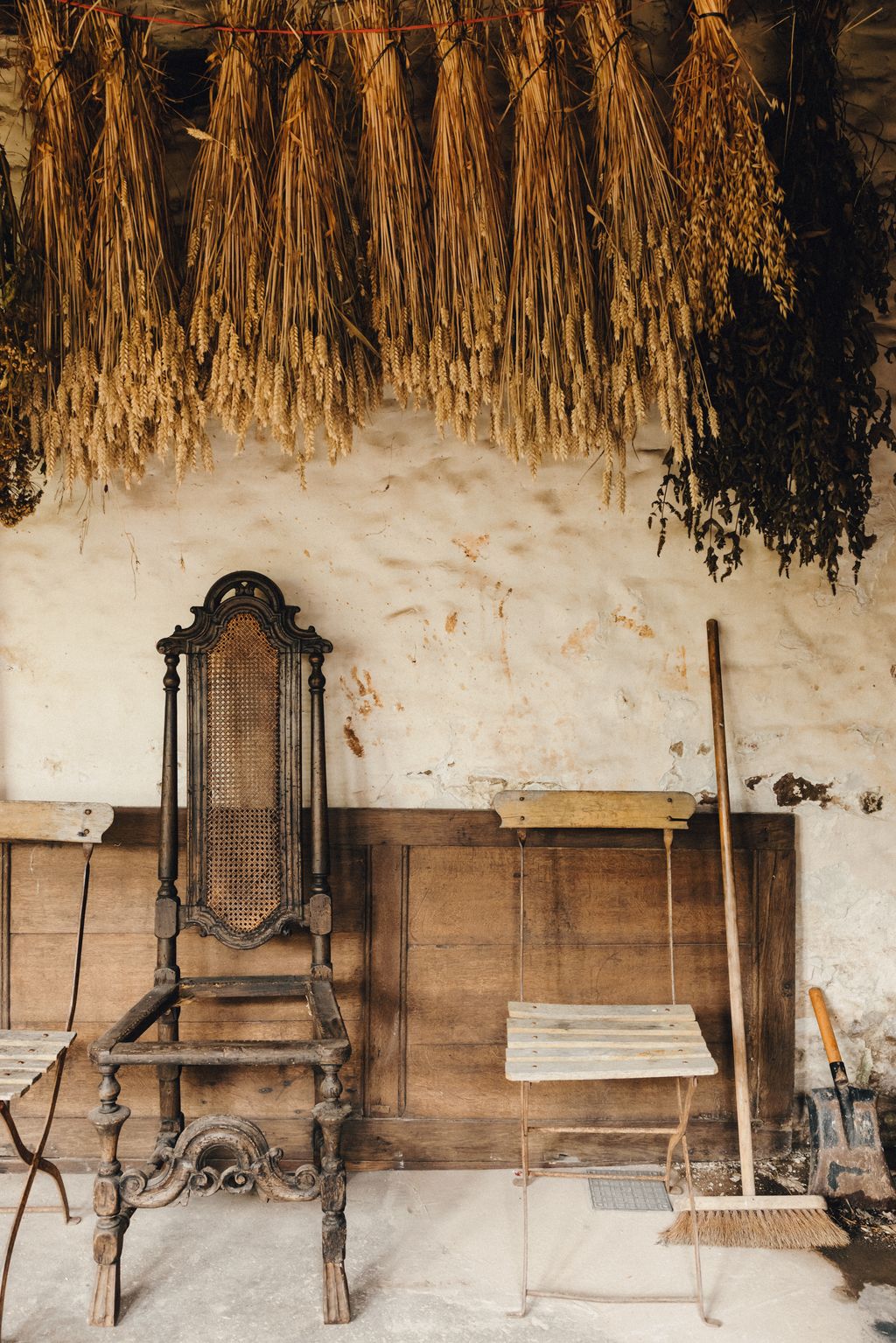
18/28Harvey dries corn grown in his kitchen garden in the washhouse. A 17th-century cane-backed chair stands underneath.
 Mark Fox19/28
Turning away from the kitchen, you can see a full length portrait, one of a series of portraits of Norfolk gentry painted by William Aikman for the Long Gallery at Blickling Hall in Norfolk. The set was painted in 1729; some are still in the house, others were sold. This painting is of John Bedingfield, high sheriff of Norfolk at the time. The staircase features 17th-century barley twist bannisters.
.jpg) 20/28
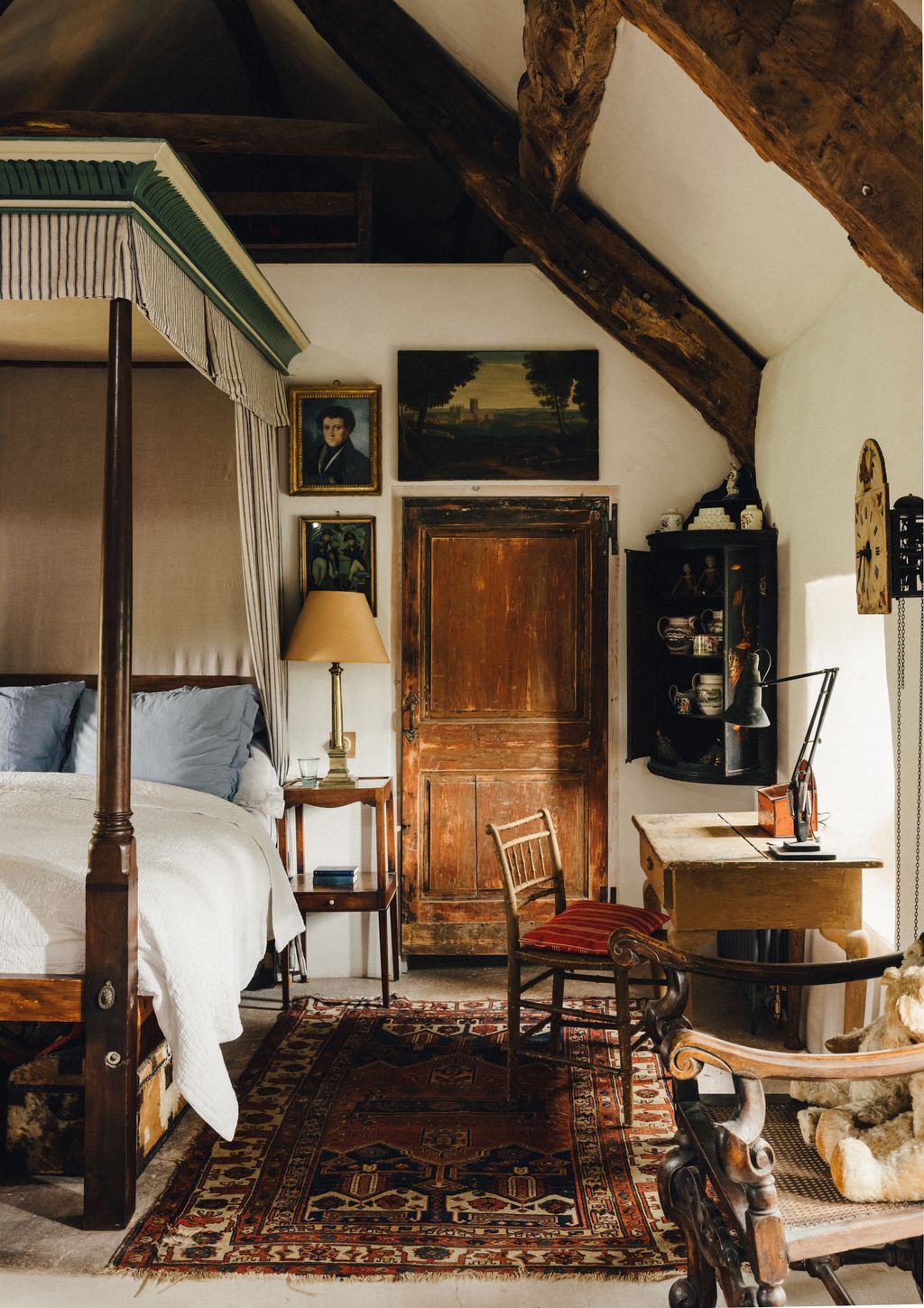
20/28The main bedroom has an 18th-century walnut bed with a cornice painted by Tim and hung with plain linen and ticking fabric. The original 16th-century cruck trusses are visible in the roof.


.jpg)
 Mark Fox21/28
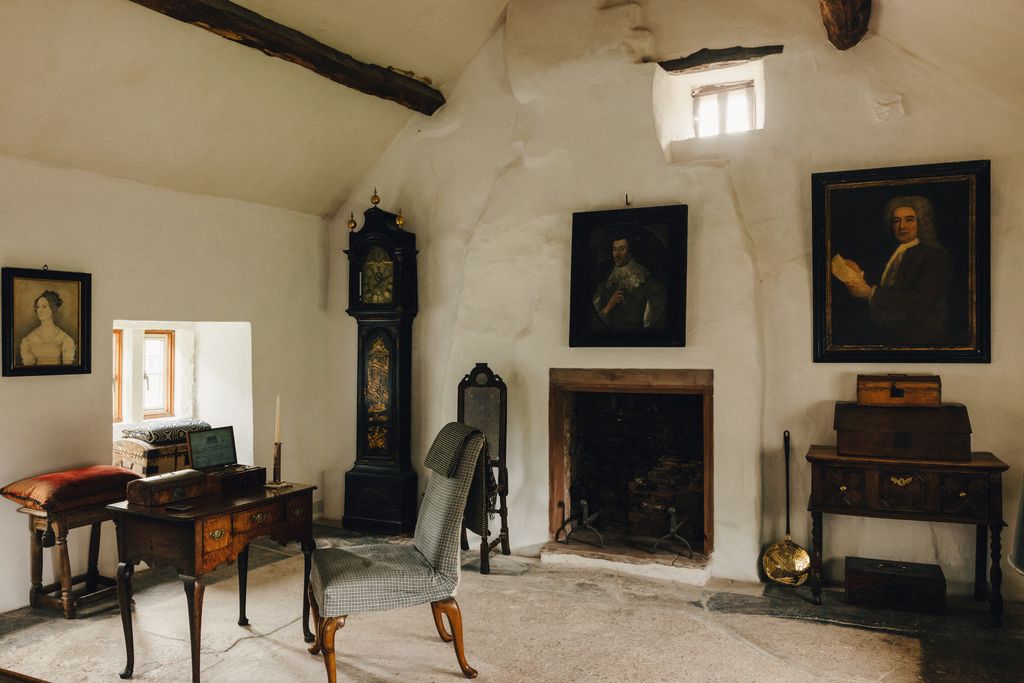
At the other end of the main bedroom, a lacquer longcase clock stands in the corner, and an early 17th-century portrait of a Shropshire gentleman hangs over the fireplace.
 Mark Fox22/28
An 18th-century mirror hangs over the bedside table. The oak door leads onto the landing.
 23/28
23/28An oil painting of Durham Cathedral hangs over the door next to an 18th-century lacquer corner cupboard. The desk was a leaving present from the Spitalfields Trust, and came from the attic sale at Castle Howard.
 Mark Fox24/28
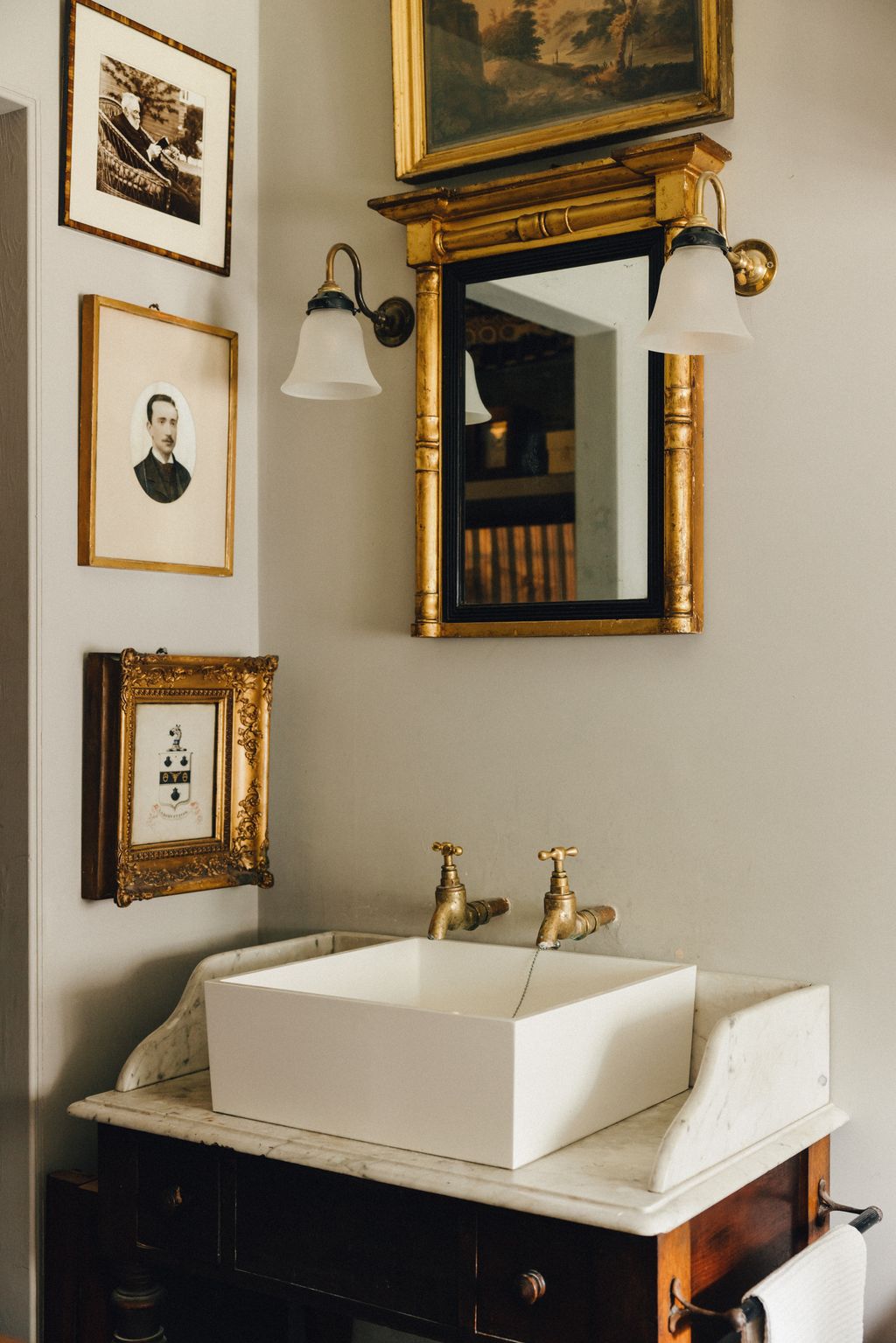
In the bathroom, a 19th-century washstand is topped with a simple modern basin, and a gilt mirror hangs above.


 Mark Fox25/28
The cistern of the loo is decorated with an old playbill in a frame, and the button to flush is on the side of the cistern. The bath is a 19th-century French zinc tub.
 Mark Fox26/28
The spare bedroom has an early oak bed with a crewelwork pelmet. The corner cupboard was bought by Tim's father in Berwick on Tweed in the 1970s, while a walnut mirror from the early 18th century was bought by his grandfather in Leeds during WWII. An American linsey woolsey coverlet covers the bed. It is called a summer-winter blanket as each side reverses the colours of the other.
 Mark Fox27/28
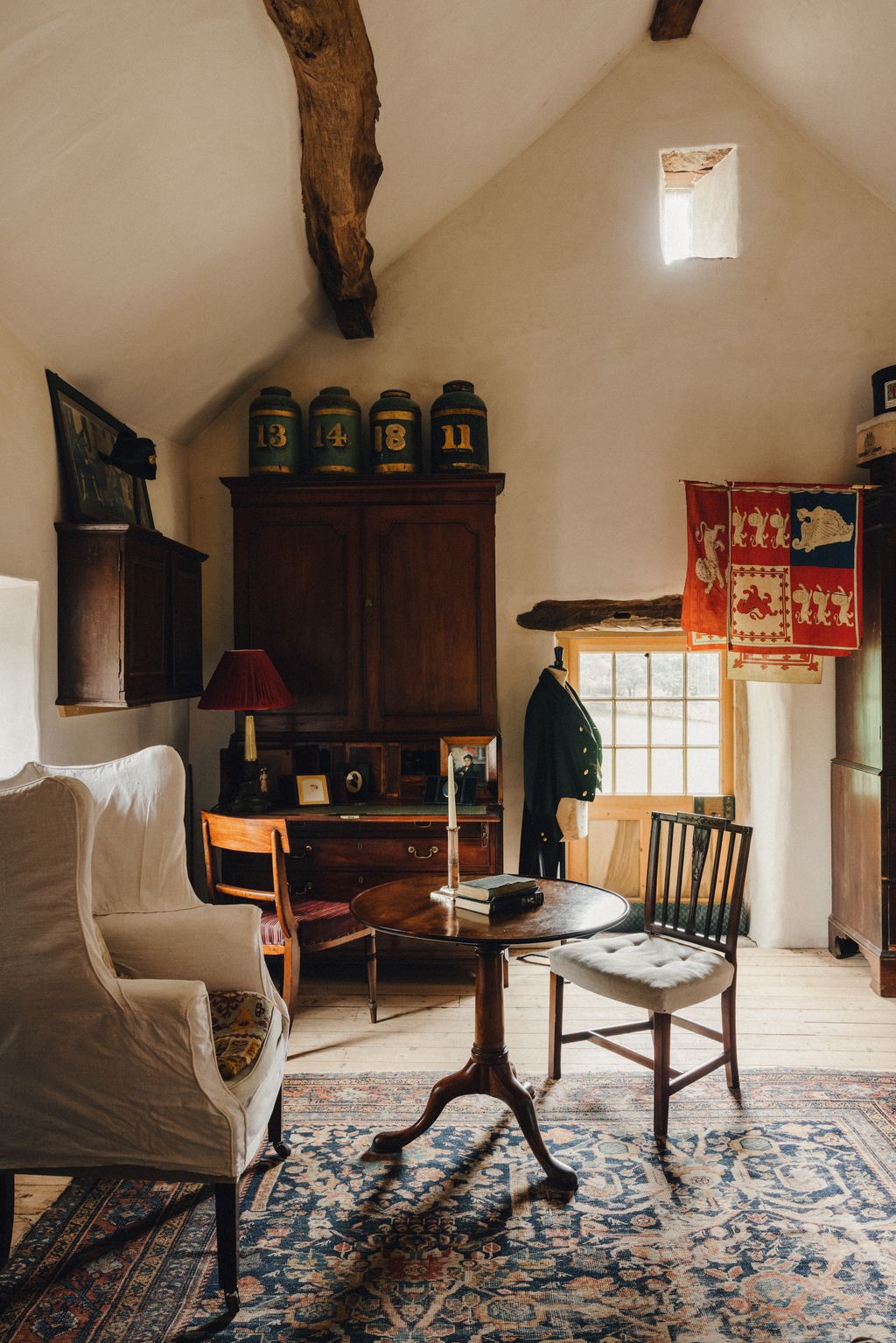
The other end of the spare bedroom. The room, which is situated over the pantry, used to be a granary, but was turned into a bedroom in the 19th century. The mannequin holds the dress uniform of a mid-19th century mayor of Newcastle.
 Mark Fox28/28
A half glazed door looks out into the field beyond. On the left is a late 18th-century mahogany bookcase, with 19th-century tea tins on the top. A series of patriotic flags from around 1910 hangs on the right.


