
A remote region of Turkey rich in history and culture
At Pinara’s theatre, among the loveliest in the ancient world, I fell to wondering when this place had last drawn a capacity crowd; perhaps during the 7th century AD, when calamitous and terminal decline threatened the region’s cities. And as we had this enchanting Lycian city all to ourselves (I exclude the goats, the tortoises and Hasan, for decades the site guardian), it further occurred to me that there might even have been more people at that final full house at the dawn of the Dark Ages than had visited the theatre ever since. I put this thought, as plausible as it was startling, to the aged Hasan as he treated us to black tea, served in tulip-shaped glasses, outside the ramshackle ticket office where the museum service recently ceased issuing tickets in a bid to boost visitor numbers. ‘I don’t have the figures,’ he said, his rheumy eyes crinkling at the weight of my question. ‘But most days up here it certainly feels like that.’
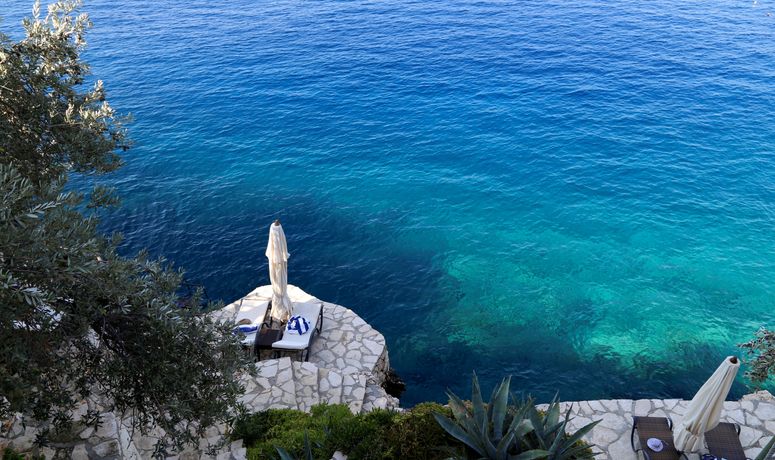
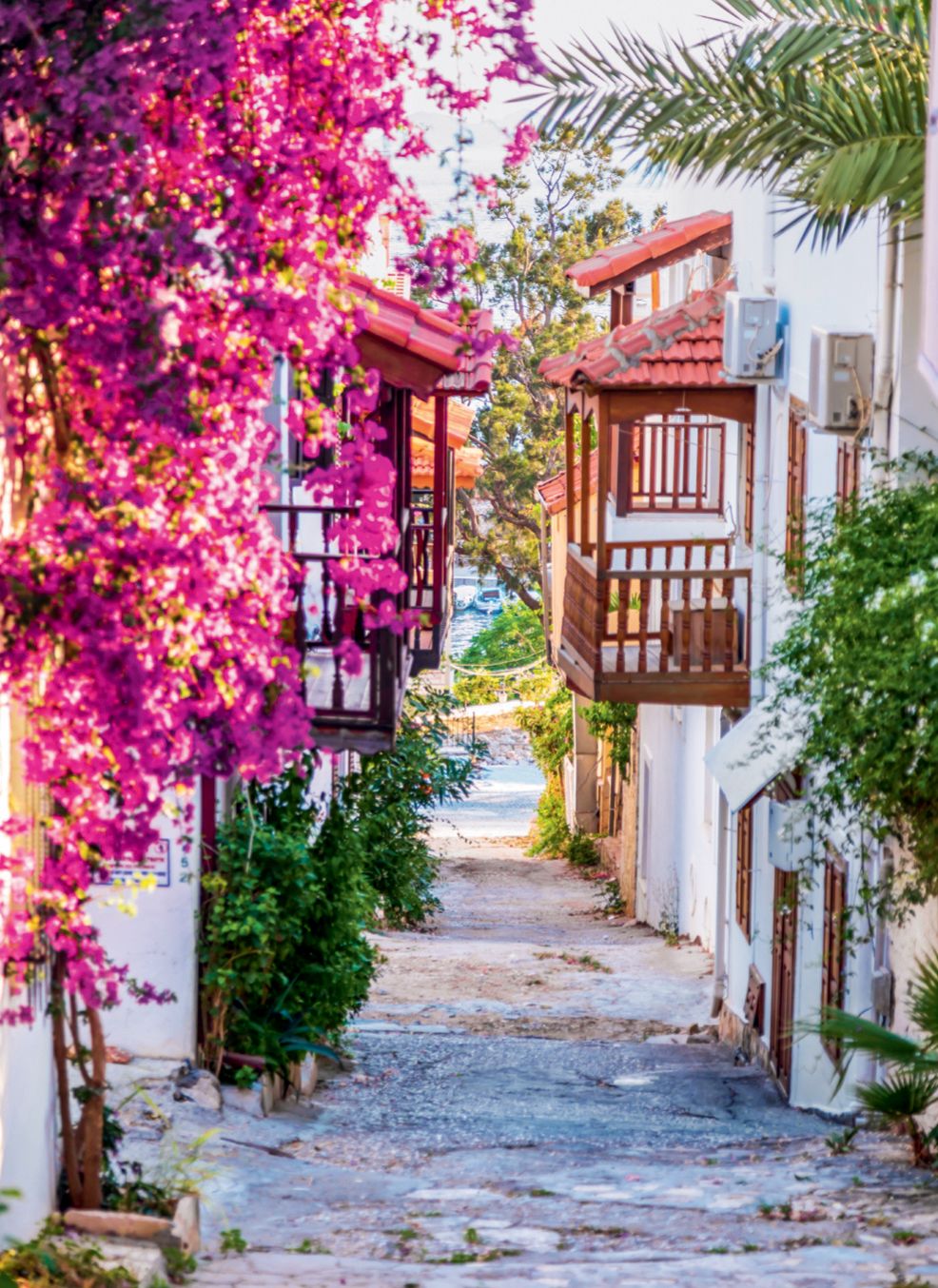
The wonder was that we were in Lycia, southwest Turkey, by a stretch the country’s busiest tourist region, and with good reason. This beguilingly beautiful land, book-ended by the airports at Dalaman and Antalya, boasts some of Turkey’s most magnificent beaches, notably the pristine delta strands at Iztuzu and Patara. It is also blessed with hundreds of pine-clad inlets and coves backed by green mountains and rushing rivers. It is no surprise, then, that once-sleepy villages such as Dalyan and Ölüdeniz have long since developed into major resorts, with day boats jostling for the best pitches in the island-strewn Bay of Fethiye, holidaymakers crowding into swanky Kalkan’s boutiques and waterfront restaurants, and paragliders taking off (at rates pre-Covid Heathrow would have been pushed to emulate) from the almost 2,000-metre summit of Babadağ to land on the golden sands at Ölüdeniz.
Lycia’s history, to judge by Pınara, has clearly failed to keep up with such developments. This was just as we liked it, of course, the absence of coach parks and visitor centre, even of display boards or marked paths, let us treat the place as our very own discovery. We could not have been happier as we picked our way through the tumbledown site to admire its treasures. A cluster of rock tombs, located in a grove of enormous Asiatic plane trees, offered fascinating inscriptions. And at the theatre, the weathered seats emerged from herb-scented pastures and stands of lilac-flowering verbena. We admired the grand views over the volcanic crag, pocked with tombs, that rises 450 metres above the city.
Of all Turkey’s ancient regions, Lycia is without question among the most alluring – and for extant remains, often in strikingly beautiful settings, the richest of all. Lycia has scores of such settlements, which experienced their heyday from the 5th century BC to the 5th century AD, when Persians, Greeks, Romans and Byzantines successively held sway. The most renowned include the capital at Xanthos, whose remarkable monuments – the Nereid Monument and the Harpy Tomb – have been prominently displayed at the British Museum since the 1800s. Myra is best known as the home of the Byzantine St Nicholas, the prototype for Santa Claus, and another magnificent theatre. More quintessentially Lycian, however, are the back-country ruin sites remoter still than Pınara – such as Hoyran, only reached on foot and with neither a written history nor a Hasan to call its own, but heartbreakingly lovely in its vine-tangled abandonment. This is the sort of place that Dame Freya Stark, who travelled extensively here in the Fifties, had in mind when she described the area (in her book The Lycian Shore) as the most magical of the few ‘places left where magic reigns without interruption’.

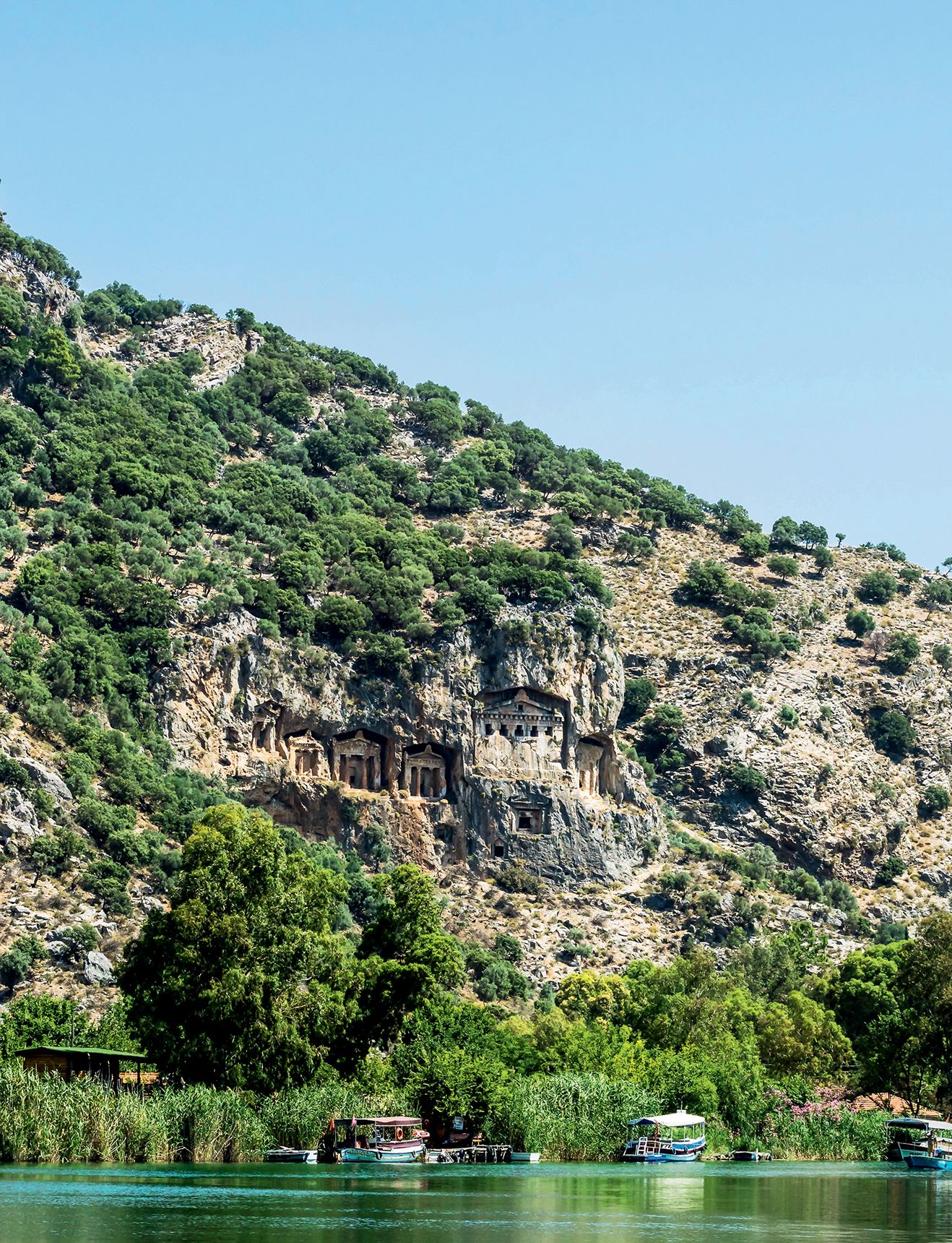
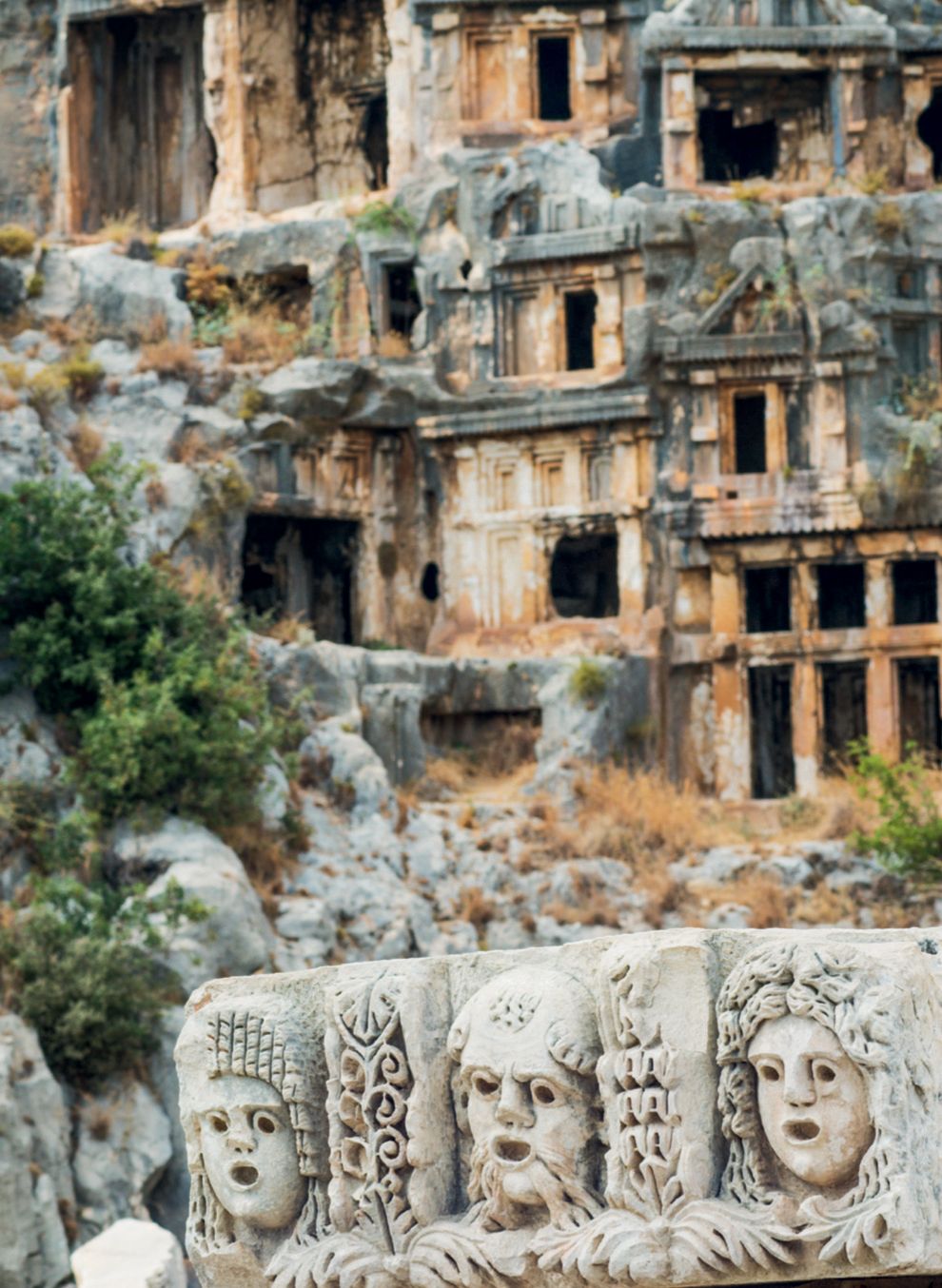
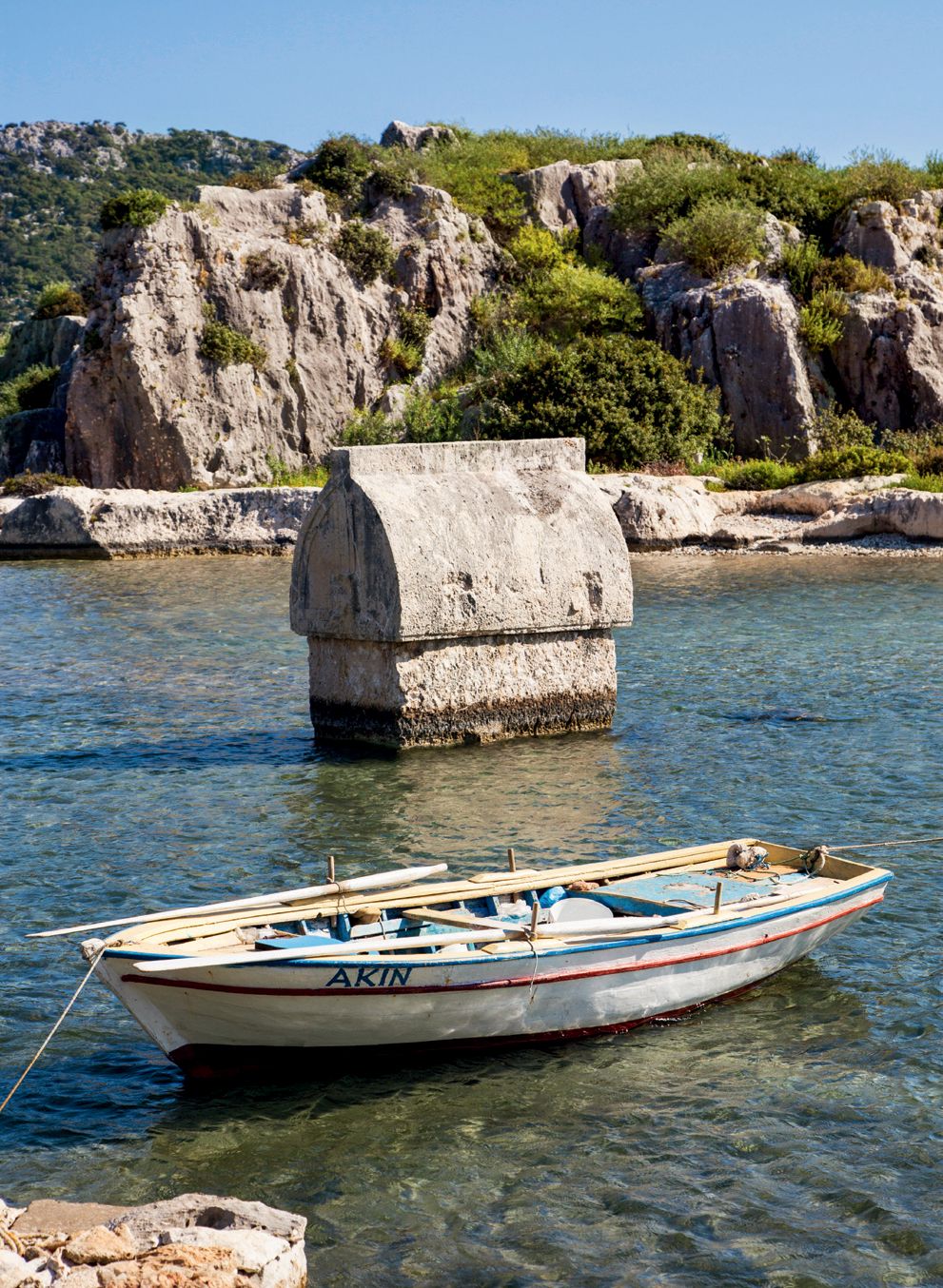
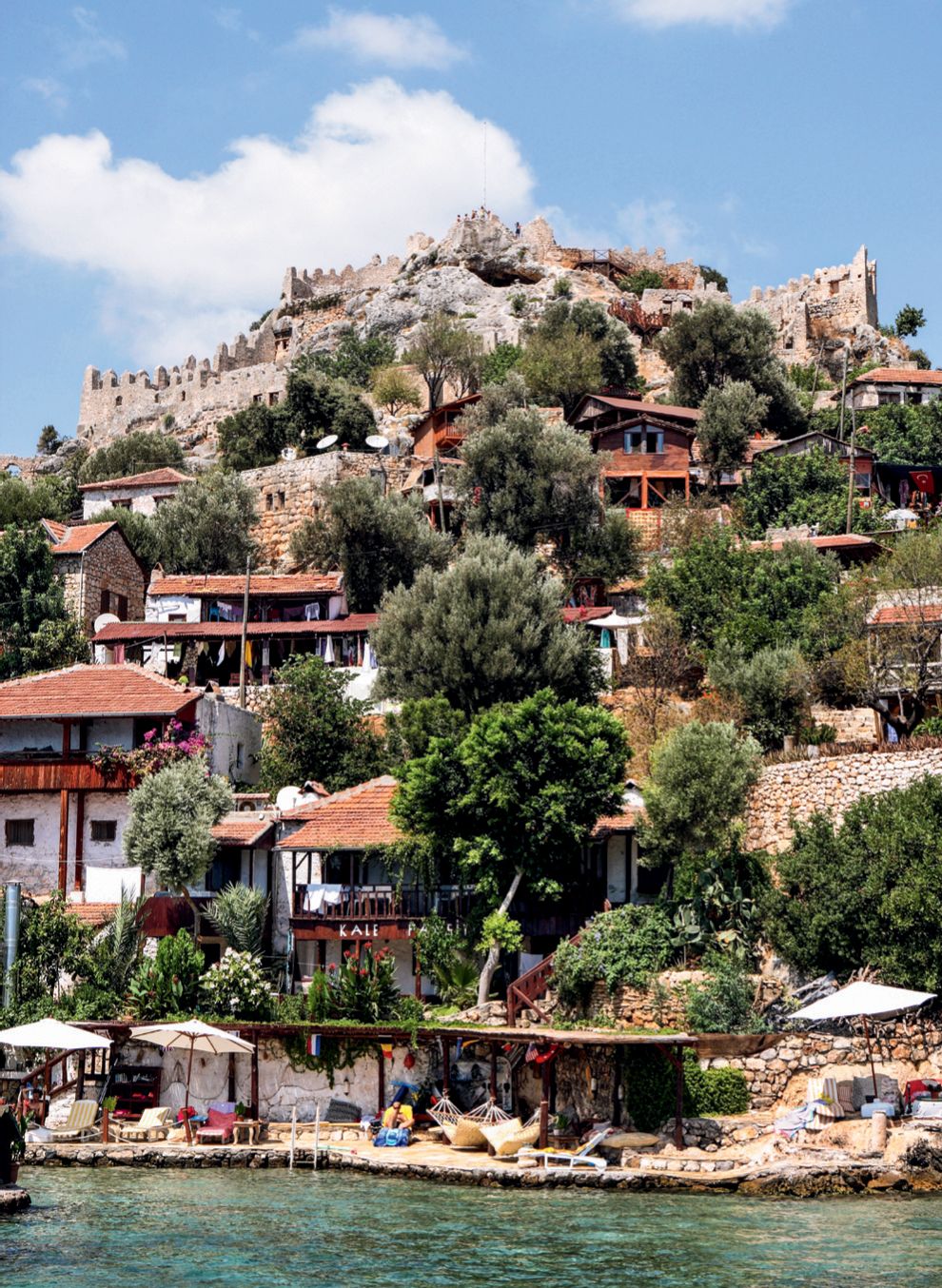
Of their history and culture, little is known of the Lycians. But with a language all their own, and a propensity to slaughter their loved ones and fight to the last rather than surrender, they seem to have been an independent lot. What survives of them, spectacularly, is a distinctive funerary architecture almost pharaonic in ambition. At Pınara, Myra and Fethiye we admired cliffs carved into houses for the dead, often with colonnaded temple facades or in the form of the traditional granaries which even now survive, shedding their bleached timbers, in remote farmsteads. Yet more profuse – so much so that the locals put them to casual use as stores, kennels and even hen houses – are the stone sarcophagi, shaped like gothic vaults or upturned boat hulls. We found beautiful ones at Simena, where an Ottoman citadel rears high over this sleepy fishing village, some among a grove of ancient olive trees, others half-submerged in the shallows.
We also discovered recent attempts to give Lycia’s history and culture something of a formal presentation, notably at Andriake where the stone granaries of Emperor Hadrian now house Lycia’s museum. The ancient port has been excavated, along with an impressive cistern, and middens of discarded shells tell of the murex molluscs that were processed here to yield the rich Tyrian purple dye beloved of Emperor Diocletian.
A similar act of curation, complete with extensive new facilities, was underway at Patara. For years archaeologists have been clearing Lycia’s great port city of the sand dunes to reveal, for example, the Bouleuterion, parliament building of the Lycian League, which has been substantially restored in recognition of its key role in pioneering democratic systems of government. The latest discovery is a Roman lighthouse complete with, exceptionally, every last one of the collapsed structure’s 2,000 constituent blocks of stone. The lighthouse, from the reign of Nero, is set to be reassembled, no doubt to considerable excitement. For now, however, we had the lighthouse’s impressive podium all to ourselves. We capped our visit by walking through the dunes down to the vast beach for a swim in the last of the light.
It only enhanced our Lycian adventures, of course, that almost all of the ancient sites lie within easy reach of favourite places to stay, notably Kalkan’s spare but gorgeous shoreside Hotel Villa Mahal and Villa Mango, an elegant Levantine-style country house in the hillside village of Faralya. But to visit Kibyra we were obliged to venture further afield. Deep in the mountains, where Lycia borders Phrygia and Caria, we found ourselves at this little-known city site, where the archaeologists have uncovered remarkable treasures. Chief of these was the odeon, or auditorium, where the orchestra floor is decorated with a unique marble mosaic rendering of a Medusa’s head. It was a thing of such beauty, and so perfectly preserved, that I did not doubt that this place at least would be seeing capacity crowds before too long.
‘A Coup in Turkey’ by Jeremy Seal (Chatto & Windus, £16.99) is out now.
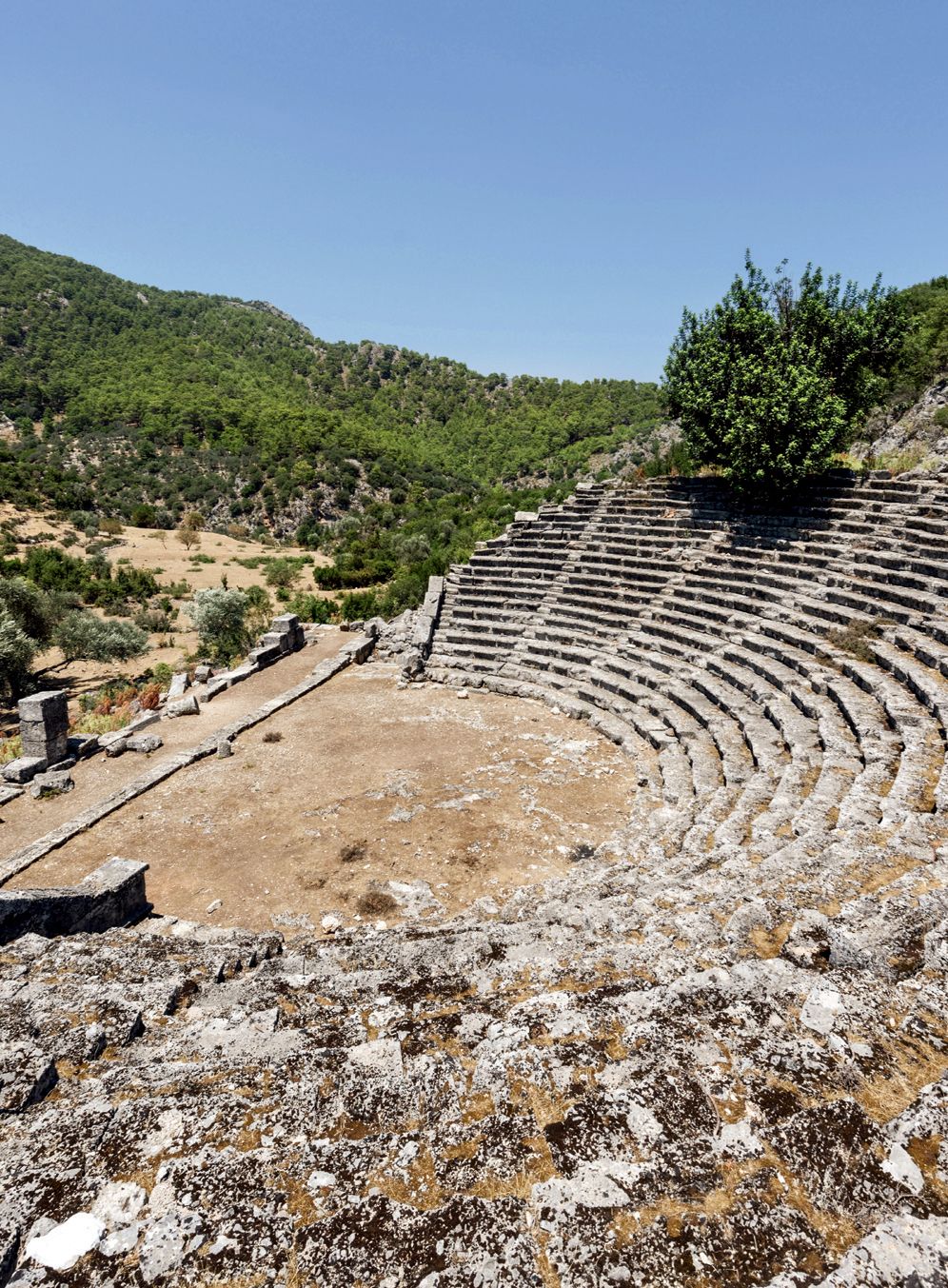 Sklifas Steven / Alamy Stock Photo1/8
Pinara’s theatre dates from the 2nd century BC.
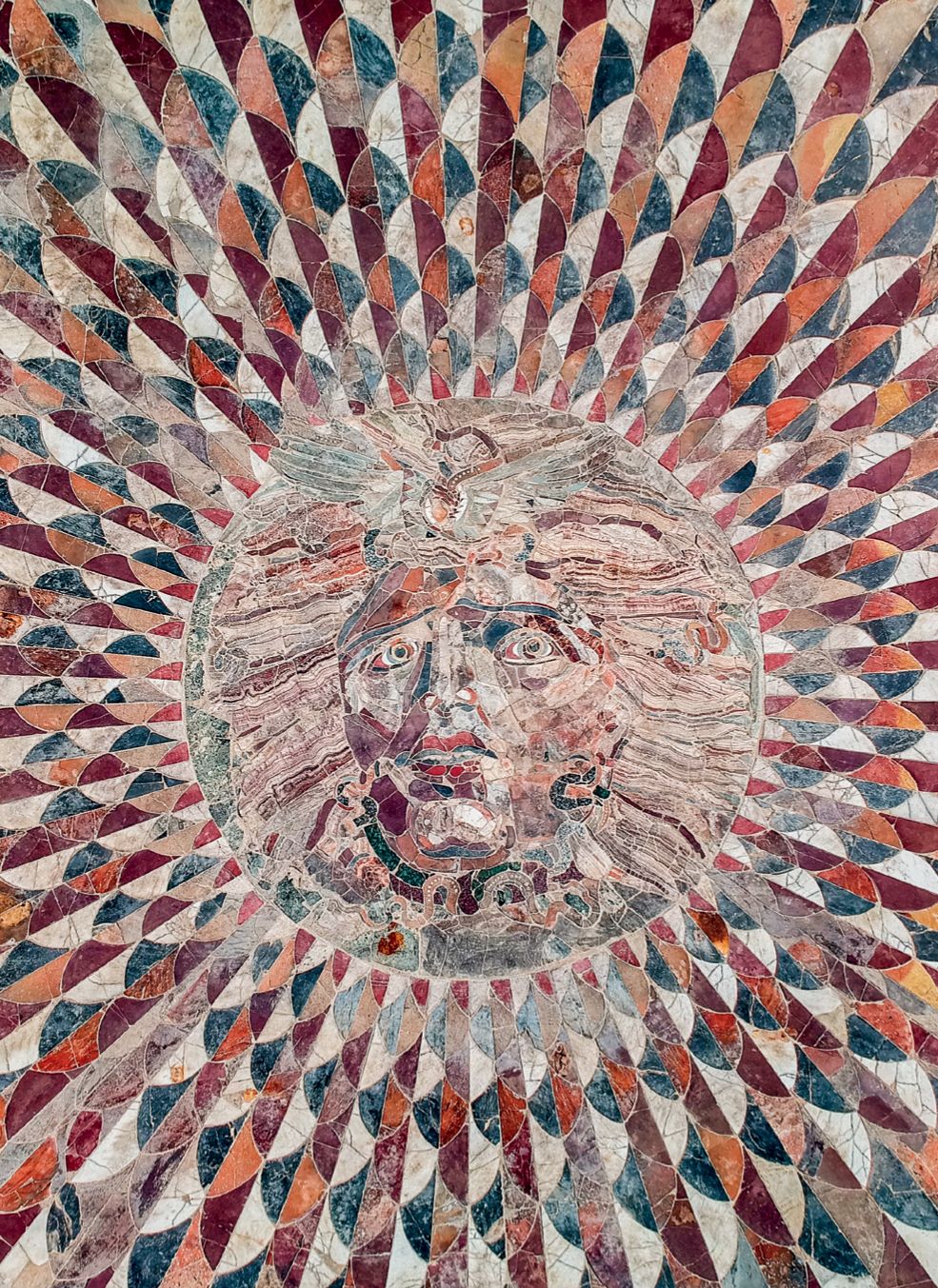 ihsanGercelman2/8
The Medusa mosaic in Kibyra.
 Birol Bali3/8
The picturesque streets of Kalkan.
 CHLOE HALL / Alamy Stock Photo4/8
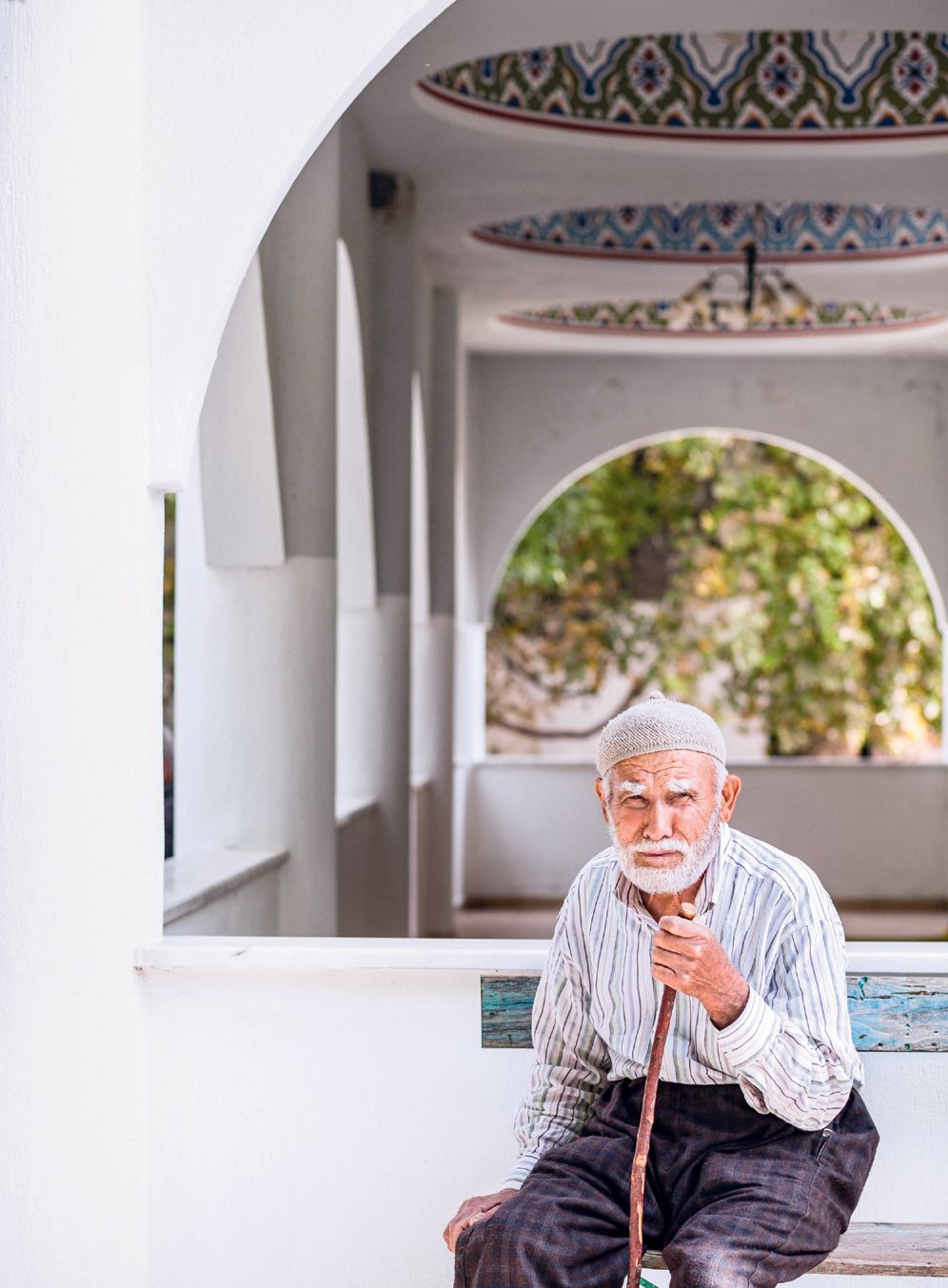
A local man outside the mosque in Bezirgan, a nearby village.


 Richard Goodrich / Alamy Stock Photo5/8
Intricately carved tombs in Myra.
 Michael Hoyer / Alamy Stock Photo6/8
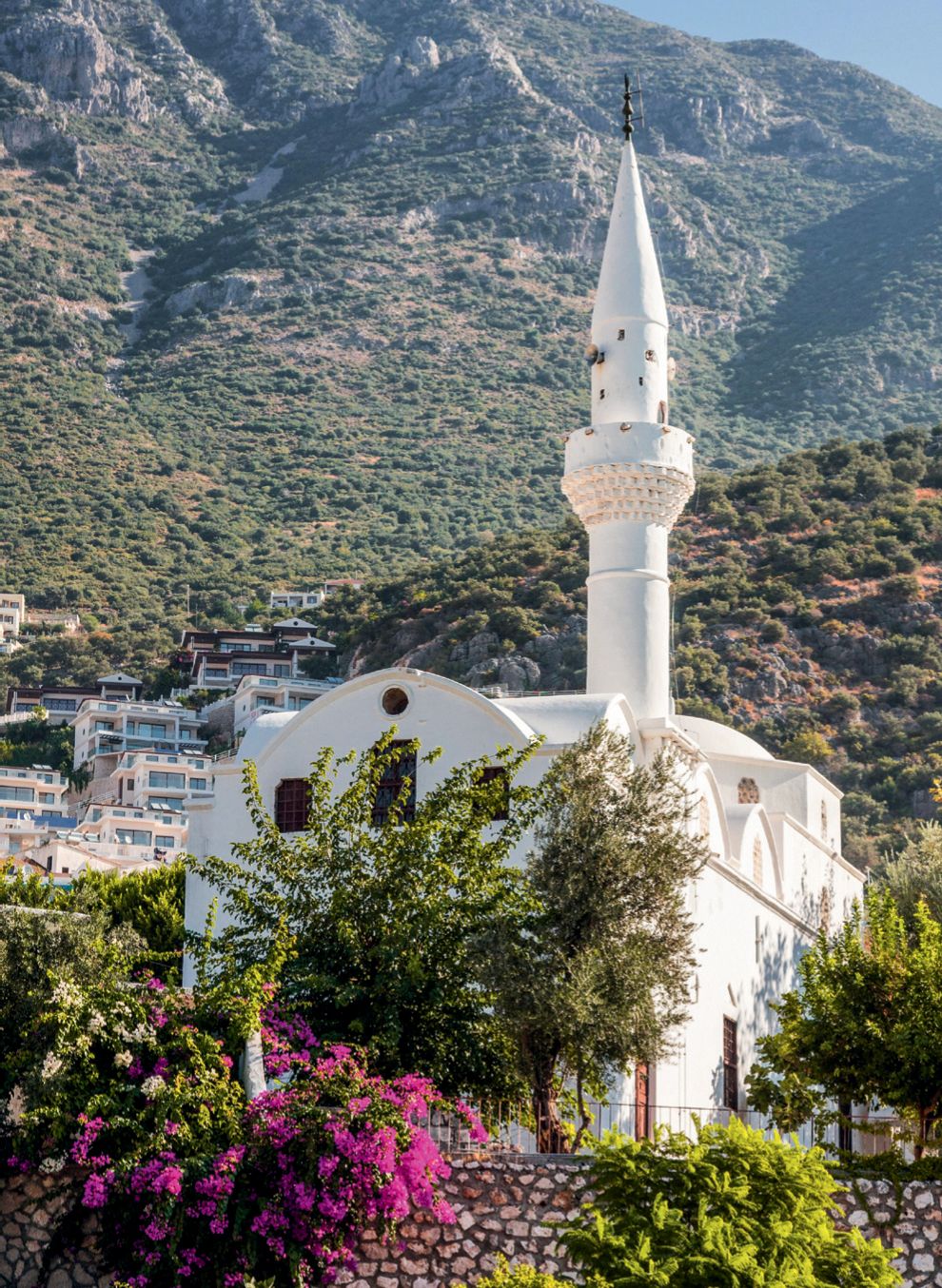
A mosque in Kalkan.
 Sites & Photos / Shmuel Magal / Alamy Stock Photo7/8
A sunken Lycian tomb of Kekova island.
 Carol Dixon / Alamy Stock Photo8/8
Simena is known for its Ottoman citadel.


