
A captivating farmhouse in the Tuscan countryside

This part of the Val d’Orcia is not only delightfully picturesque but also wonderfully tranquil. No wonder the owner and her family fell in love with such a mesmerising setting.
‘My favourite view is of the hillside opposite the house,’ she says. ‘I call it “my hill” and there is something so beautiful about it. I love the way the clouds float past it and how the grass grows in the meadow, so that in spring you see the breeze blowing through it, making green waves across the landscape. It is very poetic.’
The owner is an amateur equestrian who was unfamiliar with this part of Tuscany until she was introduced to it by her husband. They started spending holidays in the Val d’Orcia, then rented a house in the area, eventually deciding that they would love to buy a place of their own as an escape from their main residence in France. But the task of finding somewhere that would suit them and their son was not easy.
MAY WE SUGGEST: A mother & daughter's restoration of a 16th-century Tuscan convent
‘Around 12 years ago, we started to look for a farmhouse or a ruin to update and convert and finally we found two properties that we liked in the Val d’Orcia,’ she says. ‘We settled on this farmhouse, but it then took another four years to buy it because the process was so complicated. This did give us plenty of time to think about our plans for the house, though, and to observe how the landscape changes throughout the year. You really appreciate all the seasons here and the different ways the farmers work the land in each one.’
The 18th-century farmhouse, known as a podere, consisted of a number of smaller stone buildings and stables arranged in a U-shape around a central courtyard. It had begun to crumble and required extensive restoration. The owner assembled a team to work on the project, including the Italian architect Matteo Pamio of Roberto Pamio + Partners, and the French interior designer Elodie Sire of D.Mesure, who has also designed two homes in France for the family.
‘It is a Unesco-protected area, so you have to build in the traditional way,’ says the owner. ‘But it’s also an area of seismic activity, so the building codes are strict. We wanted the podere to appear the same but in a restored condition, so the exterior walls were retained and, from the outside, the farmhouse looks almost exactly as it did originally. Inside, we had a lot more freedom to do what we liked.’
MAY WE SUGGEST: A mother & daughter's restoration of a 16th-century Tuscan convent
After she and her husband bought the house in 2011, there were four more years of planning and construction. They were allowed to raise the ceiling height on the ground floor – which used to accommodate the stables – and to add more windows, while creating a fluid arrangement of spaces. This includes an open-plan sequence comprising the kitchen, dining area and family room, which leads out to a sheltered veranda with a view of the hills.
Working closely with Elodie, the family sourced materials and characterful pieces of architectural salvage that suit the modern rustic atmosphere. The semi-open-plan kitchen and dining area was partly designed around a vintage cabinet originally from a French pharmacy. ‘We would go to flea markets together to look for lighting, mirrors and furniture, and then work on the arrangement of the rooms, as well as the textiles and fabrics,’ says Elodie. ‘I also designed custom furniture for the main bathroom, a desk for the owner and the bunk bed in her son’s room. I love the quality of the detailing and the fact that there is a coherence to the house, as well as the way it is integrated so well into the surroundings.’
The family added a number of pieces gathered on their travels, including equestrian-themed items from South America. Leather riding crops and gaucho images by the Argentinian photographer Gonzalo Rivera make a striking display in the sitting room, which also features furniture by Giò Ponti and Franco Albini.
The owners’ son’s room and the spare rooms are on the first floor, as are the spacious main bathroom and the study, where a secret staircase leads up to one of the owner’s favourite parts of the house – the main bedroom on the second floor, which opens onto a hidden roof terrace. It is a restful, secluded space, in keeping with the idea of the farmhouse as a retreat and a place in which to recharge and reconnect with the natural world.
MAY WE SUGGEST: Life in an art-filled former palace in Italy, accessible only by foot
‘In the beginning, my dream was to keep my horses here as well, but the heat can be hard for them in summer so, instead, we sometimes rent horses nearby and go for a ride,’ she says. ‘We had such a good team working together and the podere feels very special as a result. Friends and family who come here tend to develop a crush on the house and landscape because they are so captivating. There is a wonderful sense of calm – and always a warm welcome’.
Elodie Sire: dmesure.fr | Matteo Pamio: studiopamio.com
 Richard Powers1/10
Ceilings were raised on the ground floor, which used to be the stables. New Crittall doors and windows fill the house with light. In the dining area, mid-century chairs designed by Giò Ponti surround Piet Hein Eek’s ‘Waste Table in Scrapwood’.
 Richard Powers2/10
An archway connects the kitchen to this open-plan sequence of living spaces, which was partly designed around a vintage French pharmacy cabinet bought at a flea market in Paris. The metal ‘Hanging Atomic Lamp’ in the dining area was created by Atelier Van Lieshout in Rotterdam. The photograph on the left was taken by Elger Esser. At the far end of the room, sofas by Axel Vervoordt and wooden armchairs from LeStudio Gallery in Paris create an informal seating area.
 Richard Powers3/10
La Cornue supplied the units, the range cooker and the central island, which provides open storage for ceramic tableware.
 Richard Powers4/10
An Aboriginal artwork hangs above the chimneypiece. The ‘PS16’ chaise longue is a Fifties design by Franco Albini.


 Richard Powers5/10
Equestrian-themed pieces include riding crops bought in South America, a lasso photograph by Gonzalo Rivera and an Etruscan figurine on the Jean-Louis Deniot coffee table.
 Richard Powers6/10
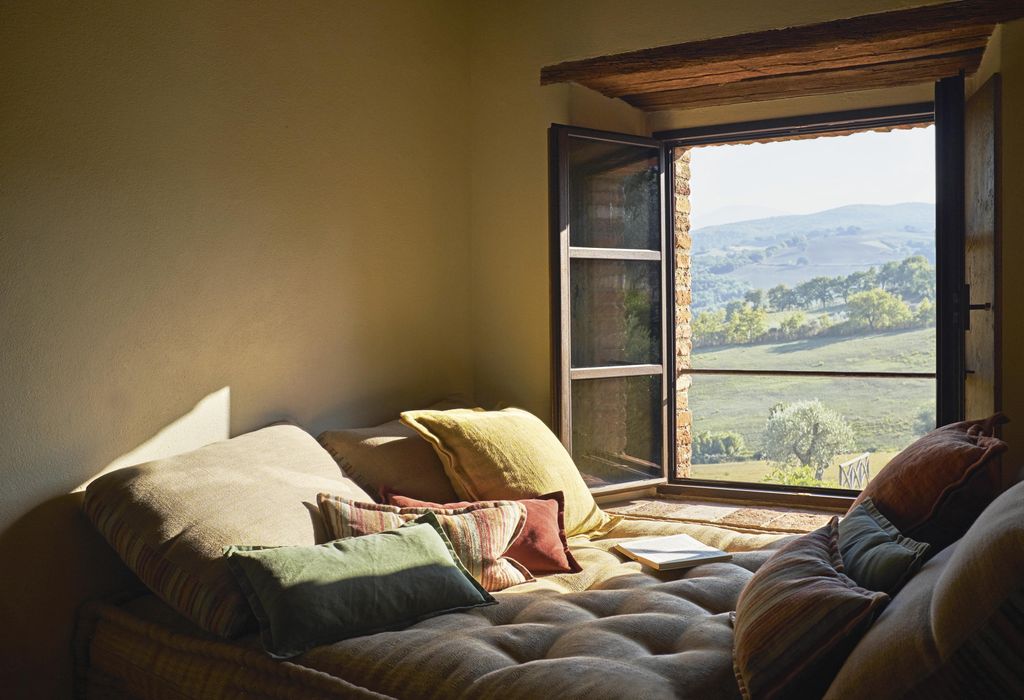
Interior designer Elodie Sire created bespoke furniture for several rooms in the house, including the leather-topped metal desk and the daybed by the window of this bedroom. The lamp is from Phillips.
 Richard Powers7/10
Linen fabrics from Designs of the Time were used to make cushions for the daybed – an inviting seat offering views of the nearby hills.
 Richard Powers8/10
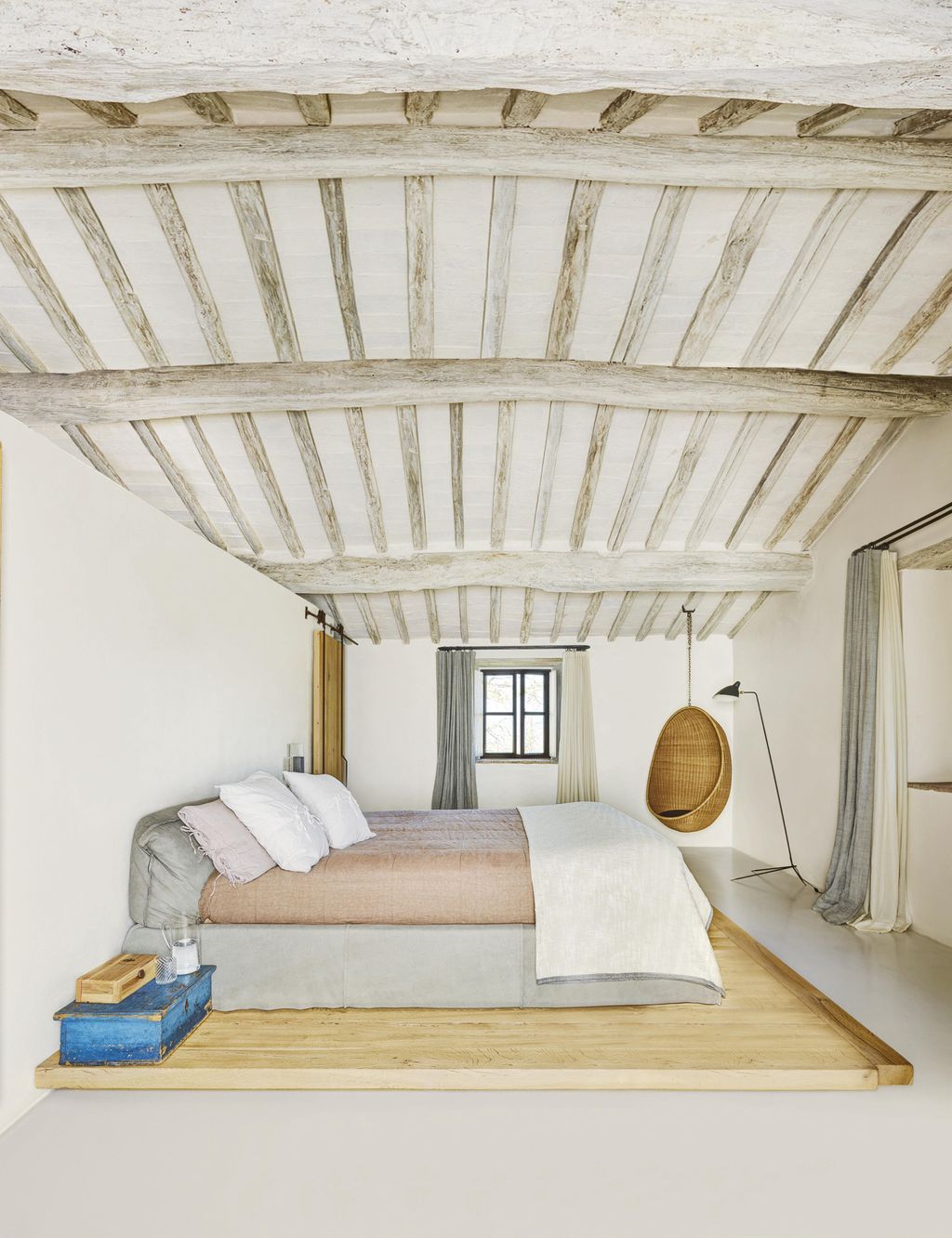
A Gervasoni bed stands on a raised oak platform above the polished concrete floor. The curtains are made from two linen fabrics from Holland & Sherry. A rattan ‘Hanging Egg Chair’ by Nanna Ditzel is suspended from a beam next to a lamp by Serge Mouille.


 Richard Powers9/10
After four years of renovation, the three-storey farmhouse has been revived but has retained its traditional character.
 Richard Powers10/10
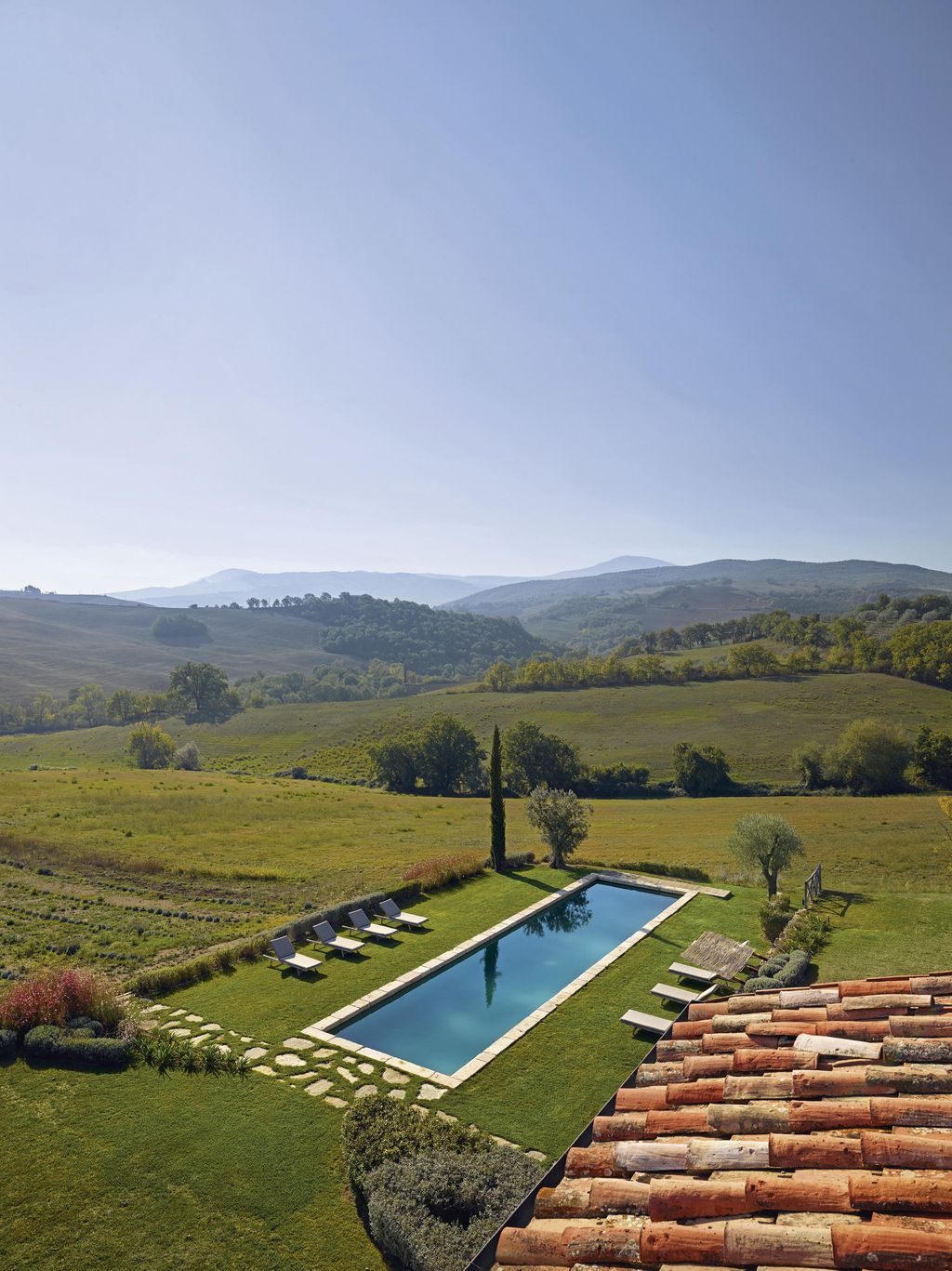
The house is in the Val d’Orcia, a picturesque region of Tuscany to the south of Siena. The roof terrace offers views of the pool and the hills beyond; the sun loungers are from Roda.


