
Why woodcuts and linocuts are the most democratic art form

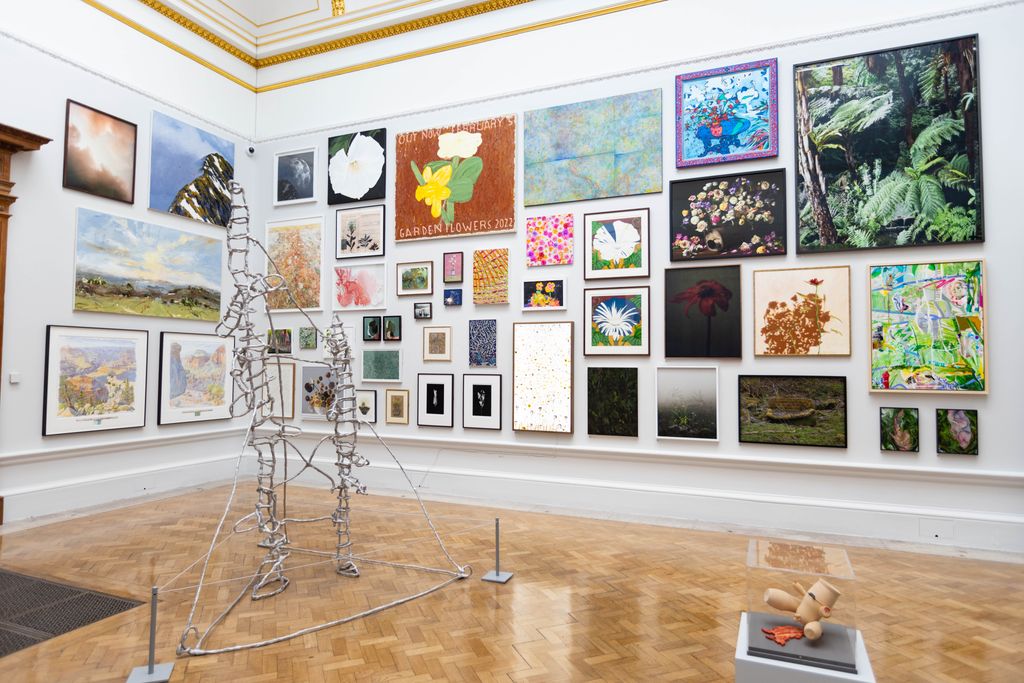
“Prints are the democratic medium,” the Royal Academician Norman Ackroyd has been heard to say, a point borne out by a visit to this year’s Summer Exhibition at the Royal Academy, which opens on Tuesday. There are a couple of beautiful and deeply covetable paintings by fellow Royal Academician Eileen Cooper–however, priced between £12,000 and £15,000, they’re hardly an impulse purchase for the majority. But, happily for those of us with shallower pockets, there’s also an exceptional woodcut by her, in an edition of 40, for £720. “But why is it so expensive, isn’t it basically a poster?” asked one of my children, misled by the world ‘print’, and frustrated that his pocket money still wasn’t going to stretch. “No,” is the quick answer, but as ever, there’s a longer answer too, for “woodcuts are one of the oldest and finest means of image making,” explains gallerist Lyndsey Ingram. “There’s something almost primeval about them, and a magic that you don’t get with any other medium,” she continues.
Firstly–and perhaps most importantly–we need to look at the difference between an original and non-original print. An original print is a work of art on paper which has been conceived by the artist to be realised as a print, and as such will be signed and numbered. A non-original print is a reproduction of work (and includes posters–which, incidentally, totally have their place, just not necessarily in the lexicon of fine art). There are different ways of creating an original print, among them engraving, aquatint, drypoint, etching, silkscreen–and woodcut.
That last, the woodcut–and its close relation, the linocut–are both types of block printing. The woodcut originated in China over 4,000 years ago, and was first used for the dissemination of information, while the linocut started being used in the west in the mid-1800s (after being invented by Frederick Walton, who was British) and was first employed for wallpaper. At its simplest, the process involves using knives and other tools to carve a design into the surface of a block. The raised areas that remain are covered in ink and can then ‘print’; the recessed areas, which do not retain ink, will remain blank–just like the potato block printing of our childhoods. More than one colour can be used, and more than one block, and adding to the beauty is “the character of the wood, which can come through into the image,” says Lyndsey. She describes the difference being “like using a really fine pencil – which would be lino – instead of a softer pencil – which would be the wood. You get a cleaner cut with lino, and it’s fascinating in itself, but it doesn’t have the same organic character as wood.”
Generally, working with woodcuts or linocuts necessitates a large area, and many artists who both paint and print, such as Eileen, will have a separate studio. “I always think that the printing studio has to be much cleaner,” she says. “You can paint over a smudgey fingerprint, but you can’t print over it.” The editions will most often be made in tandem, especially if ‘reduce block printing’ is the intention, which Picasso favoured, and which Eileen refers to as a “suicide method”. Let’s say the artist is intending an edition of 40; 40 sheets would be laid out for the first block printing. Then they’d cut away from the block, and do a second printing, cut more away from the block, and do a third–and so on, and so on. If something goes wrong, they can’t go back; instead the edition number decreases. Then there’s off-register printing, which involves using different colours with the same block, almost on top of each other, which can give a three-dimensional effect (you finish with the darkest colour). Other artists practice wood engraving, which is a form of woodcut using the end grain rather than the plank of the wood, “the output tends to be smaller in size, because the blocks are smaller; it used to be used for book illustrations,” says John Bell, who works with a number of Royal Academicians. “Sometimes several blocks are tied together to make one bigger one.” Eileen herself makes back-up blocks. She concedes that the process of this printing method is hard to explain clearly, saying “I didn’t fully understand until I was doing it, and working through it step by step.”
What’s important, says Lyndsey, is to make sure that you assess a woodcut or linocut on its own merit; “some artists are brilliant, and have really made the process their own. Dürer’s woodcuts are incredible, the German Expressionists made exquisite woodcuts, and there are many people who think Edvard Munch’s woodcuts are much better than his paintings–the energy conveyed in them is palpable.” Gauguin’s woodcuts were seen as a bridge between his paintings and his sculpture–he’d press fabric against the inked block to add yet another texture. Helen Frankenthaler, who had a deeply romanticised notion of woodcuts, used the striations in the wood to give greater depth to her prints.
As to where to go to find the best, the London Original Print Fair is a must for your diary. Certain galleries are excellent, including Lyndsey’s eponymously-named space in Mayfair, Abbot and Holder opposite the British Museum, and the Zillah Bell gallery in Thirsk, North Yorkshire. Bonhams is holding a Prints and Multiples sale on the 29th June–in which there’s a glorious Cyril Edward Power linocut for sale. Sotheby’s currently has two Albrecht Dürers available through their private sales department. Local auction houses and antiques markets often throw up treasure, and then of course, there is the RA Summer Exhibition, as previously mentioned. It brings us back to the (welcome) price discrepancy between oils and original prints. “I do like that it means more people can buy my work,” says Eileen, “but that’s not why I do it. I do it because I love the process, and I enjoy the challenge.” Woodcuts and linocuts are an art of their own.
 David Parry1/5
The Royal Academy Summer Exhibition 2022
- 2/5
Eileen Cooper, Free Spirit, linocut, 39.5cm x 28.5cm, courtesy of the artist.
- 3/5
Neil Bousfield, Sleep Took Him, wood engraving from the Wilfred Owen series, available from the Zillah Bell Gallery, image courtesy of the artist.
- 4/5
Neil Bousfield, The Last Laugh, wood engraving from the Wilfred Owen series, available from the Zillah Bell gallery; image courtesy of the artist


- Photo5/5
Cyril Edward Power (1872-1951), The Merry-Go-Round, linocut printed in a mixture of Chinese orange and chrome orange and Chinese blue, circa 1930, on sale at Bonhams
%2520The%2520Merry-Go-Round%2520Linocut%2520printed%2520in%2520a%2520mixture%2520of%2520Chinese%2520orange%2520and%2520chrome%2520orange%2520and%2520Chinese%2520blue%2C%2520circa%25201930%2C%2520on%2520sale%2520at%2520Bonhams.jpg)
Comments
Back to Top


