
A 17th-century peasants’ cottage sensitively overhauled with attention to historical detail

Antiques dealer Adam Bentley has known this 17th-century stone cottage in West Yorkshire since he was born. ‘I grew up in the house next door,’ he says, referring to the adjoining cottage, which forms part of a rural hamlet eight miles south of Huddersfield. His grandparents bought the hamlet in 1947. Over the years, parts of it, including Victorian Gothic Revival villa in which Adam's mother grew up and a string of farm building converted into houses were sold off, but the Bentleys held onto two cottages.
In 1999, Adam’s grandfather suggested that they could be knocked through to give the family more space. ‘We suddenly went from having no space to more rooms than we knew what to do with,’ Adam recalls. One room became a playroom for ‘blowing things up in’. At 16, what Adam describes as his ‘practically minded’ spirit found focus in a two-year furniture design course at what was then Leeds College of Art, where he focused on restoration. A local history course compounded his interest in antiques, especially after a tour of Longley Old Hall, a Grade II*-listed stone house in Huddersfield. ‘I precociously asked for a second tour just to look at the early English wooden furniture,’ he recalls. ‘It made me realise these were exactly the sorts of pieces that were right for our cottages.’

In 2004, Adam moved to London to pursue a career in restoration, first in the workshop at Westland London and then for conservation studio Plowden & Smith. In 2016, he set up as an antiques dealer in partnership with Cindy Chetwode, with whom he continues to work today from their Battersea showroom. When he moved to London, his mother had inherited both cottages after his grandfather’s death two years before, and she decided to hand the one they had knocked through into over to Adam. ‘I think she was worried I would lose my Yorkshire roots otherwise,’ he says with a laugh.
With the wall between the two reinstated, Adam started to make the house his own, carrying out most of the work himself on weekend visits from his main base in London. ‘No one had ever done any serious work,’ says Adam of the cottage, which consists of a sitting room and kitchen downstairs and two bedrooms and a bathroom upstairs. Although it had been subject to a string of ‘bodge jobs’, these thankfully obscured rather than obliterated original features. His first significant intervention was to rip down the modern flat ceilings on the upstairs landing and main bedroom to expose the original timber beams. This revealed ‘witch marks’ that had been carved into the beams hundreds of years before. ‘The idea was that they would ward off evil spirits,’ he explains.
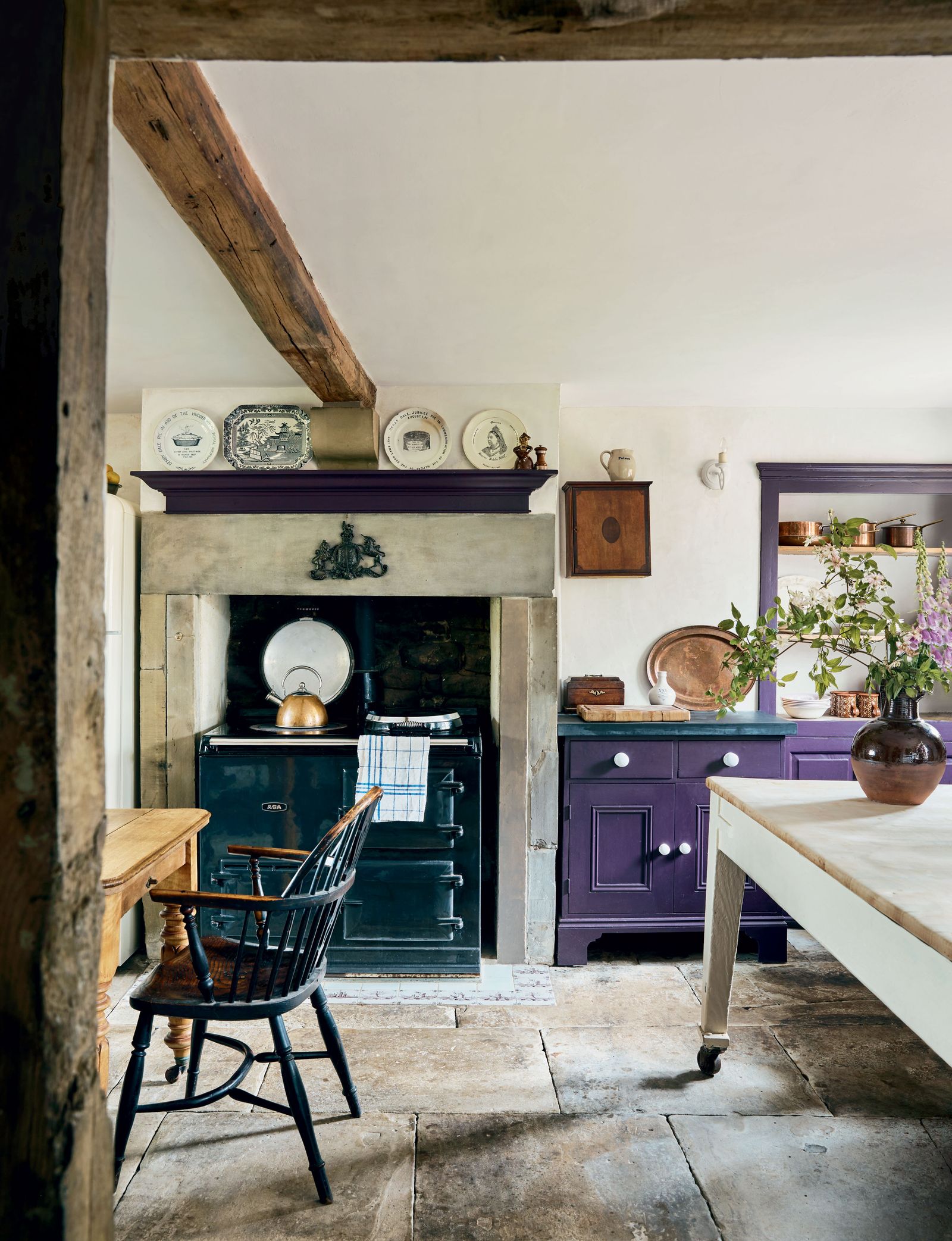
Once he had started the stripping back, he found it hard to stop. Upstairs, he replaced chipboard floors with reclaimed wooden boards. In the kitchen – the room that had hosted his teenage experiments – artificial stone and concrete were pulled up to reveal the original stone floor, while the fireplace was opened up to expose the stone surround. A new staircase, based on a late-17th-century example, replaced a Seventies one. ‘It’s about as grand as I could get away with for what was originally a peasant’s cottage,’ Adam says with a grin. Windows with uPVC frames were swapped for traditional leaded lights, while bronze-framed, double-glazed windows were installed on the rear façade to help combat the prevailing harsh Yorkshire weather.
This was one of the major issues Adam had to solve. ‘In some places, the house was three walls thick where another had been added to stop the damp,’ he says. ‘The walls couldn’t breathe.’ Adam peeled the layers back before lime-plastering them. In the sitting room, he added panelling, leaving a gap between that and the wall to aid circulation. The only alteration to the footprint was the addition of a pitched-roofed snug, which extends from the sitting room and is designed around 17th- century panelling that Adam had acquired a few years earlier. ‘It came from an old monastery in Lancashire and I’d bought it not quite knowing what I’d do with it,’ he explains.
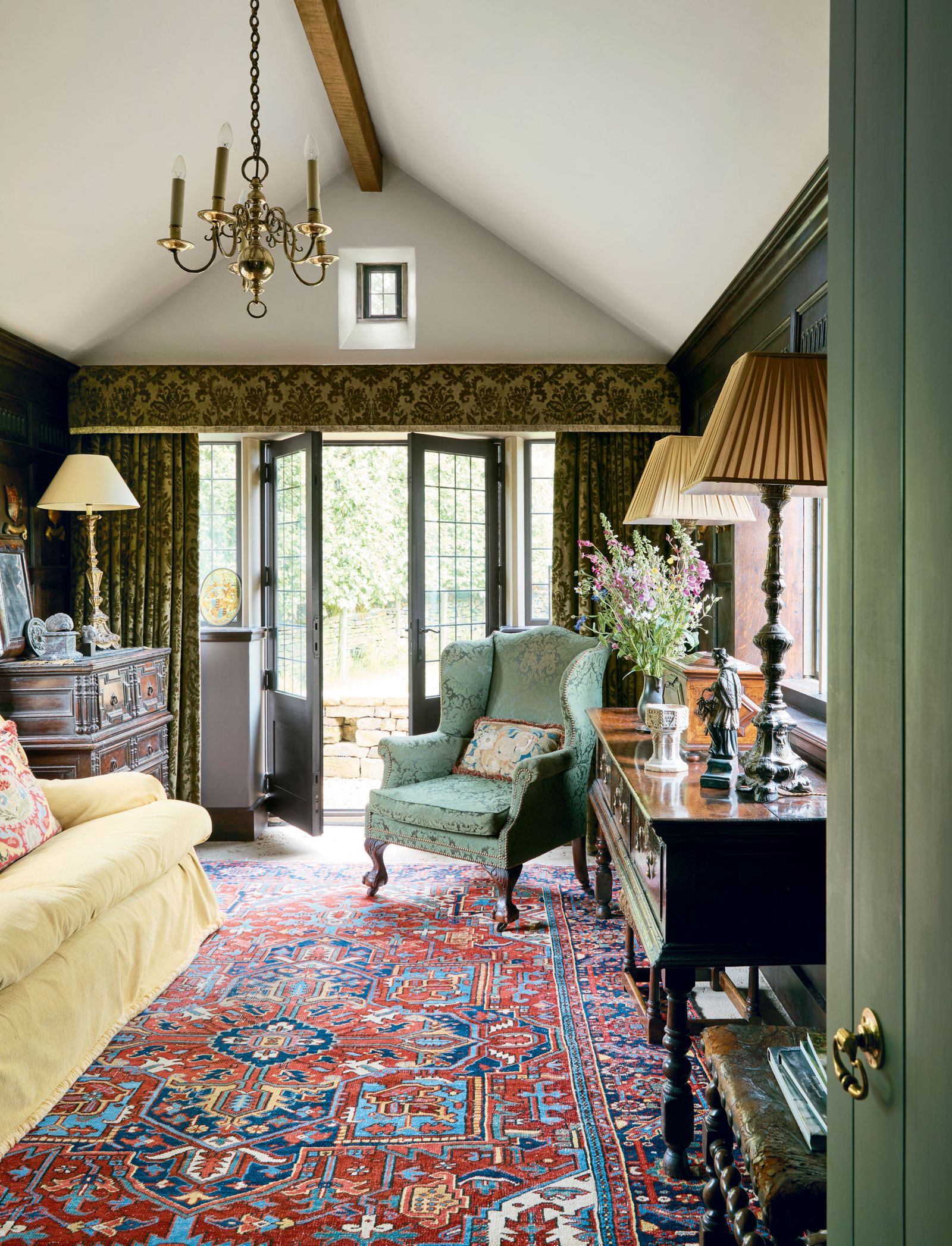
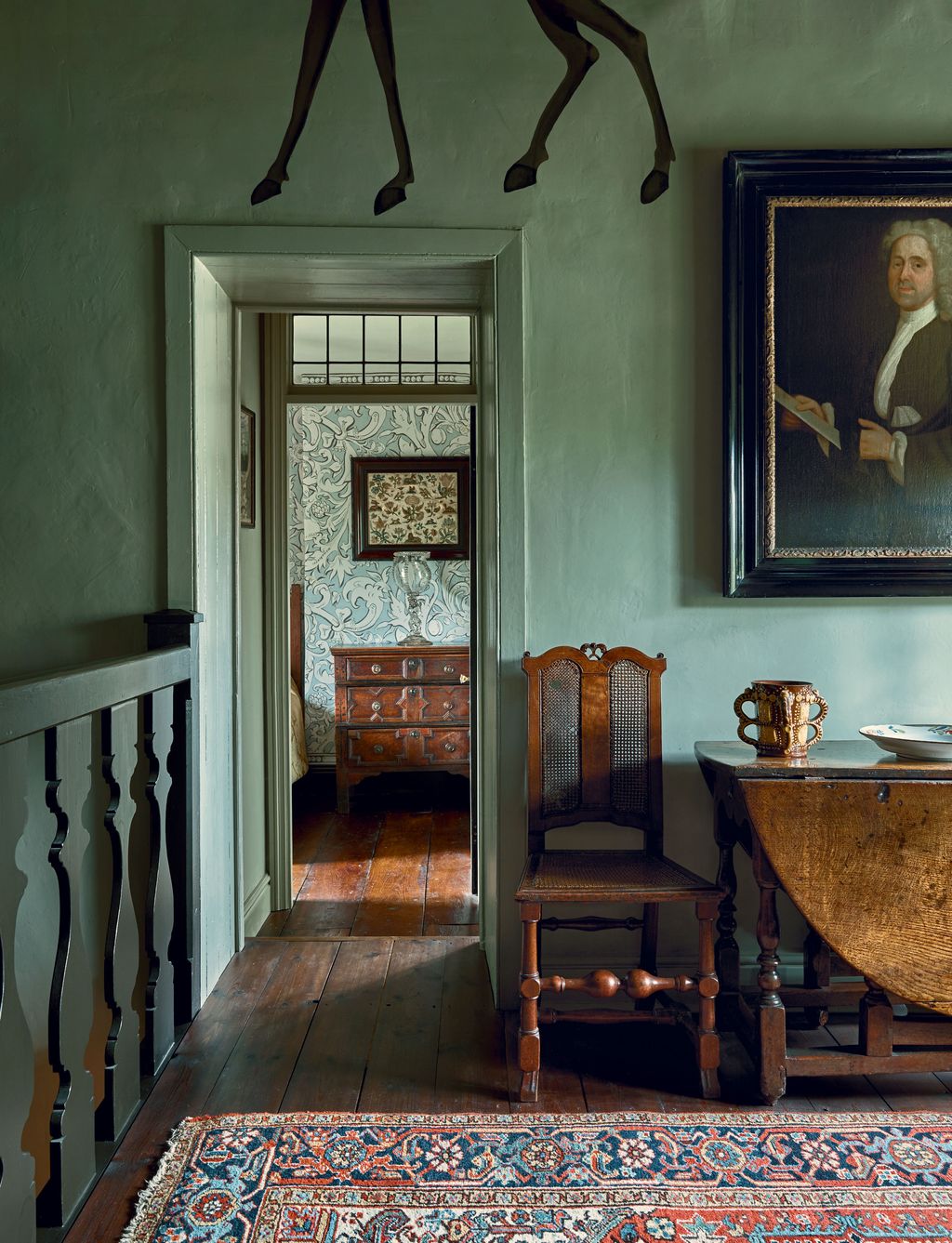
The house, unsurprisingly, is filled with beautiful antiques. On the whole, the pieces that he deals in – a mix of English and continental and 18th and 19th century – are grander than those in the house. Many pieces here, such as the Cromwellian leather-back stool in the snug, mirror the house’s age and date from the 17th century, but he is not a purist: ‘I like a mishmash of ages.’ If the painted stag’s body on the landing wall is anything to go by, he also likes to have fun. ‘It was inspired by the stag painting at Chastleton House in the Cotswolds,’ says Adam. ‘I just give things a go and they sometimes work out.’
Even the most functional spaces are rich with history. The kitchen consists of mainly freestanding furniture: Adam’s childhood family dining table, a late-18th-century dresser and a 19th-century preparation table. In the bathroom, a copper tub, found on Ebay, is accompanied by 17th-century Delft tiles and a pair of wooden panels, carved with a pomegranate to symbolise Catherine of Aragon and a Tudor Rose for Henry VIII. ‘It would take quite a lot to prise those out of my hands,’ says Adam who, on the whole, operates a one-in-one-out rule.

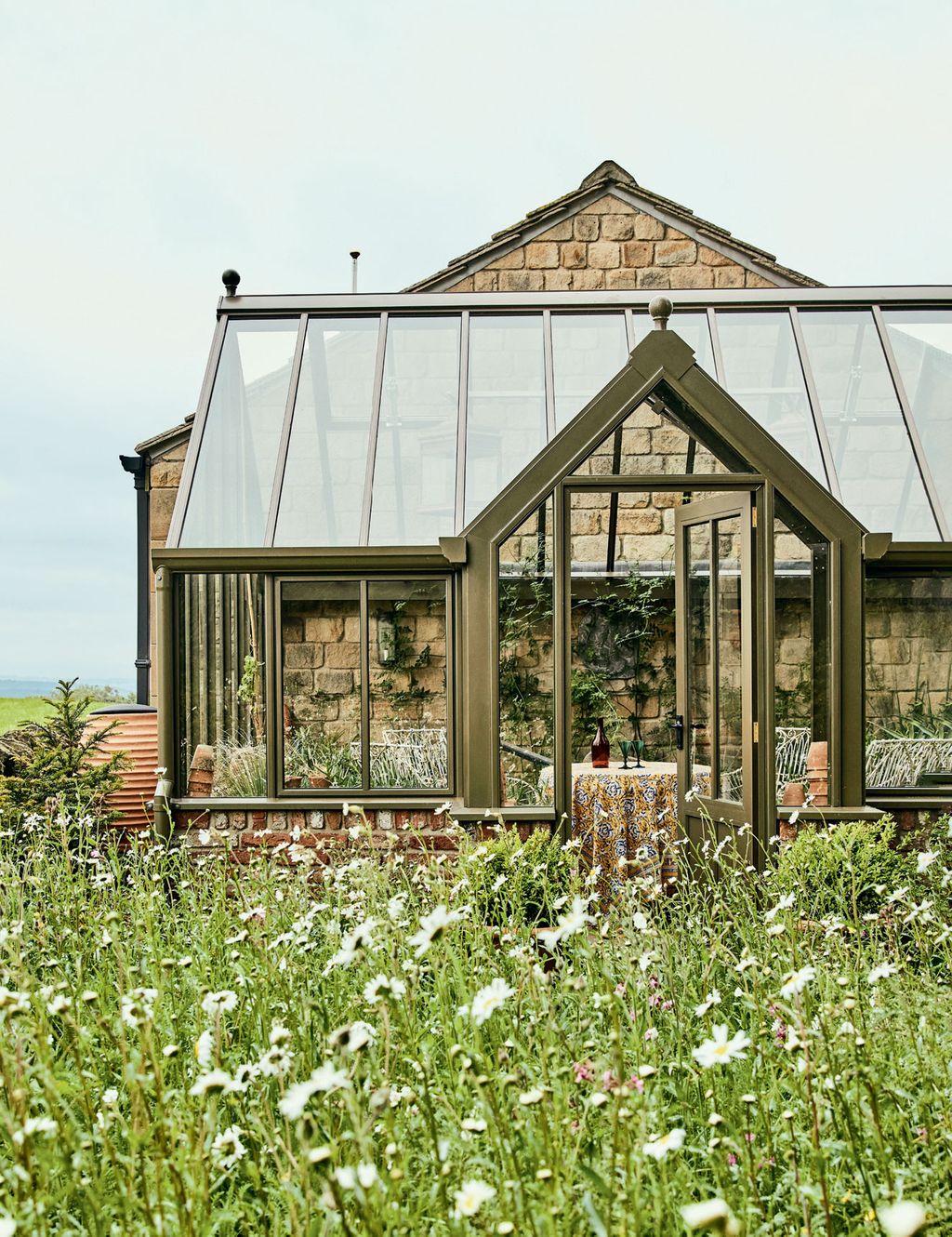
Outside, Adam has added a glasshouse and laid out a box parterre. ‘It’s my delusion of grandeur,’ he jokes. But, as with the house and its decoration, it is something that feels entirely right for its setting. And that is the magic with this house.
Adam Bentley: adamcalvertbentley.co.uk
 Martin Morrell1/5
A scrap of wallpaper informed the choice of Edward Bulmer Natural Paint’s ‘Tea Green’ on the walls. Adam found the portrait above the gateleg table on Portobello Road, but it had been overpainted – ‘I had to dryscrape it off,’ he explains. The view through the door is of the spare room lined in Lewis & Wood’s ‘Bacchus’ wallpaper.
 Martin Morrell2/5
Little Greene’s ‘China Clay’ sets off the copper bath Adam found on Ebay. He discovered the 17th-century Delft tiles, above the washstand (a repurposed Pembroke table), incorporated into the top of a Seventies coffee table.
 Martin Morrell3/5
A chair upholstered in 18th-century crewelwork and a 17th-century wardrobe from a local farmhouse.
 Martin Morrell4/5
A glasshouse was added onto the back of the garage amid a wildflower meadow.


 Martin Morrell5/5
Adam in the sitting room.


