


Dear Fiona
We’ve recently bought a seven-bedroom, one-bathroom house. Evidently, we need more bathrooms. It sounds do-able by losing bedrooms, I realise, until I tell you that we have four children – so, if they’re each to have their own rooms, and we have a guest room, we actually need to retain six bedrooms. In our bedroom, there’s a poky sort of window-less cupboard that I could turn into a shower room and loo – but it’s never going to fit a bath in it, and gosh I love a bath – so I wondered about putting the bath in our bedroom? I’ve seen it in a few hotels, and it could go under the window.
My husband was okay with that idea, but my best friend – who works in interiors and whose taste I trust – was horrified when I suggested it and doesn’t think we should have a loo in a cupboard in our bedroom, either. So what do we do? Enlarge the cupboard, which would then mess up the proportions of the bedroom? Forgo a bath (I fear I’d always regret it)? Or forget having my own bathroom, and share with my children and their accompanying plethora of plastic bath toys? The house was bigger in our imagination than it actually is now that we’ve got the keys, and I’m panicking a bit, for I’m pretty certain that we need more than two bathrooms (if I’ve got one more out of that seventh bedroom) as what about when the children all become teenagers and we’ve got guests staying?
Thank you so much, in advance, for any ideas you can provide – especially regarding the bath in a bedroom quandry.
Love,
Low-On-Washing-Facilities XX
Dear Low
We’ve all moved into smaller houses than we remember them being. And when it comes to baths in bedrooms, your best friend is in good company with her opinion. “Feature baths are cousins of feature walls; leave them to the hotels,” says Daniel Slowik, slightly damningly. His husband Benedict Foley is no more enthusiastic, and nor are Nicole Salvesen and Mary Graham of Salvesen Graham. And yet baths in bedrooms are not unheard of in domestic settings, and even naysayer Benedict concedes that there are always exceptional circumstances in which they can work rather well. Equally, for every person who says ‘no way’, there’s another who asks ‘why not?’ The great David Hicks was keen, and Francis Sultana doesn’t see an issue. Tom Bartlett of Waldo Works has a bath in his bedroom, Melinda Stevens has one in hers, and this magazine’s editor, Hatta Byng, has a bath in a guest bedroom at her home. Then there’s Vanessa Bell, and bedroom-located bath at Charleston Farmhouse, an interior which is widely agreed to be faultless. Evidently there’s a lot to unpick, and I can tell you now that it doesn’t only concern taste, but execution. Alongside, we need to find a solution for your more general issue regarding the ratio of baths to bedrooms in your new house. It’s a common problem – which won’t come as a surprise if you marry up Britain having the oldest housing stock in Europe with the fact that indoor bathrooms didn’t become mainstream until the 1950s. Increasing their number is thus a regular remit for interior designers, and they have many ideas.
Nicole and Mary explain that, as well as sacrificing bedrooms for bathrooms, they often reconfigure internal layouts to decrease the size of bedrooms and so fit in additional bathrooms, which could be a solution for you. “The idea that children need large bedrooms isn’t true,” says Nicole, mooting that they’re better “small and jewel-like” than vast and bathroom-less, and suggesting Jack and Jill bathrooms (which are bathrooms between bedrooms that you can access from each.) A not dissimilar approach was taken by Celia Muñoz when renovating her Georgian house in Hampstead; aided by her engineer husband and the architect Richard Gooden of 4orm, she cleverly managed to fit in a bathroom per child (which becomes increasingly impressive when you learn that she has five children.) Regarding maintaining proportion – for you are right that there is no aesthetic grace in awkwardly wodging a meagre en suite into a corner - Pallas Kalamotusis’ bedroom and bathroom set-up is worth studying. Finding herself in possession of a large, high-ceilinged room with grand proportions and exquisite ceiling mouldings, she’s installed a stained-oak and glass dividing wall that separates the sleeping area from the bathroom facilities.
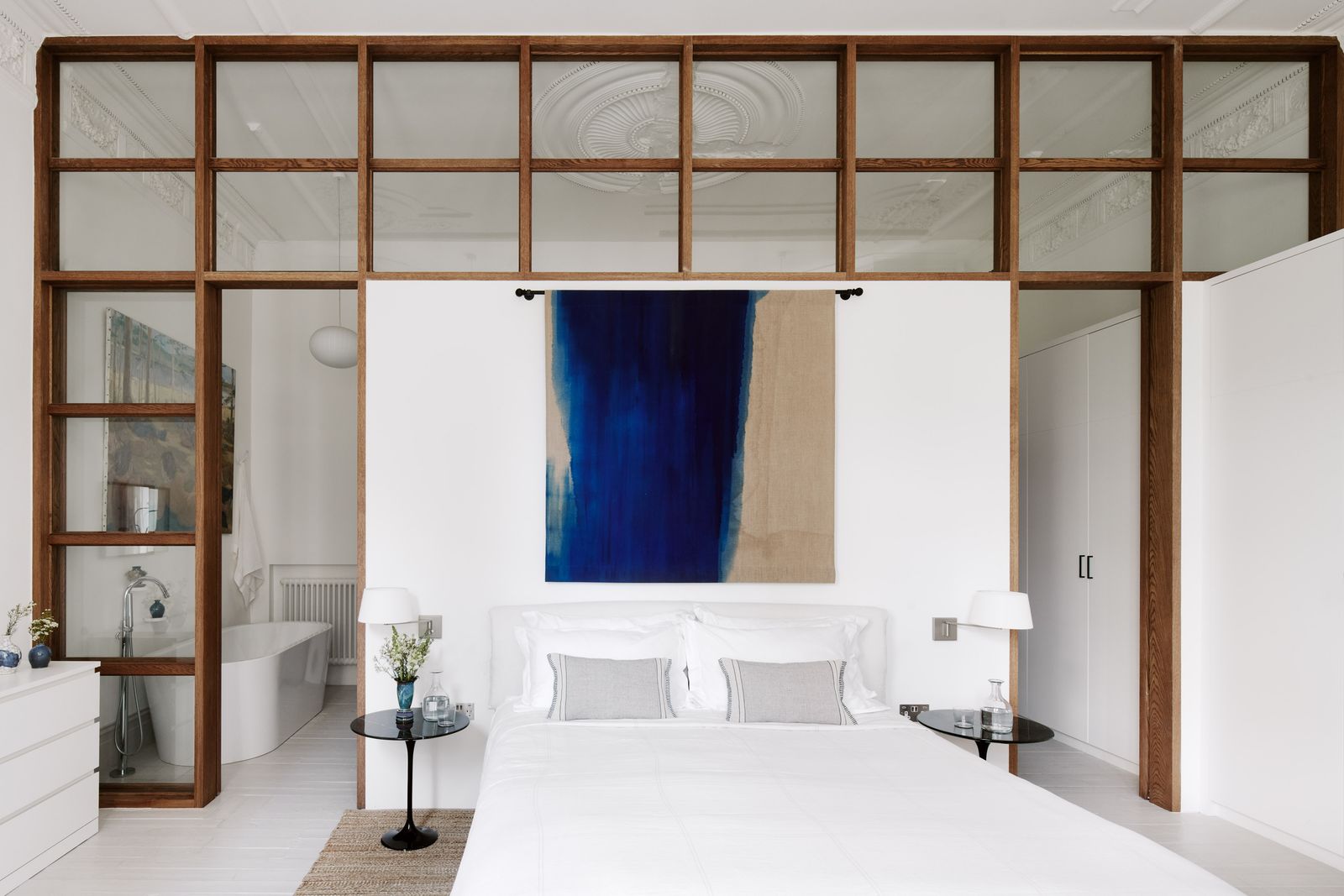
Of course, this particular approach to reconfiguring won’t work if the bedrooms are already on the tight side, in which case you’ll need to look elsewhere for areas of underutilised space. Benedict recounts that he’s been working on a house in London for a family of similar size to yours, “we have taken the over-generous landings to become bathrooms. They’re quite brief landings now, but they’re the still the same width as the corridors, and there are three bathrooms.” In a similar vein, Nicole and Mary would urge freeing up room for bathrooms by having a more flexible approach to bedrooms. “A guest bedroom doesn’t have to be upstairs, especially if it’s only ever used for a night or two at a time. You could put rather an elegant day bed into a study, a library, or even a dining room,” suggests Nicole. Taking it further, no bedroom has to be upstairs: to return to Charleston, in 1939 Vanessa Bell created a downstairs bedroom for herself from the room that had been the larder. (Her husband, Clive Bell, was moving in, and she was “putting space and privacy between them,” describes Kathy Crisp, the conservationist cleaner at the house.)
Continuing, it’s worth thinking about what a bathroom needs, what other rooms it could be combined with, and which elements could be parcelled out elsewhere. Firstly, the ideal is a window that opens; failing that, good ventilation is a must if you’re going to avoid unpleasant dampness. Secondly, there’s general agreement among the polled interior designers that a bathroom can absolutely be combined with a dressing room (phew, for I have done just this); “I found a space for the bath between my closets,” says Francis. And Benedict has been working on “a combined boot room/garden room/bathroom. Everything is concealed within other sorts of furniture so the room presents as a non-bathroom leading out to a terrace, but you can have a bath if you know where to look.” (He does concede that it’s not easy to achieve well – perhaps “one for if you’re employing a decorator” – but if you do move a bedroom downstairs, or put an occasional bed in a downstairs room, it’s something to consider.) Thirdly, you’re right in thinking that a bath can absolutely be separated out from the loo, basin and shower, but what shouldn’t be underestimated, emphasises everyone, is the usefulness of putting additional basins in bedrooms, which helps with the pressure on bathrooms (especially if there are fewer of them).

So what, might you ask, is the difference between a basin in a bedroom, and a bath in a bedroom, for those who disapprove of the latter? “Baths create a lot of damp air in everyday life,” points out Daniel. “Prudishness,” confesses Mary; “there is nothing that happens in a bath that I want to see in a bedroom.” And yet, “it’s so nice to roll out of the bath, across a carpeted floor, and straight into bed. I like the free flow,” says Tom. Ultimately, it’s personal choice – and how much you mind having an audience for your ablutions, and being the audience for your husband’s – but what is essential, if you do decide to go for it, is to do it well.
“You need palatial room sizes,” ordains Benedict. You also don’t want to splash too much – to which end I would suggest never allowing your children and their toys anywhere near your tub. You might also want to de-hotel the concept by ensuring that the bath isn’t the ‘feature’ that Daniel so dislikes. There is an exquisite Omega workshop screen shielding Vanessa Bell’s bath from her bed, and Melinda’s bath, you’ll note, blends seamlessly into the room, due to her ‘sea kelp depths’ colour scheme. In the guest bedroom of Hatta Byng’s house, the bath is behind cupboard doors. There’s also a loo and a sink – in effect a whole bathroom, “which works, and it’s fun for a couple of nights, but I don’t think you’d enjoy the set up long term, at least not if there are two of you sleeping in the room,” says Hatta – which is something to think about regarding your proposed loo in a cupboard in your bedroom. (Would you genuinely be able to use it, or might it prove inadvertently constipating?)
I hope that a few of these ideas might prove fruitful, or at least give you food for thought – and good luck!
With love
Fiona XX


