
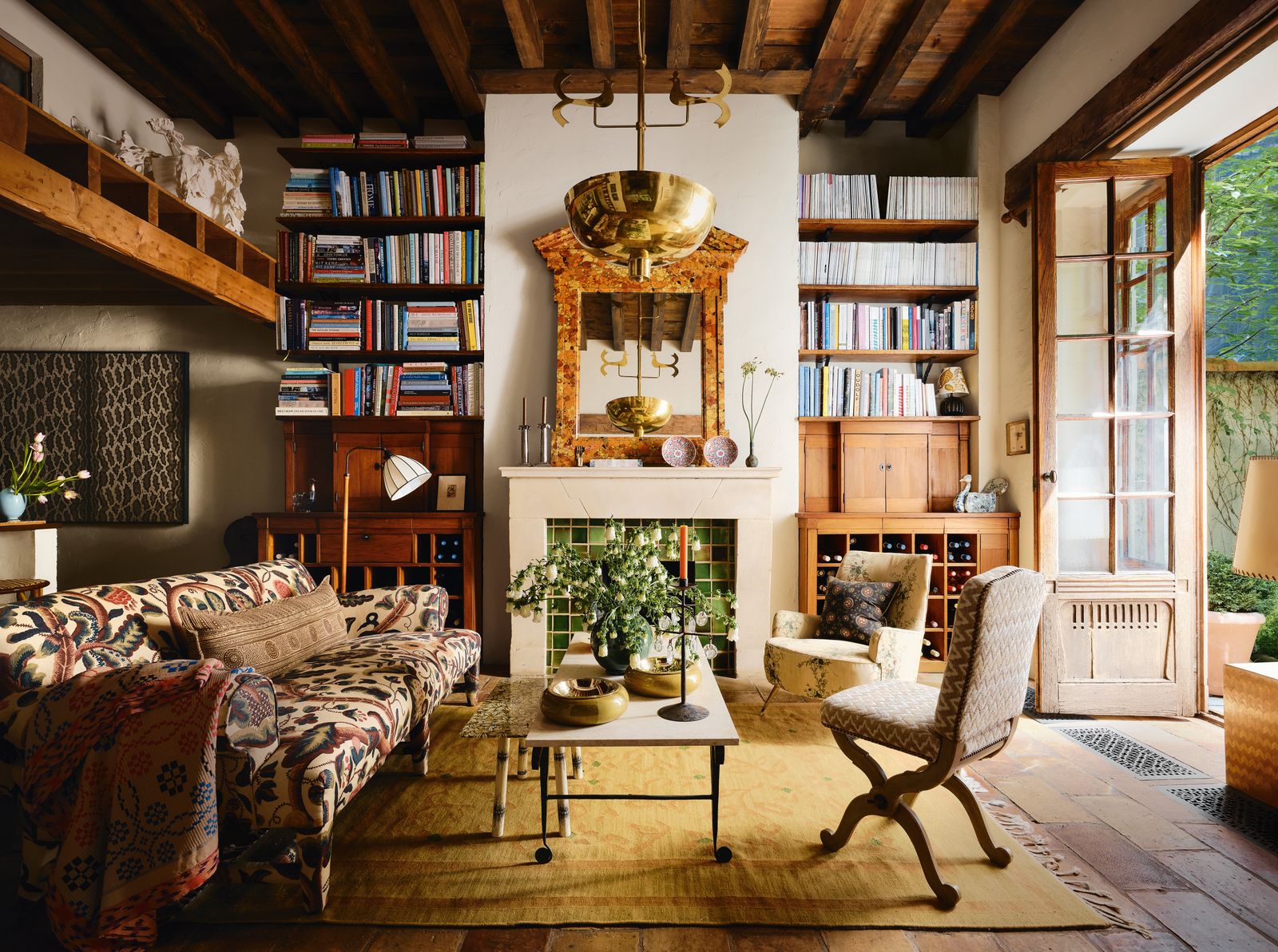
What comes to mind when we think of crewelwork? Scenes of wooden beams, linenfold paneling, and perhaps leaded glass windows likely appear. As it’s something that we expect in a particular setting, it’s a source of comfort that never grows old. It’s human nature; we seek comfort in all aspects of our lives, from what we eat to the way we adorn our surroundings. Crewelwork is certainly a comfort food in the design world, and in addition to using it to gain a cosy sense of familiarity, crewelwork can be a highly useful interior design tool.
First of all, what even is crewelwork? The layman’s definition is surprisingly minimal, as it’s just “wool embroidery of any age worked on any ground,” and ‘crewel’ is just the twisted yarn that makes up crewelwork. According to Annabel Westman in her book Fringe, Frog & Tassel, crewelwork is more technically defined as, “embroidery (often using a stem stitch) of fine two-ply worsted woollen yarns on twilled union fabric, with a cotton warp and linen weft.” The oldest surviving examples of English needlework are mostly ecclesiastical, and the most famous (and oldest) example of wool embroidery is the Bayeaux Tapestry, which dates to the 11th century. As monasteries in Britain dissolved with the establishment of the Church of England in the 16th century, ecclesiastical needlework ended. Soon after, the upper and middle classes developed a taste for secular embroidery for their homes and attire.
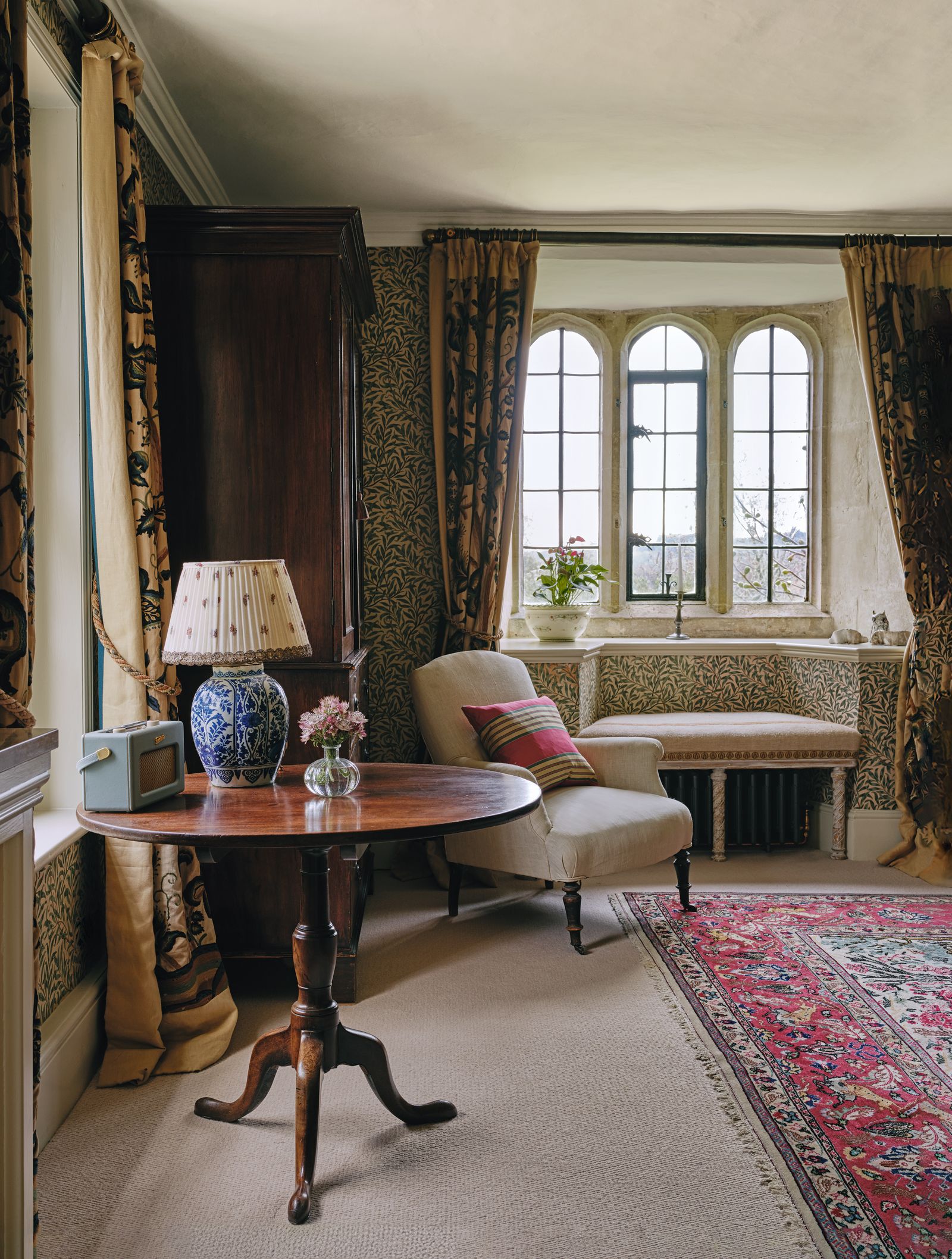

Although crewelwork was not as lavish of a way to show your wealth as damasks and Genoa velvets, it certainly allowed for colour, movement, and both literal and visual warmth. The establishment of the British East India company in the 17th century meant that Britain had more motif inspiration coming in from Chinese designs (or ‘Indian’ designs, as they called them then). Therefore, motifs from the East such as trees of life and Chinese birds stylistically mingled with Elizabethan and Jacobean motifs like acorns, huntsmen, and asparagus. These colourful works were mostly used as bed hangings on tester beds, as bedspreads, as wall hangings, and as furniture upholstery. There was a revival of crewelwork in the 19th century during the Arts and Crafts movement (fitting in with the reaction against mass and machine production), as well as in the early 20th century (as part of the Jacobean Revival). Conveniently for us Londoners, the V&A has a large collection of historic crewelwork both on view and able to be viewed by appointment. If you want to see in-situ instances of crewelwork, we recommend visiting the National Trust’s Cotehele in Cornwall for a Tudor bedhanging and Kelmscott Manor (one of William Morris’ houses) in Oxfordshire for an Arts and Crafts interpretation.
Crewelwork nowadays serves as an appropriate way to add colour and texture to a historic setting. Unless a homeowner is trying to make a design statement, there’s a certain expected colour palette in a vernacular country home that we instinctively find comforting. Think about Instagram-famous spaces like Emma Burns’ country home, Alexandra Tolstoy’s Oxfordshire cottage, or Daniel Slowik and Benedict Foley’s sitting room in the Dedham Vale. All of their spaces are painted and upholstered with colours found in nature and with historic context—like the colours of traditional crewelwork (whether they actually used crewelwork or not). Although original crewelwork colour schemes would have been bright and vivid, we have become more accustomed to their more muted, aged colour schemes.
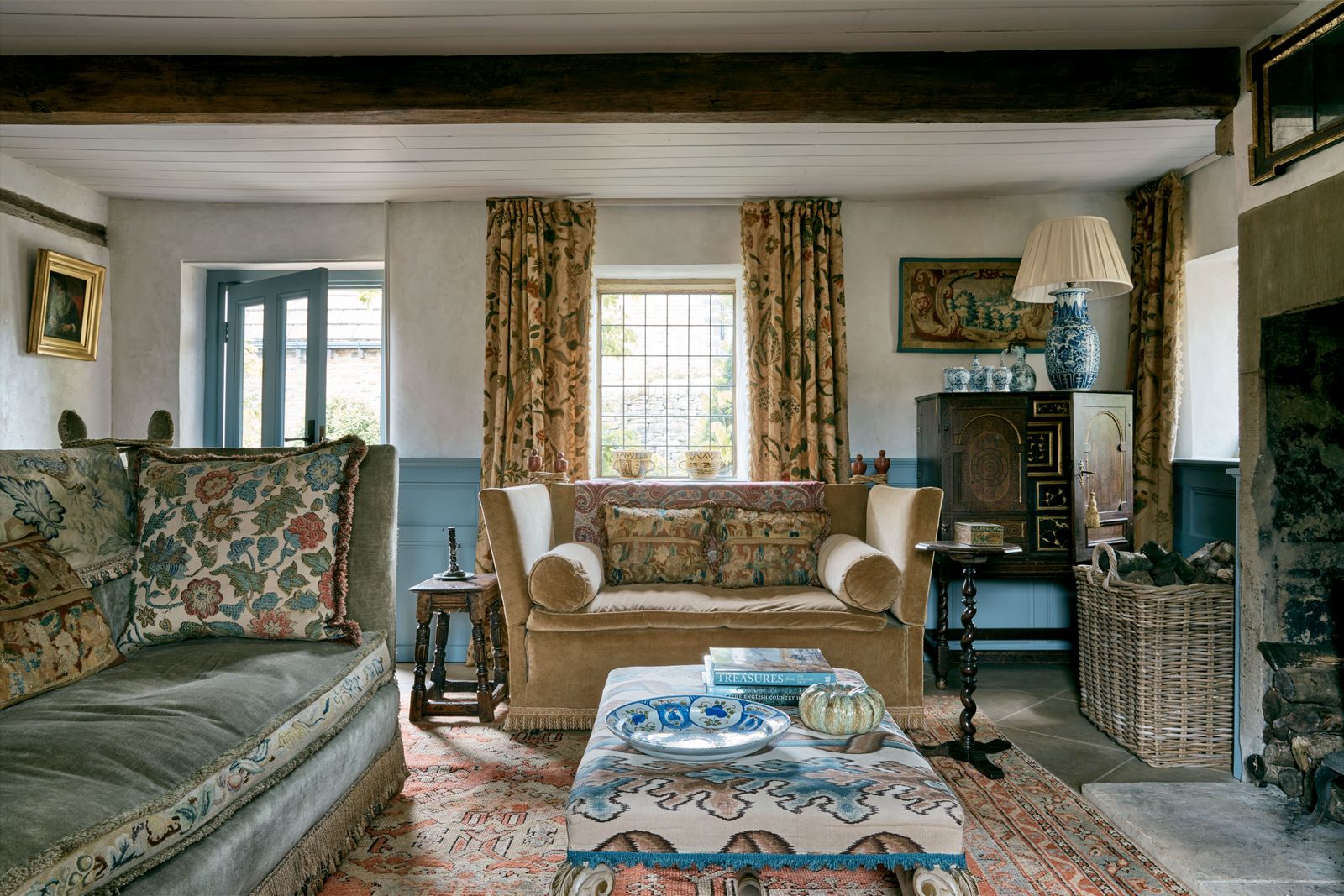
Whether it’s used in a historic or contemporary context, crewelwork is a great cornerstone piece for any space—and by ‘cornerstone piece,’ we mean the object that supports and unites the colours of a room by providing the whole colour palette in one piece. Think of it like that one painting or multi-coloured rug that ties the room together. Adam Bentley’s 17th-century peasant’s cottage exemplifies this with his abundance of crewelwork. His crewelwork cushions and curtains provide the same colour palette of dark blues, rusty reds, and sage greens that have complemented plaster walls and dark, wooden beams for centuries. His dados and trims painted in Edward Bulmer’s ‘French Blue,’ his sage and gold Knole sofas, and even the colours of his coffee table books are all drawn from his many instances of crewelwork in his curtains and cushions.
In a more contemporary setting, a cushion in Joanna Plant’s London drawing room also acts as a cornerstone piece. A small-but-mighty instance of crewelwork makes sense of a room filled with pieces that otherwise might not be related—a blue and white striped sofa in the Howard-style next to a clean-lined 1940s sofa that’s been upholstered in olive velvet; a 19th-century red leather chair next to a 1960s glossy coffee table; an old Hoshiarpur table next to a contemporary green, resin table lamp. . . it’s that little crewel cushion that unites everything to form a cohesive, harmonious space.
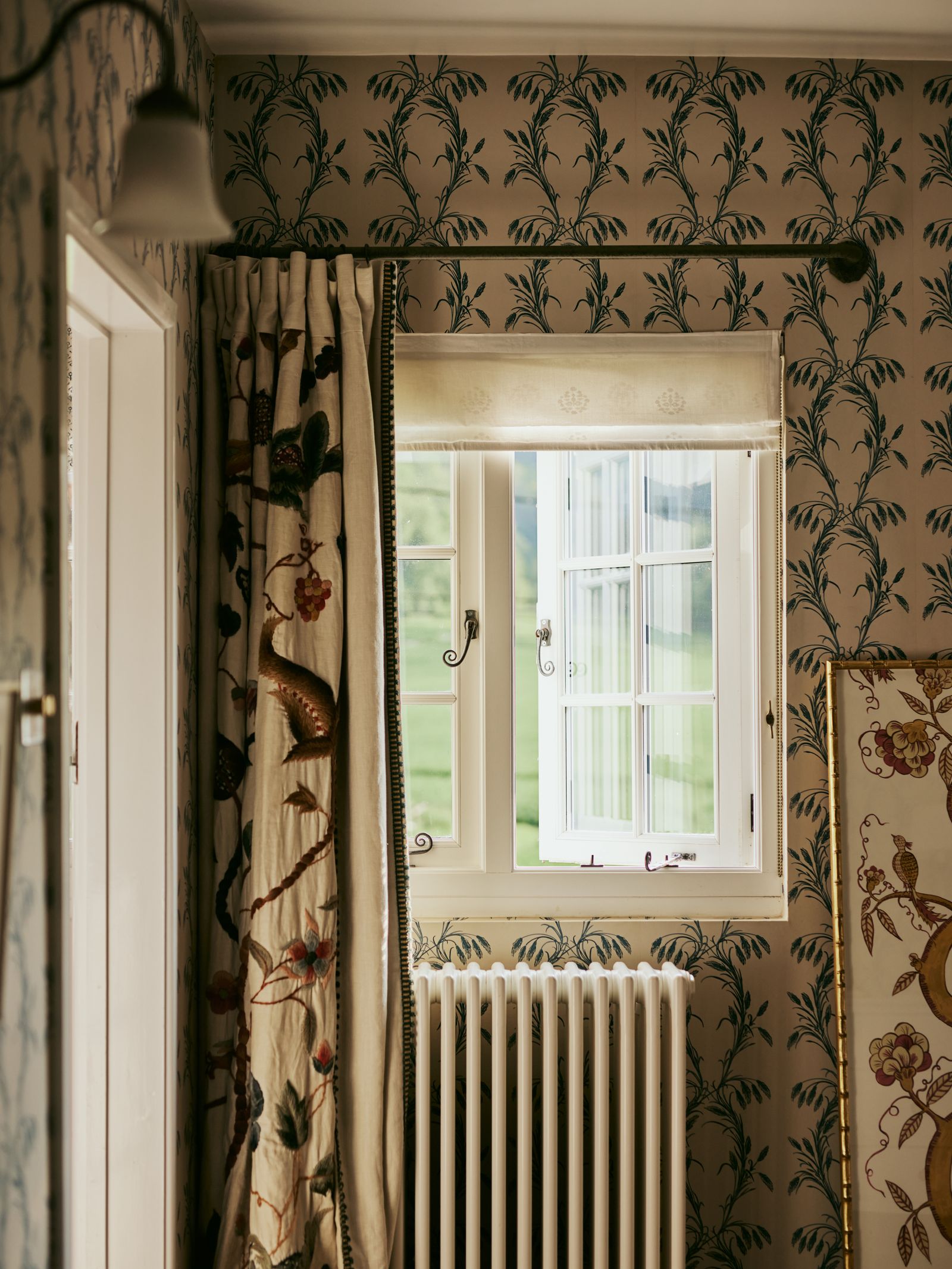
The same idea of crewelwork acting as a cornerstone is applicable to a 16th-century home in Wiltshire, which was Robert Kime’s first decoration project and was (very sympathetically) updated by the studio’s current managing director Orlando Atty. Here, crewelwork acts as a cornerstone for patterns and motifs. In addition to colour palette, it’s the sense of organic movement that allows for other patterns and fabrics of different styles and cultures to be perceived as crewel-like. For example, the use of Robert Kime’s own fabrics ‘Tashkent’ (a suzani-like print) and ‘Indian Pear’ (a paisley pattern inspired by a Kashmiri shawl) seem to speak the same language as crewelwork with their organic shapes and colour schemes. “The reason that all of these vernacular textiles work together is that they use natural dyes, which is a universal concept; in nature, colours don’t clash,” says Alexandra Tolstoy, whose homes are a patchwork of multicultural vernacular pieces. “Like folklore, folk embroidery has a sense of universal familiarity with similar underlying zeitgeists,” she continues. “Whether it’s a Swedish painted chest or a piece of embroidery from Uzbekistan, folk craftsmanship is like a global language.”
It's no wonder why crewelwork has continued to appear in our homes for centuries. With its ability to unify colours, eras, themes, and cultures, it’s undoubtedly a gentle-but-mighty design asset with a rich history and timeless longevity.


