

As someone immersed in the world of beautiful interiors, I can tell you there are few tasks as enjoyable as sitting down and writing about my three favourite kitchens. At least, that’s what I thought until I sat down and tried to establish which they were. I had instant flashbacks to when I was planning my own kitchen: bamboozled by options, stumped by deciding the optimal utility:beauty ratio, figuring out where to spend and where to save. Still, there are a handful of spaces that we’ve featured over the years and that have stayed with me: kitchens that continue to delight not only because they’re good-looking, but because they’re clever, considered and rich in character. The three I've chosen each express a very different approach: one leans towards country-house romance, another is densely patterned and intimate, and the third is unapologetically grand. But all share an intelligent use of colour, a strong sense of personality, and a deep understanding of how people really live. They’re kitchens with soul, and in each case, there’s something that makes me think: yes, this is how it should be done. And guess what? Not one of these kitchens looks like what I ended up with myself. Perhaps this is an exercise I should have done all those years ago…
Martin Brudnizki’s Sussex kitchen
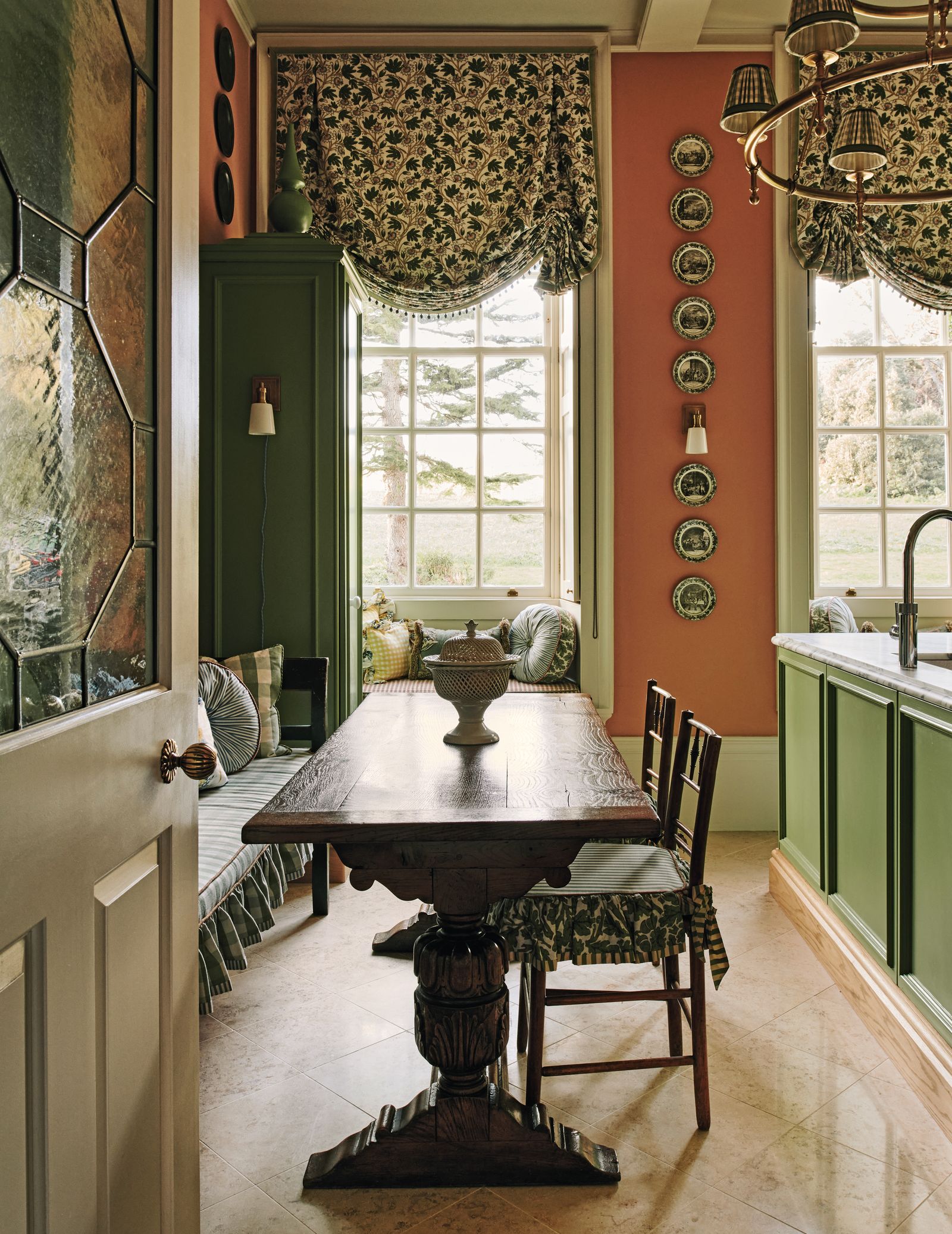
This wonderful kitchen in Martin Brudnizki’s 17th-century Sussex flat (top) feels both theatrical and deeply comfortable. The cabinetry—designed by Martin and made by Orior Furniture—is painted in a rich “Invisible Green,” a shade that balances the bold warmth of the “Dutch Orange” walls (an Edward Bulmer paint) to wonderfully dramatic effect. The Arabescato marble—used on the worktops and splashback—adds a cool but timeless counterpoint, while the tall, finial-topped cabinets emphasise the room’s lofty ceilings. They also conceal the less glamorous parts of kitchen life. But what makes this kitchen sing is its layering: the patterned chintz and gingham on the window seat, the pewter and porcelain plates on the wall, and the carefully curated lighting speak to a master’s touch. It’s joyful, yes, but not overwhelming.

A smart London kitchen by Carlos Garcia

In contrast, the compact kitchen in this South London flat by Carlos Garcia is a study in charm, balance, and smart planning. Here, the cabinetry—painted in Fenwick & Tilbrook’s gentle “Chanterelle”—provides warmth and cohesion, while Morris & Co’s intricate ‘Blackthorn’ wallpaper wraps the space in a cocoon of pattern that feels traditional and yet still invigorating. A curtain of Ian Mankin’s blue-and-white ‘Suffolk Check’ conceals modern appliances with a nod to old-fashioned sculleries, and original William Morris rush chairs add substance and story to the room.

Delft-style tiles by Douglas Watson Studio bring in a splash of graphic detail, and the window—dressed in Aleta’s ‘Iridee’ voile—lets in the light without sacrificing softness. There’s wit here, but also discipline: appliances are neatly tucked away, storage is cleverly hidden, and every decision feels grounded in both practicality and pleasure. It’s a kitchen that shows you don’t need grand dimensions to make a big impression.
The ‘Brasserie’ kitchen at Wolterton Hall
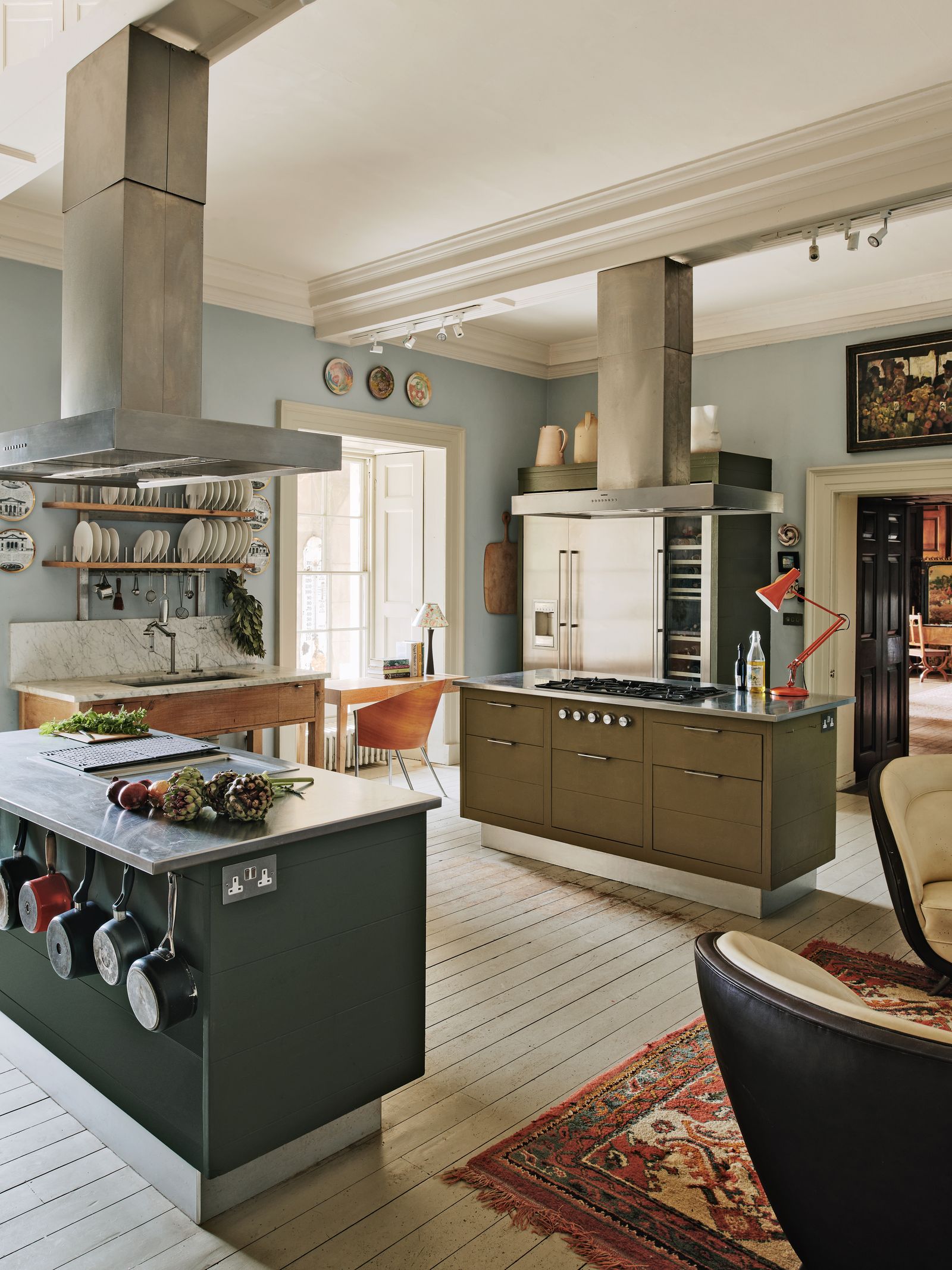
Wolterton Hall’s kitchen, designed by former owner Peter Sheppard with Smallbone, is a perfect example of how contemporary design can sit confidently and comfortably within a grand historic interior. Set within an 18th-century house, the proportions are generous, and the kitchen makes full use of them: the room is anchored by two kitchen islands—one olive, one deep green—with brushed steel tops and robust extractor hoods above, each offering acres of workspace and storage. It’s unapologetically modern in layout, yet deeply sympathetic in palette and material.
Vintage rugs, painted floorboards and decorative china soften the industrial notes, while an antique worktable and open shelves lend a sense of informality that tempers the scale. What impresses me most is the clarity of the design—each element has purpose and weight—but also the restraint. It doesn’t overstate its modernity, nor does it pander to period pastiche. It simply works, with grace, power and poise.


.png)


