


While anyone familiar with Spandau Ballet’s œuvre will know that gold is theoretically ‘indestructible’, when it comes to interiors, it would be fair to say that it’s taken rather a beating in recent decades. Associated with the abandoned palaces of usurped dictators, and Donald Trump’s much mocked Sun King-inspired New York penthouse, even the super wealthy have rejected its gleam. The preference has instead been for what HBO series Succession’s production designer, Stephen Carter, memorably described as “a bleached monotone of wealth,” giving us – or rather, them – predictable symphonies of cream, beige and marble, punctuated by suede-lined walk-in wardrobes and stainless steel chefs’ kitchens. The trickle-down effect, and fear of being thought tacky, has mostly kept the colour from our rooms, too (gilt picture frames and seasonal decorating aside) and yet, “a touch of gold instantly warms a palette,” says Sarah Vanrenen – a statement to which Juliette Byrne adds “and brings glamour.”

Proving their points are the occasional interiors that have embraced gold’s beguiling glint. Among them is the almost incomparably elegant Art Deco bathroom at Eltham Palace, with its gold tiled feature wall (it’s open to the public, you can go and see it) – and, demonstrating that gold works in more modestly scaled abodes, too, the sitting room at The Red House in Aldeburgh, former home of Benjamin Britten and Peter Pears, where gold-flecked cork walls come aglow in the afternoon sun (it re-opens in March). Then there’s Chatsworth House, which, beacon-like, beckons the visitor across the North Derbyshire moorland, glittering in the light thanks to the gilded window frames. Bridie Hall has done the same in her Georgian terraced townhouse in Islington; “in the winter, it’s like having candles lit,” she says. Finally, thanks to Ridley Scott, there’s Napoleon’s presence on the big screen. Who wasn’t distracted from the Siege of Toulon by wondering what the ornamental passementerie on his uniform might look like on a sofa? And who hasn’t, since watching the film, poured over images of his actual apartment in the Chateau de Fontainebleau, which he had completely redecorated ready for a papal visit in 1804? Gold, I think we can all firmly conclude, can be done exquisitely – and is no longer just for Christmas.

But before we can fully espouse its shimmer, it’s worth a brief look back – not least to find out what went wrong. What became known as Empire style arose from Napoleon’s eagerness to restore the lustre of the ancien régime, and an ostentatiousness richness reminiscent of Louis XIV. His architects Charles Percier and Pierre François Léonard Fontaine took inspiration from ancient Greek and Rome, while furniture of the time made heavy use of ebony and ormolu (gilded bronze). The style was mirrored throughout Europe – here in England it was known as Regency – and it survived a surprisingly long time. But it was that enduring popularity that led to its eventual Waterloo: as Edith Wharton identified in The Decoration of Houses in 1897, “the substitution of machine for hand-work has made possible the unlimited reproduction of works of art, and the resulting demand for cheap knick-knacks has given employment to a multitude of untrained designers . . . the deterioration in gilding is one of the most striking examples of the modern disregard of quality and execution.” There was, she recounts, “a plague of liquid gilding,” its excessive use leading to inevitable “vulgarisation” (as reflected in the plotlines of another HBO series, The Gilded Age.)

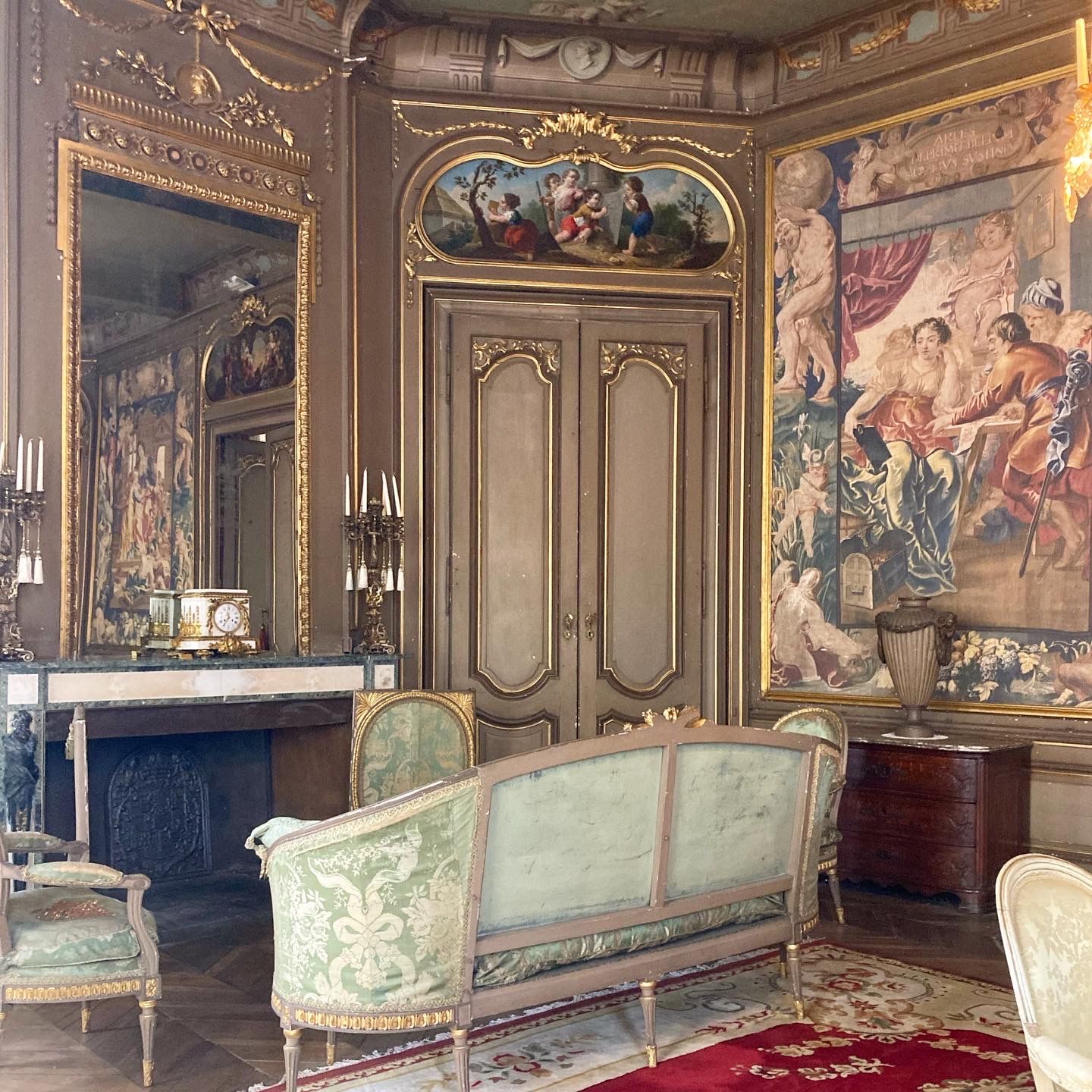
Skipping forward a century or so, contemporary designers tend to agree on the ‘less is more’ front, “race past the taste police and you’ll acquire a speeding fine very quickly,” observes Sarah Vanrenen, who uses gold as another element with her considered approach of layering different textures. And, says Lucy Mayers of Sibyl Colefax & John Fowler, “sometimes just the smallest sliver is all you need to add that important bit of sophistication.” In other words, it’s less about emulating the all-gold of late 19th-century rooms of the Palazzo Reale in Turin (which is arguably where Trump, Ceaușescu, et al went wrong) and more about the details you find in the more provincial palaces of Europe, such as the Hotel d’Hane Steenhuyse in Ghent (from where Louis XIII of France ruled from exile for a while, post-Napoleon’s eventual defeat.) Juliette Byrne explains that “historically, gold leaf was applied to certain areas, such as decorative plaster cornices and ceiling roses, timber panelling and dado rails, and that would create a sense of grandeur.” (It’s what inspired my gilding of the internal doors in my in progress Victorian terrace – which hasn’t necessarily been an unmitigated success. There’s less a sense of grandeur than a sense of living inside a box of Charbonnel et Walker Pink Champagne Truffles, but that’s doubtlessly down to the implementation – and either way, I do love it.)

Also worth looking at are some of the papers and fabrics used on the walls of those 19th century-decorated palaces, which might be delicately adorned with gold leaf and other metallic foils, and in which there are further transferrable lessons. “I used a beautiful gold and bamboo wallpaper in a very small box room. The way the light bounced off the gold helped grow the room, and the warmth of it was rather comforting,” says Lucy Mayers, who recounts also having used “a fabulous gold porcelain tile as the backsplash in a kitchen; having a reflective surface in a dark space is a very effective way of adding glamour and also helping to make the space feel larger – I think gold can be particularly obliging in smaller spaces. I’m also a big fan of a gold ceiling, although you have to be careful as in too light a room, this can make a ceiling look black.” Then there are the accessories; says Sarah “I particularly love using gold in lighting – the brushed gold lampshades on either side of the fireplace in my sitting room in London cast the most beautiful light, and were the inspiration behind my own collection of malachite and tortoiseshell lampshades that are lined with reflective gold, and I’ll chose gold for mirrors, sconces, and even curtain poles in rooms that need to feel more luxurious, such as bathrooms.” And Tiffany Duggan, founder of Studio Duggan mentions the “metallic sparkle” brought by one of Jess Wheeler’s garland candelabra.
That Jess’s designs are crafted from brass – and that the tiles, paper, curtain poles and lamp linings mentioned don’t use actual gold either – brings us on to the final point, and one that is particularly pertinent; this time round there’s a (dare we say revolutionary?) egalitarianism that sees bronze, brass and yellow-toned alloys employed as readily as the real thing. “The metallic finishes available now are limitless and can be used on metals, joinery, fabrics and furniture,” says Juliette, who also advocates for mixing brushed with polished, light with dark; “it adds interest to the room.” It’s been suggested that it was Napoleon who in fact kickstarted the latest round of dictator chic, when he declared that “men are only as great as the monuments they leave behind.” Regarding gold, perhaps this iteration’s emancipation from weighted worth will prevent it being re-consumed into powerplay and politics – leaving all that glitters to us.


