


Have you ever considered turning your kitchen table into a decorative palanquin? The word has rather evaporated from common use, but it refers to a small structure formerly used in East Asia – and a 1956 article in this magazine detailed how to effect the transformation “for Christmas”, using crêpe paper, feather mops, Scotch tape, a hammer and nails, and . . . “magic.” Suffice to say, when I tried to recreate it one year (the illustration is charmingly appealing), it was hardly an unmitigated success. I put it down to the complexity of construction, and the fact that – unlike Joseph in the Christmas story – I am not a carpenter.
Happily, among the House & Garden Top 100 and other industry insiders, there are more achievable ideas for decorating for Christmas. Though notably, there’s no consensus – even between colleagues. While Roger Jones, Director and head of the Antiques Department at Sibyl Colefax & John Fowler says his rule is to “keep it simple!”, Emma Burns, Joint Managing Director at the same firm, reckons “it’s a time for a mass of decorations!” Elaborating, she puts forward her view that “5 Hertford Street get it just right with their swags of baubles and sparkling stalagmites in red and gold.” What this means is that there is a corresponding mass of ideas which we can treat as a pic’n’mix buffet, according to our taste for tinsel or preference for an au naturel pomegranate-studded centrepiece.

So select your soundtrack of choice (for Emma, that’s Michael Bublé and The Pogues on repeat, Nicky Haslam recommends the American jazz singer Lee Wiley, who rose to fame in the 1930s, saying “if you haven’t heard of her, go and google her immediately. It was extraordinary how enchanting she was”) and get going – while keeping in mind a few words of advice that are universal to every aspect of the exercise.
Let’s give first airing to our Style Director, Ruth Sleightholme, who describes aiming for an atmosphere that gives a sense of warmth and light, and points out that certain textures will help, “a satin ribbon, a lustreware jug – and glass.” Carlos Garcia advises “concentrating on the main rooms, the entrance hall, dining and drawing room.” Then, “repetition is the key to simplicity and is always stylish,” says Philip Hooper, joint Managing Director of Sibyl Colefax & John Fowler. “A colour scheme will not only focus your mind but will create an elegantly considered look,” advise Lucinda Chambers and Serena Hood of Collagerie. Finally, “the best look is like you let off a giant party popper! ‘Tis the season to be jolly not perfectly coordinated,” declares Benedict Foley – reinforcing the disparity in approach, and the importance of what is arguably one of the most important ingredients: joy.
Foliage, fruits (and the genius of faux)
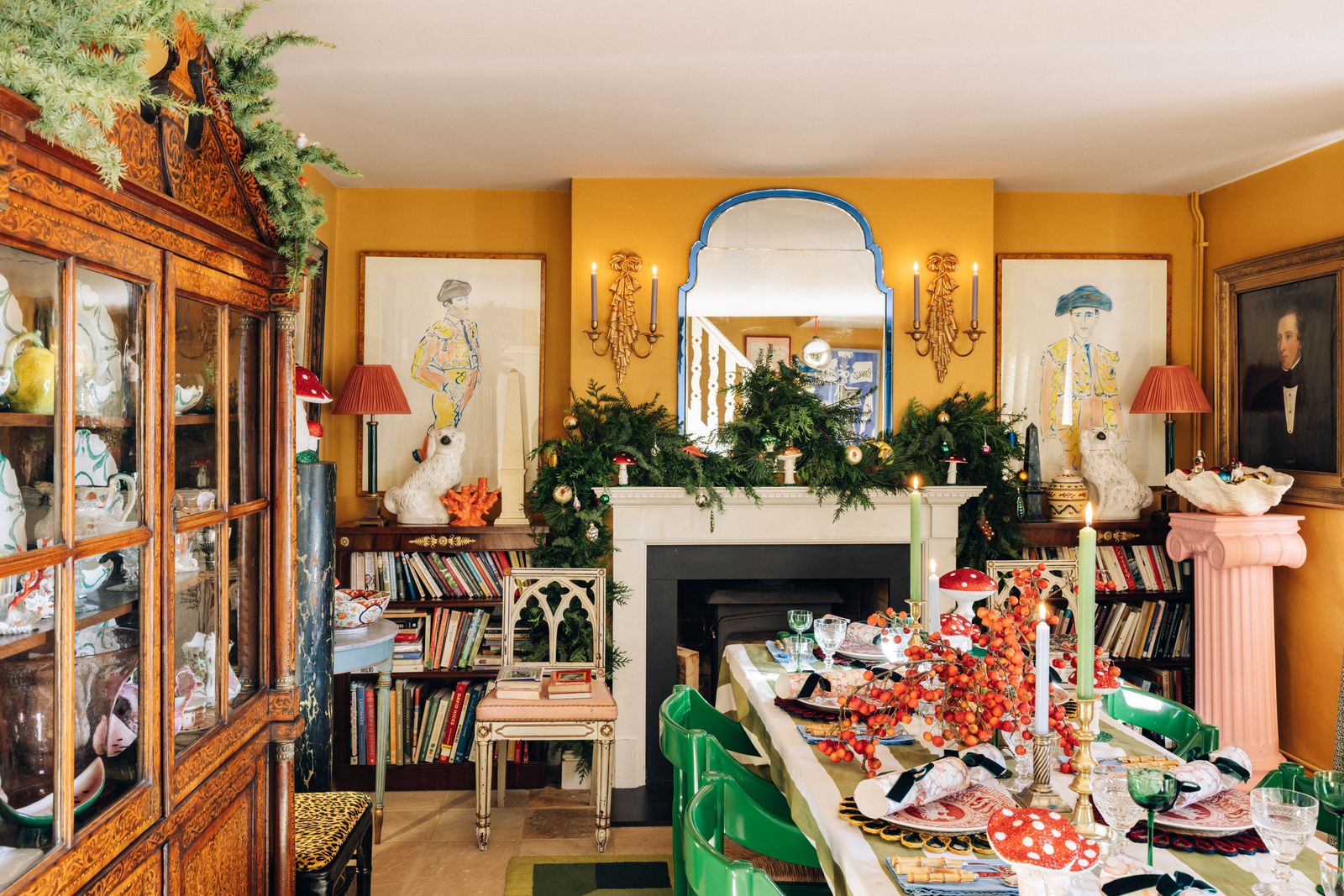
Once upon a time, Christmas decorating was straightforward: there was greenery to represent the continuity of life during the dark days of winter, and candles to represent the light of Christ - and hope, joy and peace. For many, this is where they start: “we treat Christmas like a harvest festival and bring all the natural beauty inside,” says Edward Bulmer – mentioning dried alliums and hydrangeas which add another layer of texture to arrangements, and pointing out that collecting trailing ivy from the outsides of buildings does a service for those buildings. Nicky Haslam finds ivy and holly in his garden, or in the lanes around his house, and combines it with “dead oak, that russet oak that has still go leaves on it,” positioning it “anywhere it’s going to improve the general look of things.” Martin Brudnizki goes in for “swags up bannisters, and a statement display on the mantelpiece.” Roger Jones – still claiming simplicity – says “a front door wreath, a bunch of ivy hanging inside the front door, and a couple of baskets of paperwhite narcissus.” Octavia Dickinson echoes Roger on the baskets of bulbs, adding hyacinths and cyclamen to the mix, and scattering them “all around the house.” Tiffany Duggan of Studio Duggan likes “a mix of eucalyptus, rosemary, and mint – for the scent.”
Edward employs generous bowls of fruit to bring in extra colour – also a favourite strategy of Tamsin Saunders of Home & Found, who advises putting “the expensive clementines with leaves attached on the top –e make sure your children eat from the bottom. And I like pomegranates on a plate, quinces, medlars, lychees and mulberries – especially when the bowl they’re in is lustreware.” Philip Hooper suggests “baskets or wooden bowls of large pinecones that evoke the spirit of winter, similarly a mass of clove-pierced oranges gives you the smell of a festive season.”
A warning from Edward, concerning foliage and fruit, and specifically holly-placing when it comes to artwork as “the berries can get stuck between the stretcher and the canvas” (though he also explains that, when gathering, he tries to leave the holly berries for the birds.) Octavia has an answer: “I have a large collection of faux berries, which I carefully insert into the ivy, holly and other real foliage which I drape over my mantelpiece and up the stair bannisters, and use to adorn the chandelier over the dining table. Thus no squished berries on the floor, or dropping unnoticed into a glass of red wine.”
A further note on faux, apropos the swags and garlands: there are some very good reproductions out there. Octavia’s sister, the artist Phoebe Dickinson whose Gloucestershire house featured in the December issue of House & Garden, found hers on Amazon. And “I’m not a snob about fake decorations. I think you should be able to use the same things year after year,” says Amanda Brooks of Cutter Brooks, while Melissa Hutley and Charlie Humm of Hutley & Humm point out that using “some faux foliage lets you get the structure in place at the beginning of December – you can add natural foliage closer to Christmas Day.”
Candles and fairylights

Not only are candles symbolic, but they’re atmospheric – and decidedly flattering. Martin Brudnizki likes an array “of all kinds and heights” while others like theirs scented. Nicky Haslam favours Bamford’s Lily of the Valley variety, and Octavia Dickinson “The White Company’s Winter, Ralph Lauren’s Holiday and Jo Malone’s Pomegranate Noir.” Nicky mixes his in with “masses of normal candles, some real, some fake. I buy the fakes online, and I put them in the garden as well – they don’t blow out because they’re fake – so that the outside looks special too. The aim is to make it rather mystical.” Fairylights do a similar job – and Ruth Sleightholme has put together some handy rules of use.
The tree
Christmas trees became popular in this country in the 19th century and are now almost ubiquitous – but know that they are far from compulsory, especially if your house is small and you’re going to be entertaining lots of people. Nicky Haslam doesn’t have one in his house in the Cotswolds as “there isn’t space,” he says.
But a tree “creates a little bit of magic,” moots Edward Bulmer. If you are going to have one, then go “as tall as possible,” ordains Roger Jones – or, says Philip Hooper, “get the best and densest spruce you can and enjoy it as nature intended.” (i.e. once installed, your decorating job is done.) Francis Sultana, on the other hand, doesn’t see size as important; he uses props to play with the height (for instance, employing a Fredrikson Stallard side table as a plinth), and “I love to hang things on the tree that have meaning to me – after all Christmas is a time of happy sentiments” he says. Henriette von Stockhausen bakes gingerbread with her children, which she hangs on her tree, adding ribbons, little red apples, and angel hair lametta “which is so fine you can hardly see it, but it glints.” Henriette also uses real candles for decoration, as does Martin Brudnizki - who reminds us that “this does require your being in the room at all times.”
Nativity scenes, paper decorations, ribbons, tinsel and family tradition

“I always have a Nativity scene,” says Francis Sultana. “Like most Mediterranean boys, it’s part of my upbringing and that’s key; one’s childhood traditions should be continued and treasured.” Similarly, Daniel Slowik explains “part of my family were originally Polish, so I like paper decorations and colour.” Regarding paper decorations, Edward Bulmer points out that they’re an ideal vehicle for the contents of leftover Edward Bulmer Natural Paint sample pots. And Benedict Foley bigs up tinsel “I love it! Thick ropes of it or skinny bottle brush type – bring it on!”
Then there are ribbons, which, advises Martin Brudnizki, are one of the easiest, quickest and most time-efficient means of decorating; “I adorn everything – candles, ceramic dogs, bon bon dishes, ornaments – with thin red ribbons.” Cathy Nordstrom agrees: “ribbons and bows in abundance! I have them in the tree, tied around candlestick holders, around napkins . . . everywhere. Just purchase velvet ribbon 2-5cm wide in a bunch of different colours and have fun with it,” she says (and reveals that she loves ribbons so much she’s even had one tattooed on her.) Octavia Dickinson is another fan: “I follow the rule that more is more – so the tree, over doors, around planters; anywhere that can be bowed gets bowed.”
The table
Nina Campbell believes in “every room having a centrepiece of some description to create a focal point for the rest of the Christmas decorating,” – and then explains that when it comes to the dining room, she likes two statement centrepieces, “one over the fireplace, and one at the heart of the dining table.” Matthew Bourne, co-founder of Christopher Farr, changes the backdrop to family meals, too, via his collection of antique textiles, “from fragments to full rugs. There is never enough wall space, and the Christmas holiday is an opportunity to rifle through my archive and bring out a few favourites that I haven’t seen for some time.”

As for setting the table for festive dinner parties, Nina recommends “a white tablecloth that can be dressed gold,” and for Christmas day itself recounts that she adores “a tablecloth created from vintage saris in deep burgundy, white china, polished silver, and a mix of red Murano wine glasses and amethyst water glasses.” Tiffany Duggan is similarly keen on Murano glassware, which she pairs with “a beautiful linen tablecloth – I love the ones by Cutter Brooks or Summerhill & Bishop, layered with linen napkins tied with velvet ribbon bows in deep aubergines, chartreuse and berry shades.” Sometimes, instead of the velvet ribbon she uses “leftover fabric scraps from projects, cut into thin strips.” Her centrepiece is one of Jess Wheeler’s garland candelabra “filled with tall, tapered beeswax candles” or “Salvesen Graham candleholders and shades.” And she professes to be “a big fan of handwritten name cards, or little bottles of Lockdown Liquor with personalised names for adults, and fortune cookies for kids.” (Incidentally that 1956 House & Garden article – besides the palanquin – suggested writing placenames on ivy leaves, using white ink, which looks very chic.)
Emma Burns swags tables with “metres of Ian Mankin’s red and white ticking” and builds “mini banks of moss with paperwhites and hyacinths” down the centre, before scattering chocolate coins, clementines, and walnuts that she’s sprayed gold, which both looks lovely, and is (mostly) edible. That takes us to the final point – the food itself, which some see as still falling under (or at least edging into) the category of decoration. “A mince pie and a glass of sherry for the cook are vital, as is the cook!” Exclaims Daniel Slowik. Happy Christmas, one and all.


