
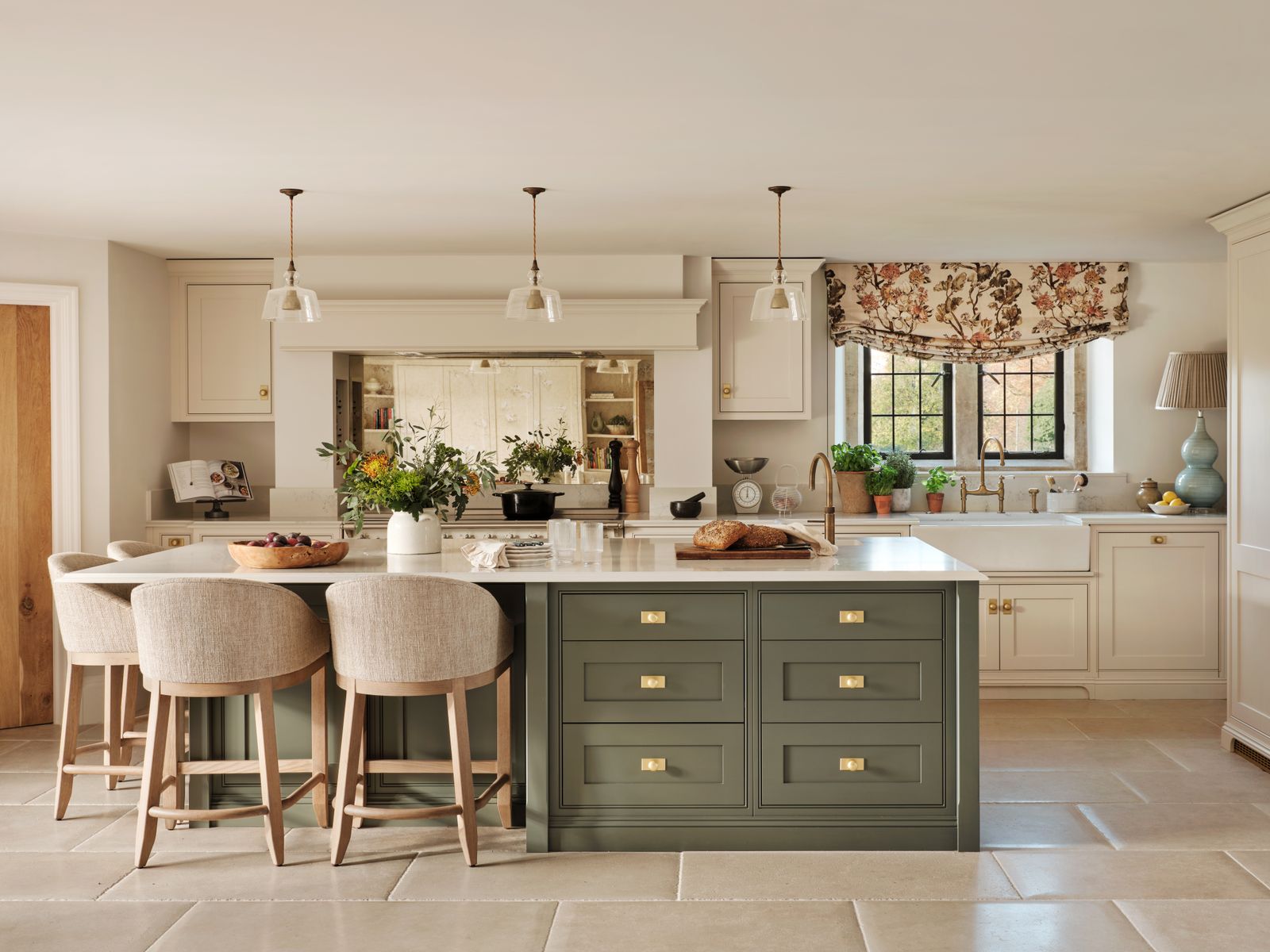
This airy kitchen is the result of two farm workers’ cottages knocked together and turned into one extensive, bright and liveable space. Designers HollandGreen were asked by the owners – a young family of four who became five over the course of the project – to create the family’s “forever home” after they relocated from London. The house had already been fashioned into one unified building when the clients bought it, though the kitchen itself was still split and the two parts only joined by a dark corridor at the back of the house. And in fact, the kitchen is actually really a kitchen, dining and living room rolled into one, with subtle distinctions and gradations which guide the eye and help one discern the character of each section. Although the house had been relatively recently redesigned, it wasn’t to the clients’ taste.

Once they had knocked the kitchen through and unified the room, HollandGreen put in significant structural support, including two steel beams, one of which is visible jutting down a couple of inches in the ceiling between the island and dining table. This rejig took about 100mm off the height of the room, but the change was insignificant, and custom joinery was created by Langstaff for the cabinets to fit the resulting space. Where the kitchen island now stands there had been a structural support, but HollandGreen managed to remove this so as to avoid having anything blocking the most liveable and day-to-day part of the kitchen. That island, custom-built for the house, has four bespoke chairs around it akin to a breakfast bar to deliberately offer a more casual area to sit and eat, particularly for when the family is alone.

Designer Charmaine White of HollandGreen put in a window seat to one side of the kitchen area, as well as incorporating discreet under-seat storage. Like the island, it was intended as a laidback and easy place for guests or family members to sit and chat while the clients are cooking or hosting. The flooring in the room was originally not dissimilar to what’s in place now, with limestone likewise in situ, but it was much yellower, and didn’t suit the clients’ taste. Charmaine and her team replaced it with a creamier and lighter equivalent akin to the Cotswold stone of the outside of the house. The stone floor now runs all the way through from the front door to the back of the house and into the rooms beyond the kitchen.
French doors which now open onto the central courtyard of the house replaced the windows which were there before; HollandGreen swapped these to allow for the option of opening them in the summer months. Similar doors on the other sides of the courtyard allow members of the family to move from the kitchen through the yard to the family room at the front or the formal sitting room on the other side of the house.

Before the renovation, the kitchen had been painted a dark blue teal, which was replaced on the walls and joinery by William Morris’s “Fired Biscuit”, a warm and unobtrusive white – other than on the island, which was distinguished in a green-grey COAT Paints’ shade called “The Coal Drop”. The joinery itself is extensive and provides subtle storage space for, among other things, a bar, a TV and a larder and microwave cupboard. The dining table in the very centre of the room was custom-made and finished by HollandGreen, and can be extended to seat 14 people rather than its normal ten.
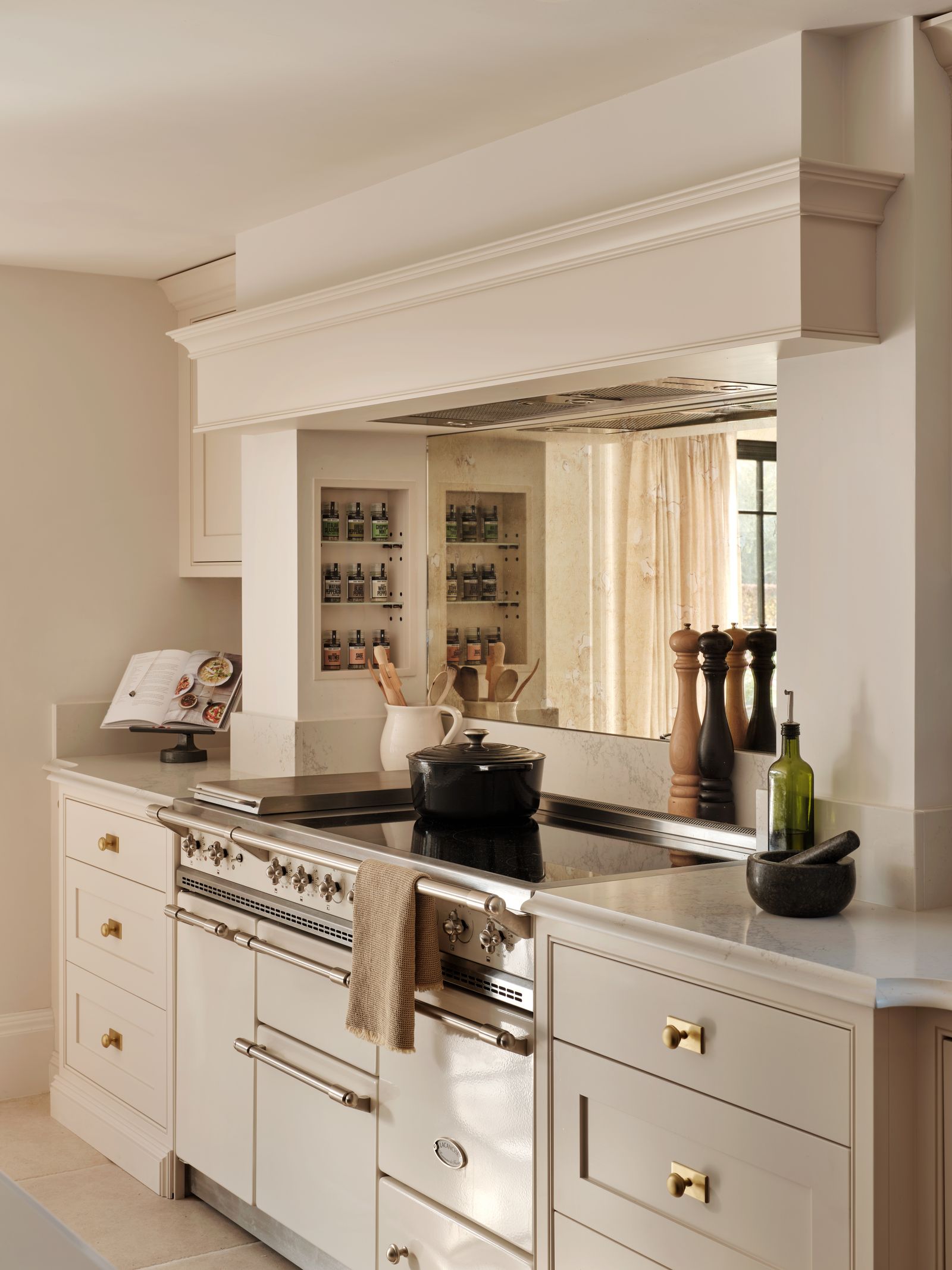
Behind the kitchen island, a built-in “dresser” which has been tweaked to house the hob and range offers even more storage space. A sink which would normally sit in the centre of the wall is instead off to the right, under the window, making space for that hob and oven. Over the window hangs a curtain in one of the rare patterned fabrics in the room, in this case a GP&J Baker/Mulberry design called “Oriental Bird”, which Charmaine had intended to be part of the room’s interiors from the get-go of the project.
Throughout the kitchen, the clients wanted a sense of lightness and warmth, and diaphanous, simple voile curtains meant there was an element of privacy without sacrificing the beautiful light that filters into the room throughout the day. The resulting room, which combines warm tones and room to sprawl and for the young family to live, will suit them for the coming decades.


