


There are certain houses that become more than the sum of their parts, entering popular imagination as near mythical places. Several of them are, in fact, fictional – Manderley, Brideshead (though that is thought to have been based partly on Madresfield Court, and partly on Plas Newydd in Wales) – but others are completely real, their elevation to this pantheon due to their architectural splendour, the beauty of their interiors, the status of the occupier, and, often, an element of romance that binds all three. Into this category fall palaces, grand country houses such as Chatsworth, and – more modestly, though no less importantly - John Fowler’s Hunting Lodge. Extraordinarily – for John died in 1977 – pieces of furniture from those exquisite rooms are being shown in the Sibyl Colefax & John Fowler showroom from today, and offered for sale, carrying within them some of John’s story, as well as that of Imogen Taylor, his longest serving assistant, and another remarkable name in the history of interior design.


John is well known to all who are interested in interiors, for he was the most influential decorator of his generation, and founder of the famously elegant firm that still bears his name. With his partner Nancy Lancaster, who bought out Sibyl Colefax’s share, his work came to define “a certain English look,” explains Roger Jones, Decorator and Head of the Antiques Department at Sibyl Colefax & John Fowler. Essentially, John and Nancy invented English Country House Style, which endures to this day – meaning it’s easy to forget “that John was an innovator, which very few people really are,” recounts Imogen. “It was a very interesting time after the war,” she continues. “All the grand houses of England had to be refurbished after they’d been used as hospitals and schools, and a new look given to them, for a new way of living.” John got rid of heavy velvets and damasks in favour of cotton chintzes, replaced heavy brown mahogany with Regency furnishings, and developed the concept of ‘humble elegance’ while ever repurposing, reworking and renewing. With one eye firmly fixed on Regency style, he made elaborate window dressings from the simplest fabrics, and, though clever use of paint, created architectural interest in the plainest of rooms.

It was in that post-war period that John came across the Hunting Lodge, near Odiham in Hampshire. Built in 1740 as a folly in the Gothick style with three Dutch gables surmounted by urns, it had reached a standard of wreck that sounds horribly daunting; chickens had been kept on the ground floor, the garden was littered with gin bottles, there was no road to the house, no sewerage, and no electricity. But John managed - and then set out to do “what I do for other people, only on a diminutive scale.” To look back at his schemes for the rooms, at the subtle colours - “which were never solid, they were always glazed, and always had a touch of black in them so they were not bright,” says Imogen – and the pieces of antique furniture – “he would have picked them up very cheaply, no one was interested in that type of thing then” – is to examine a moment of decorating perfection.

John was a consummate host and had people to stay at the Hunting Lodge almost every weekend. “It was quite an event,” remembers Imogen. “We’d be taken down by car on a Friday – he hired one every weekend – and it was always very exciting. There’d be a group of us, there were two single bedrooms and a double bedroom; one of the single bedrooms was quite awkward because you had to go through the double bedroom to get to the bathroom, but we all knew each other very well. It was always very comfortable and warm – in the winter a lovely log fire would be lit in the sitting room and we’d all gather around it – and a lady from the village, Mrs. Keogh, would be brought over by taxi to cook the food. She produced wonderful meals and would be laced with whisky to help her along. Michael and Rachel Redgrave had the cottage next door,” continues Imogen, “and they’d have guests too – so we began to meet the actors and actresses of the period, Peggy Ashcroft, and Vivien Leigh. The Redgrave children [including Vanessa Redgrave] were still growing up, they weren’t famous yet. In the summer we would sometimes swim in the lake, or go out on it in the boat, and there was lots of walking and talking. The gardening team would arrive on Saturday – we saw the garden grow up – and of course we saw the Garden Room go up, which we all loved. It was a bigger room than any in the Hunting Lodge, and we’d go down there for drinks in the evening, and then come back for dinner.”

Imogen became a salaried partner at Sibyl Colefax & John Fowler in 1966, aged 40. “She’d absorbed and learnt from John, and that is detectable in her work,” says Roger. “But she also had an enormous amount of her own talent and was inventive and accomplished.” It was Imogen who really took Sibyl Colefax & John Fowler to America, the first female British interior decorator to work across the whole country, for John had famously refused to go. (“He didn’t like the idea of travelling,” explains Imogen, “but he had American clients. We’d decorate by post without ever having seen the Mellons’ apartment in New York.” “Bunny Mellon sent over a team of decorators to learn how to apply paint and colour like John,” recounts Roger.) Ten years later, so aged 50, “I bought my first flat in Redcliffe Square,” says Imogen, adding - in words that will soothe the soul of any thirty or forty-something renter - “it took me until then to save up enough money to put down a mortgage.”
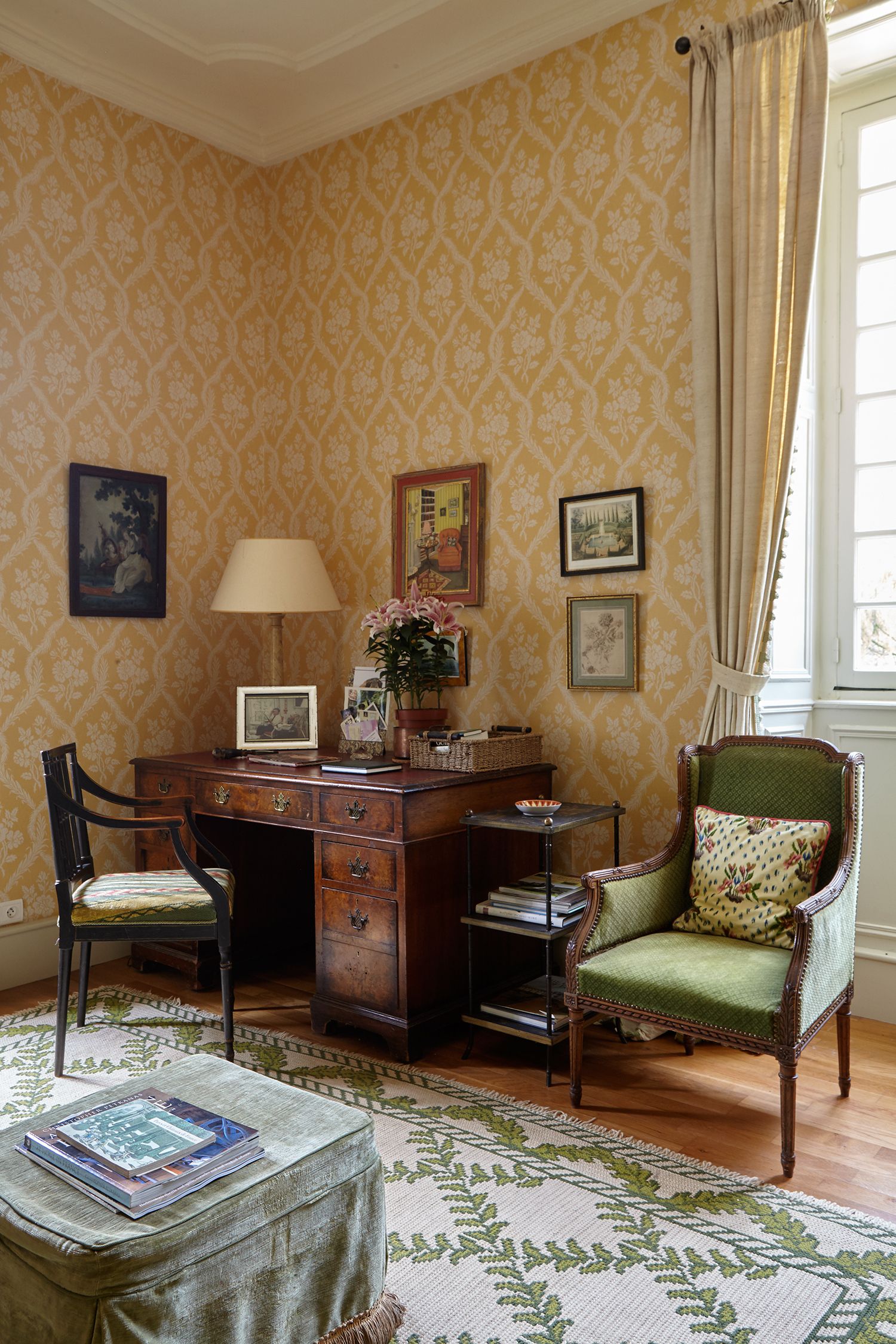
“John came to see the flat,” continues Imogen. “And realised it was jolly empty. He must have thought well, I’ll leave Imo some furniture. He was almost 70 and thinking about death and wrote a wish-list of who would get what, and I got a jolly big lump because of that empty flat, which was thrilling.” The furniture lived with her there, and then in another London flat before, aged 76, she bought a house in a village in Burgundy, where “everything John had given me fitted in terribly well because it was an eclectic mix of European furniture.” A late 18th century commode with ball and claw feet, which Roger identifies as one of the most valuable pieces in the collection, found its place in Imogen’s drawing room, while the little desk that John had at the bottom of the stairs in the Hunting Lodge was in her bedroom. And Imogen, like John, would have people to stay – often her former colleagues, who learnt, from her, “the 18th century essentials: colour, scale, the importance of craftsmanship,” details Fiona Shelburne.


Now in her 90s, Imogen has sold that Burgundy house, hence this sale. The Hunting Lodge, which John left to the National Trust, is on its second long-term tenant, Francis Sultana. (Nicky Haslam, who added layers of his own possessions and stories, bid adieu to it in 2019.) Fittingly, Roger confirms that Francis has chosen some pieces of furniture to take back to the Hunting Lodge, picking up a thread that seems less linear than spiral, reflecting the whole plus ça change, plus c’est le même chose of interior design – and indeed life (Roger is currently working with Middle Eastern clients whose house Imogen first decorated in the 1990s.) But there are still other pieces of furniture, china, and even a set of prints, which - if you’re quick - would make a gloriously Proustian addition to any well-considered room, whispering of beauty, elegance, and joy.
The John Fowler and Imogen Taylor Collection – A Selling Exhibition – will be at Sibyl Colefax & John Fowler, 89-91 Pimlico Road, until 22nd December. Visit sibylcolefaxxc.com for more information.


