

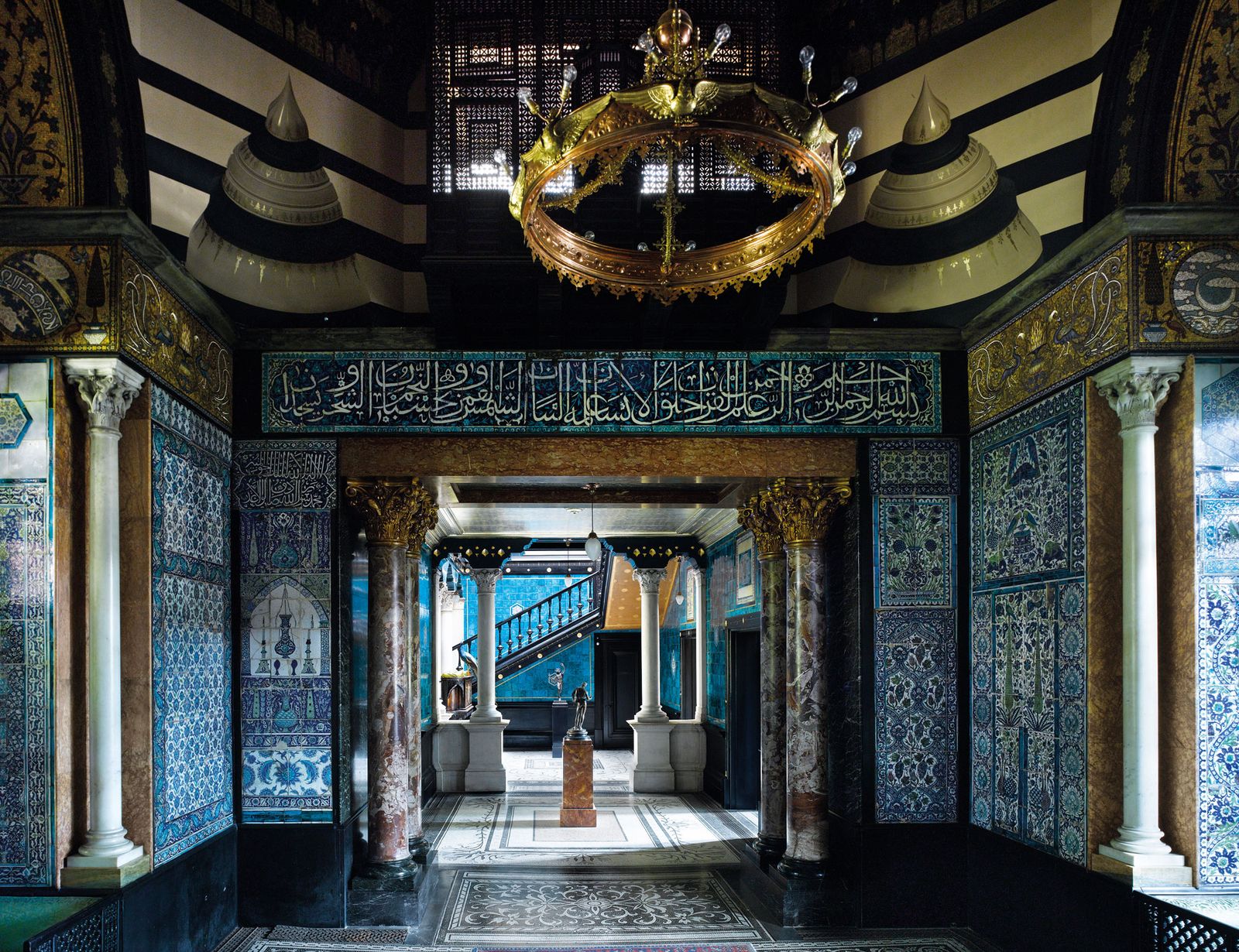
On a back street in Kensington, hidden behind a fairly unassuming red-brick façade, is one of the most beautiful rooms in Britain; specifically, the Victorian-era artist Lord Frederic Leighton’s Arab Hall. A collaboration between Leighton, his architect George Aitchison, the ceramicist William De Morgan, and others, it was partly inspired by the 12th century La Zisa Palace in Sicily. The walls are encased in exceptional underglazed tiles from the Near East (Iznik, Damascus and Persia), the windows are shrouded in mashrabiya (lattice screens), there is a shallow pool in the centre (James Whistler and Edward Burne-Jones once walked into it by mistake, mid-conversation) and the whole is crowned with a gilded dome. Designed, said Leighton, “for the sake of looking at something beautiful every once in a while,” it is a million miles from the dark and cluttered rooms that we typically associate with the time, and is part of a remarkable story of one man’s obsession with a house.
That house – Leighton House – has just had an £8 million pound refurbishment – and reopens to the public on the 15th October. It’s a must-visit; not only to gape in awe at its splendour – but for the transferrable lessons that can be taken away.

“If a house keeps changing with you, you keep it alive.”
Actually, it was Rita Konig who said that – but it could as well have been Leighton, for he had a similar attitude. Leighton acquired the plot for 12 Holland Park Road in 1864, having long harboured the idea of combining a home and a studio; he aspired to a certain grandeur, firstly because he liked it, and secondly because he wanted establishment recognition. He saw a grand house where he could invite collectors (Queen Victoria bought his first major painting in 1855; she was also a visitor to Leighton House) as a necessary accoutrement to success.
Leighton had met George Aitchison in Rome in the early 1850s and commissioned him for the project – even though Aitchison had never designed a house before (there’s another lesson there, of trust and faith.) Aitchison’s remit extended to interior design and furniture, and he worked with Leighton for 30-odd years, because Leighton continued improving the house right up to his death in 1896. The first-floor studio was enlarged in 1869-70, which involved taking down the East wall of the house, and the building of the Arab Hall took place in 1877-81. (1878, incidentally, is the year that Leighton became President of the Royal Academy of Arts – which is very establishment.) The winter studio was built in 1889-90, and the final addition, the Silk Room, in 1894-5 (it involved covering over what had been an outdoor terrace.)
The recent revamp has seen further changes made. Many are restorative – for example the winter studio has been reintegrated into the house’s interiors, and the separate entrance to the house which was specifically used by Leighton’s models (it was common etiquette at the time, signalling their professional role) is again revealed. But alongside, a new wing has been built, in the place of a 1950s addition, that not only contains a lift (Leighton House is now fully accessible) but an 11-metre-high mural hand-painted by the Iranian artist Shahrzad Ghaffari – continuing the theme of artist collaboration.

If you love something, buy it, even if you don’t know what to do with it, and then apply conviction
Orientalism was not unheard of: look at Sezincote House, The Royal Pavilion in Brighton – and, more pertinently to Victorian times, the wealth of bandstands that cropped up in seaside resorts. Travel to the East had become possible, and exotic tiles and plates were popular Victorian accessories – the scalloped edge, if you will, of the second half of the 19th century. It’s thought that Leighton started buying tiles on his 1867 trip to Greece and Turkey – possibly before he’d had the idea for the Arab Hall. There were further voyages, back to Turkey, and to Egypt and Syria, and he started asking his friends to buy tiles for him, too. Caspar Purdon Clarke, who went on to become director of the V&A Museum, purchased the pair of matching panels with grape motifs in Damascus in 1877.
But what Leighton then did was extraordinary – and a forerunner of Rose Uniacke’s point that “a dull tile used poorly in a bathroom will feel like a tragic apology, but take the same tile and cover your entire house, and suddenly it becomes a statement and it’s different.” (Although Leighton’s tiles are far from dull.
When hanging art, a theme can work
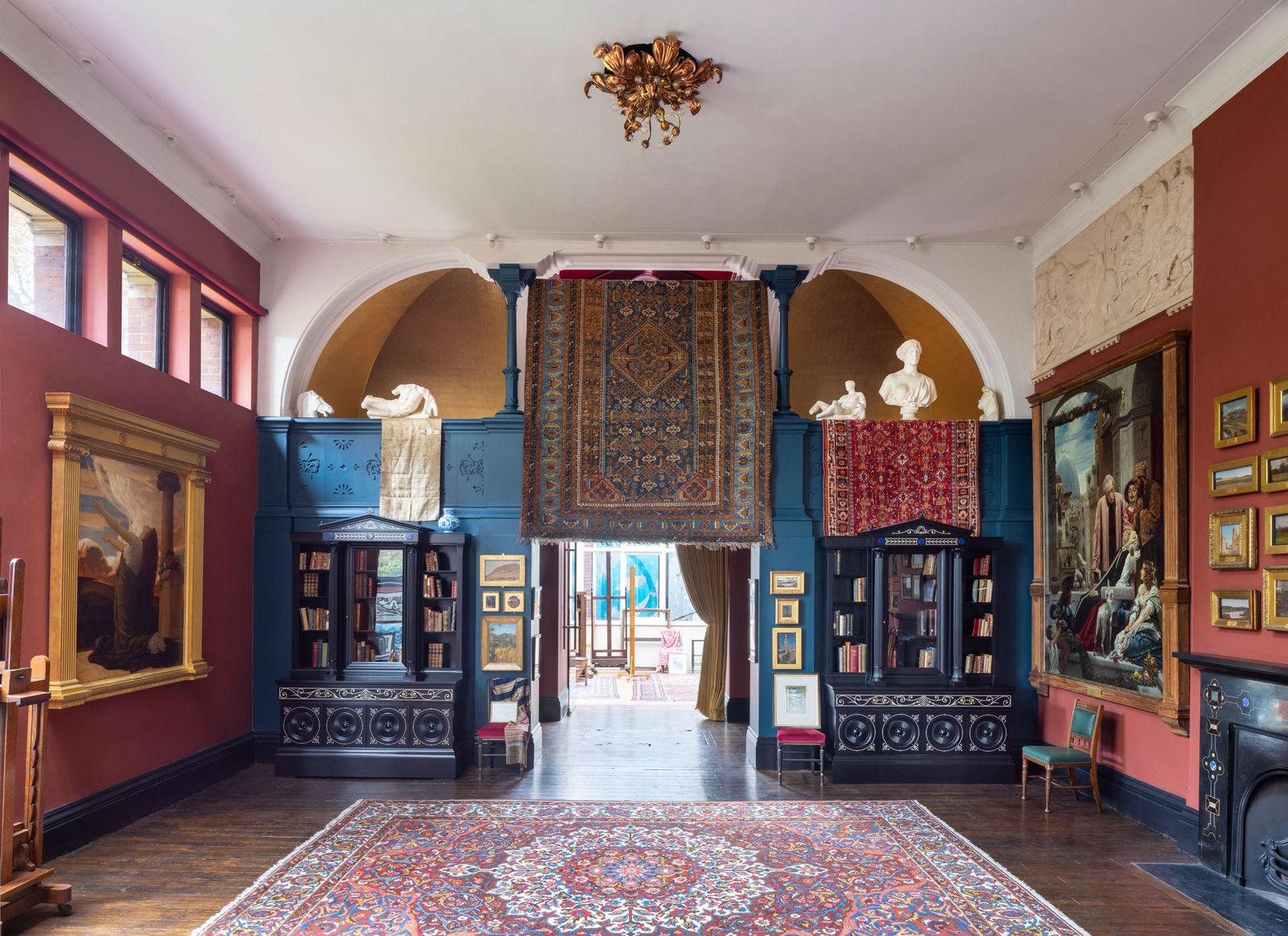
Not only did Leighton have a red-themed dining room – suggesting he knew about colour psychology – but every room had its own theme when it came to art, explains Daniel Robbins, who is curator of Leighton House. “In the dining room, for instance, the subject was landscape – it was hung with Jean-Baptiste-Camille Corot’s Four Times of Day. There was a museum quality to how Frederic Leighton decorated,” he says, explaining that the sense of it was lost due to an earlier priority given to finding examples of Leighton’s own work (they’re there too.)

There had been talk, during Leighton’s lifetime, of keeping Leighton House as a permanent home for the President of the Royal Academy, but it didn’t happen, and instead the portable contents were sold at Christie’s over the course of eight extraordinary days (another tip: never pass up a mega house sale.) However, because Leighton House was so famous – to the extent that it was regularly photographed and written about in the press - Daniel has been able to use historical records to pinpoint what is missing, track it down, and, when possible, buy it back. Leighton collected work by his contemporaries - including Dante Gabriel Rossetti, George Frederic Watts, and Albert Moore – his predecessors, such as Constable, and Italian Old Masters. While in some instances it is reproductions that are now hanging (or standing; those rather beautiful bookcases in the studio are brand new copies) in others it is the real thing: one of Daniel’s triumphs has been the re-acquisition of Leighton’s Tintoretto; it’s back exactly where it was – and the rooms once again have their themes returned.
Live exactly as you will
Lord Frederic Leighton never married, and never had children. Thus Leighton House – despite its size – has one bedroom. This attitude is something that we should all heed – and is often encouraged by interior designers who suggest that it’s more important to add worth to our own lives than the future re-sale value. Pallas Kalamotusis, for instance, gave herself one large bedroom in her Kensington abode, rather than splitting it.
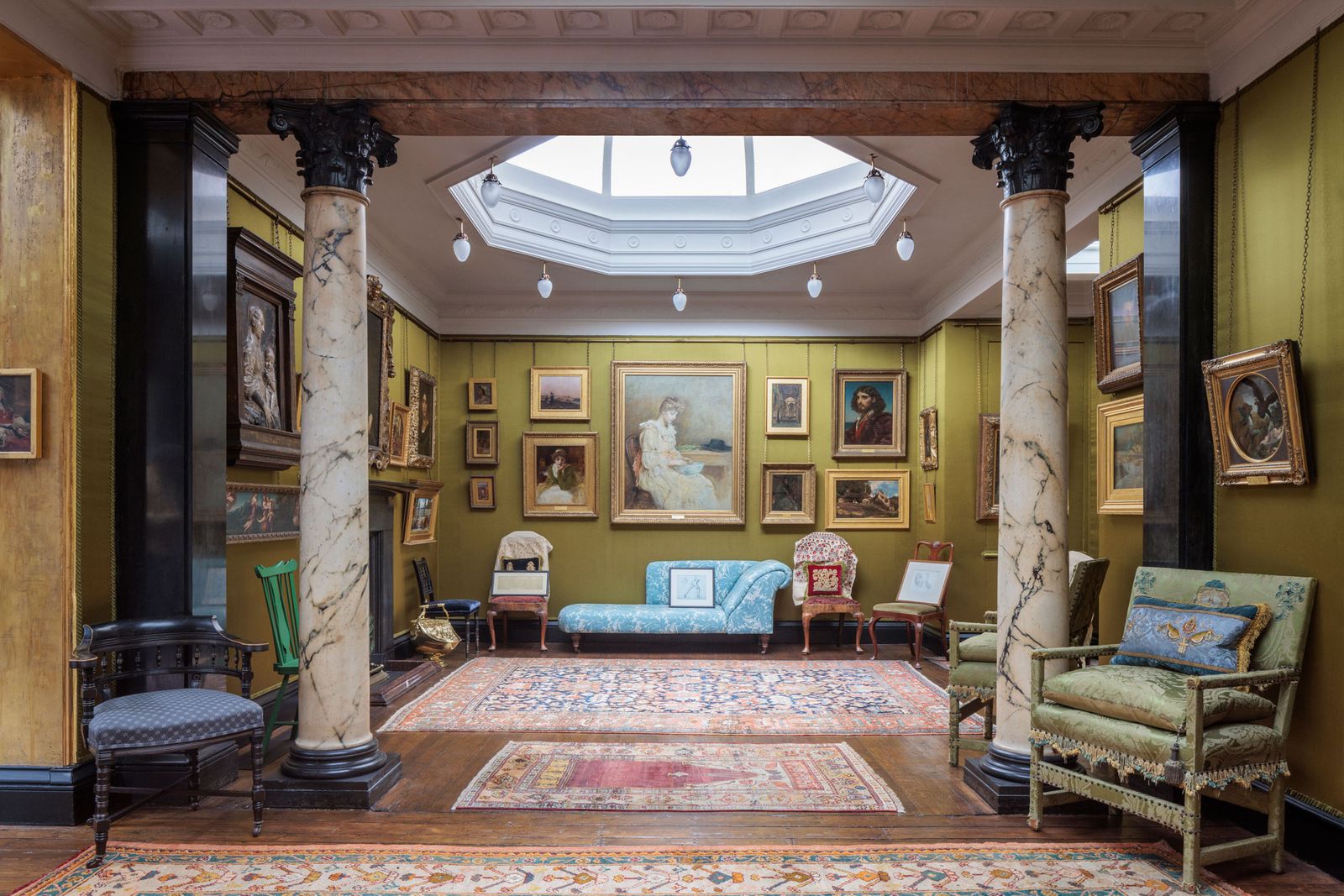
But you’ll also notice the number of paintings propped on chairs in the Silk Room – which is less often encouraged, as usually people don’t want to have to move things in order to sit down. However their position is historically accurate – it’s where Leighton himself put them; some of his chairs, it transpires, were, most of the time, decorative plinths.
(We happen to know, incidentally, of a very famous interior designer who tried very hard to persuade a client that her drawing room should instead become a smart cloakroom – because she kept leaving the buggy in there, her coats, her bags, the children’s scooters and bicycles – and more. The client insisted it stayed a drawing room. Which it is – with silk walls, and beautiful curtains. And a pile of coats, a couple of bicycles, and a collection of dog leads. We’re not sure what the moral of this story is, except that the client too is living exactly as she wanted to.)
Beauty need only be for beauty’s sake
This needs no real explanation; just go and stand in the Arab Hall and try to find the words to disagree. Worth knowing though is that Leighton loved all the arts and would host concerts in his studio for his friends. Those concerts still happen – I was taken to them as a child – and happily, this season, the Kensington & Chelsea Music Society is returning to Leighton House. Attending one – or more - might be the most delightful means possible of experiencing this Orientalist gem.
Plan your visit here.


