

You may think that stained glass primarily belongs in churches and religious buildings. Though this is where the art form’s origins lie, it is certainly not confined to them anymore. Increasingly, we are seeing the small panes of coloured glass appearing in our interiors, chosen for their impressive craftsmanship, jewel-like appearance and ability to transform a plain window (or boring view) into something rather magnificent.
The earliest examples of stained glass appear in mediaeval churches, where the fragments of glass would be arranged to depict bible stories for illiterate congregations. Over time they made their way into secular buildings and grand private residences. Though many medieval stained glass windows were destroyed during the Reformation, there are still plenty of historical and some more modern examples to be found: it’s used throughout Canterbury Cathedral and London’s Westminster Abbey, and celebrated architect Charles Rennie Mackintosh often incorporated stained glass into his designs, such as The Glasgow School of Art.

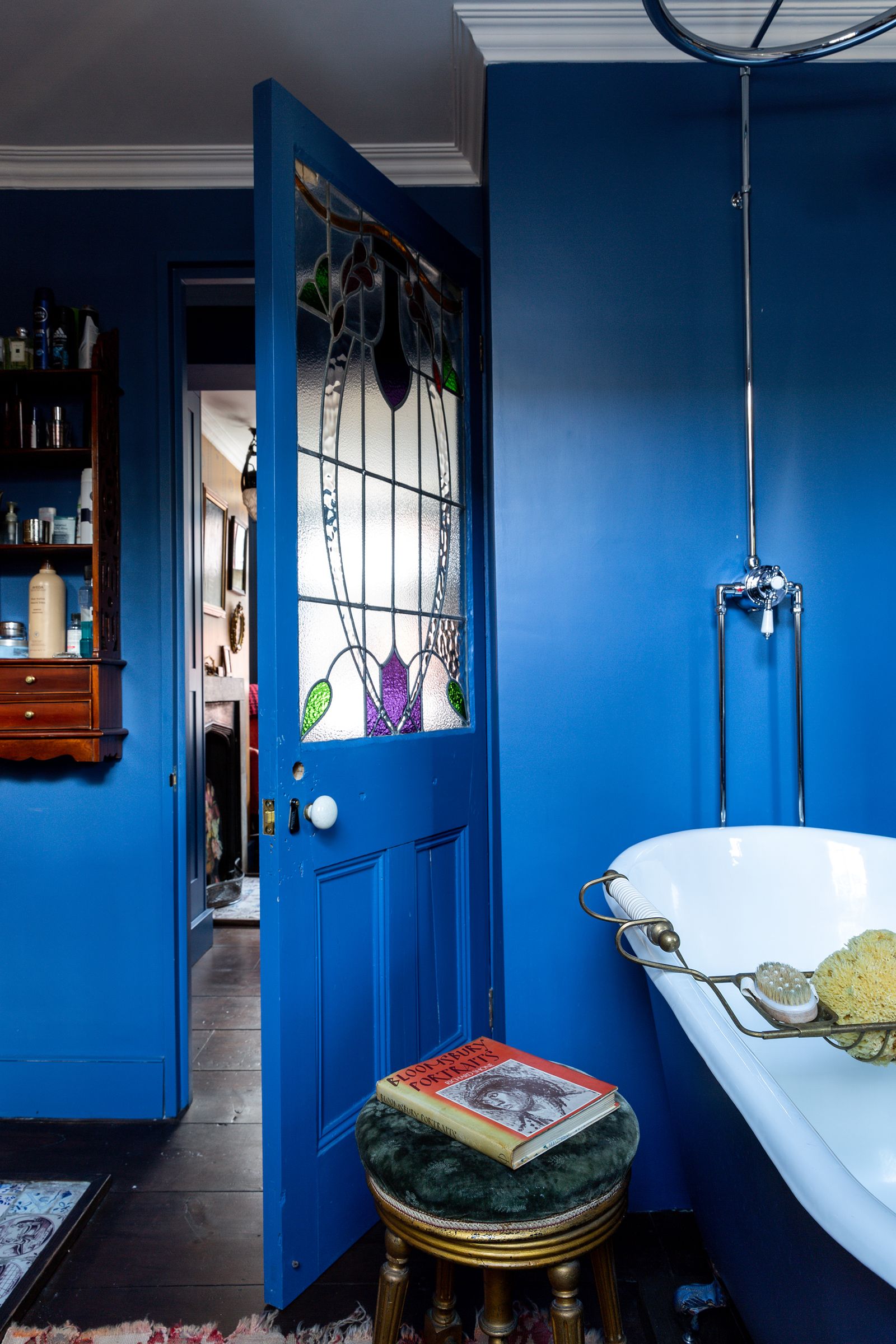
By the Victorian era they started to appear in smaller, private homes. Normally you’d find a pane or two on front doors, having the dual purpose of filling the hallway with an atmospheric light while obscuring the inside of the house to nosy onlookers (this, incidentally, also makes it a great choice for the bathroom).
The popularity of stained glass can be traced concurrently with design periods: the Arts and Crafts era of the late 19th century, which emphasised craftsmanship, favoured the art. It was closely followed by Art Nouveau, when Tiffany Lamps were all the rage. The rise of Modernism in the 20th century saw a decline in the use of stained glass, and though it never disappeared altogether, more and more contemporary designers are rediscovering how elegantly a stained glass pane can enhance a space.

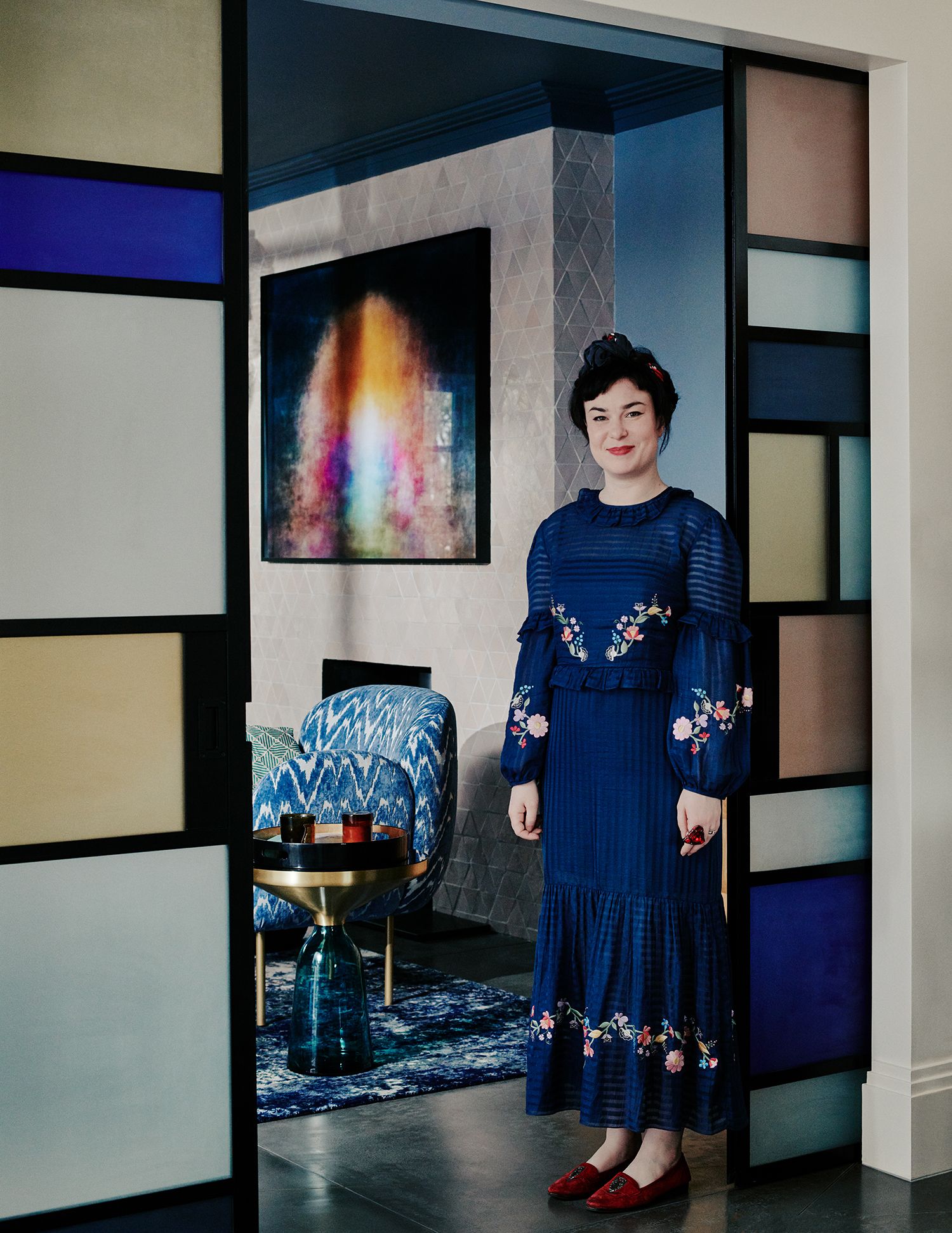
‘I love decorating with stained glass’, says Gemma McCloskey of Cuplà design studio, who recently decorated her sister Orlagh’s house to include abstract panes of glass, one blue one pink, in the darker corners of the sitting room. ‘It’s such a nice way to bring art into the architecture. Instead of leaving all of the decorative and playful elements to the textiles and accessories, I use stained glass to make the foundation as fun as it can be’.

The challenge for Gemma was marrying the modern architecture with a medieval art form. She designed the panes herself – inspired by brutalist panels seen on 1st dibs, the motif is loose and abstract. ‘Traditionally stained glass is very ornate, detailed and decorative. More modern, fluid lines can help it to feel more contemporary’, she advises. The added benefit is that as the light changes throughout the day, the room is thrown into a kaleidoscope of colours, which, as Gemma points out, ‘adds intrigue and movement to the room’. The stained glass in Orlagh’s house is backed on the outside wall by a pane of plain glass, making it just as insulating as double glazing.

In her own home, the artist Natasha Mann has also used stained glass in abundance to incorporate art into the very bones of the building. ‘If I could, I’d use it everywhere’, she says. Though the stained glass on her front door is in keeping with its Edwardian design, Natasha has been more creative in other parts of the house. In the sitting room, a coloured geometric motif of her own design obscures the view out the window: ‘I didn’t want to be able to see into the houses across the road’, she explains. ‘The stained glass is perfect because it still allows light into the room but I can’t see much out of the window’.

Upstairs, in her bathroom, she has used the windows as a canvas. Here, stained glass picks up on the pattern Natasha painted on the ceiling. The geometric design is a nod towards the Alhambra Palace in Grenada, specifically the tiles around the water fountain in the Court of the Lions. ‘I wanted to incorporate something which signifies water’, she says. ‘I feel happy every time I look at it’.
Interior designers Angus and Charlotte Buchanan are also very pleased with the internal stained glass window they installed in their laundry room. The reclaimed Victorian semi-circle design once belonged to a workmens' club in Cardiff, but now is used to brighten up the windowless room. ‘It adds interest to the laundry room, and also helps to bring in light from the corridor so it's not just a dark box’, says Angus, adding that thankfully, ‘it’s not so transparent that you can see our dirty laundry through it’.

The recent surge in popularity of stained glass has not gone unnoticed by glass artist James Williamson, whose studio, Art With Glass, has seen a recent uptick in commissions for decorative panels. ‘There was a time when stained glass might have been seen as a bit naff’, he says. ‘But these days everybody is more keen to celebrate the original architectural features of a building, and stained glass is definitely one of those’.
‘People often talk about stained glass as being tantamount to buying art’, he adds. ‘More and more, we are making bespoke panels to carry on the artistic feel of a space. At any one time in the workshop we might be creating Kandinsky, Mondrian or Gaudi-inspired panels at the same time as something in the style of William Morris.’
A commissioned work, while costing more than a plain glass window, gives you the opportunity to get creative. If you’re working to a budget, head to your local reclamation yard, advises Angus Buchanan: ‘stained glass is the sort of thing that you’ll find on a dusty shelf’. Dust it off, take it home and watch as your room is bathed in technicolour.


