


When deciding on the layout of your home, it is easy to feel like a rather harried Goldilocks rampaging round the three bears’ cottage only to discover that the proverbially perfect bed, chair or bowl of porridge does not, in fact, exist. Open-plan is too, well, open, lacking in structure, privacy and cosiness, while separate rooms can feel too rigid, traditional and claustrophobic. This is where the so-called ‘broken-plan’ layout comes in.
The term is thought to have been coined by architect Mary Duggan while judging the RIBA House of the Year award in 2015, but the approach itself has been around for much longer. ‘Broken-plan’, as the name suggests, is a hybrid of open-plan design and closed rooms, in which subtle dividers are used to create distinct zones within a single space. These dividers can be built-in, such as a partition wall, a sliding door or a substantial shelving unit, or freestanding, like a piece of furniture, a folding screen or a curtain.

One of the main benefits of this approach is its versatility and adaptability. It can be used to break up a large space into more inviting areas, or it can help to make a small flat or house feel bigger and work better. If the divisions you choose are moveable, the design becomes even more versatile and can be changed on a daily, even hourly, basis. Hubert Zandberg, who has been designing ‘broken-plan’ layouts long before they had a name, likens them to a stage set, which can be closed, opened and rearranged to create the desired effect.
This sort of flexibility has never been more important. ‘The way we live and work has shifted in recent years, with working from home being the biggest and most obvious change,’ says Ellen Cumber of London-based design studio Golden. ‘We also have clients who are looking to incorporate home gyms, as well as spaces for multiple family members to use different media to unwind. People need their spaces to work harder than ever before.’ This hybrid approach can be even more effective in smaller homes, as it allows rooms to fulfil more than one function and reintroduces wall space for concealing storage and services, or for displaying books and art.

When using your home for work, play and relaxation, privacy and noise reduction are crucial. Architect Alex Michaelis tends to use large sliding screens ‘to allow the most light and space if one wants it, and to allow privacy and silence if one needs it’. Ellen and her co-director Alice Bettington have had similar success with glazed partitions that still allow light to move around the room. ‘We use Crittall or timber-framed glazing, either full height or with a dwarf wall,’ explains Ellen. ‘Lately we have been adding internal windows, too, such as on all three sides of an internal study space.’
Anthony Earle, lead concept designer at Artichoke, has found screens with glazed doors to be very handy when partitioning a kitchen from a snug, or concealing the back-of-house areas of a large country house. Though we might think of ‘broken-plan’ as being a modern approach for modern homes, it can work just as well in period properties with the right approach. Well-crafted joinery will complement or enhance the interior architecture and proportions of an older house, and might even improve the flow of a property that has been added to piecemeal over time. ‘We play with the layers and chapters of a home’s history, mirroring the period in the joinery, be it Georgian, Edwardian or Victorian,’ explains Anthony. ‘Wibbly restoration glass for the glazing is a hands-down winner for catching the light, dancing reflections and creating enduring character.’

Just as glazed partitions can let the light in, opaque or semi-transparent dividers can help to screen the light in more modern homes with lots of picture windows or plate glass. In such cases, Hubert likes to introduce a sculptural ceramic or carved wooden screen, which simultaneously creates visual interest or, as he rather poetically puts it, ‘a vista within a vista’. ‘It is like land art in a way, except the vista starts in the interior, instead of starting, say, after the infinity pool,’ he explains. Returning to his theatrical analogy, Hubert notes that partially see-through dividers can bring a sense of anticipation and drama. ‘It’s the mystery of looking through something and seeing what's on the other side, but it’s not quite clear, like looking through the forest onto a landscape. And then walking through the spaces is almost like walking onto a stage.’
This pleasing effect need not cost the earth. A pair of curtains, a fabric hanging or a folding screen can demarcate a space very effectively, while bringing in pattern and softness. Or why not take an inexpensive plain screen and cover it in a beautiful fabric or wallcovering? More expensive fabrics become more affordable on a smaller scale, and you won’t have to leave it behind when you move. A pot of paint can also work wonders. ‘It's a perfect opportunity to do good, old-fashioned colour blocking in a chic way,’ says Hubert. ‘And it gives you the chance to hang that particular painting on an Yves Klein blue wall without having to paint the whole room in that shade.’
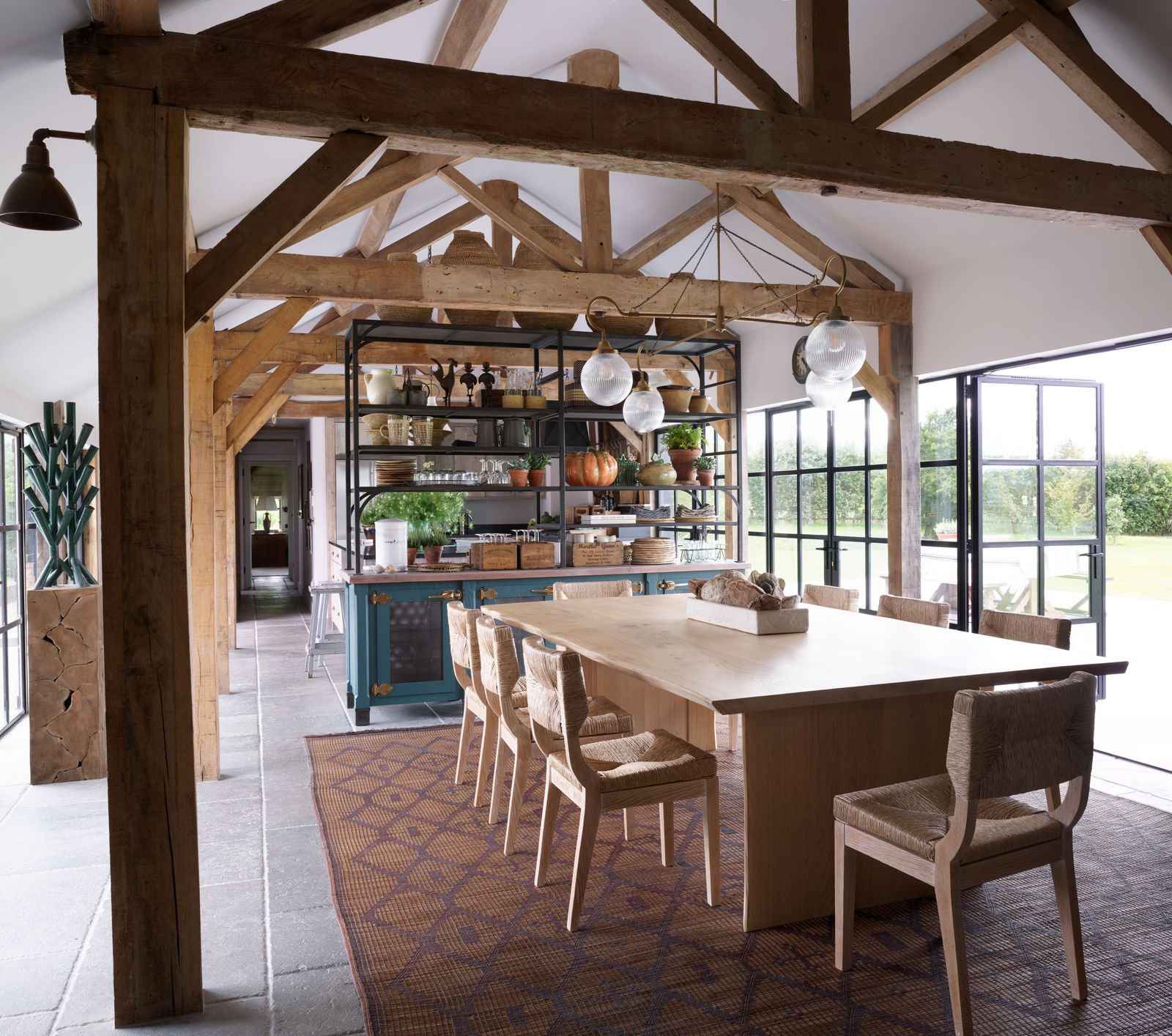
Alternatively, you can play around with existing or new pieces of furniture, as a well-placed sofa or bookcase can provide just enough sense of separation. Many of us feel that furniture must always be positioned against a wall, but that is certainly not the case. As Maria Speake of Retrouvius told Elizabeth Metcalfe for her piece on open-plan living, ‘We can be really fluid and flexible in how we use furniture to create different atmospheres and environments.’ Even freestanding kitchen furniture, be it a pantry cupboard or a set of shelves, presents an excellent opportunity for zoning.
Above all, we want homes that are deeply practically yet visually appealing, and ‘broken-plan’ marries the two with relative ease. But before you divide and conquer your floorplan, be sure to heed Hubert’s advice and tape everything out on the floor to ensure the perfect arrangement.


