
Do you have enough art in your kitchens and bathrooms? Here's why you need it

Kitchens and bathrooms are so often denigrated as purely utilitarian spaces. Living rooms and bedrooms are adorned with our best artworks, hung with love centre stage above the bed or mantlepiece. But the reality is that we spend a huge proportion of our time in our kitchens and bathrooms. We're firm believers that even the smallest galley kitchens or downstairs loos could benefit from a lovely piece of art. “We like to treat functional spaces like bathrooms and kitchens in the same way you would any other room, adding warmth and character using fabrics, artwork and furniture,” says designer Sarah Vanrenen.

Stuck on what kind of art to select for these rooms? Well, kitchens are logical places to hang pictures of food, from oil paintings of fruit to contemporary photography of plants or herbs. “I try to stick to a bit of a theme with the artwork – always food-related in the kitchen and always put ships in the bathroom,” says Joanne Burgess of The Curious House, whose eclectic Henley house treats bathrooms and kitchens as true rooms, rather than decorative afterthoughts. Thematically, if nautical imagery doesn't work for you aesthetically, the intimate nature of a bathroom can lend itself well to nudes, whether that's a watercolour or line drawing. “Bathrooms are a very personal space, so clients are often drawn to pieces that have some historical or emotive meaning to them,” explains Honor Devereux of Devereux Designs.
You might worry about water or heat damage, in which case do refrain from hanging your ancient family portrait above the bathtub. But something in a glass-fronted frame should stand up well even in the steamiest of boudoirs. “It does depend on how humid it gets though,” reminds designer Lonika Chande, “If it has a generous window with good ventilation, and a separate shower enclosure, then it’s probably going to be okay! We generally avoid hanging precious original works in bathrooms and gravitate more towards framed posters, lithographs, or prints instead.”
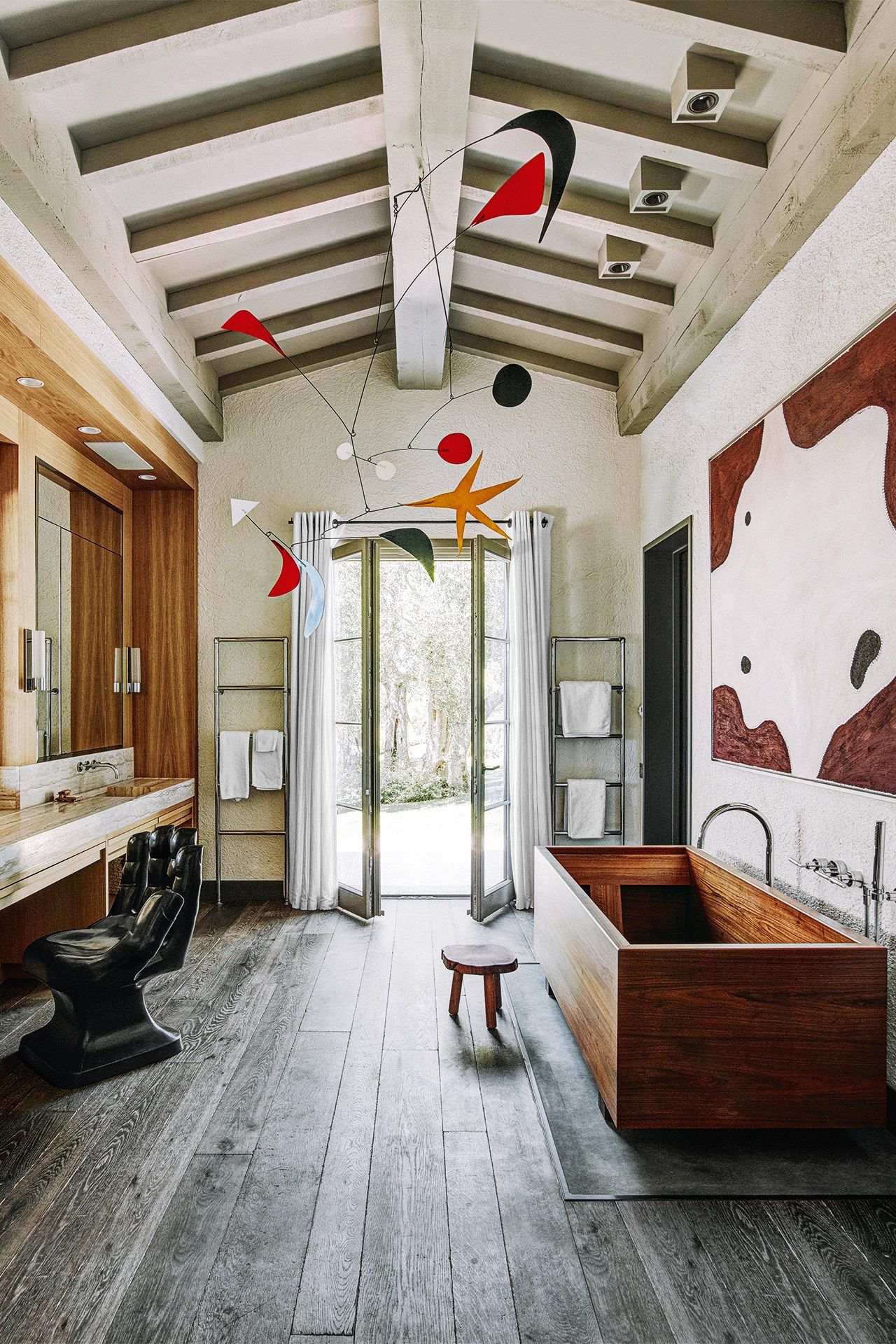
It's not just two-dimensional artwork that you can feature in your bathrooms (though that tends to be the most practical way of integrating visual interest), with some of our favourite houses from the archive including sculptural works. The dramatic bathroom in a Provençal house designed by Andrzej Zarzycki, for example (above), features a Calder-inspired mobile over the bath and a glossy hand-shaped chair sourced from the Marché aux Puces in Paris. The acrylic nature of the chair makes it well suited to a damp environment, where you might avoid using something like leather or canvas.
The mobile in the Provence project also means you can sit back in the bath and watch the colourful shapes dance in the breeze from the open door. In the Chelsea townhouse designed by Honor and Steph Hill below, the splashback behind the hob is a wonderful (and food-themed) artwork: much more interesting to look at whilst cooking than a piece of stainless steel or tiles. So, it's not just the artwork but the positioning and placement of the pieces that is so important in kitchens and bathrooms. “I love to incorporate art into bathrooms as these spaces are often places for contemplation and relaxation. Adding art at either end of a bath for instance can be somewhere for the eye to rest and the mind to wander. It can soften the room, making it feel less functional and more of a living space for relaxation," says Honor.

Art can also be used to soften a space, as well as to tie outlier rooms to the rest of the house. Honor believes that “using art in kitchens can transition the space from being a functional room to a living space. Open-plan dining and kitchen areas are now fairly common, so I find that incorporating art into the kitchen connects the areas together." Sarah adds that these rooms “should be comparable in style to the rest of your home; don’t be tempted to approach them just as utilitarian spaces, but make them feel cosy. Even in a bathroom we try to make the space feel lived in, and avoid blank spaces by using our clients' favourite art, furniture or personal collections.”

Honor notes that clients are often “drawn to pieces that work tonally to the colour scheme in the bathroom, which aide in the restorative atmosphere while lifting it and creating a focal point.” Certainly, artwork is not only a useful way to add to your experience in the kitchen and bathroom, but it can also form the basis of the design scheme. If you know you want to feature a red painting in your kitchen, for example, you may choose to have red as a featured colour throughout the room. You can also choose to create contrasts with the artwork you select; Honor opts for plates in soft, painted environments, but soft canvases in tiled, colder spaces.
Lonika takes a different approach, often opting for black and white prints in bathrooms, “they are grounding and give balance to the other colours in the room,” she notes. But still, she says, levity can be found in loos by using “fun, bold shapes and art forms, that stand out well against tiling and stone.”
We've taken a look through the House & Garden archives to find the best uses of artwork in kitchen and bathrooms, to inspire your next project. And remember artwork can always be changed as your tastes and needs change. Bored of your kitchen or bathroom schemes? Why not try swapping the art between the rooms and seeing how it looks…
 Mark Anthony Fox1/21
In the kitchen of this Hackney maisonette, the yellow is Farrow & Ball's ‘Babouche.' The wooden cabinet is from Sweet Interiors on Chatsworth road. Most of the accessories are from HAY. The red artwork (with a matching red frame) picks out the red details from around the kitchen.
 Owen Gale2/21
Plates are wonderful decorative and robust features for bathrooms and kitchens, and will last a longtime (as long as they are firmly fixed to the walls.) Here, the roll-top bath in Lucinda Chambers’s colourful west London home is painted in a joyful Little Greene yellow, with contrasting feet in Sanderson’s ‘Bengal Red’. A French macramé lampshade and an eclectic display of plates on the wall above the bath give the city house a particularly charming rustic look.
 Boz Gagovski3/21
This is a prime example of how art can elevate even the smallest kitchens. “We based the kitchen on the sort of details you see in service areas in country houses,” says Benedict Foley of the cleverly-designed flat in Hackney that he shares with Daniel Slowik. It is “simple but well drawn.” The shelving is based on the design of the base and feet of a provincial George III cabinet, the oven and hob was recycled from the previous kitchen as they both work well. The hanging hooks left are from Pinxton, the tole chandelier was once John Fowler's, and the counter is reclaimed teak from Retrouvius. The counter curtains (and blind) are made of a digital print created by Viola Lanari.
 James McDonald4/21
Antique dealer Jack Laver's Bruton house features a collection of seashells and coral displayed in an Edwardian case on walls in ‘Euphorbia’ by Paint & Paper Library – another example of a designer using sea or coastal themes in a bathroom. A Victorian pot cupboard stands beside the salvaged bath, which complements the framed vintage artworks.


 Mark Anthony Fox5/21
In the Gloucestershire farmhouse of Thomas Dane, a striped wool rug, picked up by Thomas in Transylvania, is set off by natural sisal flooring and introduces an element of colour and pattern to the mainly monochrome scheme. The photographic portrait of Samuel Beckett above the bath is by John Haynes.
 Owen Gale, Styling: Rachel Moreve6/21
There are no doors between the primary bedroom, the wardrobe and the bathroom in this West London family home given a new lease of life by Polly Ashman. The space is open, serene and, for Polly, “full of joy.” “I wanted to keep it really calm here, so the wall colour is the same throughout.” In this setting, Edward Bulmer's ‘Clover’, is almost a neutral, and it acts as a canvas for the display of artwork and ceramics on the walls. The open nature of the bathroom and bedroom means Polly doesn't have to create hierarchies between the rooms, and the bathroom is graced with a beautiful oil painting that might normally be reserved for a living room.
 Dean Hearne7/21
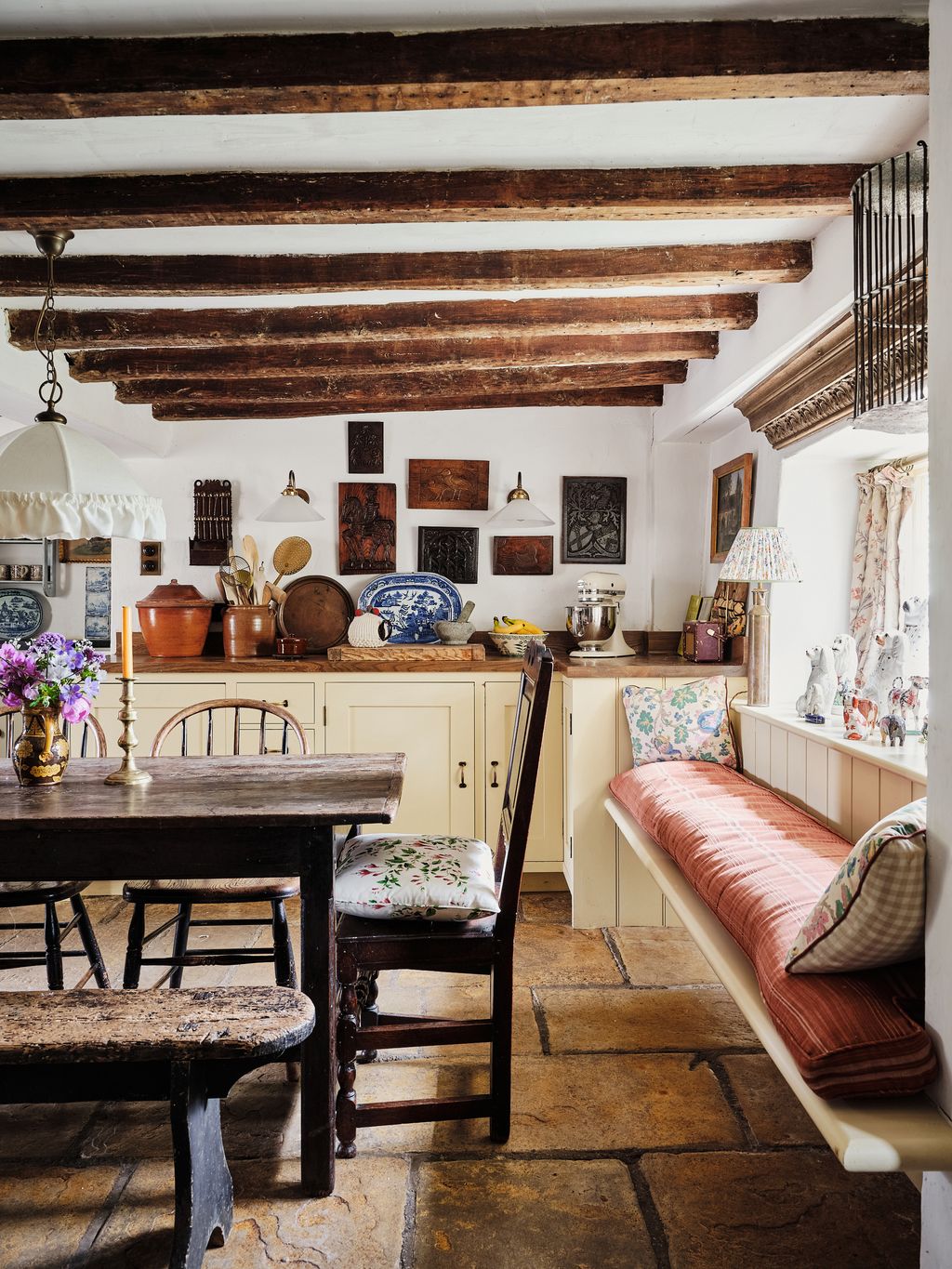
Alexandra Tolstoy's Oxfordshire cottage is entered through the large kitchen, where cabinets designed by Emma Burns occupy one wall, and an antique farmhouse table sits in the middle. Emma Burns of Sibyl Colefax & John Fowler brought in joiner Chris Bell to create units an inch shallower than the existing ones, which helps the kitchen feel larger. The dark stained etching boards and carved wooden pieces on the wall draw out the beams and create a nice contrast with the white-washed walls. Wood is a hardy, waterproof material which is well suited to being in a kitchen.
 Paul Massey8/21
Botanical prints from Odyssey Fine Arts tone with ‘Jaisalmer’ wallpaper by John Stefanidis in this bathroom by Rita Konig. The symmetrical nature of Rita's hanging means the room feels ordered and calm, but still creative.


 Christopher Horwood9/21
Patrick O'Donnell, brand ambassador for Farrow & Ball, has warmed up the bathroom in his Worcestershire house with the discontinued Farrow & Ball wallpaper pattern ‘Orleans Stripe,’ with a ‘Pearl’ border from Adelphi Paper Hangings running round the top. The side table and the Spanish lebrillo plates are from Brownrigg Interiors in Tetbury.
 Art: Henri De Waroquier © 2023 ADAGP, Paris/ ARS, New York10/21
To make the small kitchen in her small Parisian flat feel more spacious and bright, fashion designer Morgane Sézalory enlisted the help of an artisan to make a custom mirrored wall, complete with carved frames and cleverly designed ledges where she displays her various collections. The stacked ceramic coffee cups are from Les Composantes, the Braque exhibition poster is vintage, the painting is by Henry de Waroquier, and the stove is Lacanche.
 Owen Gale11/21
Clever colour combinations form a thread that runs throughout the suites at 8 Holland Street Townhouse in Bath, where wall tiles by Balineum set off an antique cast iron bath, a Vico Magistretti ceiling light and an artwork by Man Ray.
 Paul Massey12/21
Cath Kidston has mastered the art of the decorated bathroom in her west London house. Walls in Paint & Paper Library’s ‘Plaster II’ showcase artwork collected by Cath over the years. A rug from Caroline Marcq Interiors tones with the holland linen blind from The Blinds Company.


 Christopher Horwood13/21
In the bathroom of this former tannery transformed by Howark Design, the panelling is painted in Farrow & Ball's ‘Arsenic’. Bert & May's 'Maison Decor' tiles line the floor. The sunset tones from the painting are picked out in the burnt orange bath and satsuma shelf.
 Christopher Horwood14/21
In her rented flat, Sally Wilkinson has added a skirt around the basin, a simple decoration fix to add flair to an ordinary bathroom feature. Wall light and shade by Howe London, custom-made vanity skirt in The Cloth Shop fabric, framed blue and white tiles by Brownrigg and striped hand towel by Zara Home. Tiles are a great way of adding visual interest as they are water resistant.
 Mark Anthony Fox15/21
The bathroom set, off the studio in artist Haidee Becker's house, is lined with art, as well as plants. The hanging paper mobile was created for Haidee by her daughter, Rachel. Whilst the paper is surely fragile, it must be nice to watch the mobile move and dance whilst you're taking a shower.
 Simon Brown16/21
Wipeable floor tiles are the perfect choice for this boot room bathroom in a Georgian house by Salvesen Graham. The wallpaper is Soane's ‘Seraphic Star Bastille’. The lively floral oil painting above the loo directly informs the wall and panelling colours in clashing red and blue.


 Christopher Horwood17/21
The kitchen in a former tannery-turned-stylish flat near London Bridge is painted in a bespoke shade of olive green, perfectly matching the print which is hung high to maximise the space. The pared-back panelling was designed to blend in with the industrial setting of the apartment.
 Owen Gale18/21
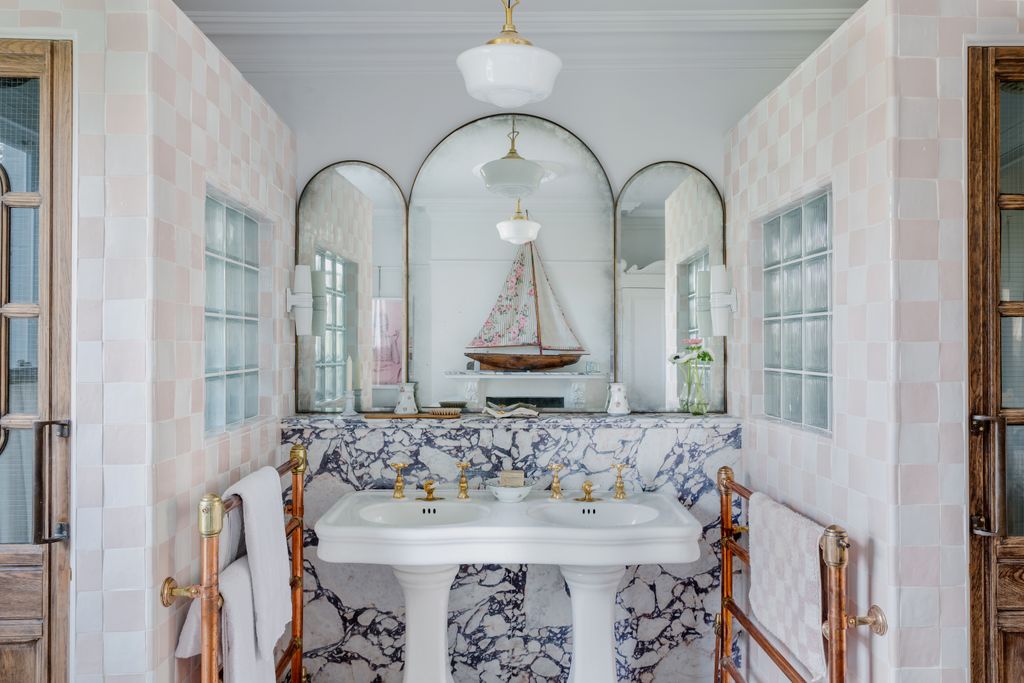
The reclaimed double sink stands against a half-wall of Calacatta Viola marble in Charlotte and Angus Buchanan's main bathroom. In the mirror you can see a model ship on the chimneypiece; this is an antique Victorian pond yacht that Charlotte gave Angus for a birthday, and he re-rigged the sails in Buchanan Studio's Ticking Rose linen.
 Milo Brown19/21
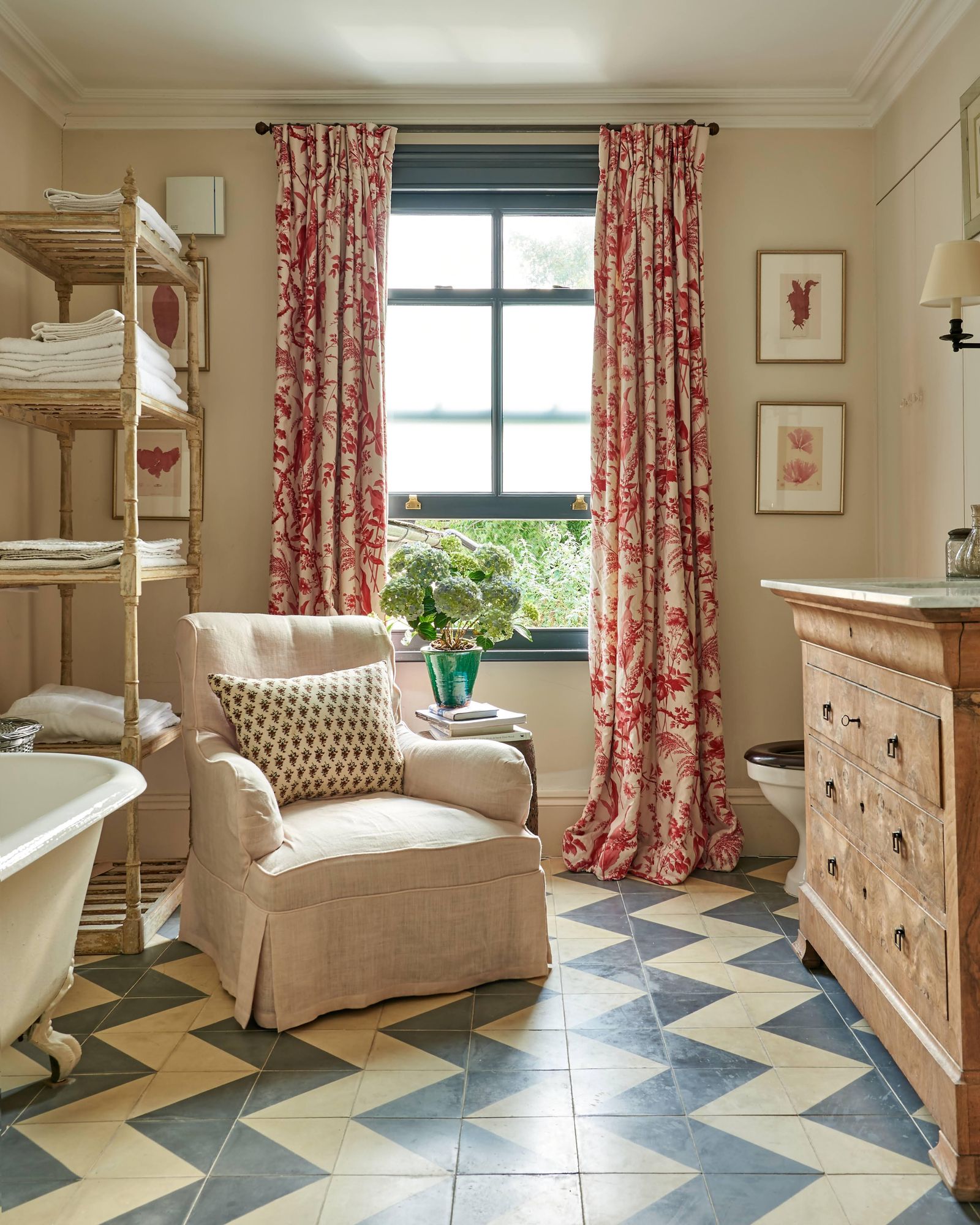
The family bathroom in this Lonika Chande project is a bright, large space with encaustic cement floor tiles from Marrakech Design and a vintage Swedish rag rug used as a bath mat. From a practical point of view, Lonika added a wide marble surround to the bath as the bathroom is used by three children and so needs to function well. The leafy monochrome print above the bath echoes the plants around the room – its glass fronting will protect it from splashes - whilst the monochrome contrasts with the colourful bathroom scheme.
 Martin Morrell20/21
The compact galley-style kitchen in a 19th-century barn in the Cotswolds is accessed by openings from the dining area. The classical oil painting above the oven works on the food theme, with plenty more visual interest to be drawn by the array of mismatching framed artworks.


 Owen Gale21/21
The kitchen in a jewellery designer's playful Victorian house is a kaleidoscopic room that best shows the Spanish influences in the house. “It’s the room we knew we’d spend most time in,” says Sandra, “so we spent the longest making sure we got the design right." The artwork excitingly clashes with and compliments the colourful kitchen. The cabinet doors are painted in Farrow & Ball’s ‘Calke Green’, Paint & Paper Library’s ‘Geisha’ and ‘Rowan Berry’ from Sanderson, while the walls are an archive Farrow & Ball paint called ‘Orangery’.

Comments
Back to Top


