
A surreal adventure crossing the Andes between Chile and Bolivia

There is a frontier feel to the northern Chilean town of San Pedro de Atacama. Beyond a huddle of backpacker hostels, cafés and boutique retreats lies an inhospitable wilderness shaped over several millennia by fiery rumblings in the earth’s belly. Vast salt flats glint with buried-treasure deposits of lithium, guarded by a chain of active volcanoes belching plumes of smoke from their perfect cones, and walls of gypsum whistle and groan a discordant dawn chorus as they are warmed by the morning sun.

Clambering over the rocky floor of a steep-sided gorge in the Puritama Conservation Reserve – a protected area managed by mountain specialists Explora – I am on high alert for signs of the rare Andean mountain cat. Despite the silence, there is evidence of recent animal activity: paw prints in the muddy banks of a seasonal stream; and the flickering whiskers of a viscacha (similar to a chinchilla) as it shelters in dark crevices in the cliffs. There are signs of human existence, too, in the form of the 2,000-year-old hunting shelters built by ancient civilisations transiting through these parts.


San Pedro has long been a resting place for travellers, a stopping point for trading caravans passing from the Andes to the coast. For the past few days, I have been hiking at giddy altitudes to acclimatise for an adventurous, multi-day journey designed to retrace part of their route.
Around 500 people a day make an overland journey across the border from Chile into Bolivia – mostly backpackers in minibuses. But Chilean-owned operator Explora has launched its more comfortable and luxurious Travesía (Spanish for ‘crossing’) trip, which includes the services of a private guide in a Lexus 4x4 and accommodation at three new, very remote mountain lodges.
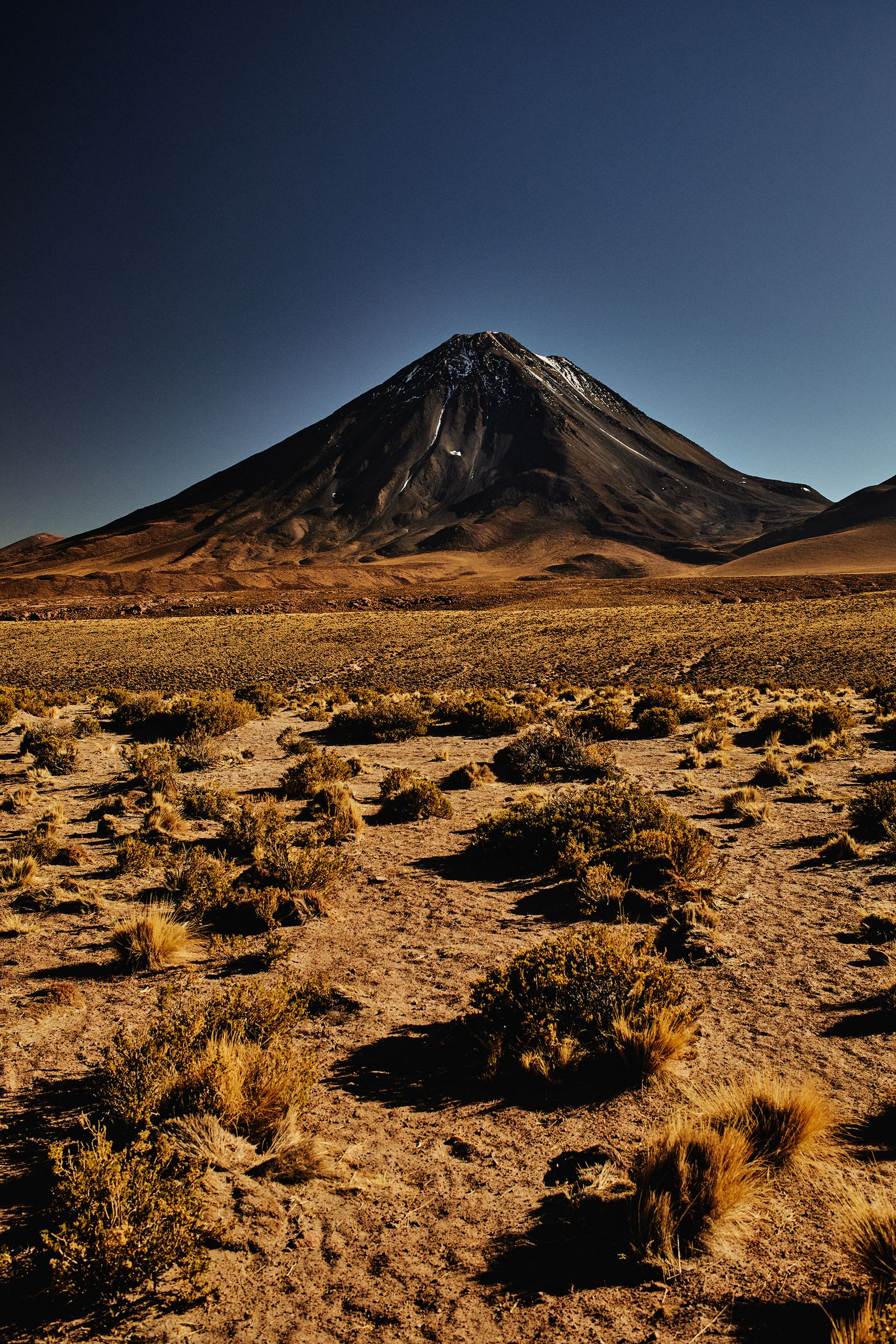
It is a short ride from Explora’s Atacama property to the international checkpoint. Once documents have been stamped, we meet our Bolivian driver and gently ease into the adventure by visiting some of the popular highlights in the Altiplano. Dangerously beautiful lagoons shimmer in a palette of acidic hues, from the arsenic-laced Laguna Verde, more emerald than the Indian Ocean, to the blood-red waters of Laguna Colorada, where fuchsia-feathered flamingos parade in a courtship dance. In Salvador Dalí Desert, wind-hewn rocks form a surreal gallery of imagination- sparking sculptures, while bubbling mud pools splutter furiously at Sol de la Mañana, the highest geyser field in the world.
Distances are big in the Altiplano and journeys are long. Our only fuel is carried in tanks on the roof of the car, our only means of contact (in case of emergency) on the road is a satellite phone. One step ahead of the busy tour buses, we soon leave them trailing in a cloud of dust. ‘If people go one way, we go the other,’ says Explora’s exploration designer Sebastián Navarro Cox, who has meticulously planned a series of – largely exclusive – adventures for guests.

Three distinct sections form the Travesía, each with their own lodge, though all are similar in design. Climbing further and further, we reach our first stop, Ramaditas Mountain Lodge, part of the trip’s lagoon and volcano zone. Tasked with maintaining a light footprint, the Chilean architect Max Núñez came up with elevated metal containers, which could easily be removed without leaving a trace.
Large windows gaze out to a lagoon from the comfortable, wood-panelled interior of the sitting and dining area. An open kitchen bustles with activity, as staff from the local community prepare a menu designed by chefs from La Paz restaurant Ancestral. Each of the four separate, self contained suites has a bed softer and more enveloping than the big sky’s ever-shifting clouds.

We are at 4,100 metres above sea level and the effects of altitude are starting to sink in. A thumping head and dry mouth are only the beginning of what turns out to be a sleepless night. Before heading to bed, I glance enviously at a Swiss couple glugging glasses of Carménère. Not everybody is affected by altitude in the same way.
Water and breathwork aid recovery the following morning. But the main course of action is to go slow. Having discussed my options with Sebastián, I opt for a short hike around Turquiri lagoon. A flotilla of teal ducks sails across its wind-rippled surface, watched by a black-chested buzzard eagle nesting in the rocks. A short climb takes me to a viewpoint decorated with a dreamscape of cartoonish rocks and bulbous 500-year-old yareta shrubs. From there I look down on a farm- house, apparently owned by an elderly lady who lives alone with her llamas.

Both mentally and physically, everyone but the hardiest is challenged when at these altitudes for any length of time. At Chituca Mountain Lodge, our next stop, I learn more about the Aymara communities of the Altiplano in the Travesía’s second zone. A cactus-wood door creaks open to a stone church in the abandoned village of Ikala, used as a civilian hideout during the late-19th century War of the Pacific. In the former Spanish settlement of San Pedro de Quemes nearby, children play football on a government-funded pitch. At a lower altitude, the area is a purple haze of cultivated quinoa fields – the entry point to the Uyuni Salt Flats, our final zone.
As I am driven across a brilliant white crust stretching for 10,000 kilometres, directions on a map become meaningless and my only point of navigation is the sun. Clouds disappear into a blurred horizon and cacti-studded islands appear to float above what has been scientifically declared as the flattest place on earth.

Far from the World Heritage Site’s cluster of hotels, Explora’s east-facing lodge sits below the shadow of Tunupa volcano on the edge of the salt flats. The journey over, I spend my last sunrise hours watching the crystalline landscape bathed pink like a polar dawn.
‘You won’t appreciate the Travesía until it’s over,’ Sebastián had said. Thrown by a combination of giddy elevations, infinite horizons and brain-stretching timelines, for several days, I have been lost in a fug of confusion. Even once we have reached our finish point, my thoughts continue to whirl. But that is to be expected, because, in essence, a true travesía has no distinct beginning or end.
WAYS AND MEANS: Sarah Marshall visited Chile and Bolivia as a guest of Explora, British Airways and Abercrombie & Kent (abercrombiekent.co.uk), which offers an eight-night trip, including the Travesía, full board, from £9,999 per person, based on two sharing, including all flights. British Airways (ba.com) flies from London Heathrow to Santiago, with connections to Calama and Uyuni.
 Frédéric Lagrange1/5
Llamas near a pond on the road from Chituca to Uyuni.
 Frédéric Lagrange2/5
A view of the dormant Tunupa volcano from the Isla del Pescado, a rocky outcrop dotted with giant cacti in the middle of Bolivia’s Salar de Uyuni, the world’s largest salt flat.
 Frédéric Lagrange3/5
A woman in the doorway of her shop in the village of San Juan in Bolivia.
 Frédéric Lagrange4/5
The exterior of the Explora lodge at Uyuni, designed by the Chilean architect Max Núñez.


 Frédéric Lagrange5/5
The wood-panelled interior of the Explora lodge at the Uyuni salt flat in Bolivia, furnished simply with ceramics, artwork and textiles in a palette of natural earthy tones.


