
How to do a contemporary Arts and Crafts interior

You may have noticed that the Arts and Crafts movement is having a bit of a moment, with some of today’s naturalistic wallpapers and fabrics, rustic furniture and pared-back interiors seeming to have their roots in this style. Spanning 1860 to 1920, Arts and Crafts was a celebration of simple, honest craftsmanship. It was a reaction against mass production and the excesses of Victorian design, which were flaunted at the Great Exhibition in 1851. This show-cased contemporary industrial design and featured more than 100,000 objects. It was an exciting spectacle, but it did have its detractors, including William Morris, one of the movement’s most famous figures. He was so appalled by the show’s excesses that it reputedly reduced him to a bout of sickness.

If it was originally a response to industrialisation, then perhaps its current resurgence is a reaction to digitisation and the pace of the modern world. ‘The ethos of the Arts and Crafts movement is very relevant to life today,’ says antique dealer and designer Christopher Howe. ‘There is a renewed interest in the way furniture is made, which values materials and the revival of craftsmanship.’
It heralded a new approach in which architecture, furniture and adornments were all intended to sit in harmony. Many of the period’s key players were architects, for example Edwin Lutyens, who was renowned for his imaginative adaptation of traditional building styles, and Philip Webb, who is best known for designing the Red House in Bexleyheath as a family home for Morris in 1859.
Designer Ben Pentreath, who decorated an Arts and Crafts house in Hampstead featured in the May 2018 issue of House & Garden, is an advocate of its contemporary appeal. ‘Is there anything more soothing than the idea of a generous, friendly bay-window seat, overlooking a herb garden; or a deep inglenook fireplace, with wide oak boards on the floor and a gentle ticking of a Charles Voysey clock on the mantel?’ he asks.
Despite their rejection of Victorian frivolity, the proponents of Arts and Crafts embraced ornament – as long as it was ‘secondary to the thing ornamented’. Wallpapers and carpets were acceptable, as long as their patterns were not ‘suggestive of anything but a level or plain’. Hence the rather flat, simplified style of Arts and Crafts patterns, which continue to capture our imaginations today.

Living pattern
William Morris created his first pattern, ‘Trellis’, in 1862. His designs, which featured British flora and fauna and naturalistic colours, gained popularity in the 1880s and 1890s, and a huge number are still available today through Morris & Co., who's most popular collection, ‘Pure Morris’, launched in 2016 and features neutral coloured, pared-back designs. ‘This range has taken Morris’s designs to a new audience who found the original colour palette did not work in their homes,’ says Clare Vallis, Creative Director of Morris & Co. Morris & Co also has a collection in honour of May Morris, William’s youngest daughter, who was a very accomplished embroiderer and textile designer. ‘She was ahead of her time,’ says Clare Vallis, Creative Director of Morris & Co. It is called ‘Melsetter Wallpaper’ and incorporates May's prominent embroidery skills.
Others followed in Morris’s footsteps, including the architect CFA Voysey, whose patterns featured bold repeats and col- ours. Some of his designs are available through House of Hackney, Lewis & Wood and US company Trustworth Studios.
Elegant simplicity
In a lecture in 1880, William Morris said that ‘simplicity of life, even the barest, is not a misery, but the very foundation of refinement.’ Arts and Crafts furniture followed a similar vein – it was clean-lined, relatively free of adornment and made of solid, quality materials, such as oak. ‘The great thing about this furniture is that it is easy to look at,’ says antique dealer Paul Reeves, who spe- cialises in Arts and Crafts furniture and textiles, and counts Veere Grenney and Ben Pentreath among his clients. ‘It can go in all sorts of interiors – from the grand to the country cottage.’ The downside? ‘Some of it can be too big for the modern home.’
Key designers from the period include Charles Rennie Mackintosh, the Scottish architect who crafted distinctive high-backed chairs, Ernest Gimson, best known for his traditional ladder-back chairs, and Philip Webb, who produced simply constructed rustic furniture. What should we be buying now? ‘George Walton, who was a friend of Mackintosh, is very under-rated, perhaps because his designs are rather subtle,’ says Paul.
If your budget does not stretch to original pieces, there are contemporary designs that have their basis in the Arts and Crafts. Heal’s has released the ‘Blythe’ collection, which nods to the pieces designed by Ambrose Heal in the early twentieth century. Russell Pinch’s work also takes its reference from Morris. ‘I was exposed to his work a lot as a child and it has had a lasting impact,’ says Russell, whose ‘Avery’ chair has its roots in Morris’s rush-seat ‘Sussex’ design. ‘It is all about the simplicity of the line in this chair – it is still so relevant to today,’ he explains. It is not just the aesthetics that relate to the Arts and Crafts, but also Russell’s approach to craftsmanship. ‘Morris worked tirelessly with makers to keep them going and I want to celebrate the unsung heroes in the workshops that we use. Can we raise a toast to them?’
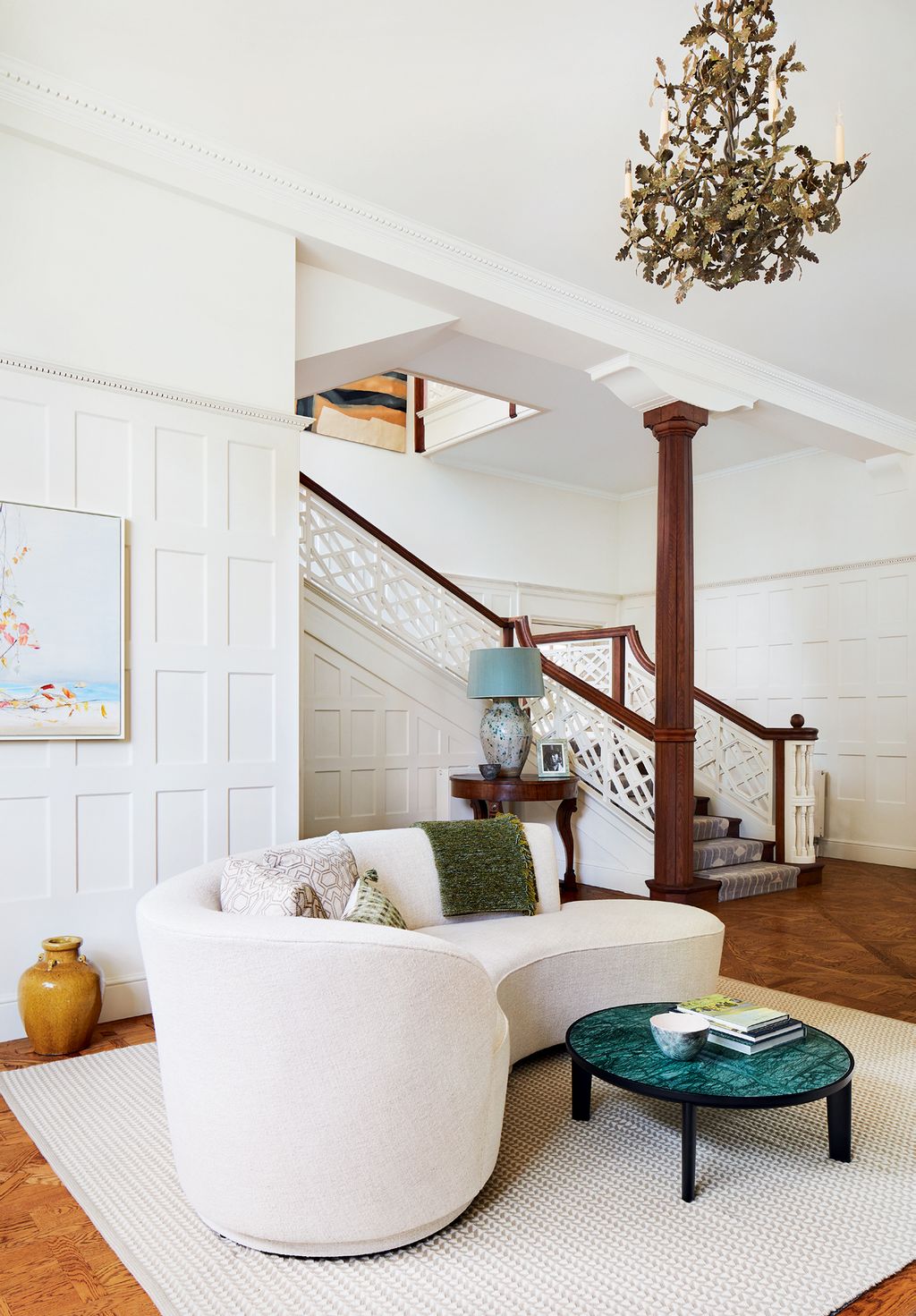 Alicia Taylor1/15
Interior design studio Todhunter Earle has added an element of glamour to this Arts and Crafts house in Surrey. Here, the tone is set with a palette of peaceful neutrals, upon which furniture has been layered. The bespoke sofa is covered in Pierre Frey’s ‘Basile’ in crème. The marble-topped ‘Hole Coffee Table’ by Gabriel Tan is from The Conran Shop.
 Alicia Taylor2/15
The duo worked with paint specialist Edward Bulmer to find the exact strength of tint which would perfectly highlight the architectural features. A glass and bronze pendant light from FBC London hangs over a ‘Riva Table’ in walnut by Fiona McDonald. Chairs from Svenskt Tenn were upholstered in ‘Fez Weave’ by Guy Goodfellow Collection.
 Dean Hearne3/15
Demonstrating a more contemporary take on a classic Arts & Crafts, foliage-heavy pattern, the wallpaper in the hallway of this Putney house by Field Day Studio is House of Hackney's ‘Hedera’ pattern.
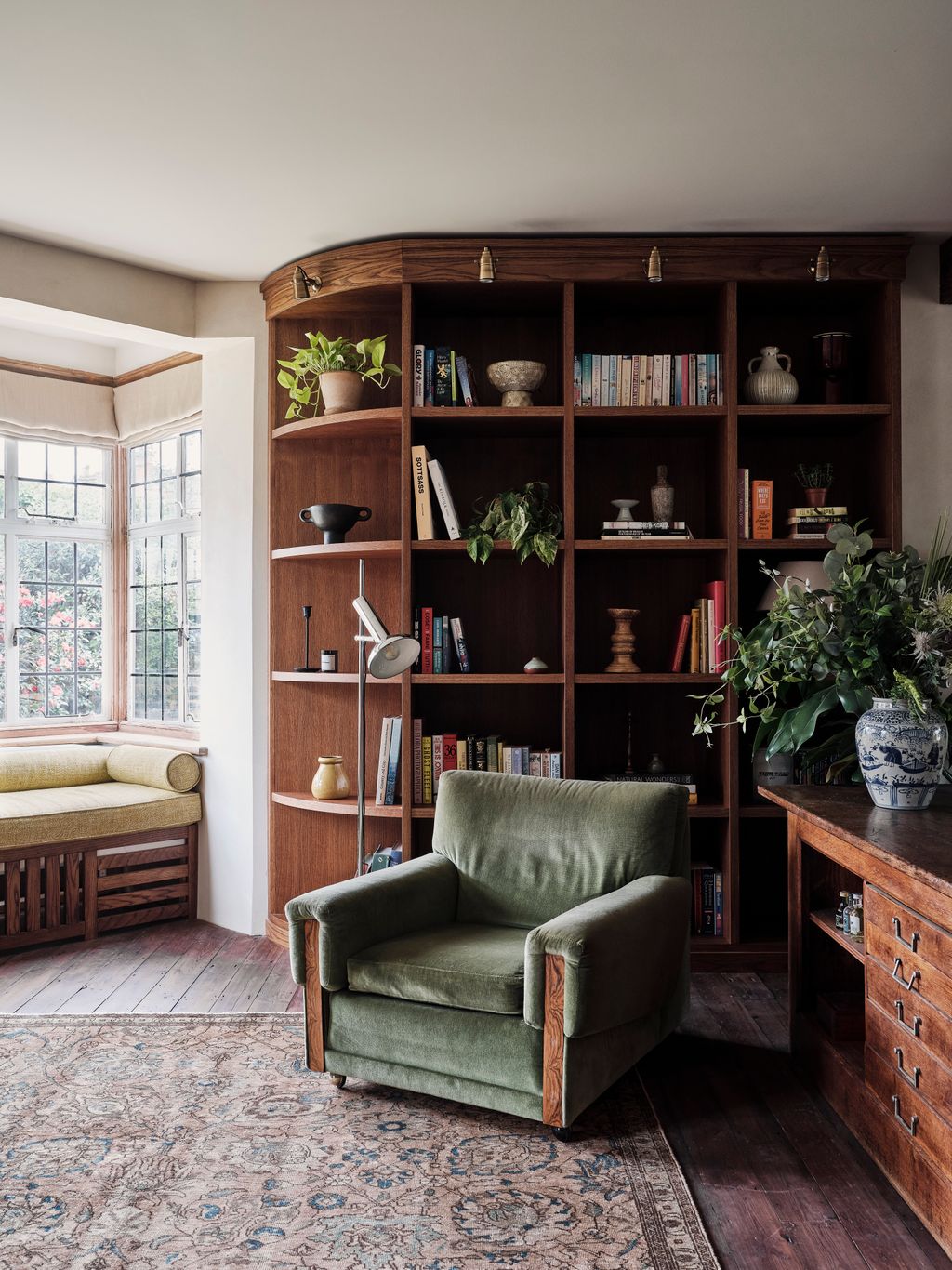 Dean Hearne4/15
Though it has a distinctly contemporary feel, the sitting room of the house still echoes some of the key elements of Arts and Crafts design. A vintage chest from VintageFrench divides the library side of the room from the rest of the space, where bespoke wooden joinery curves around the walls.


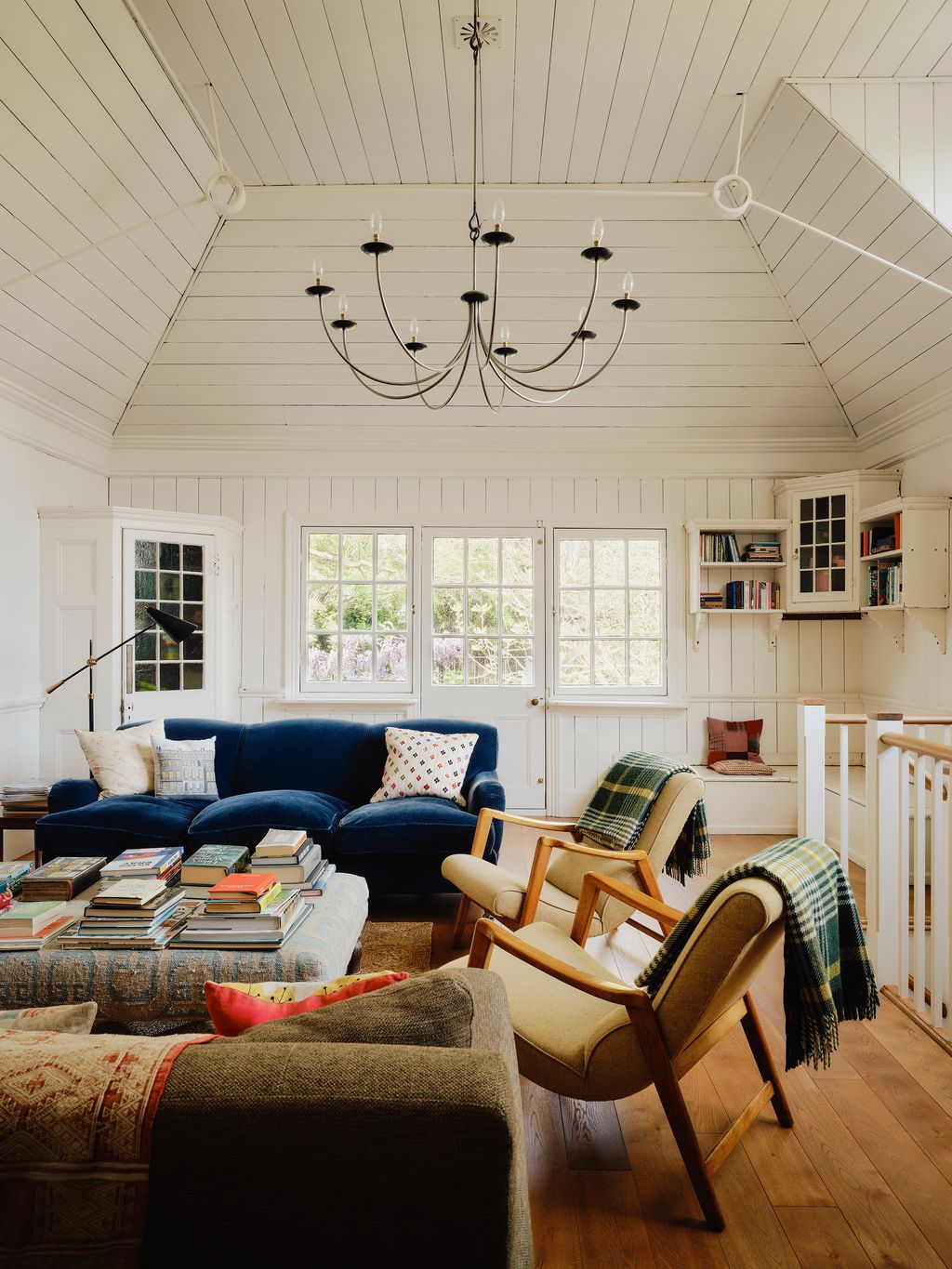 Dean Hearne5/15
Rebeka Russell discovered leading 20th-century architect Philip Webb’s drawings for this house at the Victoria and Albert Museum. They depict the internal chimneys which he designed to conserve heat inside the building. This was new. Webb, who also designed William Morris’s Red House, in Bexleyheath, was ahead of his time. Its contemporary decoration stays sympathetic to the original structure of the house, though with light white walls and a footstool and sideboard sourced online, which sit on plain rush mats over an oak floor.
 Dean Hearne6/15
A view from the master bedroom of the hallway and the family bathroom in Rebeka's house encompasses three William Morris wallpapers: ‘Trellis’, ‘Marigold’ and ‘Willow Bough’.
 Christopher Horwood7/15
Carlos Garcia borrowed plenty of inspiration from the Arts and Crafts movement when it came to the decoration of this small terraced house in London. In the kitchen, ‘Blackthorn’ wallpaper in autumn, from Morris & Co, is enlivened by woodwork painted in Fenwick & Tilbrooke's ‘Chanterelle’. A ‘Rise and Fall’ pendant from Broughtons of Leicester hangs above the dining table.
 Paul Massey8/15
Textile designer Lindsay Alker is a passionate fan of the Arts and Crafts movement and before moving into her cottage in east Sussex had already – almost unwittingly – acquired the basis of what would come to furnish it. In the kitchen, fiery Crocosmia ‘Lucifer’ in a Belgian Art Nouveau jug enlivens an Arts and Crafts table bought at Lots Road Auctions and 1920s Heal’s rush chairs. The Finnish birch plywood floor is softened by the seagrass rug, which picks up on Mario’s painting Annex: IMO Circular #13, exploring small-boat migrant journeys across the channel.


 Paul Massey9/15
In the sitting room of Lindsay's cottage, walls in Farrow & Ball’s ‘Studio Green’ and curtains in Lindsay’s ‘Saint Clement’ provide an atmospheric backdrop for an English Arts and Crafts table, brightened by a jug of Inula magnifica, and a Stickley side table with a Habitat lamp bought years ago. A kilim found in a local antique shop complements the original parquet floor
 Alexander James10/15
‘I wanted to make it lighter and fresher, without altering its architectural spirit,’ explains Sarah Peake of this Arts and Crafts house in Surrey. In the entrance hall, light wooden panelling creates a light and airy feel, while a Swedish rug from Robert Stephenson, an antique sofa covered in ‘Ripstop’ fabric from Howe at 36 Bourne Street – with cushions in Fermoie and Soane fabrics – and a painting by Peter Joyce bring colour.
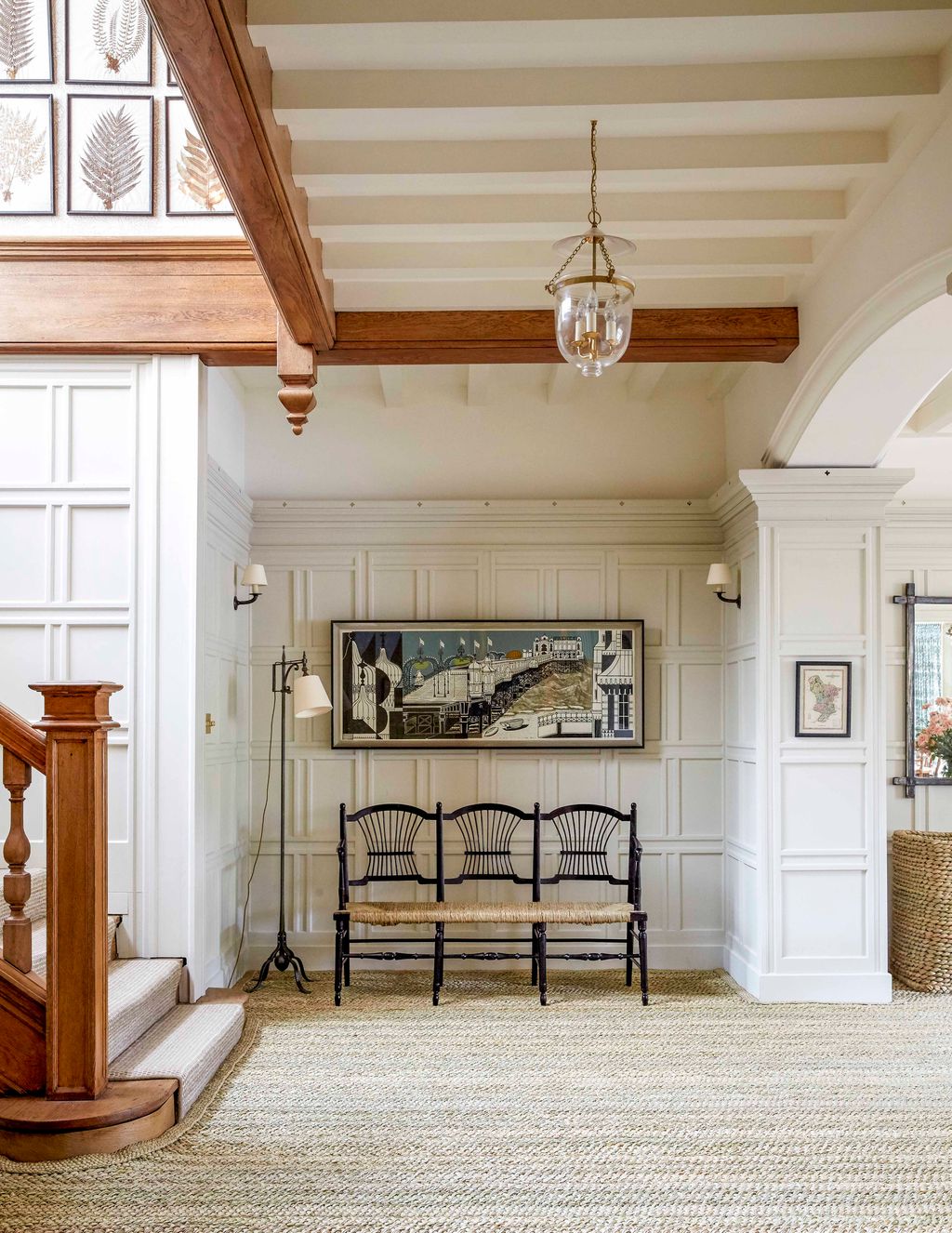 Paul Massey11/15
For this Arts and Crafts house in north London, Ben Pentreath freshened up the original panelling – a typical element of this style of interior – by painting it in Farrow & Ball’s ‘Shaded White’. The antique ‘Sussex’ bench by William Morris continues the theme, as does the complementary look of the Edward Bawden linocut.
 Paul Massey12/15
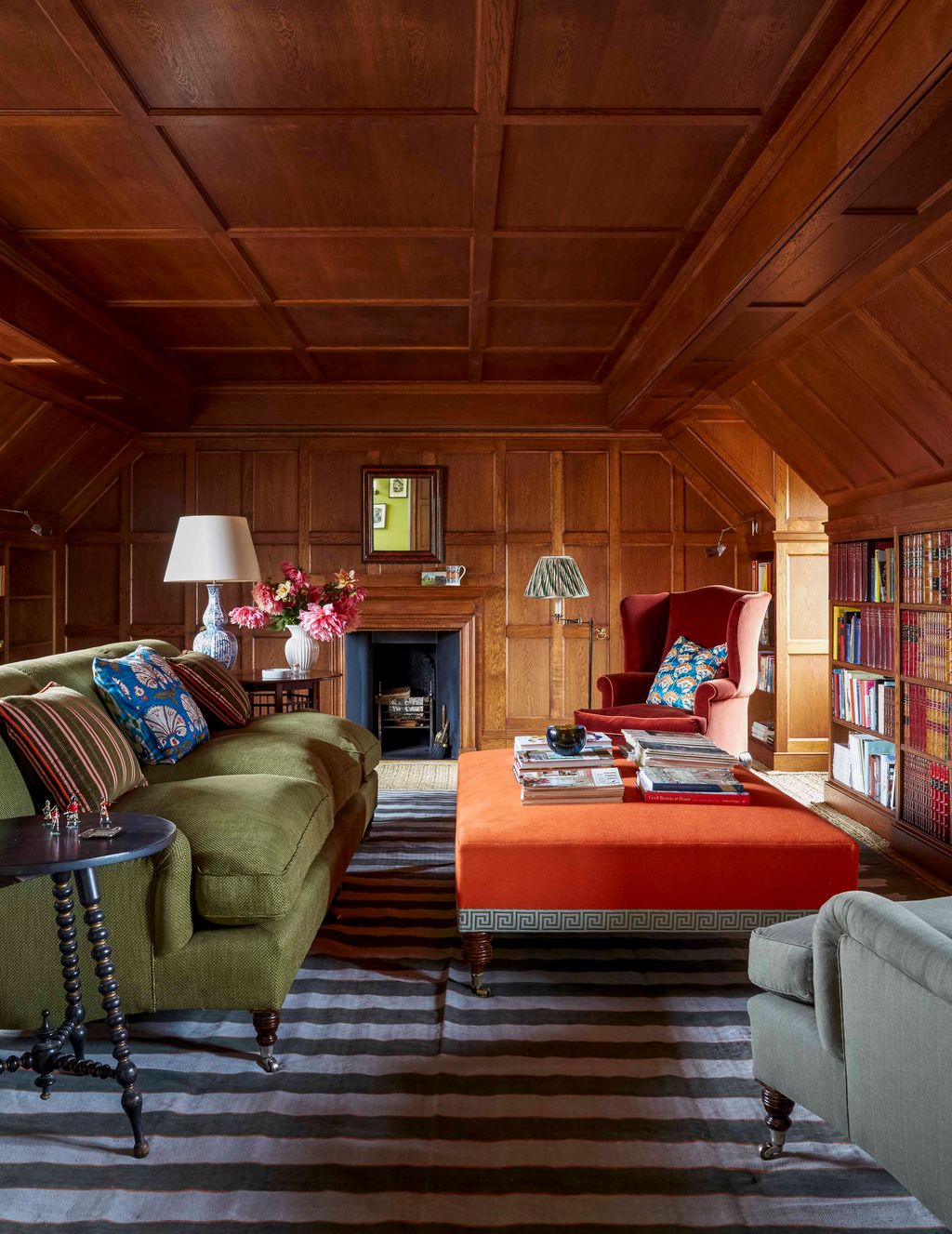
Elsewhere in the same house, wooden panelling clads the walls, making for a cosy and warm atmosphere. The orange ottoman in this room was designed by Ben and covered in a Pierre Frey fabric with a Samuel & Sons braid.


 Paul Massey13/15
Douglas Watson Studio supplied the tiles for the unusual fireplace. On the floor is an antique kilim.
 Paul Massey14/15
This house in London has been carefully and meticulously restored to its full Arts and Crafts-era glory by Brandon Schubert. In the dining area, panelling, designed by Brandon, in Farrow & Ball’s ‘Blue Gray’ frames a painting sourced from A.Prin and an Arts and Crafts steel grate with a fire surround in Mandale’s ‘Derbyshire Fossil Limestone’. Johannes Andersen chairs in a Pierre Frey fabric partner a Twenties Heal’s table from Miles Griffiths Antiques.
 15/15
15/15The bathroom upstairs is papered in ‘Willow Bough' – a classic William Morris print.


