
Interior designer Ben Pentreath turns his hand to an Arts and Crafts house

We call this colour “freshly laid cowpat”,’ says the designer Ben Pentreath of the greeny-brown grasscloth used on the bedroom walls of this house in north London. ‘That’s how we sold it to the owner.’ Ben is particularly fond of this colour; he used it in his own house, which was featured in House & Garden in August 2016. She laughs and admits to being totally sold on Ben, who has helped her make some brave decisions. The house, built in 1910, in an area of Arts and Crafts houses, was dark and very tired when she and her husband bought it four years ago. ‘There were lots of small rooms, but no obvious main sitting room,’ says her husband.
Chris Pask of Charlton Brown Architects had just begun the task of turning two ground-floor rooms into one big living room when Ben came on board. ‘The first thing was restoring the panelling in here to emphasise its Arts and Crafts sensibility,’ says Ben. His office drew the design and it was made by Symm, along with the rest of the joinery. ‘I wanted this room to feel calm and soothing,’ adds Ben, looking round at the neutral tones of the paint, fabrics and rush matting.

Ben’s interiors are known for a layered feeling, a mix of objects of different eras and styles, so his rooms appear to have been put together over many years. The layers in the living room include a Sixties-style brass cocktail trolley, twentieth-century abstract paintings, vivid Svenskt Tenn cushions, a nineteenth-century mahogany library table, a Chinese bowl and some mochaware mugs arranged, with bashed-but-beautiful brass candlesticks, on the mantelpiece.
There are many other touches of brass throughout the house, but the Seventies-inspired dining room, with its grasscloth walls, is the brassiest of all. A mirror-brass sideboard, designed for the room by Rupert Bevan, reflects the maze pattern of the rug, and there are chunky brass candlesticks on the table with a Stilnovo mid-century hanging light overhead.

If the dining room is perfect for entertaining, the kitchen is a scene of architectural piety. In a handsome new wing, Chris has paid tribute to Edwin Lutyens’ majestic kitchen at Castle Drogo, Devon, finished in 1930. Daylight floods in from the central dome and from curved windows in the arched walls, lighting a vast marble-topped island. Beside the metal doors, made by Clement, that lead to the kitchen garden, there is an oak table in the Arts and Crafts style. The rush-seated Ernest Gimson-inspired chairs were made by the Warwickshire-based craftsman Lawrence Neal.
The pendulum swings back to the mid century in the small office space next to the kitchen, with its Danish rosewood desk and orange Hans J Wegner ‘Wishbone’ chair, and continues into an informal sitting room nearby, with walls in a graphic print fabric and a cheery yellow roman blind in Christopher Farr Cloth’s ‘Meander’ linen.

Up the stairs, a William Morris wallpaper is the background for a grid of framed pressed ferns. A spare room, which opens directly off the landing, is papered in Morris & Co’s vivid ‘Fruit’ pattern. ‘I’ve always loved William Morris, but I would never have dared to put those wallpapers so close together,’ says the owner.
Things are quieter in the main bedroom, where the grasscloth walls provide a calm background for a yellow sofa in the bay window and a beautiful table at the end of the bed. Its shape looks convincingly mid-century, but it was designed in the Pentreath office and made by Rupert Bevan. Concealed on the underside of the hinged tabletop – with clever springs and no trailing wires – is a television screen. The adjoining dressing room has two walls of cupboards with ikat fabric panels. It leads to a glorious bathroom, papered in Morris & Co’s ‘Willow Boughs’, with brass-framed mirrored cabinets and a brass stand for the twin sinks.
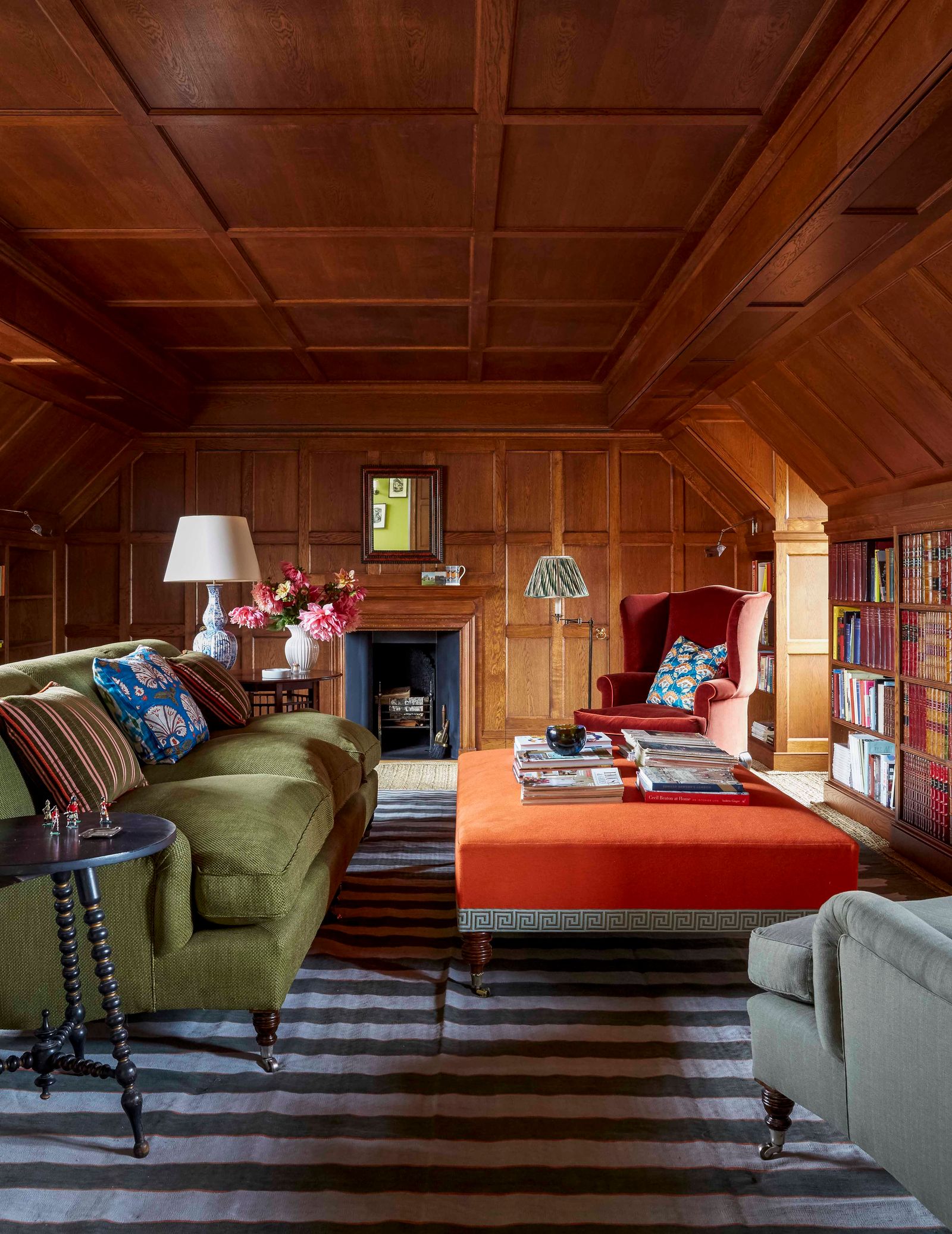
In the attic, the husband’s study has views over the red-tiled roofs of other houses of the era and reflects their colouring in its dark panelled walls. These are joined by a claret wing chair, a green sofa and an orange ottoman. ‘The husband especially wanted a dark panelled room. They both have strong tastes and are such good fun,’ says Ben. Both agree working with him has been a joy – for his efficiency, and for a home that is fascinating to look at and easy to live in. It has also introduced them to new things: they now collect, among other things, Arts and Crafts furniture, Edward Bawden paintings and Sixties glassware. It is a house with as many layers as a mille-feuille.
In our October issue, on sale now, you can see exclusive images of an Oxfordshire stately home which Ben has completely transformed. Subscribe or download now to read the full story. Ben has also written a new book ‘An English Vision: Traditional Architecture and Decoration for Today’ which will be published on September 24.

 Paul Massey1/7
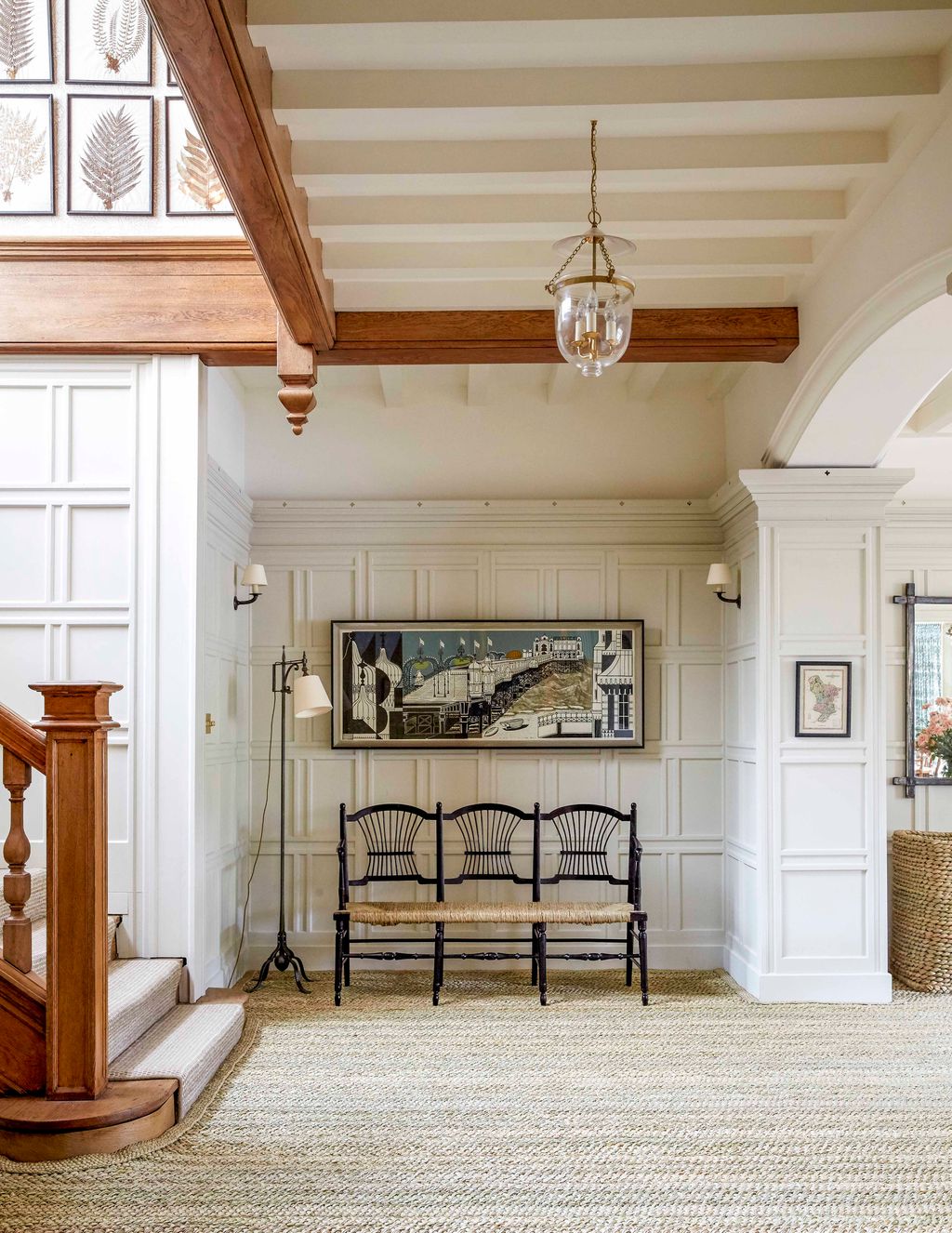
A ‘Sussex’ bench by William Morris and a linocut by Edward Bawden stand out against the panelling, which is painted in Farrow & Ball’s ‘Shaded White’.
 Paul Massey2/7
Near the doors to the drawing room is a Thirties table from Holly Johnson. To add texture to the hall and drawing room, Ben chose rush matting from Waveney Rush. Its handwoven and hand-sewn ‘Traditional Rush Matting’ costs from £258.21 a square metre. It needs to be sprayed with water once every four to six weeks to prevent it drying out and becoming brittle.
 Paul Massey3/7
In the dining area, a runner by Roger Oates was turned into a rug. The bespoke table was made by Christopher Clark Workshops. The chairs in the kitchen are by Lawrence Neal, who crafts chairs using rushes from local rivers.
 Paul Massey4/7
Beside a Luke Irwin rug is a sofa covered in Manuel Canovas ‘Kansas’ fabric, in the anis colourway, from Colefax and Fowler.


 Paul Massey5/7
The cupboards in this room, which leads into the main bathroom, are lined with a Robert Kime ikat.
 Paul Massey6/7
Douglas Watson Studio supplied the tiles for the unusual fireplace. On the floor is an antique kilim.
 Paul Massey7/7
The bedside table is from Christopher Hodsoll. In this room Ben has used the William Morris wallpaper ‘Fruit’ (lime green/tan). It is sold in 10-metre rolls and costs £73 from Style Library.


