
Jacques Grange brings humour and exuberance to Pierre Passebon's Paris apartment

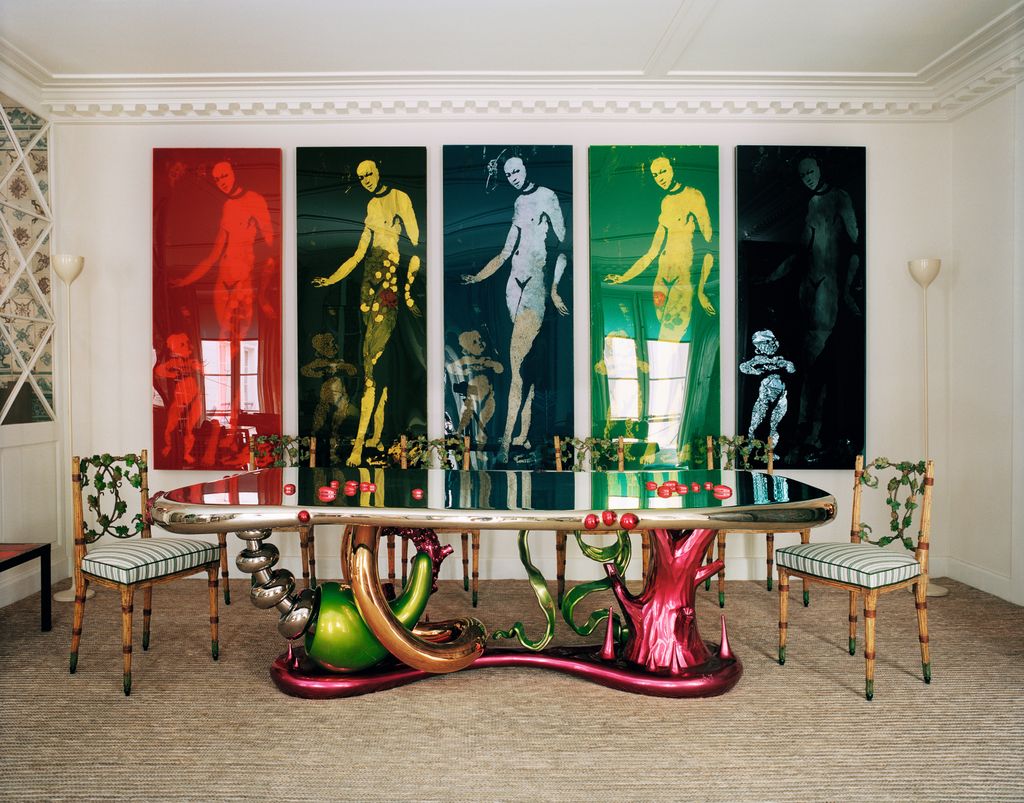
bronze and steel by Mattia Bonetti, and on the wall behind it, the five-panel pop art work Amore Mio by Gino Marotta.Francois Halard
On entering Pierre Passebon’s 1820s Directoire apartment in the historic center of Paris, no guest can remain indifferent to the sight of a spectacular sixteenth-century Italian marble fireplace carved in the form of a grotesque gaping mask, set in a chimney breast lined with French black-and-white marble checkerboard tiles. (The black-and-white motif was inspired by Siena’s famous cathedral.) This kind of aesthetic jolt is what has made Passebon’s Galerie du Passage in Paris an essential source for artistic clients looking for unusual designs, from furniture to ceramics and textiles. The rest of the room is furnished with a carefully assembled collection of paintings, artist’s furniture, and decorative art that speaks volumes about the owner’s eclectic tastes, and his life’s work as an art dealer and antique collector.
For his apartment renovation he teamed up with his life partner Jacques Grange, opening up the interior to create an airy and more fluid space to show off a spectacular collection of modernist furniture by Paul Poiret, Jean-Michel Frank, and the Vienna Workshop. These treasures seamlessly share the space with a custom-made quilted sofa designed by Jacques Grange, furniture once belonging to Madeleine Castaing, a painted panel by José Maria Sert, and a tea table by Claude Lalanne. Yet, these salons remain a model of restrained elegance in the impeccable taste of their arrangements of furniture and objects spanning centuries and world cultures.
MAY WE SUGGEST: Yves Saint Laurent's spectacular Tangier villa with interiors by Jacques Grange
It is in the dining room that Pierre’s provocative sense of humor and unrivaled flair for surprising juxtapositions bursts into view. The room is dominated by Gino Marotta’s five-panel Amore Mio, where Cranach collides with pop art, a set of Italian dining chairs bearing the initials of the Colonna family, and Mattia Bonetti’s beautifully crafted, phantasmagorical Abyss dining table (2004) in vibrant hues of cast bronze and aluminum nickel. Here, there are no rules except for exuberance and delight.
 Francois Halard1/10
A Nabis screen dominates the salon. Sofa designed by Jacques Grange.
 Francois Halard2/10
The living and dining room, with a table and chairs by the Atelier Martine. On top of the cabinet, a pair of bronzes by Franz von Stuck.
 Francois Halard3/10
A pair of bronzes by Franz von Stuck.
 Francois Halard4/10
Displayed on the walls are original plates from Pierre Passebon’s remarkable collection of comic strips. The day bed was designed by Jacques Grange.


 Francois Halard5/10
The dining room is filled with rich, vibrant color, with a dreamlike Abyss table in colored bronze and steel by Mattia Bonetti, and on the wall behind it, the five-panel pop art work Amore Mio by Gino Marotta.
 Francois Halard6/10
On the writing desk, a pair of bronzes and an Egyptian mask. Lamp by Marc du Plantier.
 Francois Halard7/10
Coffee table by Claude Lalanne. Carpet by Mattia Bonetti.
 Francois8/10
Part of Pierre Passebon’s eclectic collection of furniture and objets d’art.


 Francois Halard9/10
A tapestry screen by Edward Burne-Jones stands behind an American Arts and Crafts armchair.
 Francois Halard10/10
The sixteenth-century Italian marble fireplace in the form of a grotesquemask.


