
Classicism meets modernism at the Spitalfields house of the owners of Jamb

The street in east London where the owners of Jamb, Will Fisher and Charlotte Freemantle, own a house, feels a world away from the broad avenues of Chelsea where they have their shop. Narrow and crowded with tall, spindly Georgian houses, these are streets that have been home to industry and trade since they were first developed in the seventeenth century, and they retain the energy and vitality of centuries of commerce.
Will first tried to buy a house in Spitalfields nearly 30 years ago. It was one of the Huguenot weavers’ houses on Elder Street, where the Spitalfields Trust had been campaigning to save buildings from demolition. The houses were preserved and became part of a conservation area, but Will wasn’t destined to own one; it was swept out from under him by another buyer on the day of exchange, and a couple of decades of regret ensued. So when a chance to buy this house nearby came along, Will and Charlotte decided to pounce. No matter that the house was occupied by a commune of squatters, and that the couple’s lawyer beseeched them not to go ahead. “I met with the head guy of the commune,” says Will, “and said, ‘Look, are you actually going to leave if I buy this house?’ He assured me they would go and they were absolutely true to their word.”
The house itself emerges from the tangle of shops below, a late 19th-century building spread over five compact floors and culminating in a roof terrace that looks out towards the skyscrapers of the City. Various qualities of the house, and the interplay between them, caused Will to fall in love with it. “It finds itself slightly confused between whether it is residential or commercial,” he explains. “It also has the feeling of a New York house to it, and it was built (like many New York houses) at a time when classical elements remained in the architecture but everything was also moving towards modernism. It feels like the perfect place to explore that fusion or transition between the historical, antique world we live in at Jamb, and the modern world.”

In their design for the house, Will and Charlotte have tried, as he puts it, to weave together all of the worlds the house evokes. The commercial element remains: originally home to a milliner’s shop, the building still houses a shop on the ground floor. A solidly elegant wooden staircase that Will loves – “There’s no nonsense to them; the balustrades are almost something you might tether a barge to” – leads you up to the first of four residential floors. Both in the overall decoration and in the pieces that furnish the rooms, the relationship between the simplicity of the Huguenots and that of the modernists has been fully explored.
The structure of the house itself is simple and pleasing. A drawing room on the first floor and two bedrooms on the second and third each take up the entire width of the house, while more utilitarian areas run towards the back of the house in an L-shape. A dining room and kitchen stretch backwards off the drawing room, while dressing rooms and bathrooms lead off the bedrooms. The most significant addition was the roof terrace, added by Will and Charlotte and brought into a seamless flow with the rest of the house. The iconic skyline of the City looms to one side, adding to a sense that the house might be a New York residence in disguise. “There’s an excitement to that view,” says Will. “You go up and up and you don’t know quite what you’re going to find up there.”
The various spaces are unified by a soft, elegant colour palette that conveys both the restraint of an 18th-century industrial premises and a Kettles-Yard-like spirit of modernity. The interior architecture has been sensitively restored: Will recounts the hours he spent with a builder friend, Robert Hilton, building in the dressing rooms, restoring the staircase, and obsessively poring over the minutiae of mouldings. Panelling in the bedrooms references the Huguenot house they loved and lost, but in its spareness and elegance it feels strangely modern at the same time. What Will calls a “clerk’s screen” has been installed between the kitchen and dining room—this is both a practical solution for separating the open-plan space and a reference to the house’s commercial history.

As ever with Jamb, what makes these interiors special is the blend of extraordinary pieces. Lighting and furniture designed by Will and Charlotte for Jamb that take inspiration from the house live happily here, of course, alongside serendipitous finds that just make sense for the rooms. “The first time I started decorating it,” recalls Will, “I felt there were things that didn’t quite sit right, and then in the fullness of time I found the missing bits. You have to find the thing that, as my old mentor Warner Daley said, looks like it has grown roots there. It’s hard to look at something on a piece of grass at an antiques market and know if it’s extraordinary, but it’s when you put it into an environment that you see it come alive.”
Not many people would be happy to entrust such a house and its beautiful contents to tenants, as Will and Charlotte now do. But it has been a project based on serendipity, and each tenant that comes through the door stays for years. “It’s been a blessed building with fabulous custodians,” says Will. “I like presenting people with an environment for people to enjoy. They can take all of this and incorporate it into their own lives.”
Jamb is a member of The List by House & Garden, our essential directory of design professionals. Visit The List by House & Garden here.
 Mark Anthony Fox1/17
The drawing room is decorated with several pieces from Jamb, including the ‘Batsford’ dish light hanging overhead. A late 19th-century stone chimneypiece provides a focal point, with a ‘Chamber’ fire guard in front. The mirror hanging over the fireplace is also a Jamb design.
 Mark Anthony Fox2/17
Jamb's ‘Klismos’ chair in the foreground faces a ‘Hanbury’ sofa across an antique rug and a glass coffee table based on French designs from the 1930s. The cushions on the sofa are from Howe London.
 Mark Anthony Fox3/17
A mid-century bronze lamp stands on the plinth in the corner, with an ebony side table in front. On the mantelpiece is a giallo antico marble tazza.
 Mark Anthony Fox4/17
A textile by Grayson Perry hangs above a 17th-century chinoiserie chest; a tribal ebony figure stands in the corner.


 Mark Anthony Fox5/17
Looking from the drawing room into the dining room, where a pair of Jamb's ‘Apsley’ dish lights lead the eye towards the kitchen. The ‘Cruxton’ table, with its Arts & Crafts form and brass top, was developed especially for this house; a pair of late 19th-century benches provide seating. A glass dome by Jamb houses tribal sticks, while wall storage comes in the form of display cabinets from the British Museum.
 Mark Anthony Fox6/17
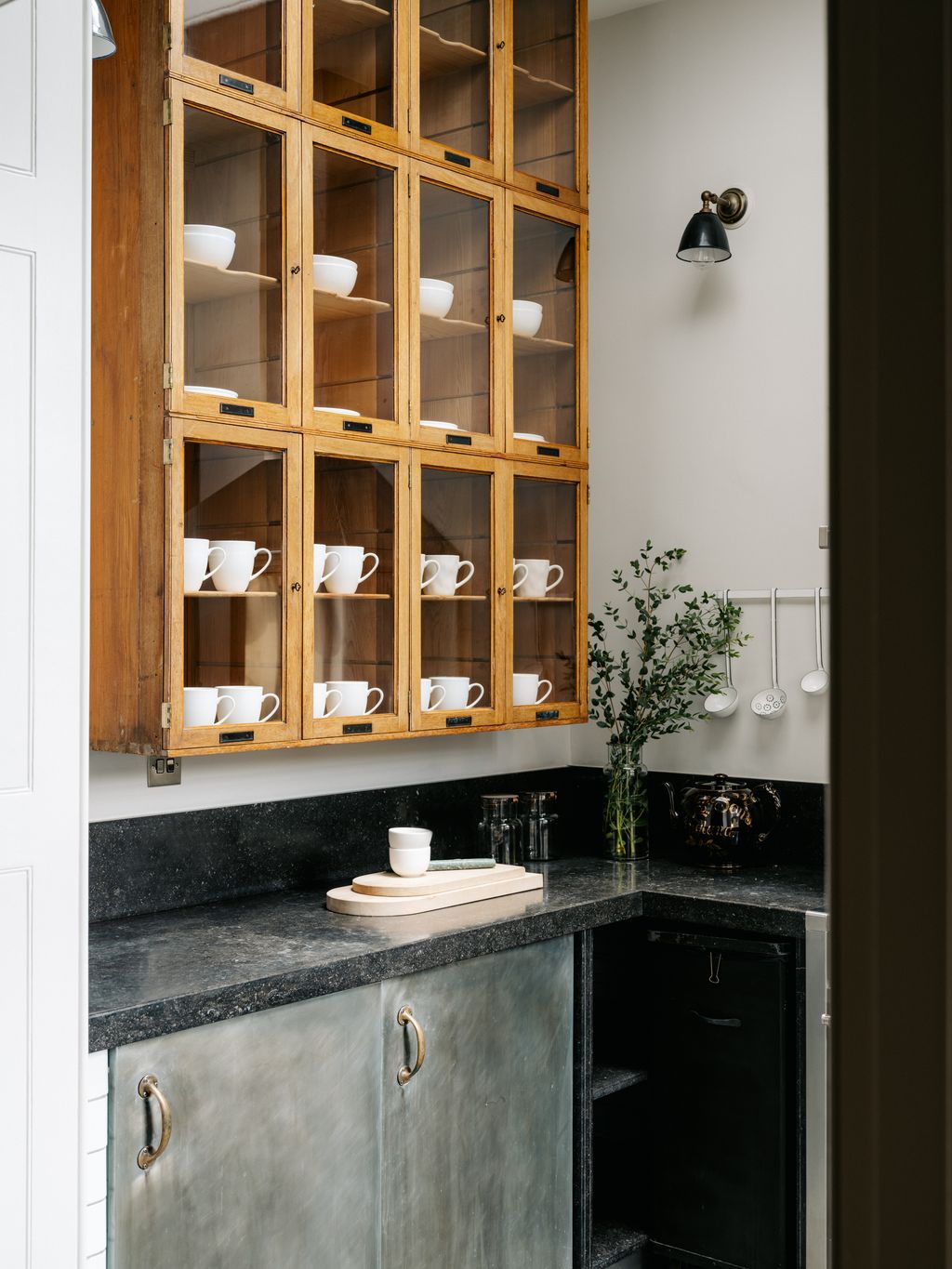
A towering antique cabinet from the British Museum takes up the wall on the left hand side of the kitchen. On the right is a plate rack from Jamb.
 Mark Anthony Fox7/17
‘Croft’ wall lights have been used in the kitchen, along with an Irish fossil worktop and zinc cupboards with antique brass handles.
 Mark Anthony Fox8/17
The sink is in hand-beaten brass.


 Mark Anthony Fox9/17
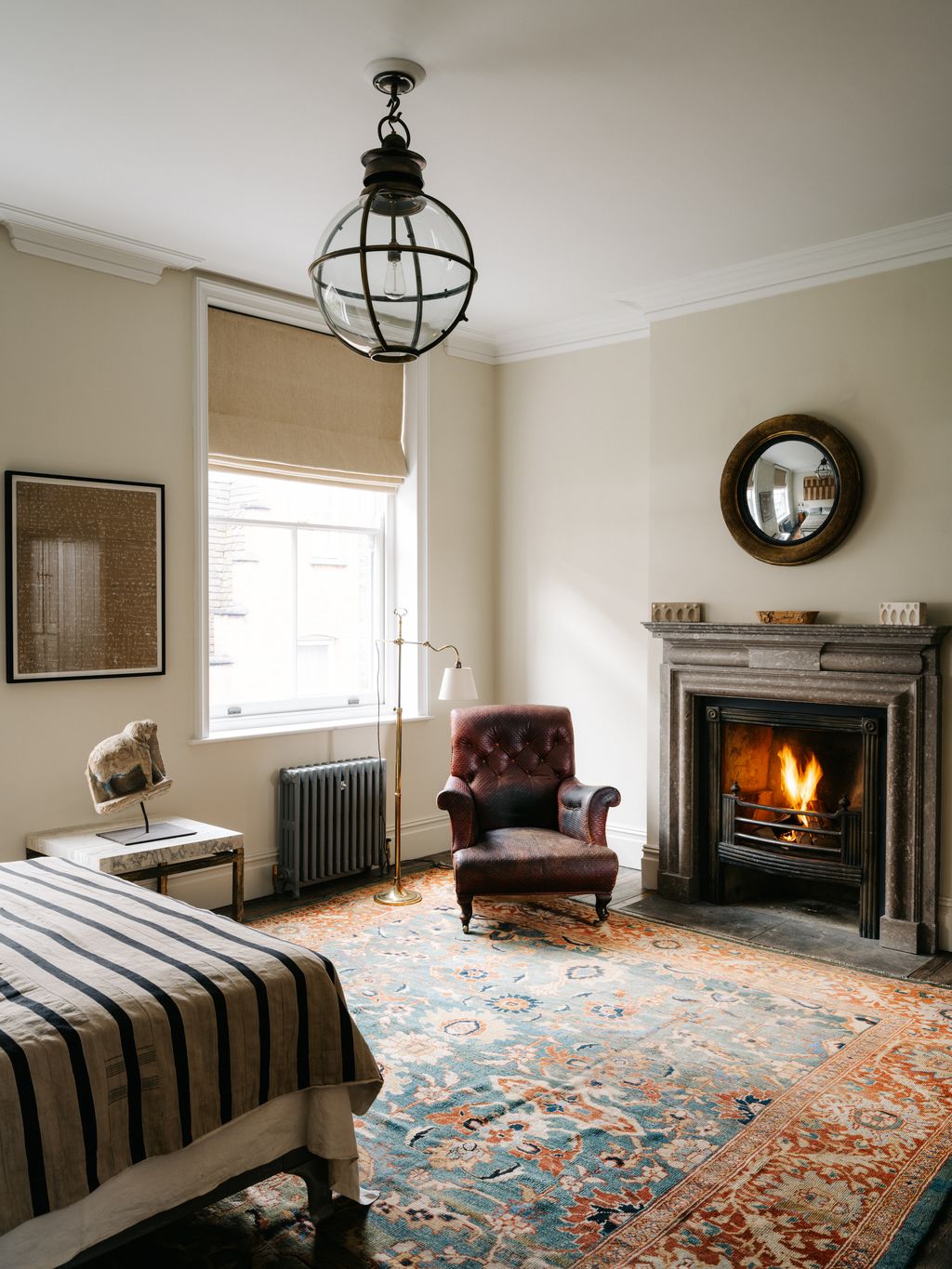
Collected fabrics add colour to the bed in the main bedroom, along with an antique African textile hanging above the bed. A ‘Baxter’ table light stands on a ‘Perwick’ side table next to the bed.
 Mark Anthony Fox10/17
A ‘Morton’ globe light hangs overhead; the carpet is antique.
 Mark Anthony Fox11/17
At this end of the room is a ‘Lutyens Bolection’ chimneypiece in Derbyshire fossil with an antique mirror above; the ‘Cobblers Stool’ is also from Jamb.
 Mark Anthony Fox12/17
A 19th-century Buddha stands on an early 19th-century teak campaign chest of drawers with assorted works of art, including a Tracey Emin.


 Mark Anthony Fox13/17
The main bedroom leads via a dressing room into this bathroom, where an antique French cupboard serves as a bathroom cabinet.
 Mark Anthony Fox14/17
A generous double basin sink from The Water Monopoly takes up one wall in the bathroom, with an equally expansive marble-lined shower behind. ‘Conroy’ wall lights from Jamb are fixed above.
 Mark Anthony Fox15/17
The second bedroom, with a bespoke chimneypiece in Peacock Eye marble.
 Mark Anthony Fox16/17
In the second bathroom is a reclaimed Victorian cast iron bath with a shower curtain from Balineum, and a ‘Ruhlmann Wine Table’ from Jamb.


 Mark Anthony Fox17/17
The roof terrace has views over the city, with a bespoke table made for the space.


