
From the archive: a London flat packed with clever small space ideas (2013)
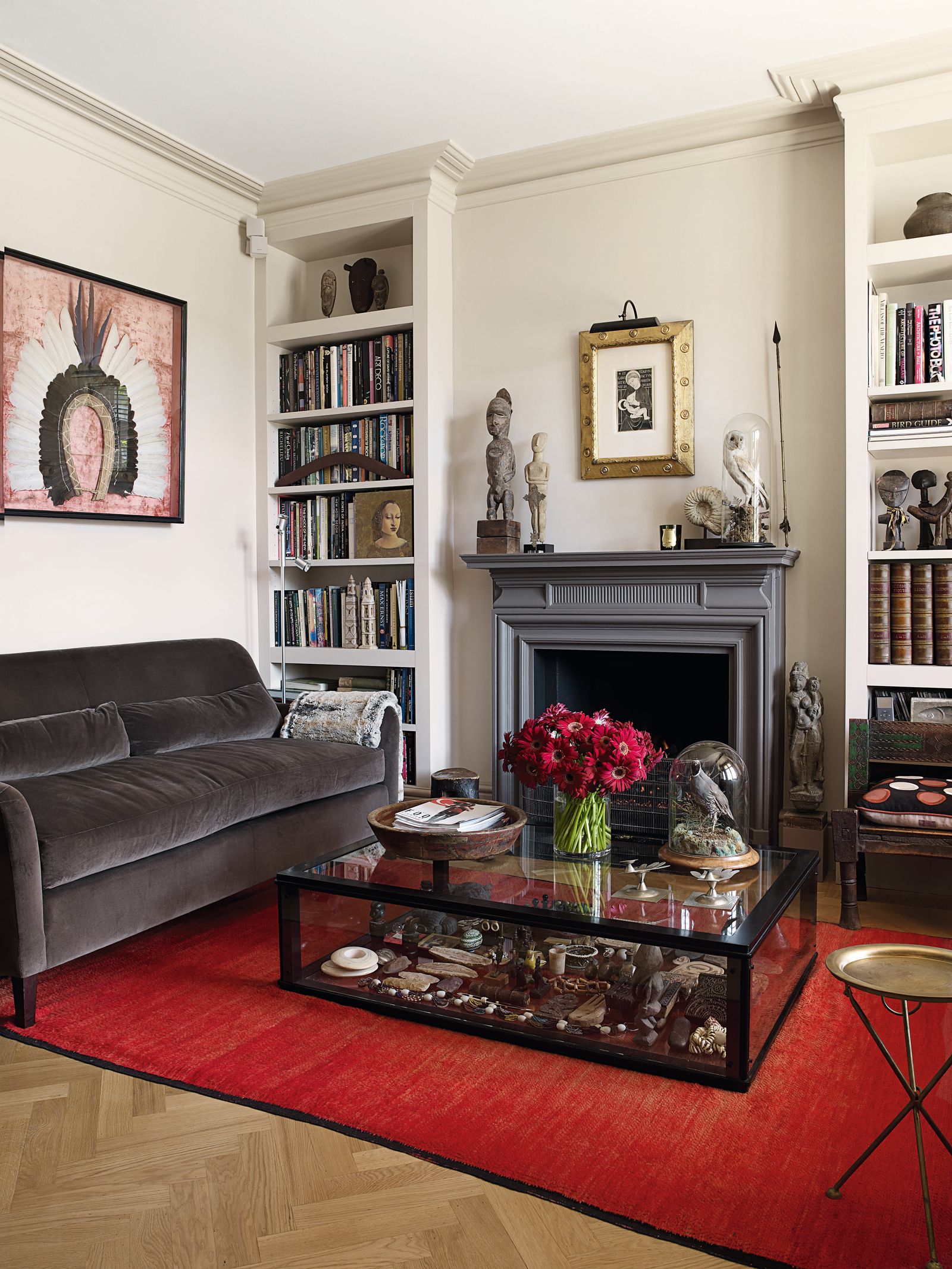
Not many people can say they were brought up in the Dorchester, but then Jane Taylor's family just happened to own it at the time - her father, Alistair McAlpine, was actually born there. It may sound like a privileged upbringing, but in the flesh Jane is as jolly and self-deprecating an interior designer as you could hope to meet. 'No, really!' she chortles as we joke over coffee and croissants. Her home is surprisingly modest too: a two-bedroom flat in an Edwardian mansion block in Chelsea, where she has lived for the last 25 years with her husband, Simon, and their son, Henry.
But what an apartment! Though flats such as this were purpose-designed, they're often an awkward shape, and this one is no exception. There are two flats on each floor of the block, separated by a central staircase, and they're far deeper than they are wide.Jane's is to the right of the stairs, and like the others, her entrance door opens into a long, high and potentially rather gloomy corridor that connects the front rooms to the back. The sitting and dining rooms at the front have bay windows overlooking a small front garden. Immediately behind are two more rooms: the kitchen, entered from the sitting room, and the main bedroom, entered from further down the corridor. At the far end of the corridor is Henry's room and a shower room.

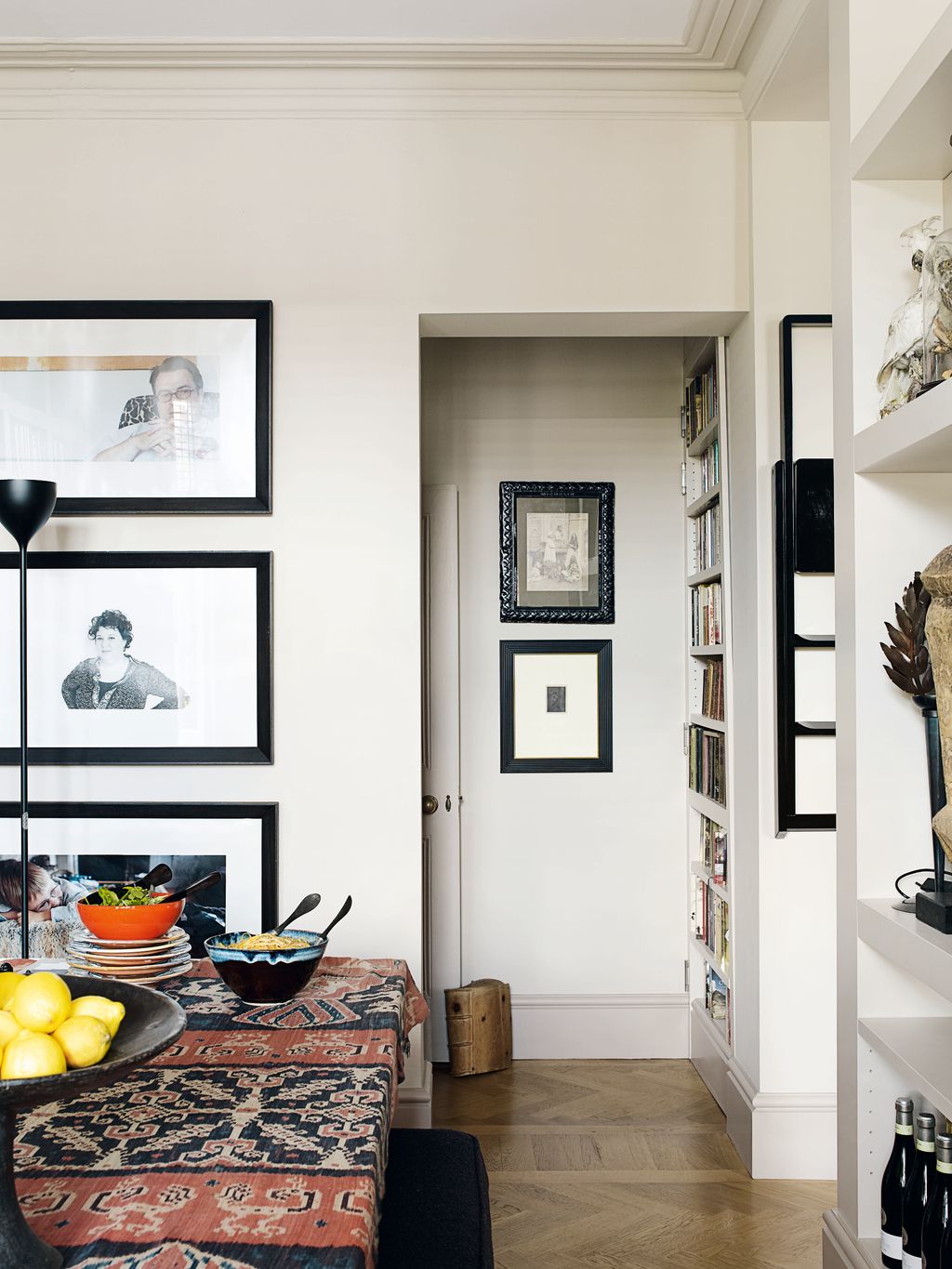
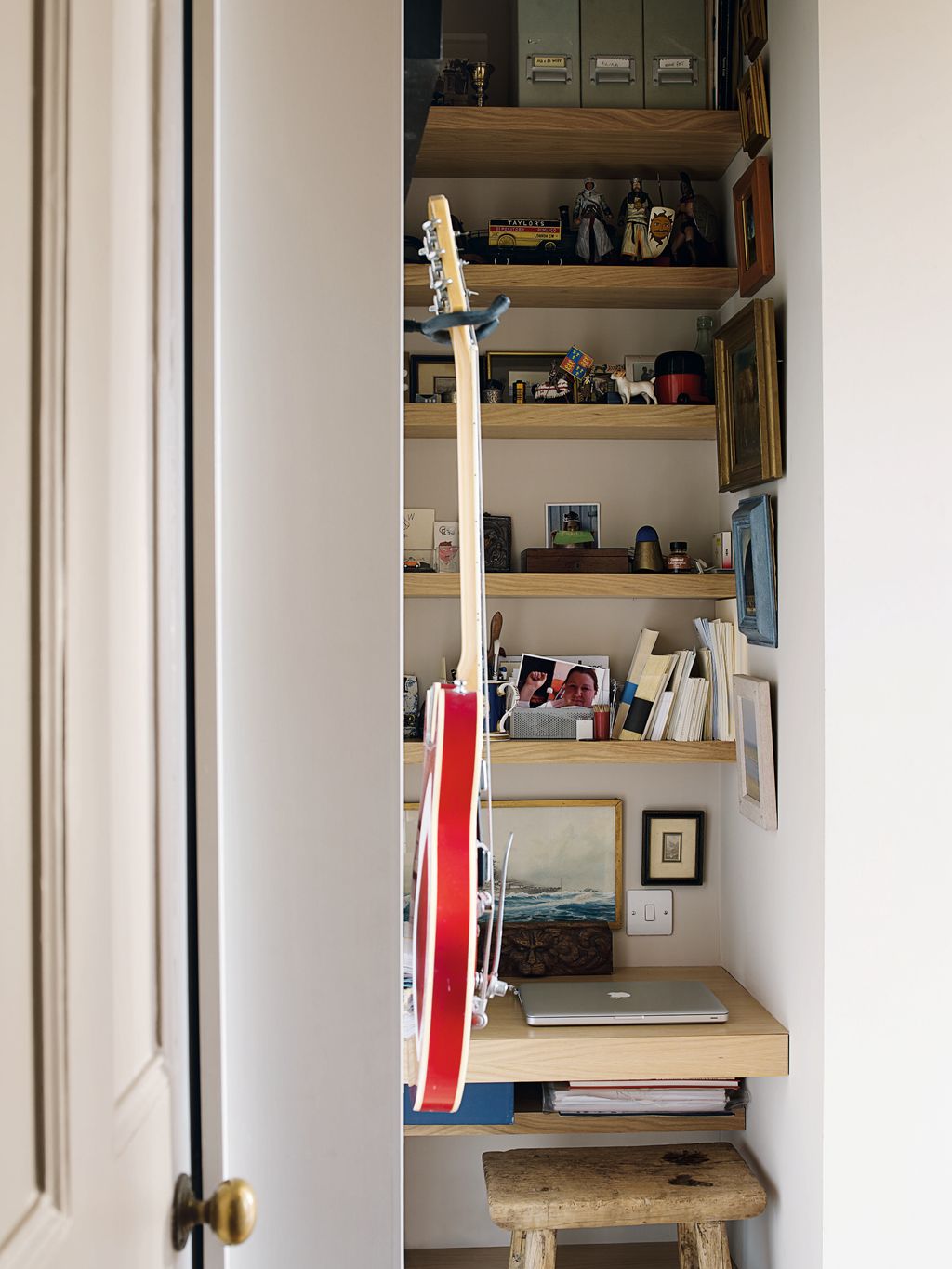
It's a conventional enough layout, but this particular London flat is a cross between a cabinet of curiosities and a box of brilliant, space-saving tricks. The curiosities are mainly thanks to Simon, a publisher, who has a thing for stuffed birds and animals;Jane shows me a slightly wonky armadillo that she brought back for Simon from Texas, whose tail rather suffered in transit. Books, as you'd imagine, are much in evidence too, and it's in the design of the bookshelves that Jane's genius first becomes apparent. The large set in the dining room incorporates jib doors that open into Jane's office, while another set conceals a little desk and set of shelves for Simon. The CD shelves in the sitting room, for their part, clip back into place to form the entrance to the kitchen. My favourite innovation, though, is the way that a picture of Jane's mother by the painter Bryan Organ - his first portrait -slides aside on hidden runners, enabling another set of bookshelves to open and give access to a hidden cupboard behind.

The sitting and dining rooms are full of further space-saving devices. The window seats lift to reveal storage space beneath, and the flat-screen television rises, at the touch of a button, from the base of the display cabinet that divides the sitting room from the dining room. 'This was originally one long room,' explains Jane, 'and I had to convince Simon and Henry that dividing it up like this wouldn't make it feel smaller. We'd never really used the space in the middle anyway, and though they took a bit of convincing, they're totally converted.' Even the box-bench seats on either side of the dining table turn out to have a second function: they're hollow, with runners inside from which hang suspension files for Jane and Simon's paperwork.
The all-white kitchen makes good use of a relatively narrow space. Curved shelves and cupboards round off awkward corners, and the drop-down kitchen table - MDF sprayed to a chip-proof white at a car-repair shop - is securely clamped to the radiator in the window. Ample cupboard and wardrobe space is also a feature of the main bedroom down the corridor, which has a feeling of spaciousness and calm despite its relatively small size. Painted in soft off-white, with a simple panelled motif repeated on each wall, it has its own smart little en-suite bathroom, whose double doors - mirror-faced on the inside - and slightly higher floor give it an extra touch of glamour (the floor conceals the plumbing). Jane's favourite element, though, is the mirror-glass dressing table, which fits neatly into the window- 'I'd wanted one for years,' she says.
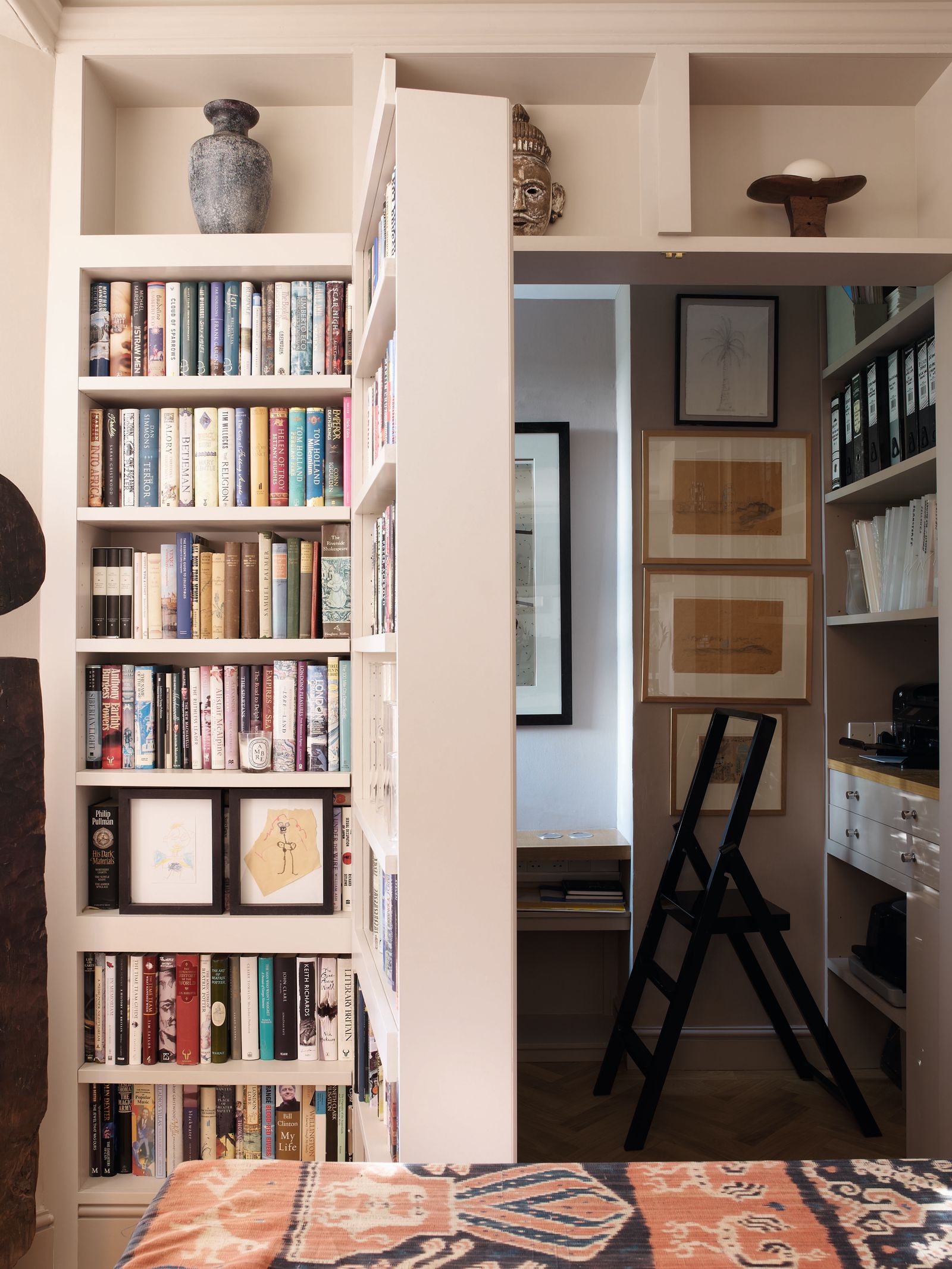
A door at the far end of the corridor, which is lined with family photographs, leads to Henry's self-contained domain, which has a shower room and an L-shape study-cum-bedroom. Filling the short arm of the L, tucked behind the shower room, is a stepped-up platform bed with its own little window. By now, I'm hardly surprised when Jane shows me how the bed swings up, revealing storage for sheets and duvet covers in a cavity underneath.
Jane studied at the Architectural Association, but fell into interior design almost by accident. Her first projects were kitchens, of the rather grand variety; at Hatfield House, Madresfield and Burghley her designs had to be fitted into the Grade I-listed interiors. Some time after that people started asking her to look at other rooms as well.Jane's projects range from a house designed as a series of pavilions on Mustique and a beach house in Lombok, to the riad-style house she designed with her mother, Sarah, and her mother's partner, Tommy, on the edge of Marrakesh. 'We both hate glaring blue swimming pools,' she says, 'so I came up with the idea of lining hers with pale pink plaster. It's lovely, like swimming in rose water.' More recently she has also designed a couple of restaurants: Machiavelli in Covent Garden and Manicomio in Chelsea.
I'm so impressed by her flat I tell her that if I could afford it I'd ask her to redesign my own. 'No, really!' she exclaims, as she helps me on with my coat. But I'm really not joking: I would.
 Sarah Hogan1/9
A flat-screen television is concealed within the space-saving cabinet, which also provides shelving for DVDs.
 Sarah Hogan2/9
Jane's husband, Simon, collects taxidermy; some of this is displayed in the cabinet that separates the sitting room from the dining room.
 Sarah Hogan3/9
Another bookshelf off the dining room swings open to reveal Simon's miniature home office.
 Sarah Hogan4/9
A guitar hangs on the back of the door to Simon's home office. The work space contains a desk and shelves.


 Sarah Hogan5/9
The kitchen table is made of MDF sprayed to a chipproof high-gloss white at a car-repair shop.
 Sarah Hogan6/9
The marble-topped kitchen units are softened with rounded edges.
 Sarah Hogan7/9
In the main bedroom, wardrobes are concealed behind the panelling.
 Sarah Hogan8/9
A mirror-lined dressing table fits into the window reveal in the main bedroom.


 Sarah Hogan9/9
The raised bed in Henry's bedroom lifts up to reveal extra storage beneath.


