
The remarkable transformation of a former cowshed into a timeless, elegant house

A single-storey office with foam ceiling tiles and caged strip lighting may not sound like the ideal environment for a home. In fact, when Jeremy Rothman and his wife Anna bought the property in 2010, they had no intention of living in it. They were based five miles down the road with their two – then teenage – daughters, in the Hampshire village of Bramdean. This space presented itself as the perfect workshop for Jeremy, who has been restoring and manufacturing fine giltwood furniture for clients, among them Jamb founder Will Fisher and the interior designer Nina Campbell, for the best part of 40 years.
By 2014, however, Jeremy and his team were fast outgrowing the workshop. At the same time, he and Anna were on the hunt for a new house. ‘We’d sold up in the village and had been renting the wing of a charming house nearby. But the owners put it on the market and we ended up with two months’ notice to move out,’ explains Anna, a trained textile designer who now works for Jeremy’s business, restoring pieces and producing exquisite hand-drawn designs. And so a plan was forged: the workshop would move to a larger location near Winchester (where it remains) and this freed-up space would become their home. ‘It has beautiful views across the fields – we couldn’t really contemplate living anywhere else,’ says Jeremy.

The first task was to make the space habitable, which the couple achieved over the course of a swift 10 weeks. ‘We stripped it to the shell, removed stud walls, added insulation and installed oak floorboards with underfloor heating throughout,’ recalls Jeremy. ‘I treated it rather like I would a restoration job in the workshop, cutting out all the bad bits and creating a clean palette to build on.
The office building, converted from a former cowshed in 1987, is in fact one of two barns the couple own, both clustered around a courtyard. It is an L-shaped building, one length of which – originally a warren of storage rooms, corridors and toilets – became three bedrooms and a bath- room, while the other now accommodates the pièce de résistance, a vast space containing the kitchen, dining area and sitting room. ‘We ripped the ceiling down to expose the beams, which gives this wonderful volume,’ says Jeremy.
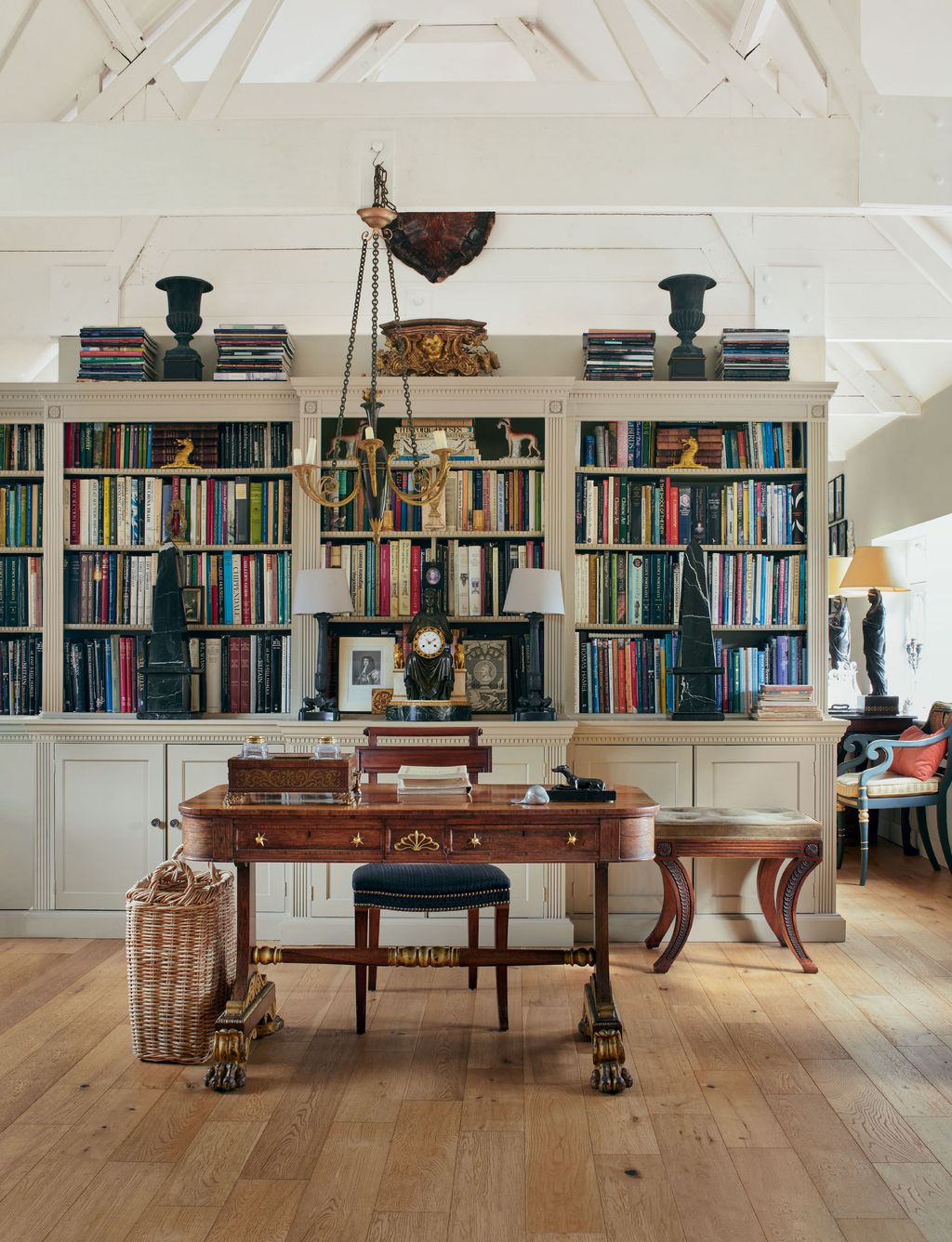
Aiding this increased sense of space are cleverly positioned partial dividers that create intrigue as to what lies beyond. A couple of half-walls separating the drawing room from a study area provide ideal hanging areas for Jeremy’s collection of giltwood mirrors, many of which he has crafted himself. A bookcase, made 20 years ago for one of the couple’s previous homes, divides the study from the kitchen-dining area, while accommodating Jeremy’s huge library of reference books. Anna says that the streamlined Ikea kitchen, arranged as a bank of units and an island, was chosen as a ‘quick and straightforward’ option, but, in fact, it forms a pleasing contrast with the rest of the antique-laden space.

The wall colours – a series of whites and soft greys – were the starting point for the decoration. ‘Anna and I have always been fascinated by whites, because they’re never just white,’ says Jeremy, gesturing to the walls of the sitting room, painted in Farrow & Ball’s ‘Old White’, which can read as both green and grey. ‘I’m Danish, so I guess that’s why I go for these colours,’ Anna adds. But the soft tones also provide a calm backdrop for the couple’s collection of 17th-, 18th- and 19th-century furniture, decorative arts and paintings. ‘We both love William Kent, as well as the Regency period,’ says Jeremy, pointing out a late-Regency rosewood desk at the far end of the sitting room, which used to be his mother’s dressing table, and a pair of marble-topped mahogany tables on either side of the Jamb chimneypiece the couple had installed. The sofas, based on a Regency carved mahogany sofa at Chatsworth, were made bespoke for the space and now form part of Jeremy’s own furniture collection. The four-poster bed in the main bedroom, based on a design in Thomas Chippendale’s The Gentleman and Cabinet-Maker’s Director, was another custom piece made by Jeremy’s workshop.
The couple’s obvious love of collecting underpins the house, even the more utilitarian rooms. The bathroom, for instance, which they had panelled to bring in an ‘old feel’, is a showcase for an array of greyhound prints amassed over the years. What is remarkable is how seemingly formal pieces – from giltwood mirrors to ormolu clocks – create a wonder- fully relaxed atmosphere. Take the vast painting of Jesus in the hall, partially concealed by a tallboy, which was picked up for a song from a West Country auction house 30 years ago, ‘Nothing here is of any great value, but I cherish all of it,’ says Jeremy, who shuffles pieces around every few weeks. ‘I like having it layered up – it’s almost as though we’re in a junk shop.’ That, the house most certainly is not. Perhaps the greatest accolade came from Nina Campbell, who visited recently: ‘If I lived in the country, this is the house I’d like to live in – exactly as it is now,’ she said. Praise indeed.
Jeremy Rothman | jeremyrothman.com
 Michael Sinclair1/8
A mid-20th-century painting of Rome hangs behind a marble bust of Caesar Augustus displayed on one of a pair of George II mahogany side tables sourced from the Olympia Art & Antiques Fair.
 Michael Sinclair2/8
Made for a previous home, the tall bookcase housing Jeremy’s reference books separates the open-plan kitchen and dining space from the study area with its inherited late-Regency rosewood desk.
 Michael Sinclair3/8
An ‘Onslow’ chimneypiece from Jamb is complemented by ‘Chippendale Gainsborough Chairs’ and two ‘Derbyshire Sofas’, based on a Regency carved mahogany design at Chatsworth and covered in Villa Nova’s ‘Geneva’ fabric, all from Jeremy’s furniture collection. The specimen marble-topped coffee table was made by a friend in Rome.
 Michael Sinclair4/8
The mahogany dining chairs were made by Jeremy's workshop, copied from a c1810 original, to partner a 19th-century French walnut table. Framed prints of kings, rescued from an old damaged book, are arranged on the wall.


 Michael Sinclair5/8
Farrow& Ball’s ‘Shaded White’ on the walls and ceiling showcases sleek Ikea cabinets, on top of which taxidermy fish are displayed. The ‘Regency Decorated Dining Chair’ with a striped yellow seat is from Jeremy’s collection, inspired by a Regency Grecian design.
 Michael Sinclair6/8
Panelling in Farrow & Ball’s ‘Old White’ creates a traditional, layered background ideal for displaying Jeremy’s collection of greyhound prints, amassed over many years. The sinks were bought ‘off the shelf ’ from Bathroom Warehouse.
 Michael Sinclair7/8
Framed Vogue covers and antique butterfly specimens line walls in Farrow & Ball’s ‘Light Gray’.
 Michael Sinclair8/8
The four-poster bed, made by Jeremy’s workshop and based on a Thomas Chippendale design, was the starting point for this room. Flanking an early 18th-century Italianate painting bought at an antique shop in Stockbridge are Jeremy’s giltwood ‘Adam Oval Ram’s Head Mirrors’. The cotton velvet cushions on the bed came from H&M Home, while the ottoman at its end has been cleverly upholstered in a leftover offcut.


