
The colourful Hackney workshop of stained-glass artist John Reyntiens

'Can you imagine, in the Middle Ages, seeing stained glass for the first time? It would have blown you away,' enthuses the second-generation stained-glass artist John Reyntiens, talking about the period when its installation became widespread in English churches. When John was growing up, his father often took him to visit early examples, which combined chromatic wonder with storytelling. Patrick Reyntiens' designs bridged the figurative and abstract; with John Piper, he designed and created magnificently scaled, jewel-hued windows for the modernist cathedrals of Liverpool and Coventry. Today's landscape is trickier: with few new churches and the post-Second World War stained-glass renaissance long over, there is less scope for such commissions. 'And no one really needs stained glass,' adds John. 'You have to convince people of its beauty. It's about colour and the dimension that light brings to it.'

Under the name Reyntiens Glass Studio, John, who is also Master of the Worshipful Company of Glaziers and Painters of Glass and received an MBE in 2023, works out of a studio complex in a former cigarette factory in Hackney. He has been here since 1996 and now has two sizeable workshops. John describes his own practice as spanning 'art, craft and restoration'. In the downstairs space, when we visit, he and his team of three are hand moulding replacement lead strips for original panes from a historic City of London building and renewing the watertight cementing by way of an oily putty. Other notable projects include the reglazing and restoration work at Big Ben. There is also still occasional call, says John, for new ‘traditional’ windows. In 2011-12, he designed Her Majesty's Diamond Jubilee Window for the Palace of Westminster, with a heraldic shield and stained-glass painting carried out by master craftsmen.
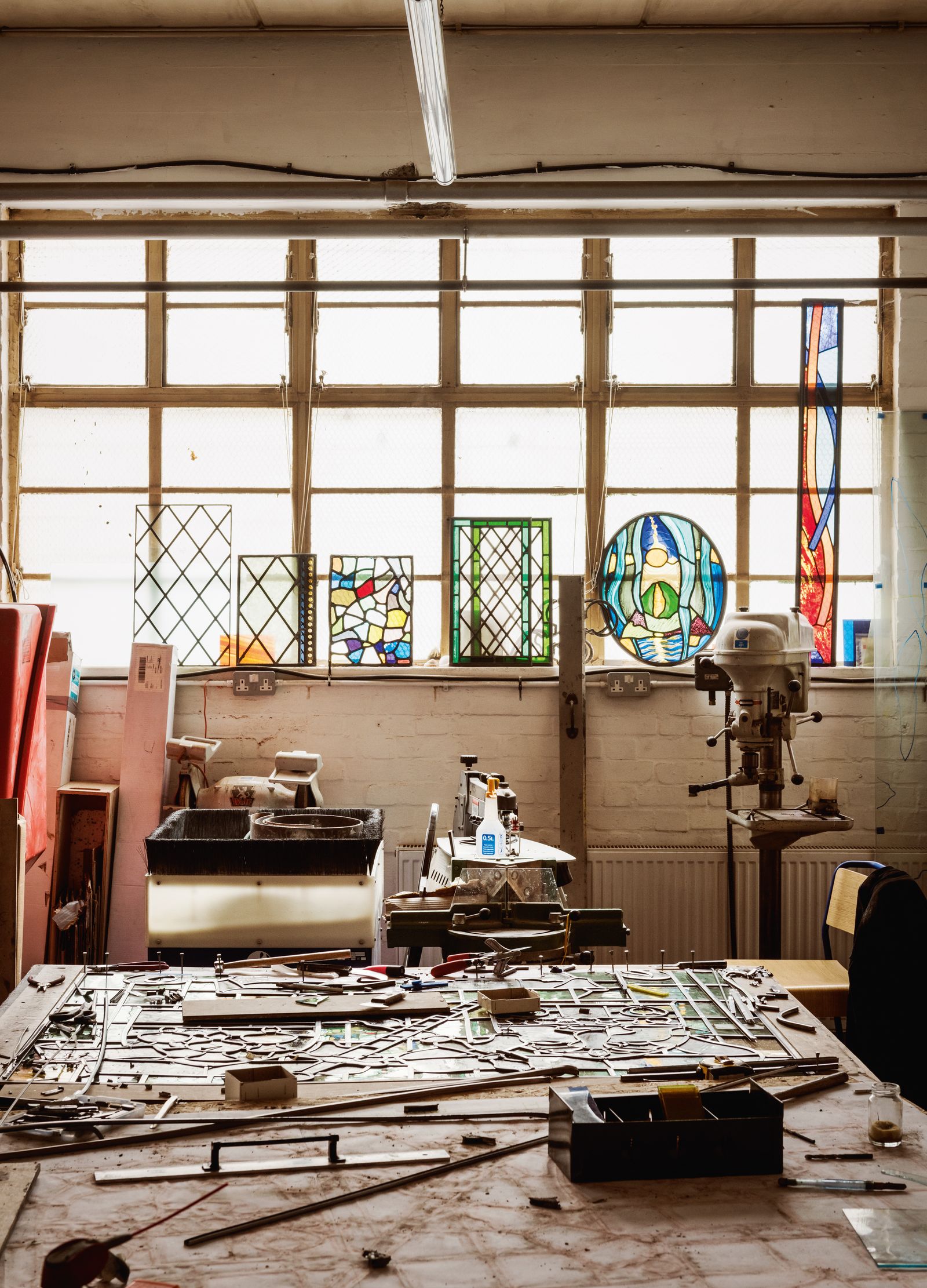
In parallel, he has collaborated with Annie Morris on the stained-glass window in The Painter's Room bar at Claridge's and installed vibrant creations in private homes. It is in the upstairs space, amid shelves holding coloured glass imported from France, Germany and the US, that such contemporary possibilities are explored. There are tonal test panels 'for a cathedral that hasn't quite finished its windows', designs that make use of light boxes and intriguing Pop-art-leaning experiments. (John once wrote to Roy Lichtenstein to ask if he had considered the medium of stained glass; correspondence ensued - though regrettably without consequence.)
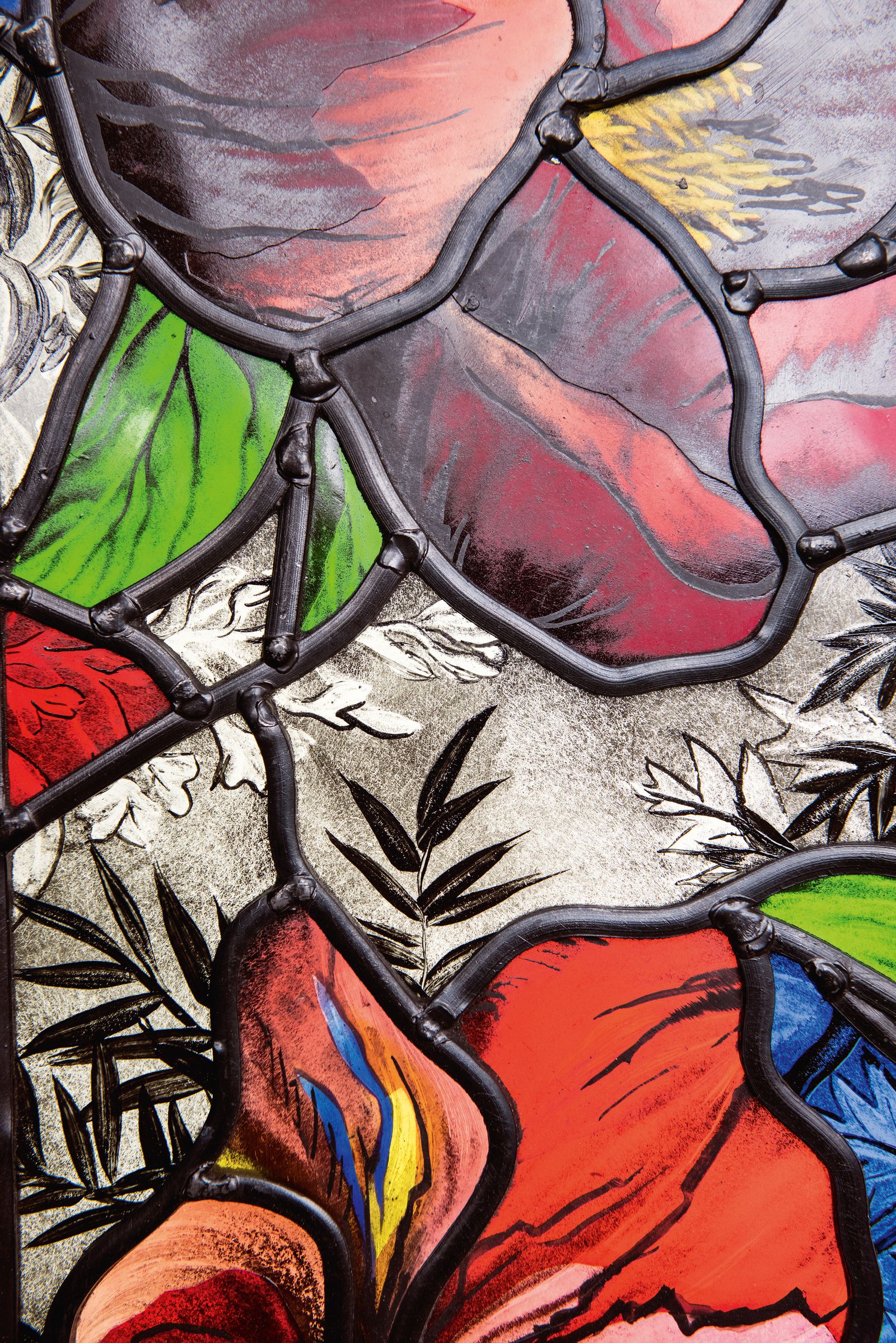
There is also, laid out in pieces of paper, a private commission that John is currently working on with his colleague, Mai-loan Tu. They have used collage – 'The influence of Dad and Piper,' says John – to create arrangements of flowers and figures intersected by bold diagonals of strong colour. The mind's eye can readily make the leap to the end result and the assured beauty of this expression of the form.

Comments
Back to Top


