
An unusual gothic revival house in north London with a dramatic interior by Maddux Creative

Among their many talents, Scott Maddux and Jo leGleud of Maddux Creative have a rare skill for adding a sense of drama to a project. This can be – and has been – expressed in a seemingly endless number of ways, from a dazzling gold sitting room ceiling to a bold juxtaposition of the very contemporary and the antique. A close relationship with top decorative paint specialists is a key part of their armoury.
The project on these pages might be seen as Maddux Creative’s magnum opus. As with the most successful undertakings, it was one that was shared, in this case with Jenifer and Kunal, the young couple who bought this house in north London and had plenty of ideas and ambition of their own.

Built in 1879 for the grand sum of £4,600, it is in the gothic revival style and has a commanding presence. The exterior bears some of the hallmarks of the style – from the pointed arches of the windows to the quatrefoil motif – and foreshadows what is to be found inside. It is no surprise to learn that it was once used as a location for a Hammer Horror-inspired episode of the BBC TV programme Inside No. 9; the review in The Times advised it was ‘best avoided by those of a nervous disposition’.
Jenifer and Kunal met as students at Gonville & Caius College, Cambridge, a stone’s throw from the gothic master-piece that is King’s College Chapel. During the summer, they would escape to Italy where they were taken by the country’s own versions of gothic and gothic revival architecture. Perhaps these memories were stirred when they came across this house for sale in 2013. ‘It was the only house that we viewed,’ recalls Kunal. ‘We walked in, loved it and knew that we had to buy it.’

A previous, unsuccessful buyer had secured planning permission for a series of works. This was no mean feat considering the Grade II listing of the house and the highly engaged local conservation society. Wisely, the couple decided to piggyback on some of these permissions and instructed the same architect, Frank Reynolds. It was his London practice that also designed the eye-catching extension.
While the peak-and-trough roofline of this addition mimics that of the main house, it is built in slimline Danish brick. This creates a distinction from the original house, which is clad in stone, cut in a crazy-paving pattern. Within is a huge, modern-country-style DeVol kitchen, which benefits from plenty of natural light.

Before buying the house, which they share with their two small children, Jenifer and Kunal were living in a contemporary flat in Shoreditch. They knew they would need help with such a large project and kept coming across the name Maddux Creative, which they had spotted in House & Garden’s list of Top 100 Interior Designers and in The World of Interiors, when a Maddux-designed arabescato marble-clad bathroom was featured on one of its covers. ‘I remember thinking “Wow”,’ Kunal explains. ‘I really liked what they did with the materials and the colours they used.’
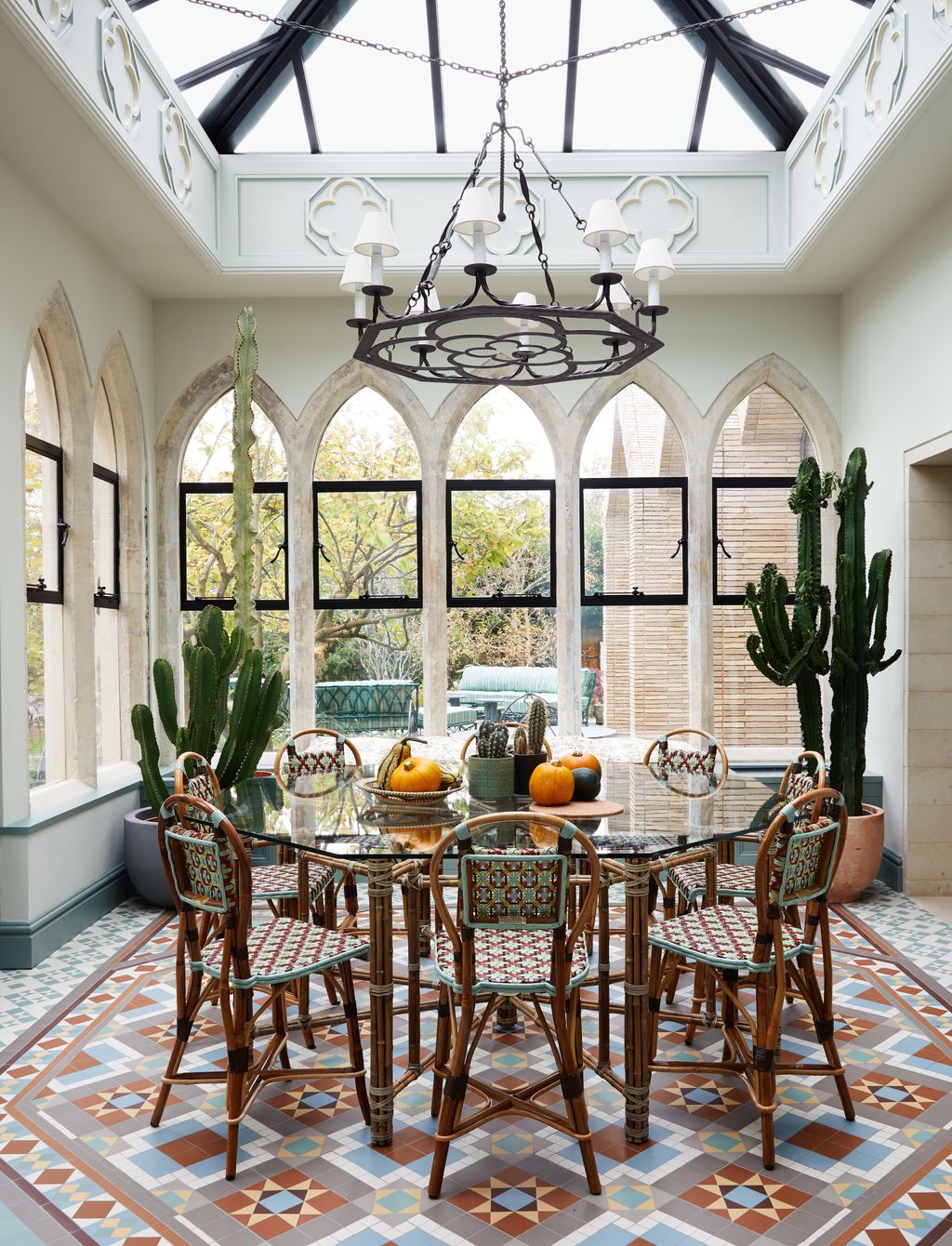
Moving from the kitchen to the front of the house, you pass through the original conservatory, which has several skinny windows that are topped with gothic arches. Under the glass roof, a quatrefoil-within-octagon frieze was added. These two motifs are standard gothic fare, and were inspired by those on the original chimneypieces and wooden doors. The frieze reappears in the adjacent sitting room, under a newly created octagonal skylight. These two rooms are bright and airy spaces, rich in understated detail. Things get more lavish as you progress through the house.
First to the dining room, where Maddux Creative took its lead from what Scott calls the ‘polychromatic’ Victorians. ‘You see it a lot in houses in San Francisco, where that tradition is still very much alive,’ he explains. ‘They will use eight or nine colours to create a pleasing whole.’ In this case, the myriad blues, reds and yellows of the wallpaper borders are picked out on painted walls and ceilings. So strong are the original features that these decorative gestures enhance rather than overshadow them. ‘When you are working in a house with this level of detail, you have to bring something of the same level,’ Scott continues. He points out the long, octagonal table that they designed: it is set with panels of Portofino marble shot through with fiery red veins.

Colour inspiration for the drawing room next door came from the celebrated Peacock Room, decorated by James Whistler and Thomas Jeckyll. Also known as Harmony in Blue and Gold, it was created in a Kensington house at around the same time that this one was built. These colours define the luxuriantly swathed Victorian salon of a space, from the gold-flecked wallpaper to the peacock-themed, verre-églomisé-fronted corner cabinets. Inspiration also came from artist Darren Waterston, whose clever reimagining of the Peacock Room was displayed at the V&A a couple of years ago, and whom Scott, Jo, Kunal and Jenifer commissioned to create a group of artworks for this room.
Into the broad entrance hall and up the once-whitewashed staircase, which is now stripped back and dressed in a bespoke Le Manach runner from Pierre Frey, you arrive on the first floor. Here, three rooms have been converted for Jenifer and Kunal. It is bright again up here, thanks in no small part to the decision to remove the ceilings in the bedroom and the dressing room. ‘These came out during construction and, when they saw the enormous volume, they wanted to keep it,’ Jo explains. Anything above the original ceiling height remains seemingly rough and unfinished (it is actually clad in reclaimed barnwood and the beams are perfectly stripped back). Below this line, the decoration is refined – from the hand-painted wallcovering in the bedroom to the gold leaf added to the gothic tracery on the dressing room cabinets.
Jenifer describes the process of restoring this house to its former glory as a labour of love. ‘But also insanity,’ she admits. ‘You do have to be a little bit mad to take on a project like this and to persevere with it.’ What was meant to be a 13-month refurbishment turned into a complete restoration and rebuild that lasted more than five years. ‘There’s something about this house,’ she says. ‘When you walk in, it seems to have a life of its own. I feel like we are its caretakers, rather than simply the owners’.
See the full Top 100 and find out all about our award winners at houseandgarden.co.uk/top-100
 Paul Massey1/11
Maison Gatti French café chairs echo the London Mosaic floor tiles in the conservatory.
 Paul Massey2/11
The bespoke rattan-backed sofa in the sitting room is teamed with vintage rattan finds – an ‘Emmanuelle’ peacock chair from Pamono and a mirror from 1stDibs.
 Paul Massey3/11
A wall hanging sourced from a vintage textile dealer is the backdrop for a sofa in Holland & Sherry’s ‘Primo’ velvet in calypso. The scroll-armed sofa is in ‘Montepulciano’ chenille in argento from Watts 1874. Maddux Creative designed the corner cabinets, which were made by Wardour Workshops with verre églomisé peacock panels by Studio Peascod.
 Paul Massey4/11
In the kitchen, a rug taken from a larger piece of William Morris carpet picks up on the DeVol cabinets in a custom blue.


 Paul Massey5/11
In the dining room, a chandelier from Windsor House Antiques hangs above a bespoke table with Portofino marble inserts, which is paired with gothic chairs from John Nicholas Antiques.
 Paul Massey6/11
In the main bedroom, Fromental’s ‘Prunus’ wallcovering in a bespoke colourway showcases the carved walnut four-poster, which has a bedcover in Schumacher’s ‘Khotan Weave’. The custom sofa in de Le Cuona’s ‘Vienna Velvet’ anchors a ‘Digby’ rug in bone from Stark.
 Paul Massey7/11
In the dressing room, a ceiling clad in reclaimed wood from The Main Company contrasts with the elegant cabinetry in Farrow & Ball’s ‘Castle Gray’ with gold-leaf tracery. An antique valet stand is positioned beside the antique copper bath, both from The Water Monopoly.
 Paul Massey8/11
Arabescato marble provides a striking background for the Catchpole & Rye shower in the main bathroom.


 Paul Massey9/11
Murals painted by Lizzi Porter frame the door to the turret, where there is a bespoke peacock hanging seat made by Justin Van Breda.
 Paul Massey10/11
Balineum wall tiles showcase the Thomas Crapper basin.
 Paul Massey11/11
Morris & Co’s ‘Compton’ wallpaper envelops the space in the spare room.


