
Molly Mahon's joyful, colourful Sussex cottage

Sometimes a dream house is not a dream house until you make it one, as the textile designer Molly Mahon found when she bought her Sussex cottage ten years ago. Just off a bumpy track that wends its way into the forest, the house has a charming higgledy-piggledy look about it, with a slightly wonky roof and windows that seem to peer owlishly out onto the garden. On paper it was everything Molly wanted when she and her husband Rollo began searching, having already left London for a rented house nearby, but fairytale cottages, for all their charm, have their drawbacks.
The very oldest part of the house dates from the 1600s and its original incarnation was as a woodman's lodge, but over the years it has gradually grown into a larger version of itself. In the 19th century another house was built onto the side, and for a time Molly's cottage served as the servants' quarters for that house, before eventually separating again. When the family found it, it had been neglected for some time, and Molly was disappointed when she saw it. "My heart just sank," she says. "The ceilings felt low, the kitchen didn’t even have a window, and I thought I didn't want to spend all my time in that cave of a room." Six months went by, and nothing came on the market in the area they wanted, so with a little persuasion from Rollo, "I agreed it was better than nothing."
MAY WE SUGGEST: A stylish London house where colour takes centre stage
From this inauspicious start, however, the story could only get better. Molly, Rollo and their children lived there for a year until they knew what they wanted to do with it, and then the work began. "We went full speed ahead once we started," says Molly. Packing up all their belongings, they moved everything into two tents in the garden, set up a kitchen in the garage, and went to town. The main work was to the kitchen. What is now a spacious L-shaped space with room for a dining table was originally three separate rooms with ceilings low enough to be a serious inconvenience for the tall Mahons. They dug down to create a lower floor, knocked the walls through and replaced the windows, allowing light to flood into the room.
The other major improvement was to the staircase, which was then right at the back of the house. Moving it to the centre of the house allowed for a much easier flow between downstairs and upstairs. "I had been terrified to do it," recalls Molly, "but in the end it took two days and was remarkably simple." Once these works were complete, the house was transformed, with plenty more light and a considerably airier feel. "We'd taken the time to think about what we wanted, but I don’t think I ever thought it would be as good as it is," she says.
At the time when they moved in, she had just begun to launch her eponymous block-printing company, starting with stationery and with some wallpapers on the way. Having embarked on this career with a workshop at Tobias & the Angel while still living in London, Molly has grown it over the last ten years into a highly successful business, and the house is a showcase for the joyful, colourful papers and fabrics she has created over the years. The patterns come together to create a distinctive look, but as Molly explains, "it's not really about creating a look, it's about creating a feeling. I want my space to feel welcoming and warm and relaxed. I think you know when people really care about their houses; it becomes an expression of them, organic and flexible, and that makes it special."
MAY WE SUGGEST: The founder of London gallery 8 Holland Street's Somerset cottage
As you'd expect from this philosophy, the house is by no means a showroom, but immediately feels like the inviting, lived-in, well-loved family home it is. The gaily patterned fabrics that catch the eye everywhere in the kitchen and sitting room are just one expression of Molly and her family; the antique furniture, much of it inherited from family, the cheerful potted plants, and the piles of books are all testament to a much-loved home, rooted in its own traditions. "We inherited a lot of dark wood furniture from our grandmothers," she says, "and it feels resilient and timeless. We've got Moroccan rugs from our travels and even one rug that my grandfather stitched himself. I like that the house speaks of our ancestors and where we come from, it's not a pre-designed look, it's made up of the people we are." And it's when it's filled with people that this house really comes into its own. "When I first saw it, it was so empty and lacked energy, but now when we have family and friends here, the fires roaring and dogs sleeping all over the place, that's when I love it most."
 Owen Gale1/20
The kitchen, which was renovated and extended by Molly and Rollo when they bought the house, has a long area for a dining table, and shelves filled with a colourful collection of glassware and ceramics. The tablecloth is in Molly's 'Marigold' fabric, while the lampshade is in 'Pattee'.
 Owen Gale2/20
The navy cabinets have curtains in an array of hand-block printed cottons by Molly, while the blind is in the 'Rose' fabric from her Jaipur collection.
 Owen Gale3/20
A vintage dresser displays a collection of mugs designed by Molly.
 Owen Gale4/20
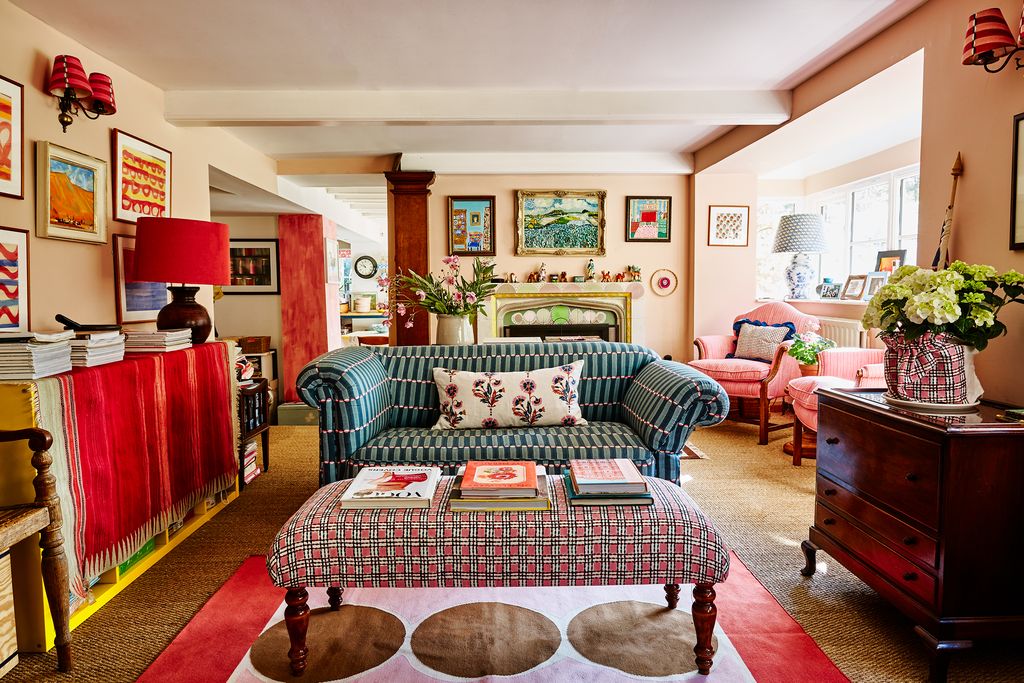
In the sitting room, a vintage sofa is upholstered in Molly's 'Luna' fabric, while the rug is also by Molly.


 Owen Gale5/20
The Dormy House footstool is covered in 'Trellis', a new fabric launching in February 2021.
 Owen Gale6/20
The wall lights have lampshades in Molly's 'Luna' fabric. Artwork by her son Algie surrounds the centre painting done by a friend.
 Owen Gale7/20
Molly painted the fireplace in a style reminiscent of Vanessa Bell and Duncan Grant's nearby house, Charleston.
 Owen Gale8/20
Looking into the sitting room from the direction of the kitchen, the comfortable sofa is by Maker & Son, while the cushions are from Molly's new collection.


 Owen Gale9/20
Upstairs in the main bedroom, Molly's fabrics take centre stage. The wallpaper is her 'Marigold' pattern in pink and blue, while he headboard is covered in 'Stripe' in blue and a 'Pattee' quilt adorns the bed.
 Owen Gale10/20
The curtains are in Molly's 'Buti' fabric, and the lampshade is in the hand block printed cotton 'Dash'.
 Owen Gale11/20
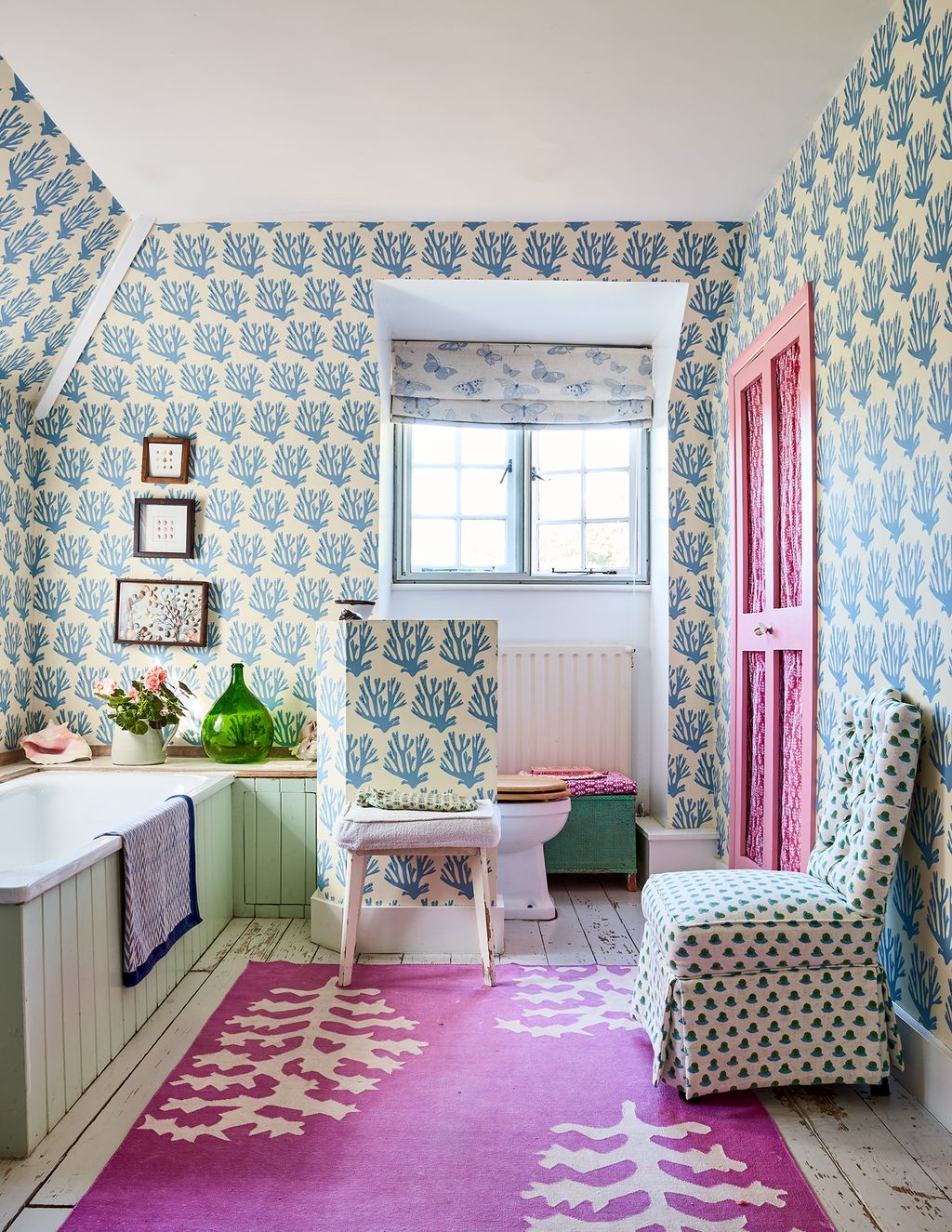
The main bathroom is wallpapered in Molly's 'Coral' wallpaper, and the chair is upholstered in a new fabric, 'Berry' launching in spring 2021.
 Owen Gale12/20
In Molly's son Orlando's room, a bed from the Dormy House is covered in her 'Tuk Tuk' cotton in blue, with a 'Star' quilt on the bed.


 Owen Gale13/20
Molly also printed the fabric for the chair at the other end of the room; the wallpaper is her 'Spot and Star' pattern.
 Owen Gale14/20
In Molly's daughter Lani's room, the wallpaper is in Molly's 'Fern' pattern. A bed by Dormy House is covered in 'Luna' in khaki. The yellow bedside table is from Chelsea Textiles, and a vintage quilt covers the bed.
 Owen Gale15/20
 Owen Gale16/20
Molly in her studio at the end of the garden.


 Owen Gale17/20
These blocks were carved especially for Molly's garden inspired block printing workshops, which she holds at Wardington Manor with the Land Gardeners and at Charleston in Sussex.
 Owen Gale18/20
Molly has painted the cabinet in her studio in Charleston-style patterns.
 Owen Gale19/20
A wall of experimental prints in the studio.
 Owen Gale20/20
All of Molly's blocks are hand carved by master crafts people in India.


