
The joyfully eccentric London house of designer Phoebe Hollond

When Phoebe Hollond and her husband bought their Victorian townhouse in Shepherd’s Bush in 2017, they were looking for a house in which they could put down roots. “I love the bones, the architecture in West London,” says Phoebe. “We moved in just after we got married, and we loved this house because it was completely stripped back to its raw form.” The previous owners of the 1860 house had removed much of the architectural detailing from the interiors; Phoebe, who was in the early stages of an interior design career, had “a total blank canvas” on which to work. And as she redecorated each room in turn over the next eight years, the house would become a living record of that career.
Many houses take their starting point from their entrances, or at least their main living spaces – in fact, that’s how one normally describes a design scheme, by starting on the ground floor and working up. It makes sense, given those are the places that a visitor would experience first. But the story of Phoebe’s house begins at the top, in her bedroom, which was understandably the first room on which she made her mark, and it ends in the spacious semi-basement kitchen, which was only completed in March last year.

The bedroom was also in need of the most attention aesthetically, having been disfigured with grey synthetic viscose carpet and stark white walls, to the extent that it felt “clinical”, says Phoebe. Possibly as a subconscious reaction, she says, she chose a “super cosy” new design scheme, with brown seagrass Tatiana Tafur wall covering and stripped floorboards, and a calm new Farrow & Ball ‘Light Blue’ paint for the ceiling.

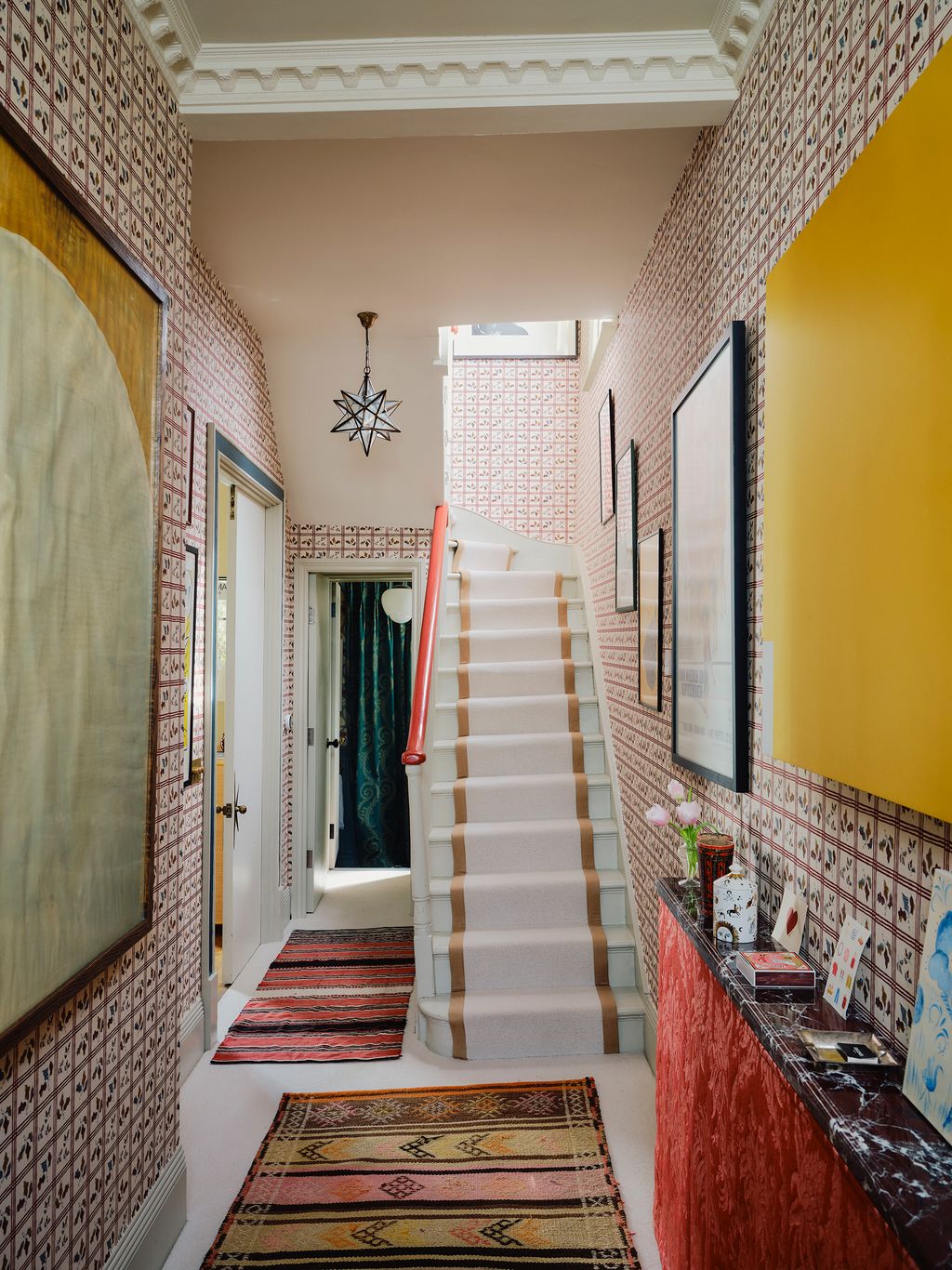
The project continued over time, depending on costs and Phoebe and her husband’s capacity: the next thing she turned her attention to was the downstairs entrance hall and the sitting room, both of whose original Victorian detailing had been removed by the previous owners of the house. In the hall, there were “quite crappy skirting boards” which needed to be replaced. “I think it had been slightly decimated,” observes Phoebe, “and that was quite exciting.” An antique pendant light and bespoke runner up the stairs enhanced a space already full of character thanks to the charmingly askew Victorian staircase. More recently, she has papered the hallway in one of her own Studio Hollond designs, ‘Strawberry Jazz’.

In the two-section sitting room, both areas were redecorated at once, though with subtly differing inspirations. In the section of the room nearer the back of the house, Phoebe introduced new ornate plaster moulding, cornicing and bookshelves either side of a chimney breast. “I was going through a stage of being completely obsessed with Madeleine Castaing, and then Jacques Grange – I was really into that period of history and going quite French, quite over the top.”

In the front, meanwhile, a pinstripe fabric wall covering from Claremont replete with padding, stuffing and batons and a profusion of playful pattern and colour stopped just short of being reminiscent of the circus, Phoebe says. Tall skirting boards, 33 centimetres high, were inspired by those in a specific Parisian flat by Jacques Grange, while the parquet flooring that runs through both parts of the room gives them a certain visual unity. “Despite the fact that they are pretty different in style, the connection is that they both are quite dramatic and whimsical.”

There are further, more subtle nods to Phoebe’s career as an interior designer in the furniture. Both the exuberant round mirror in the “French” back part of the room and the poster for Roger Vadim’s film Le Repos du guerrier were gifts from Beata Heuman, under whom Phoebe started her interior career before she founded Studio Hollond. She was working for Beata when she designed these rooms, and credits Beata’s style with some of her own inclinations at the time: “I think at that point, I was at the pinnacle of my maximalist phase.”

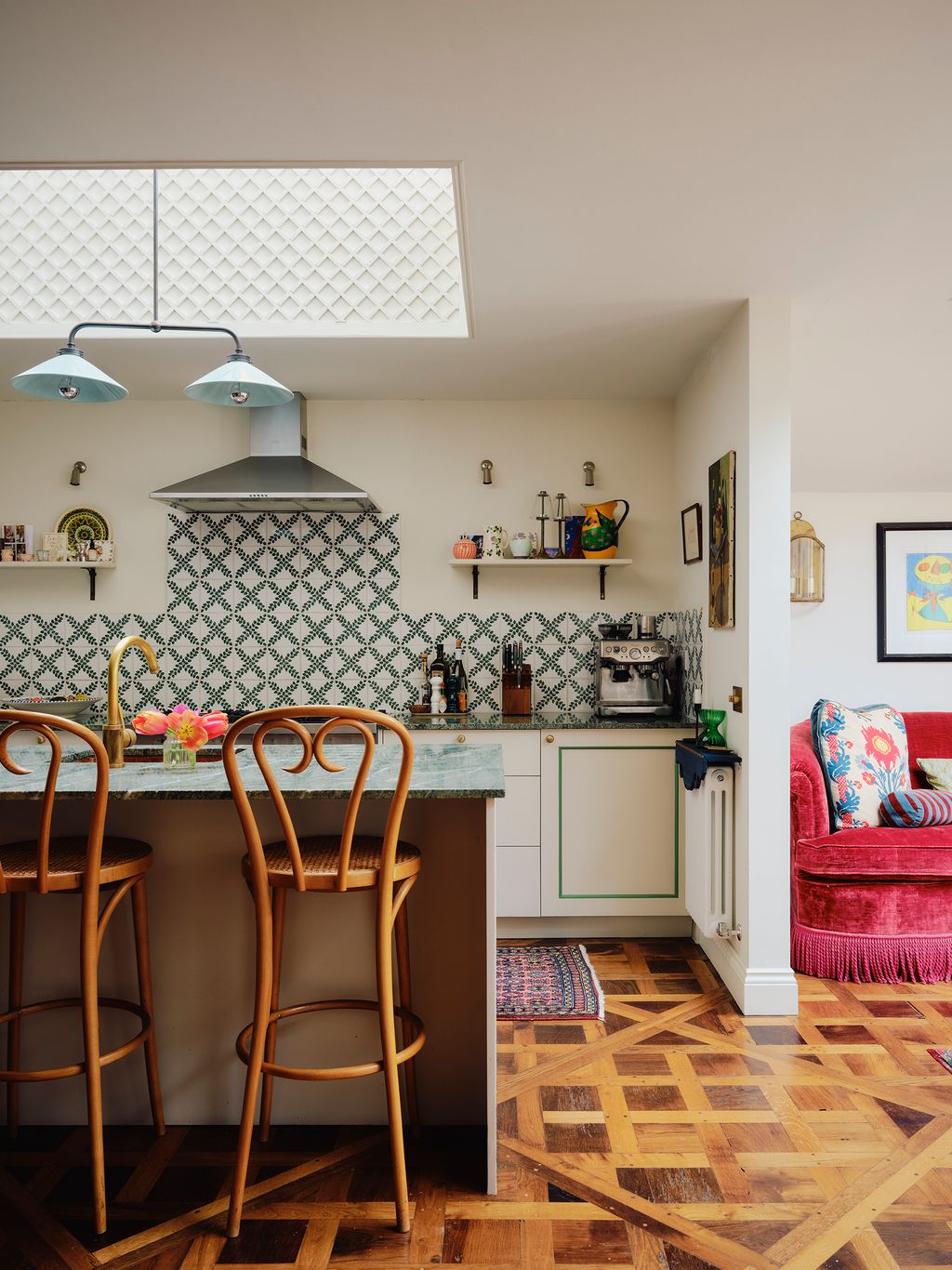
Another floor down is the kitchen, which was recently extended to encompass half of the back garden. When Phoebe moved in, the house had an inexplicable galley kitchen in what is now the powder room between the ground and basement floors, making hosting and cooking at the same time very difficult. The new, enlarged basement, by comparison, makes it that much easier, and light has been introduced thanks to a new lantern built into the roof. Original plans for a more extensive Victorian-style one were kiboshed by the council, despite being more in keeping with the original 1860 fabric of the house; Phoebe had to hire an architectural historian to write an argument in favour of the new lantern.
The result is a lighter and visually quieter space than the living rooms upstairs, in line with how Phoebe likes to design in 2025. Diaphanous curtains and a Murano glass chandelier bought from Venice (“You cannot imagine how many pieces it was delivered in”) retain the sense of whimsy which runs through the whole house, and there’s still a generous use of colour typical of her work, but as a whole, the room is a good example of what a client working with Studio Hollond might expect from Phoebe’s work. And, as you’d expect from the house of a designer with such eclectic tastes, it’s still a work in progress. “There are so many things that I still would love to do,” she says. “It’s an ever-evolving canvas.”
 Dean Hearne1/12
Phoebe has papered the entrance hall of the house with a design from Studio Hollond’s debut collection, ‘Strawberry Jazz’. The stair runner is bespoke and the pendant light is an antique.
 Dean Hearne2/12
 Dean Hearne3/12
In the basement kitchen, the splashback tiles are from Balineum, and the pendant light is from Hector Finch. The walls are painted in Farrow & Ball’s ‘School House White’, and the chairs at the island are vintage, bought from Pamono.
 Dean Hearne4/12
The larder was custom-designed and built into the room, then painted in Farrow & Ball’s ‘Shaded White’. On the wall is a framed drawing of Phoebe’s mother by Fanny Rush.


 Dean Hearne5/12
 Dean Hearne6/12
Over the Studio Hollond ‘Serpentine’ dining table in green lacquer hangs the Murano glass chandelier Phobe had delivered from Venice in “what felt like a million pieces” before assembly. The rug is antique, as are the chairs, which are upholstered in a Le Manach fabric.
 Dean Hearne7/12
The wainscoting in the powder room – which was once the house’s kitchen – is painted in Edward Bulmer’s ‘French Blue’, while the wallpaper is ‘Jet’ by Whiteworks. The antique lantern and the sink were both found in reclamation yards.
 Dean Hearne8/12
The curtain in the powder room is an antique fabric. The light is from Skinflint Design.


 Dean Hearne9/12
The bedroom was the first room Phoebe redesigned, covering the walls in Tatiana Tafur wall covering and painting the ceiling in Farrow & Ball’s ‘Light Blue’. The headboard of the bed was made bespoke, and is upholstered in Pierre Frey fabric.
 Dean Hearne10/12
In the bedroom, an antique suzani sits on the bed beside an original Victorian fireplace. The armchair is upholstered in Beata Heuman’s Palm Drop in ‘Squid Ink/Brick’.
 Dean Hearne11/12
In the bathroom, the walls are painted in Farrow & Ball’s ‘James White’. The side table is by Charles Orchard and the blind is a fabric by Nicky Haslam.
 Dean Hearne12/12
In the playroom, the wainscoting is painted in ‘Dayroom Yellow’ by Farrow & Ball, beneath an Antoinette Poisson wallpaper. The armchair is upholstered in Svenskt Tenn fabric.


