
An enchanting 17th-century country house with interiors rooted in the past
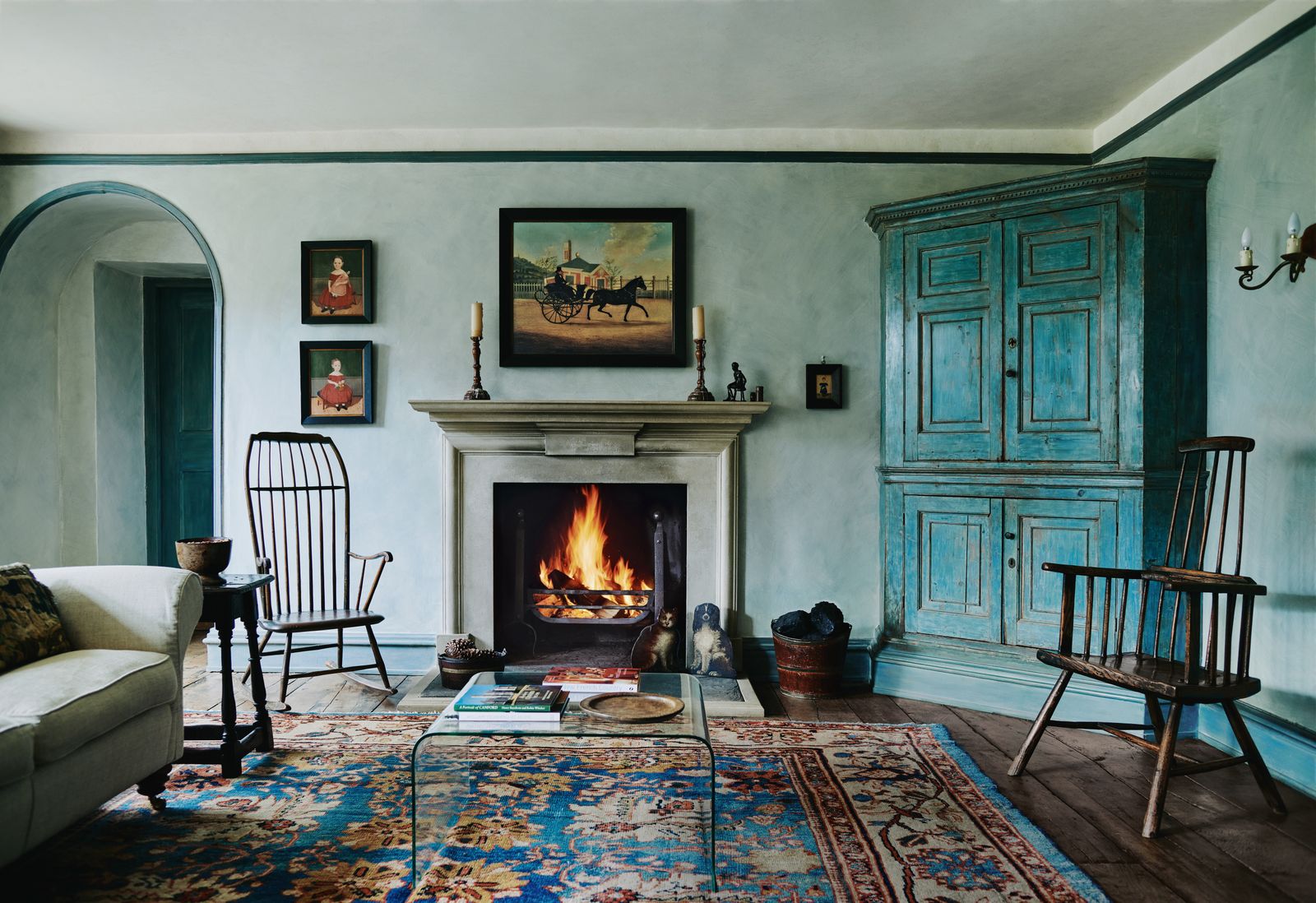
Some of the most enchanting houses are those where any alterations are inconspicuous: the type where you would be hard pushed to distinguish old from new and would struggle to detect the hand of an interior designer... Such is the case with this 17th-century dower house in Northamptonshire, where a patchwork of terracotta tiles and wooden boards, rich distemper walls, and an exquisite collection of primitive English furniture and folk art sit together to create an interior that looks as though it has remained largely unchanged for the best part of 400 years.
That was all part of the plan, of course. ‘We wanted to make it look like it had always been this way,’ says antique dealer and interior designer Robert Young, who worked on the house just over 20 years ago, in collaboration with the then owners, who were in their seventies at the time. ‘Almost everything that looks original is in fact a new addition,’ explains Robert, gesturing to the uneven-width reclaimed floorboards in the entrance hall. ‘Over the years, the character had been lost, so the house was really quite ordinary. One of the only things we retained was a built-in cupboard in the dining room, which we had dry-scraped to reveal the original paint.’

The house no longer exists in the form seen here: shortly after the House & Garden photo shoot, it was sold by the owners’ two daughters, following their parents’ deaths. These pictures, therefore, are a record of a house that was the culmination of a 35-year relationship between Robert and his clients. ‘I first met them in the Eighties when I was painting murals,’ he recalls. ‘They were living in London at the time and asked me to do some painting in their house. One day, the man said to me, “I like you; I like your colour palettes.” I wondered what he was talking about, because there wasn’t that much on the walls at that point, but he meant the flecks of paint on my ladder.’
Although Robert was yet to set up Rivière, the interior design studio he co-founded with his wife Josyane in 1983, he started to advise the couple on interior decoration. They became regular customers at the antiques shop he opened in Battersea, too, indulging their love for vernacular English furniture.
The pair bought this house in 2000, having sold a sprawling Queen Anne house in Bedfordshire. While relatively humble by comparison, this house provided them with an opportunity to bring together treasured pieces and create exactly the interiors they wanted. ‘From the word go, it was very much a place where they could welcome their grandchildren and live with their favourite things,’ explains their youngest daughter. Spread across two floors, with a further attic bedroom, the house is mostly one room deep, with six bedrooms on the upper floors and a modest kitchen on the ground floor leading onto a dining room, an entrance room and two sitting rooms. ‘Though it required an enormous amount of work, they felt the skeleton was beautiful enough,’ adds the eldest daughter.

Robert was called onto the project at the start, as were a trusted builder and a carpenter who had worked for the owners on previous projects. Garden designer Arne Maynard was tasked with reconfiguring the grounds to help bed the house into its surroundings. At the front, a tired kitchen garden was replaced by a series of box balls, while the rear underwent the most significant transformation with the addition of a cobbled driveway and a small stream, which now connect the house to a string of outbuildings, including a home office.
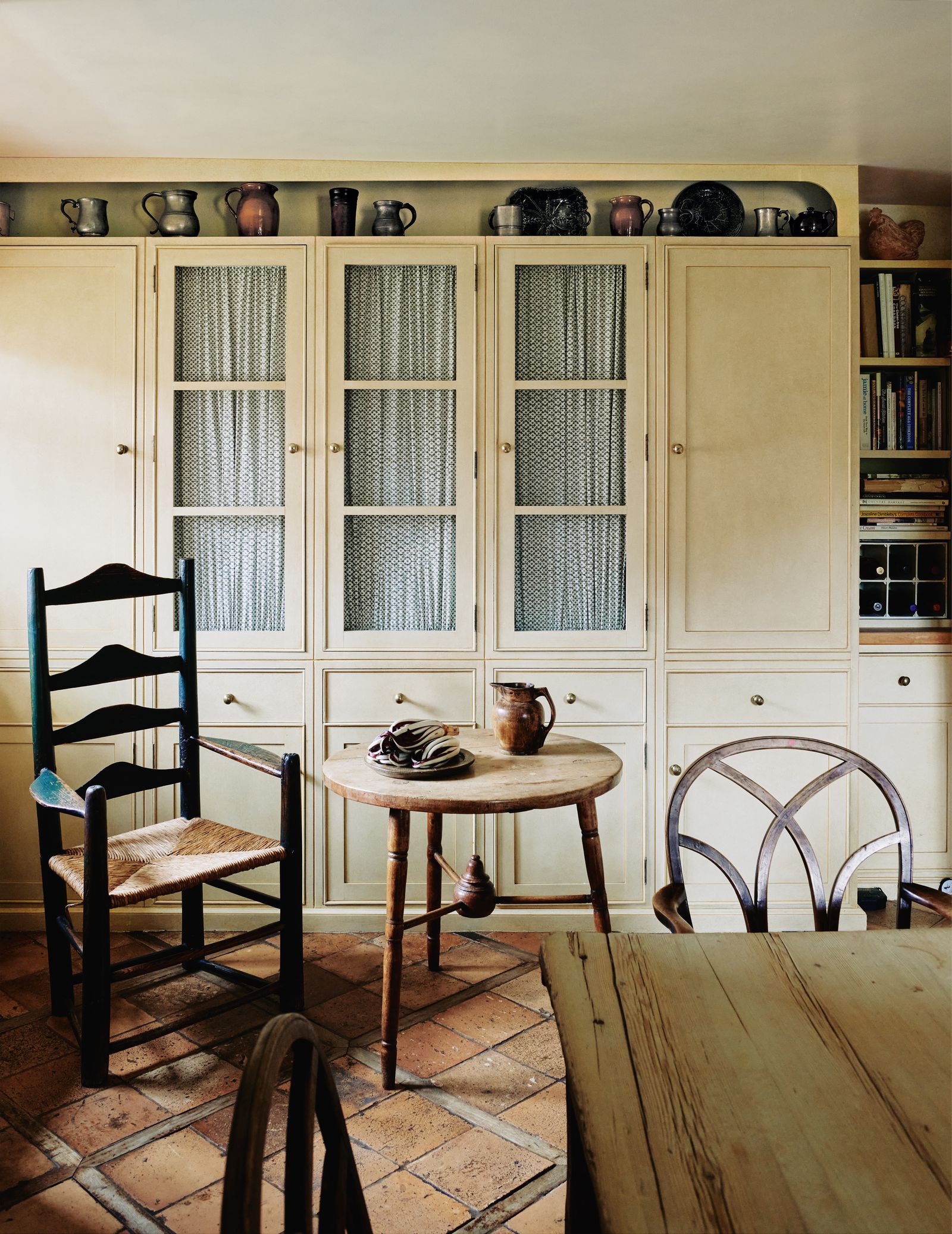
When it came to the interior, the layout remained largely the same upstairs, but changes were made downstairs. In the kitchen, Robert added a door, which opens out onto the courtyard and became the main entrance to the house. A chimney breast was removed to make way for an Aga and – at the husband’s request – a deep fat fryer. ‘They had big demands for a small space, so it was a case of squeezing it all in,’ explains Robert, gesturing to a half-wood, half-marble table at its centre. ‘He wanted to make pastry, so we chose this lovely piece of marble and had the table adapted.’ The former entrance hall at the front of the house was opened up to create a space generous enough to accommodate a remarkably large 1780 West Country elm settle, which the owners had bought almost 20 years previously. ‘It’s a rare piece and I’m so pleased that they pushed to include it here,’ Robert enthuses.
Much of the furniture and art came with the owners, including a stellar collection of vernacular antique comb-back and Windsor chairs acquired from Robert, as well as dealers such as Andras Kalman. ‘Some of what they had was not suited to the scale of this house, so we edited it down to their favourite things and bought some bits specifically for the space.’ The colour and finish of the blue walls of the main sitting room were created to complement a blue painted corner cupboard, which had originally been sourced by Robert for the owners’ London house. ‘The wall colour was based on a Georgian blue reference,’ explains Robert. ‘It was achieved with layers of chalk-based distemper by DKT Artworks. It was built up gradually from an orangey-red ground and it was a real lesson in colour for me.’ The wall colours throughout were all mixed by hand: the dining room, for instance, is an inviting red, while the husband’s dressing room upstairs – ‘actually somewhere he’d go for a smoke’, Robert says, with a smile – is a richer red distemper.
Although much of the furniture and the artworks are rare examples of their type, the owners were not precious. ‘Dad would love sitting with his grandchildren, explaining how a primitive lantern worked, and nothing was ever off limits or behind glass,’ explains the youngest daughter. Many of the pieces have now been passed on to them and on to the grandchildren, who were able to choose one piece each. One granddaughter chose the huge settle, while a grandson picked a handsome 18th-century upright hall chair. In a case of serendipity, he later discovered that at some point in its history, someone had graffitied a set of initials – the same as his own – under the seat. ‘This was such a happy house and the pieces we have remind us of that,’ says the eldest daughter.
Robert Young Antiques: robertyoungantiques.com
 Michael Sinclair1/5
The broken-colour walls, built up in layers with chalkbased distemper then varnished for added depth and patina, are the backdrop to 19th-century paintings from the English Naive School. A 17th-century English oak love seat, with 18th-century antique verdure tapestry upholstery, stands on the floor created from reclaimed wooden boards and terracotta tiles, arranged diagonally to make the room feel larger.
 Michael Sinclair2/5
The French sheet-metal stylised cockerel weathervane, c1840, sourced by Robert, contrasts with a 19th-century American rooster weathervane, from dealer Andras Kalman, displayed on the windowsill.
 Michael Sinclair3/5
Pigmented and aged distemper was used to create the look of limewashed walls by DKT Artworks, which blended the colour on the panelling to match a Georgian sample. The chair is Swedish, c1800.
 Michael Sinclair4/5
Chintz curtains frame wooden decoy pigeons, c1900, sourced by Robert, as was the 19th-century Alsatian bedcover.


 Michael Sinclair5/5
Walls in fabric from Pierre Frey’s ‘Comoglio Collection’ and a bespoke bed were chosen with grandchildren in mind. The primitive stick and comb-back chair in ash and oak came from Csaky Antiques.


