
Sophie Ashby sensitively reimagines the house where JM Barrie wrote Peter Pan

Most of us would balk at the many restrictions of living in a Grade II*-listed property in which not one single detail (door handles included) can be changed without permission. The residents of this west London townhouse think differently. That is because their Regency villa, screened from the busy Bayswater Road by high walls, is something of a literary landmark. It is here, at a desk overlooking the oaks and cascading horse chestnuts of Kensington Gardens, that JM Barrie sat down to write his story about a boy who would not grow up.
Like Peter Pan, this is a house suspended in time. Its last owners, the Young family, lived here for almost 90 years. Theirs was an intellectual and artistic household. They installed bookshelves and entertained like-minded intelligentsia in the panelled drawing room, but left the interior alone. Visiting for the first time in 2015, the current owners discovered an intriguing time warp of flagstoned passages, snug parlours and below-stairs servants’ quarters unchanged since Barrie’s day. Even the authorial loo remained intact.
They were keen it remained that way, says Giles Quarme, the architect commissioned to restore the building. ‘It’s an unusual house: my job was to preserve its quirks,’ says Giles, an historic buildings expert whose practice has won awards for its work at Althorp House in Northamptonshire and Glynde Place in Sussex. Modern comforts, including new bathrooms and central heating, were needed for the family of five. But elsewhere, they trod lightly to conserve this rare example of ‘a vanished, upper-middle-class way of life’, he explains.

It was not just Barrie who was inspired by the house. His wife, the actress Mary Ansell (who later ran off with a much younger novelist), was a flamboyant decorator who transformed the interior. ‘The house was built in the 19th century for a plantsman who worked in the local market garden. It was an ordinary home, until Mrs Barrie gave it an Edwardian makeover,’ says Giles. All the chimneypieces and grates, the cast-iron staircase to the garden, the door furniture and original floorboards, basins and floor tiles have been individually restored by specialist craftsmen across the country.
When they began work, the builders discovered a scrap of wallpaper hidden behind the paintwork. William Morris’s ‘Willow’ pattern was the catalyst for vivid new decoration by Sophie Ashby of Studio Ashby. ‘The history of this house is so interesting – my clients wanted to reference that. Everything had to be imaginative and bold, with lots of pattern and colour,’ says Sophie, who chose hand-blocked wallpapers and fabrics to evoke the property’s Edwardian heyday.
For the bedrooms, each with its own fireplace, she found deep fireside chairs and Arts and Crafts bedsteads. Like her predecessors, she looked to the park for ideas: clouds scurry across wallpaper; a console is wreathed in bronze oak leaves; in the music room, tree murals add Neverland-ish charm.
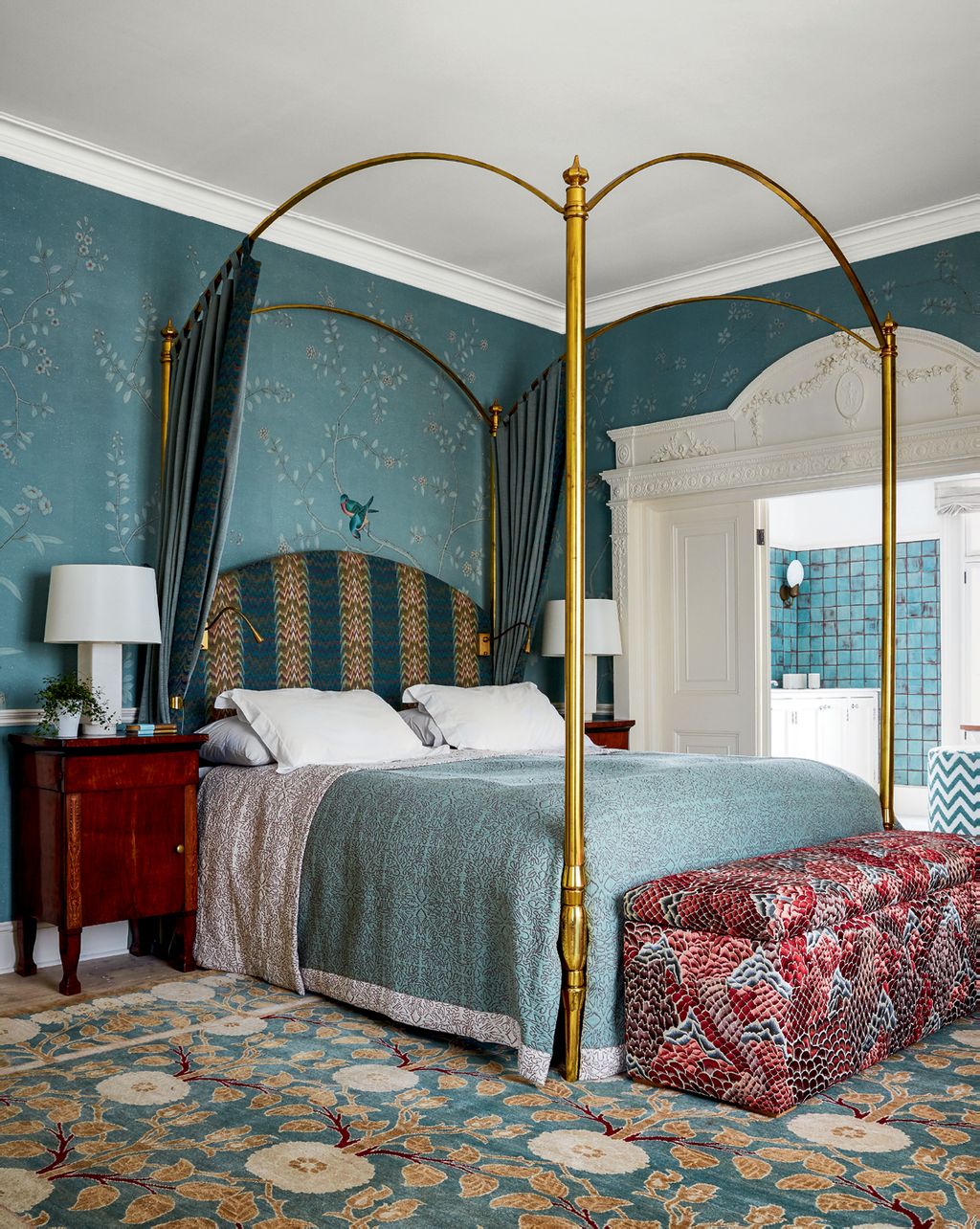
We tread Mrs Barrie’s dramatic staircase to the main bedroom. The original plasterwork, which frames the entrance to the bathroom like a proscenium arch, is echoed in the curves of the four-poster and scrolling foliage of the wallpaper. The Barries’ marriage has always been shrouded in speculation, says Giles, who thinks that a door, covered in wallpaper by the last owners, may have led to a separate bedroom used by the author. Next door, a corner room has a sash window that opens onto a diminutive balcony repainted in its original olive green. It does not take much imagination to picture a moonlit boy, dressed in ‘skeleton leaves’, alighting here.
Rehearsals for the stage play of Peter Pan were held in the dining room, where Barrie made the actor who first played Nana observe and mimic his own dog, Porthos, a St Bernard nearly as large as the author. Next door, Mrs Barrie knocked through three small rooms to create the drawing room, which features one of the first conservatories to be built in London. Restoration revealed that the panelling was made of plaster rather than wood ‘for reasons of economy’, says Giles.
MAY WE SUGGEST: Sophie Ashby and Charlie Casely-Hayford's flat in west London’s former-BBC building
When the carpet was lifted, a cast-glass floor underneath was exposed for probably the first time in almost a century. Part of the heavy structure had been damaged, so a craftsman was commissioned to make a mould of the original to ensure old blends into new. ‘Mrs Barrie added the floor to bring light to the kitchen downstairs,’ says Giles. ‘I also think it was a risqué joke. For servants to be able to see up the skirts of their employers in those days would have been scandalous.’
After the Barries divorced in 1909, the house was sold. Later, their friend the sculptress Kathleen Bruce, the widow of Scott of the Antarctic, moved in with her son Peter Scott, Barrie’s godson. Her second husband was the MP Edward Hilton Young. Their visitors included TE Lawrence, John Betjeman and the architects Alison and Peter Smithson, who designed the unusual Brutalist extension at the back. In the Seventies, the house was listed, saving it from redevelopment. Today, it feels like a relic of an older, less frenetic London.
One of the few changes the last owners made was to embed slivers of mirror in the brickwork, to mimic the sparkle of Tinker Bell’s wings. The new owners have added their own homage to Barrie’s creation. In the drawing room, opening the drawer of a walnut games table by Hugh Miller reveals a carving of a tiny Peter Pan. It marks the start of a new chapter in the history of this wonderfully idiosyncratic home.
 Paul Massey1/10
Panelling in ‘Glass V’ by Paint & Paper Library tones with cabinets from Lorfords Antiques. To evoke the room’s Edwardian heyday, interior designer Sophie Ashby layered patterns on new and antique furniture. The footstool was embroidered by Fine Cell Work in a homage to Peter Pan, references to which are also concealed in a games table by Hugh Miller.
 Paul Massey2/10
Chairs from Howe are covered in GP & J Baker’s ‘Meadow Fruit Velvet’.
 Paul Massey3/10
The wicker sofas are from 1stdibs. A painting of the house’s conservatory by Alison Pullen was commissioned via Byard Art in Cambridge.
 Paul Massey4/10
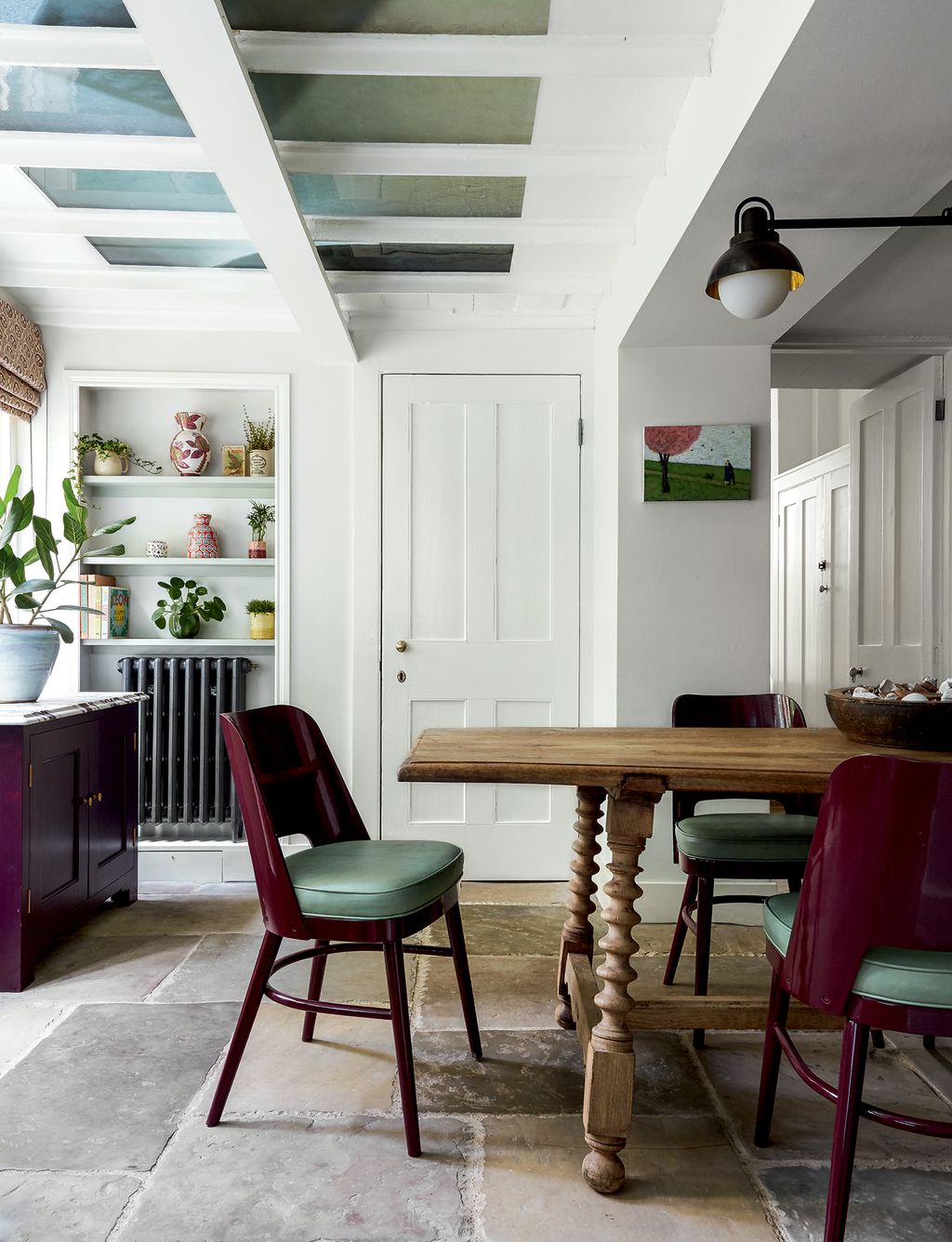
In the once-Dickensian basement kitchen, the new owners were allowed to remove part of a wall to bring light to the space. The ‘Camembert Chairs’ are from Howe and the ceiling light is by Allied Maker.


 Paul Massey5/10
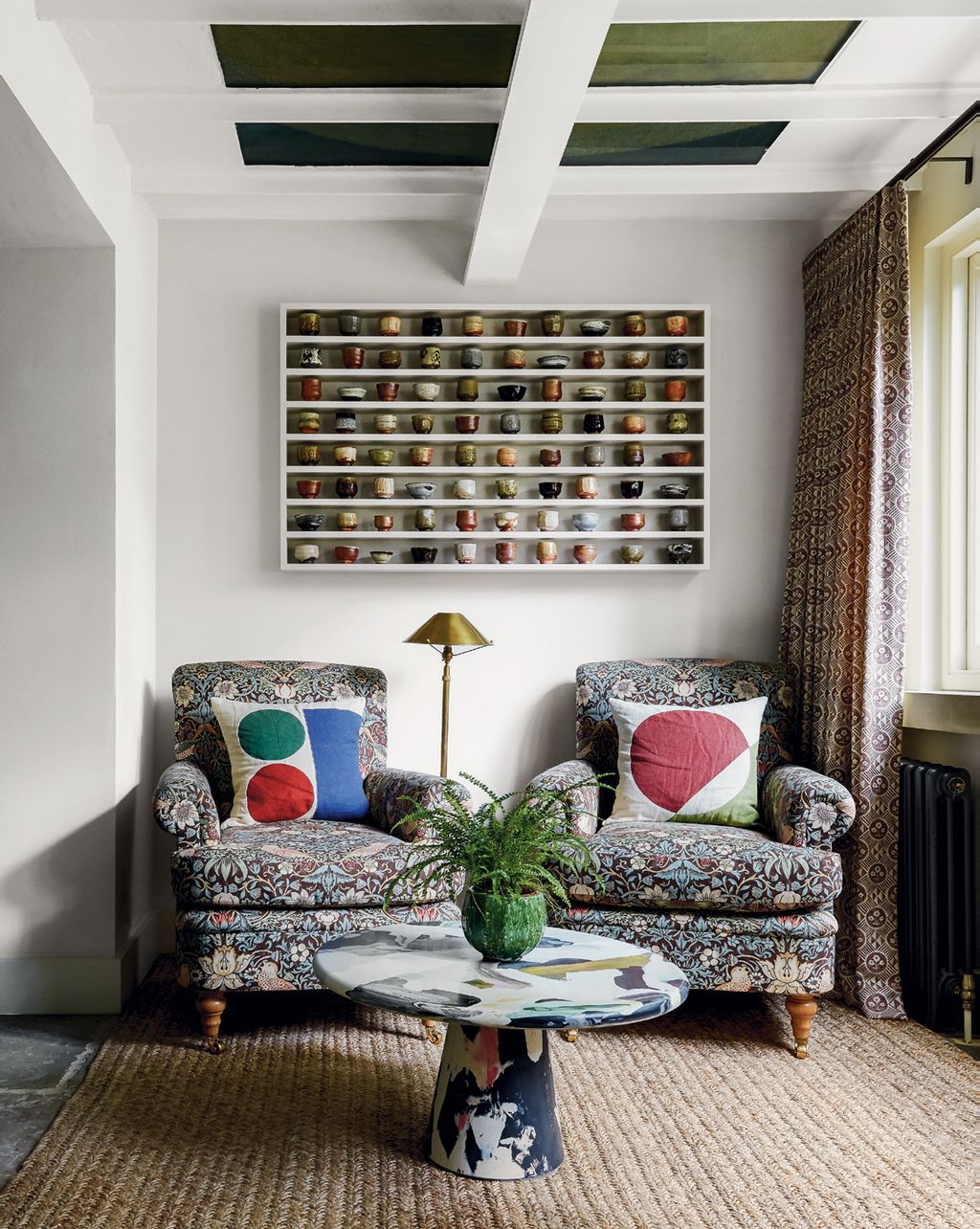
Under the cast-glass floor of the drawing room above, one corner has become a sociable spot, with armchairs from Atelier Ellis covered in ‘Strawberry Thief ’ by Morris & Co. Bespoke shelving for ceramics houses Phil Rogers’ Set of 80 Guinomi from the Goldmark Gallery.
 Paul Massey6/10
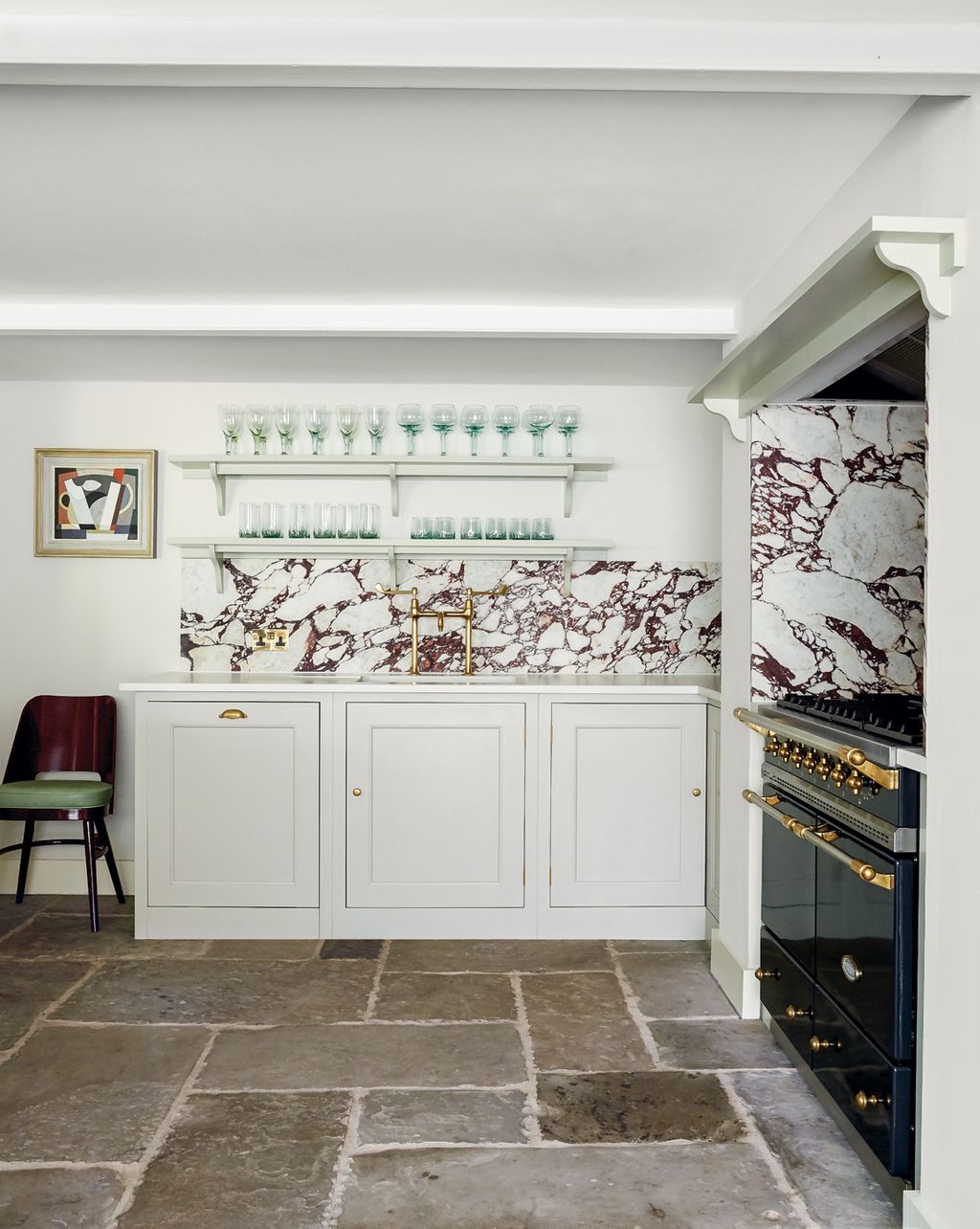
Cupboards by Plain English are teamed with a Calacatta Viola marble splashback.
 Paul Massey7/10
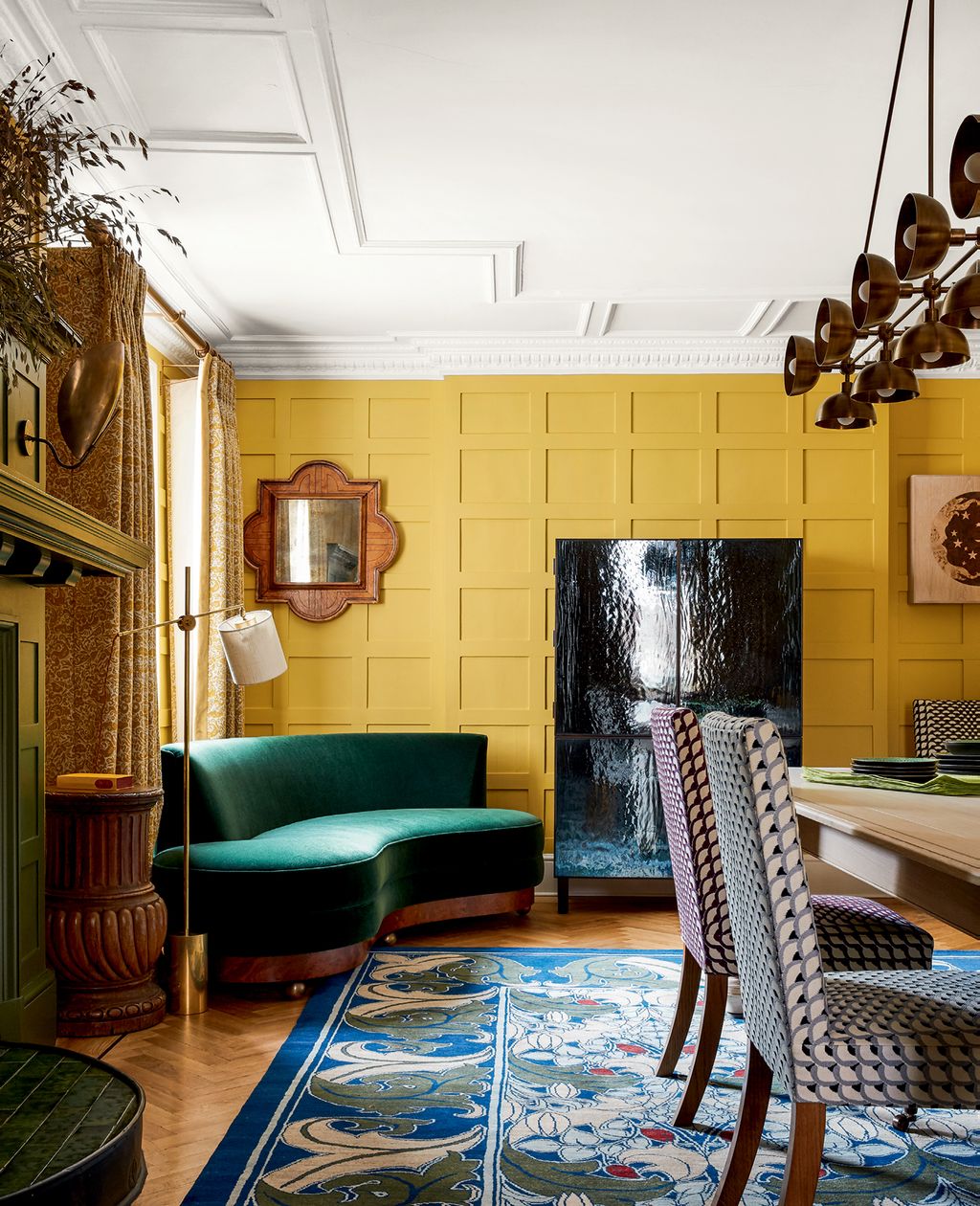
The oak dining table, made by Sir William Bentley Billiards, opens up to become a billiards table. A sofa from Sedilia and a custom cabinet from Pinch contrast with panelling painted in ‘SC227’ by Papers & Paints. The William Morris-inspired bespoke rug is from Parsua.
 Paul Massey8/10
Wallpaper by de Gournay and a four-poster by Collier Webb were chosen to echo the whimsical details installed by Mrs Barrie. The headboard is covered in ‘Bargello’ from Gainsborough, teamed with bed curtains in Claremont’s ‘Armure Cannele’ silk.


 Paul Massey9/10
The original washbasin has been restored. ‘Jennifer’ wall lights from The Urban Electric Co enhance the Edwardian feel.
 Paul Massey10/10
The bedcover is in ‘Nantes’ by Lewis & Wood. The blind is in ‘Crewelwork’ by Bennison and the wallpaper is Quercus & Co’s ‘Tempest’.


