
Inside Studio Vero, a London design practice founded by childhood friends

Never do business with friends is the oft-repeated advice. It is not a saying, however, that applies to Romanos Brihi and Venetia Rudebeck. The interior designers met when they were 13 and, as Romanos says, ‘Our lives have been entwined ever since.’ With a shared appreciation for colour, art and antiques, it was almost inevitable that the KLC-educated friends would pool their skills to found their practice, Studio Vero, in 2014. ‘Before then, we ran our own businesses,’ says Venetia, who trained with the ‘enormously influential’ designer Dido Farrell and, later, Charlotte Crosland, whose ‘sense of colour’ left an equally lasting impression. ‘But we would call each other every day to share discoveries or unpick problems,’ continues Romanos, who began his career at interior design firm Finchatton. ‘When we told friends we were joining forces, no one was surprised.’
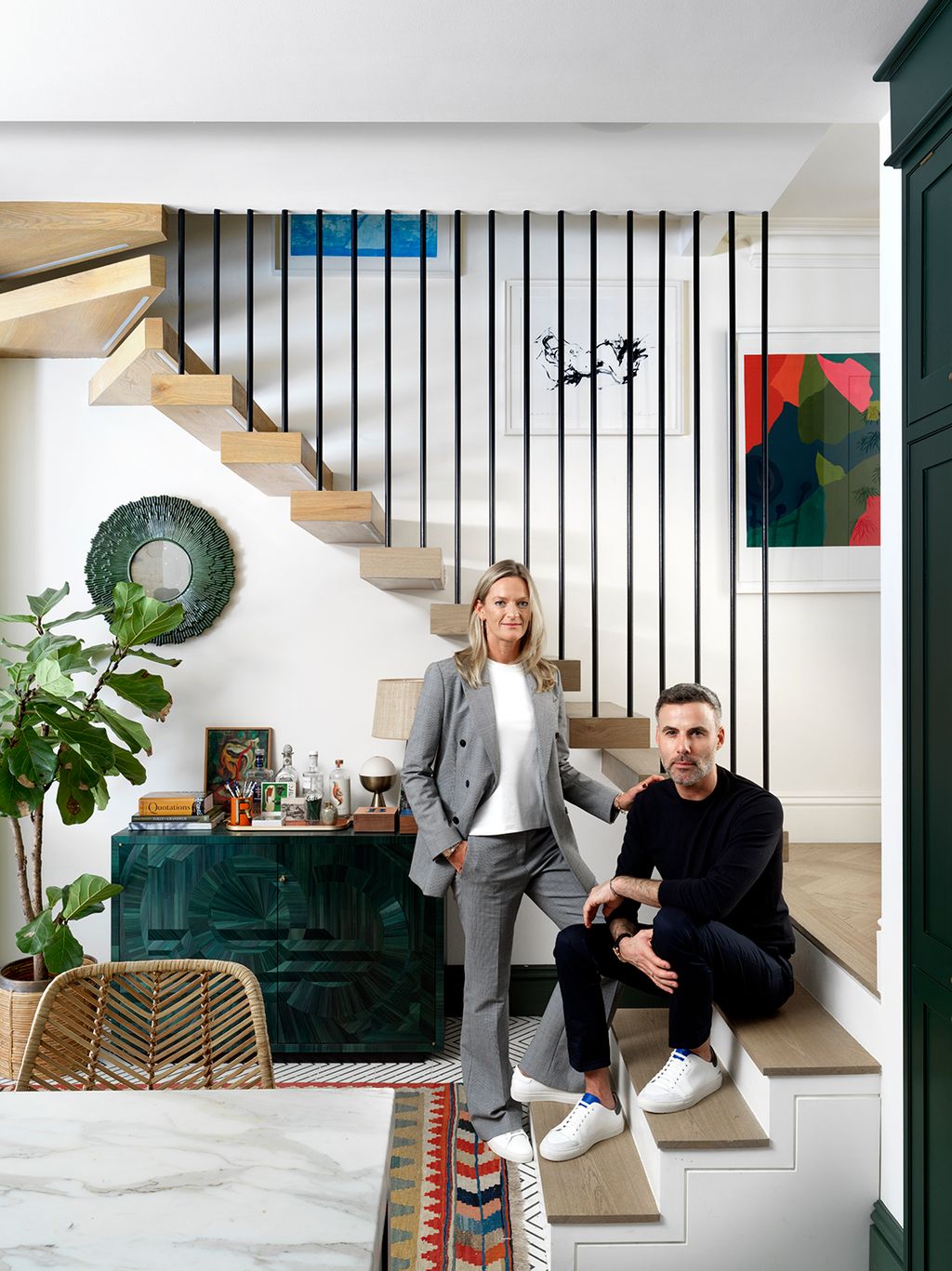
For a snapshot of their ‘collaborative aesthetic’, I am given a whistle-stop tour of Romanos’s own Kensington apartment. Set over two storeys in a stucco-fronted conversion, it was taken back to brick by the friends, who also added a sympathetic extension with doors that open out to the garden. Judiciously used colour, artisanal surfaces – faux marble, a deep-green plaster effect – and striking antiques encapsulate their approach. Crucially, there is comfort, Romanos says, singling out the sofa that ‘wraps around you like a duvet’. Venetia adds, ‘We love rooms that feel inviting and intriguing, with corners you can retreat to with a friend for a good conversation.’
Every project is a joint venture for the pair. One of the earliest clients to appreciate this ‘two-pronged’ approach were the owners of a north London newbuild by architect Ben Pentreath. Behind the neoclassical façade, they designed a contemporary scheme confident enough to match the double-height interior. Recently, for a home in Chelsea, they sourced furnishings and fittings, and commissioned hand-painted chevron walls to accentuate the proportions of the 7,000-square-foot interior.
Increasingly, they are asked to weave clients’ possessions into schemes. For the waste-conscious owner of a country house, sweeping curtains left by the previous owner are being stealthily included in the new scheme. ‘Working within parameters makes you more creative,’ says Venetia, who describes their shared aesthetic as a sixth sense.
Growing up in London in the Eighties, they cite pioneering boutique hotelier Anouska Hempel as a lasting influence. ‘She has such a distinct look; the moody palette and monochrome stripes made her stand out,’ reflects Venetia. The maternal effect is another factor. Romanos’s mother, who worked in fashion, is a keen collector. ‘Every Saturday, we’d go to Portobello Road and I was allowed to choose a trinket,’ he recalls. Venetia’s mother, who grew up in Lisbon, was an antique dealer in the UK: ‘I owe my love of pottery and colour to her. We’re both drawn to thought-provoking things.’

Both were also lucky enough to study art history in Italy and often source artworks for clients. For one, they assembled a collection of contemporary British pieces, including works by Gary Hume and Antony Gormley, found during ‘long but fascinating’ trawls of auction and gallery sites. ‘This is as much a hobby as it is a job,’ says Romanos. ‘It has to inspire you.’
For his own home, Romanos chose to hang his most prized artworks in the bedroom. So, Fernand Léger’s Projet pour une peinture monumentale (c. 1950) greets him each morning: ‘There’s something comforting about waking up to your favourite painting.’ A Gigi Radice chair is equally reassuring. They were bought as a pair – Venetia has its partner in her sitting room. For both of them, the mid-century Italian seating is a daily reminder of a friendship that celebrates its 30th anniversary next year. studio-vero.com
 Simon Brown1/8
 Simon Brown2/8
 Simon Brown3/8
 Simon Brown4/8


 Simon Brown5/8
 Simon Brown6/8
 Simon Brown7/8
 Simon Brown8/8


