

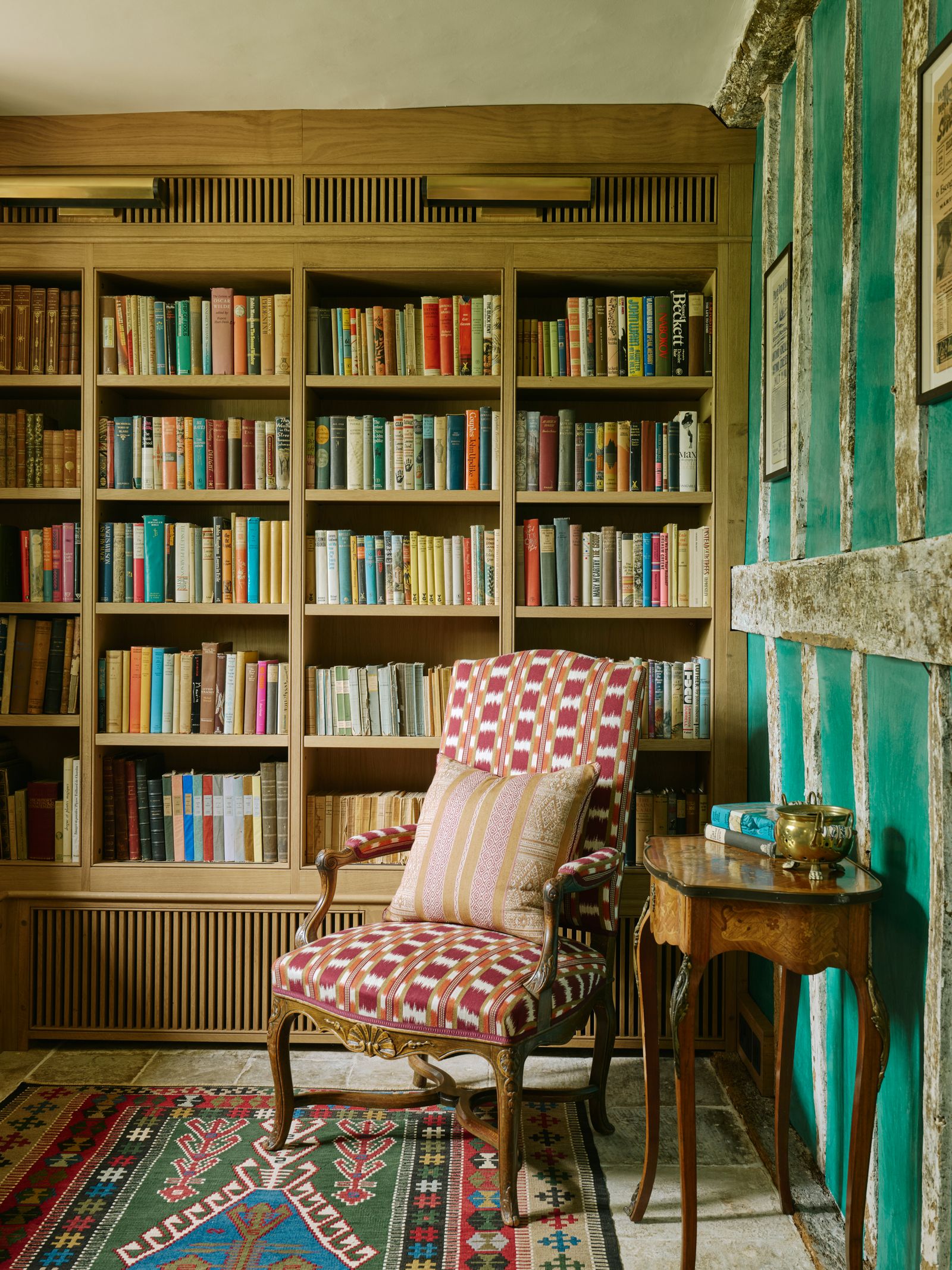
‘For me, houses without books are houses with no soul,’ says Emma Burns, joint managing director of Sibyl Colefax & John Fowler. And notably, countering a multitude of predictions, the advance of the e-reader has not done for books what digital platforms have for CDs. Across the world, print sales are stable, and even growing. It’s a fact that comes as no surprise to those of us whose libraries are loved for tracing an autobiographical path of developing passions, and whose copies of The Mill on the Floss hold within them not only the tragic tale of Maggie and Tom, but a memory of our 18-year-old selves. Moreover, literary collections pose an inviting predicament for the interiors enthusiast, the possibilities being many and varied. The ever-present upshot is the question of whether we are maximising our collection to its best effect – because, in the immortal words of Anthony Powell, employed as the title for the tenth volume of his twelve-novel sequence A Dance to the Music of Time, ‘books do furnish a room.’
The retention of reading matter dates to Ancient Greece. Aristotle amassed scrolls on subjects including metaphysics, ethics, politics, and poetry, and devoted much time to organising them in a systematic fashion. Books arrived in the 1st century AD and became increasingly widespread with the invention of the moveable printing press in the mid-15th century, which decreased their cost. They could still, however, be precious: Catherine de Medici, Queen of France from 1547-1559, kept her hand-painted and jewelled manuscripts behind sliding panels in the famous Chamber of Secrets at Blois.

Indeed, it wasn’t until the 17th century, following innovations in binding that allowed books to stand up - and the development of a status-driven trend for reading amid the Paris salons - that the home library, as we know it today, was born. There are magnificent instances within Britain: at Horace Walpole’s Strawberry Hill, books are housed in Georgian-Gothic shelves featuring intricately carved and crenelated arches, the ceiling is adorned with coats of arms and mythical beasts, and the windows filled with stained glass. Edith Wharton, in her 1897-published directive The Decoration of Houses, described a library as affording ‘unequalled opportunity for the exercise of an architect’s skill’. She favoured a two-storied room with gallery and stairs, a domed or vaulted ceiling - and built-in bookshelves.
There’s still opportunity for exciting design, and there are decisions to be made regarding freestanding or built-in shelves, decorative trim, painted detailing, colour, and glass fronts - which are a dust deterrence, and good for first editions, but can feel less friendly if they’re protecting average paperbacks. And friendliness is key, because crucially, today’s archival display isn’t about browbeating visitors into a state of awe regarding our sophisticated intellect and deep pockets. Rather, says Chloe Willis, associate director at Sibyl Colefax & John Fowler, a home library is about ‘comfort, and it shouldn’t feel contrived.’ Besides books, it needs ‘a very good chair, a table to pour over larger books, and good light to read by.’
What’s also pertinent is that these days most of us are a bit shorter on space, and so ‘a library may not be called a library, or be only a library,’ observes Chloe. She mentions a recent project’s ‘part library, part study, part snug,’ and Emma Burns, in her country home, has turned a barn into a book room-cum-sitting room-cum-guest bedroom. Turner Pocock have created a library in a downstairs loo (a contentious move in some quarters), Laura Stephens Interiors have designed a library that also serves as a playroom, while for others of us our tomes might take up shelves on corridors or landings – or be spread through a house. And there is a compelling argument for that. Dorothy Draper, in her 1939-published manual Decorating is Fun!, recommended always keeping some books in the sitting room, as they are means of making a room look comfortable and as if it gets plenty of use. Penny Morrison gives the same advice regarding a dining room – a room whose death knell is ever being sounded. Books, repositories of transformative texts and romantic tales, made unpredictable by their variance in size and colour of spine, come with an animated allure. And, emphasises Rita Konig, ‘rooms need things that one does not have any control over.’
Of course, there are those who’d prefer a measure of uniformity, and there are solutions. Edith Wharton recommended rebinding, a hobby Virginia Woolf took up as a teenager, and continued, finding it a relief from the mental strain of writing. The architect William Smalley has installed in his home, à la Queen of France, ‘big built-in cupboards which are lined with shelves, so all my books are hidden away. I’m glad not to have them shouting at me.’ (To note: he also has a bar in those cupboards.) There’s the vogue for storing books with the spines facing in, which can offer a pleasing arrangement of texture, albeit little practical information (to the point that William describes the arrangement as ‘clearly stupid.’) Then, colour can lead a system, as practiced by House & Garden’s Decoration Editor, Rémy Mishon – though she clarifies, ‘never in rainbow order.’
Others follow Aristotle’s example and group by type: fiction, poetry, art, travel. Such selections might be further marshalled, either alphabetically by author, or perhaps by date of publication, which can create parallels between War and Peace, Twenty Thousand Leagues Under the Sea, Lorna Doone, and Good Wives (1869 was a strong vintage.) There’s the Dewey Decimal system as favoured by actual libraries – although that is perhaps an institutionalisation too far.

For there are also plenty of people whose styling provides an appealing riposte to any imposed rigidity – and who maintain that there’s no reason why theology, cookbooks, drama, and dystopian fantasy shouldn’t all bunk up together. Brandon Schubert, for instance, ‘puts books on shelves without any thought to organisation, except that I try to vary heights and widths so that the end result is inconsistent, and I always incorporate vases, glass ornaments, sculptures – all sorts of things.’ Philip Hooper, joint managing director of Sibyl Colefax & John Fowler, feels similarly, and reckons ‘it looks very relaxed and chic to hang a picture in front of books.’ He’ll place large books horizontally and sometimes props a small painting on top of them - but all his spines ‘kiss the edge of the shelf and are vertical, it not on to have them slouching at jaunty angles.’ He professes to enjoy the fact that things can get lost, because ‘in searching for something you stumble on a lost treasure.’
There are further considerations. To return to books’ position as a marker of enlightened intelligence in 17th century Paris, some of us are still susceptible to the imagined opinions of others, and disingenuity can creep into a display, by way of both cuts and incredulity-stretching submissions. We might excuse it on space and aesthetic grounds: the spines of my Dick Francis thrillers are less attractive than those on Salman Rushdie’s novels, and there isn’t room for both. Other times, it’s personal preference: ‘I’m not sure I want to the world to see my collection of vintage Just William books,’ says Philip (and that’s what bedroom bookshelves are for.) But, while it’s one thing holding on to our grandparents’ copies of Proust, hoping for a future season of madeleine-consumption and found-time, says Brandon, ‘there is nothing worse than a bookcase full of books that clearly do not belong to the occupants of the house, whether they’re in different languages or on topics that no one who lives there in interested in, like 19th century bird identification in Patagonia.’ Should you be suffering from bare shelves, the answer is not to buy by the metre, but to go to a good, independent book shop, such as Heywood Hill or Daunt Books, who will delight in putting together an appropriate library.
What is worth taking from the Paris salons is the highlighting of particular publications – a recent exhibition catalogue, a new interiors book, or whatever we’re currently reading – by positioning it within easy sight, on a side table or ottoman. We might also place a choice novel beside the guest room bed, and invite our friends to borrow from our shelves (if they return what they’ve taken.) For the other joy of a personal library, whatever form it takes, is the common connection it can ignite with those we invite to our homes. And that’s an occurrence that is consistently soul-affirming. Says Cindy Leveson, ‘books, and more books, make a home.’


