


If you’ve ever lived in a house with low ceilings, you will be familiar with the associated challenges. From the danger of banging your head to the dilemma of where to put your furniture, they can be a literal and metaphorical headache. However, they also have their own charm and character, can present an opportunity for creativity when it comes to decoration.
The same is true of hanging art in such spaces: you just need to know where to start. Who better to turn to for advice than gallerists, interior designers and an artist? Based on their own personal and professional experiences, these are their top tips for turning a daunting task into a fulfilling and, dare I say, fun process.
If you are yet to paint or wallpaper your room, you might like to consider doing something to minimise the impact of your low or sloping ceilings. When designer Joanna Plant was decorating her attic bedroom in her former London home, she lined the entire space in a bold floral print because ‘the expanse of plain ceiling was just too much’. Artist Rachel Bottomley, whose 17th-century cottage in Surrey is full of beams and tricky angles, also likes to ‘disguise awkward shapes by using the same wallpaper on the ceiling and walls, or by painting them the same colour’. And Emma Burns, of Sibyl Colefax & John Fowler, notes that ‘painting the cornices out with the walls can help to give the illusion of more height’.
‘With a low ceiling it’s more important to centre it top to bottom so the picture is in the middle of the wall, even if that means it is below eye level and close to the floor. If it’s too close to the top edge it will look pinched,’ says Julia Collins, vintage art dealer and founder of Collins & Green Art. Rachel similarly avoids hanging too close to the ceiling as she’s found that it can make an already tight space feel even more cramped.
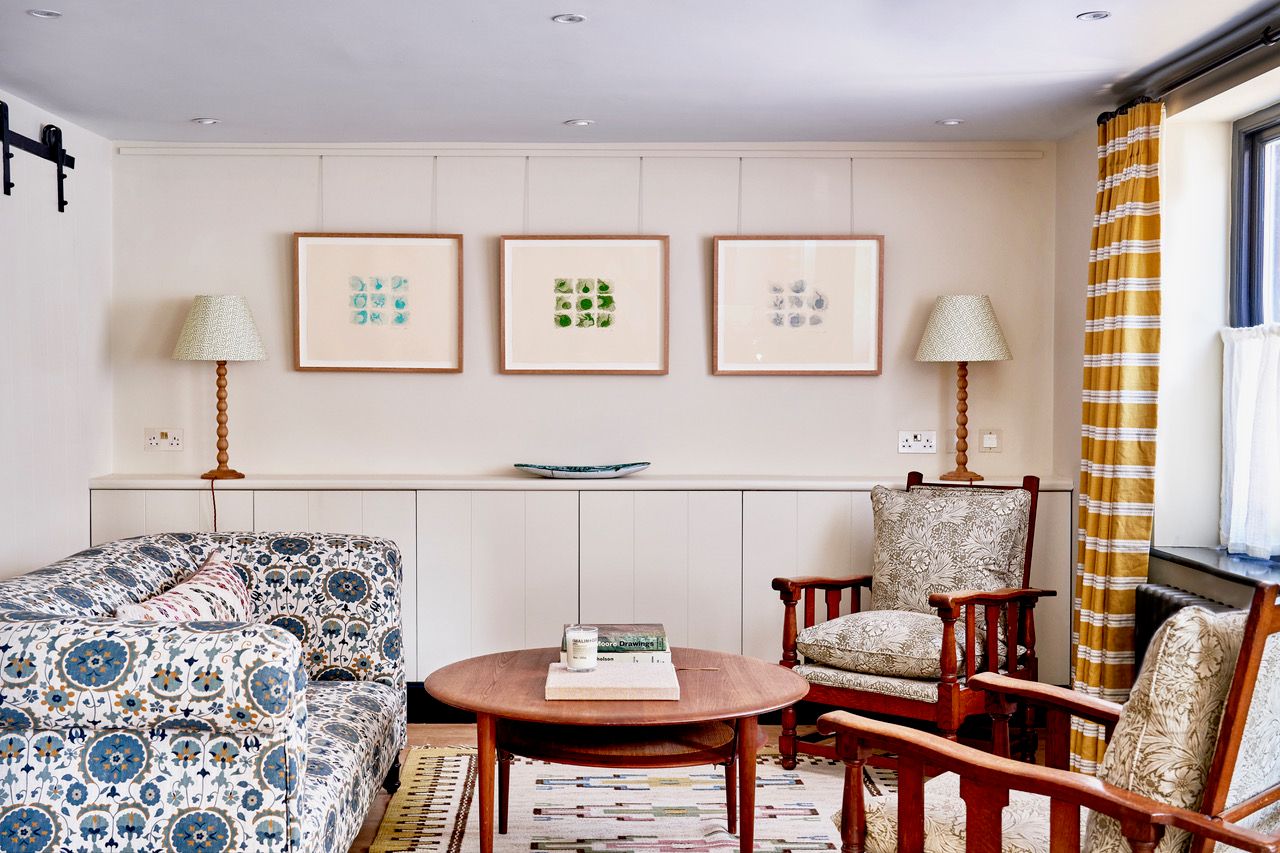
Jenna Burlingham explains that, in her Hampshire gallery, she and her team ‘try to keep everything within the same space on the same centre-line, so that the eye can move from one work to the next’, but admits this does not always work with lower ceilings. ‘Rules are made to be broken and if you need to hang lower, then do,’ she adds. ‘There are some fantastic examples at Kettle’s Yard, with work hung below windows, on angled walls, and so on.’
If you’re struggling to work out the most natural position, furniture can be very helpful. ‘I learned that hanging pictures low works well when they relate to furniture rather than the usual eye-level rule of thumb,’ says Joanna, explaining her approach in her old attic bedroom. ‘The little drawing of a whippet hung low over a chest of drawers feels wonderfully intimate and is nicely lit by the lamp and then the two adjacent pictures – just visible beside the curtain – are hung so that their centre is the middle of the drawing so that it all makes visual sense. On paper it shouldn’t work as they are all hung at less than 1 metre off the floor, but it does.’
Julia suggests paying attention to the shape of your furniture, too. ‘If you have a low ceiling with a piece of furniture under the ceiling, a chest or a sofa for example, try to find a painting that reflects that long, thin oblong rather than a squarer piece,’ she says. ‘Very wide, thin paintings are hard to find so you could use a run of smaller ones, but I would make them all landscape rather than portrait aspect – it results in a calmer, more balanced feel.’

Interior design consultant Lucinda Griffith often eschews the ‘don’t hang too high’ mantra when displaying above furniture: ‘I find groups of pictures of different sizes and frames, hung from the ceiling to the furniture, helps to make the space feel bigger, somehow pushing the ceilings up a bit.’
‘We often try smaller works for smaller spaces,’ explains Jenna, ‘perhaps stacking one above the other, putting them in a tight grid or a clean horizontal row. Slightly smaller, thinner or elegant bespoke frames also allow a space to breathe.’
However, if you live in a higgledy-piggledy property that does not lend itself to order, a slightly looser arrangement is sometimes preferable. ‘Try groups that aren’t too symmetrical – be a bit more organic with your grouping by using different sized pictures,’ says Lucinda. Likewise, Julia thinks that a gallery wall is the ideal solution as it gives you greater freedom. ‘You can even continue the hang round corners into the window reveal, or little nooks and crannies, which helps to give a cohesive look as you are disguising the odd angles of the room.’

Though larger works do require more thought, displaying them in a restricted space is not out of the question. ‘My office in the gallery is a small space with a sloped ceiling and it can often be the best place to put a large floor-to-ceiling upright canvas that fills the room,’ says Jenna. Lucinda also notes that ‘oddly, if you do need to fit in a large oil or two, it can work better to put them on a more compact wall so that they don’t drown out everything else in the room. Perhaps enclose them with a pair of wall lights or candle sconces, or hang them over a bigger piece of furniture so they have something to relate to.’
This might feel risky – both aesthetically and practically – but it can work brilliantly, as Emma discovered. ‘Having run out of wall space in my old house, I hung a mirror and an engraving on the soffit under the stairs,’ she recalls. Julia is a fellow advocate and has a handy tip: ‘It’s not hard to do if you use mirror plates attached to each side of the picture. It’s unexpected and it looks really good.’

As with most aspects of interior decoration, there is no such thing as a one-size-fits-all solution. ‘Our advice is always “don’t be afraid to experiment” and see what feels right,’ says Jenna. Emma could not agree more: ‘Just go for it and don’t worry about your ceiling height. The important thing is the balance and the rhythm. It sounds a bit fey, but I find that pictures decide where they want to hang. The most amusing thing I did when I moved house was to hang all the pictures I had in one room floor to ceiling and then went shopping in my own gallery.’
Lucinda suggests marking out your wall space on the floor and playing around with your collection: ‘I do a sort of “jigsaw” with my pictures to see how they will work together, and then hang them based on the pattern that works the best. The pictures don’t have to be related to each other, or of a similar period or style. It is your love of them that binds them together – although I do avoid mixing mediums such as photography with oils and watercolours and stick with either a common colour palette of sorts, or medium.’ Julia urges us to let our inner curator run wild: ‘You could do a totally disparate collection, a thematic collection, a selection all framed in the same way. Gallery walls are limitless.’

The most important thing to remember is that unusual ceilings are not an obstacle; they are an opportunity for creativity. Do not let them get in the way of displaying your favourite pieces, whatever form these might take. As Lucinda rather poetically puts it, ‘The brilliant thing about lots of pictures hung together is they become a sort of choir – singing together to make a fabulous contribution. You may not have many soloists, but I bet you do have the makings of a choir in that jumble of pictures lying against the wall that you haven’t hung yet.’ It’s time to find your perfect arrangement.


