


“There’s something very primeval about ceramics, something very earthy about it,” says the artist Martha Freud, who has an exhibition opening next month at the Nonemore Gallery on Rathbone Place, and whose large light installation you might have spotted in Melinda Stevens’ treasure trove of a house. “It’s one of the oldest art forms. People have been working with clay for thousands of years. And yet it never stops being fascinating, and you never seem to run out of things that you can do with it.” That said, she didn’t find the medium immediately. “I worked in film, in the art department, and my degree was in furniture and product design. I worked with so many different materials – just not clay. That came later.”
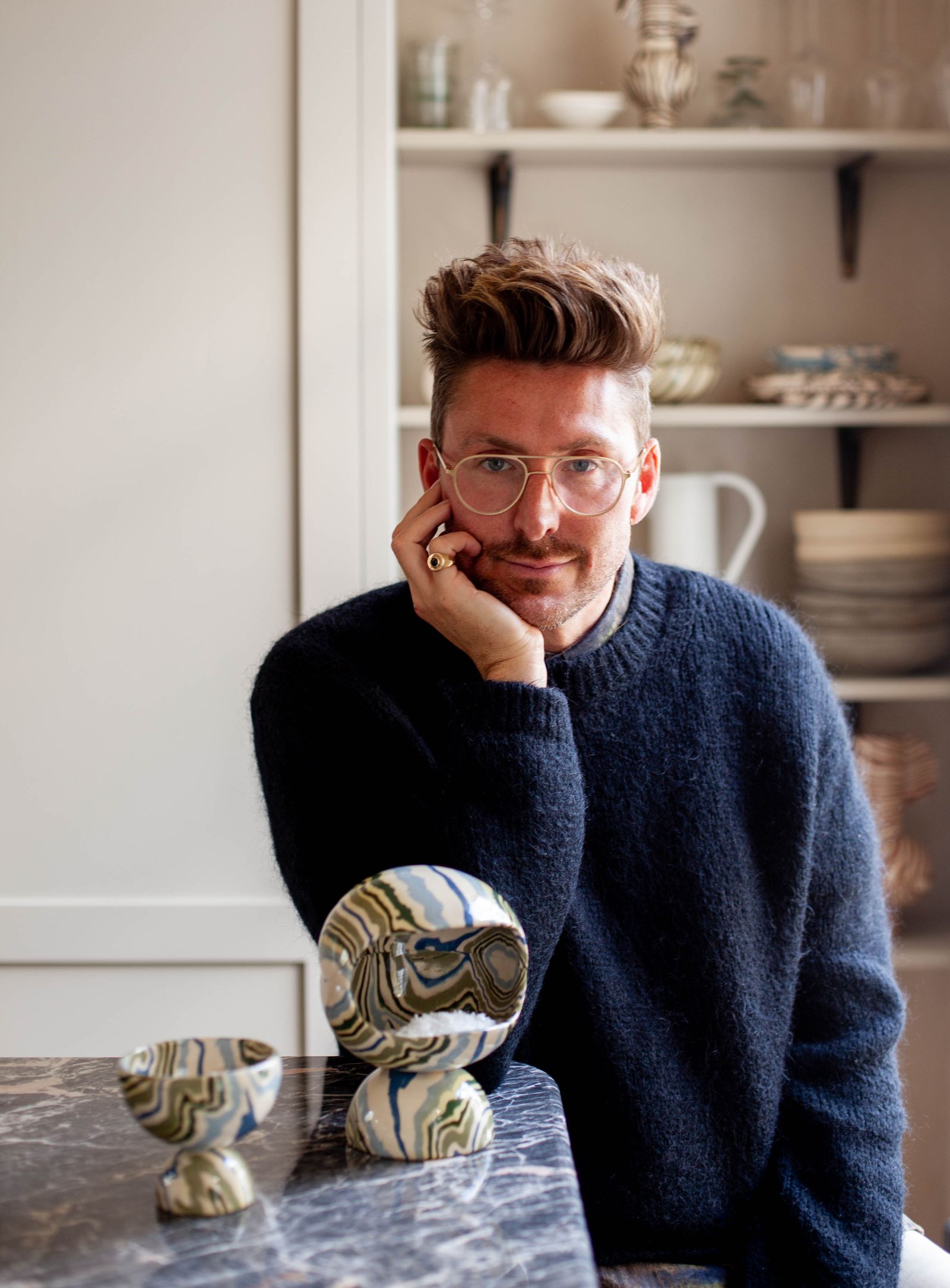
Not dissimilarly, Henry Holland had a successful career in fashion before segueing into ceramics during lockdown; his homeware is now stocked at Liberty, and his lighting collaboration with Studio Ashby launches next week. And Henry’s story doesn’t differ wildly from Brad Pitt’s; in a recent interview with GQ, the actor showed the interviewer a pair of porcelain candlesticks he had made. Brad, we imagine, probably won’t give up his day job immediately – which makes his practice comparable to Gavin Houghton’s who, having inherited a kiln, makes contemporary Bloomsbury-eque vases, tiles and plates alongside designing exceptional interiors. He’s recently created a special collection for the shop at Charleston Farmhouse, inspired by Duncan Grant’s erotic drawings, to chime with the exhibition Duncan Grant: Very Private? which opens on 17 September. Then there’s Alexandra Robinson, whose furniture and lighting is sold by The New Craftsmen, and who has recently developed a side line in ceramic candlesticks, butterdishes and other items that she sells on her Instagram account.
The Covid-caused surge of interest in a return to handicrafts is only growing, especially now that in-person courses are again taking place. In a world where there is so much emphasis on message over making, there’s inordinate pleasure to be found in focussing only on the latter. The choice of medium can seem overwhelming, which is why it’s reassuring to hear that it isn’t necessarily innate – though it can, evidently, be life-changing. But trying ceramics can seem a bigger commitment than, say, purchasing one of The Fabled Thread’s heavenly embroidery kits online, or ordering block printing materials from Molly Mahon, before signing up for her (excellent) Create Academy course. And yet, if you do have hazy memories of having rather enjoyed your time in the ceramics department at school, there are ways and means of again getting clay under your fingernails, and, happily, they don’t necessarily cost a fortune.
Henry started with weekly lessons from a ceramicist at the Ridley Road Studios in Dalston. “I did it for about three to four months,” he says. “Initially it was just as a creative outlet – I never imagined it was going to become anything commercial.” Alexandra did a clay sculpture course at London Fine Art Studios, followed by lessons at the not-for-profit organisation Clapham Pottery. Gavin had “a few evening classes in the slab technique in the basement of a church in Lambeth.” For Martha, it was a term of once-weekly two-and-half-hour slots in Chelsea; “it was an Adult Education course,” she explains. If interested, do check your local college for similar; there are also places such as Studio Pottery London where you can have lessons, and rent space. “It doesn’t take long to catch the bug,” says Henry. “I stumbled across the Nerikomi technique that I use, and that really just struck a cord. The distinctive nature, the way of using colour and pattern – I thought to myself that if I was ever going to make pots and sell them, this was what they would look like.” Several were made in his kitchen – which he then carried to Ridley Road Studios to get fired – and he put some pictures on Instagram, asked people to DM him if they were interested. Unsurprisingly, they sold out in 24 hours; he now runs his own 12,000-square-foot studio of seven makers in Hackney Wick.

Others prefer a smaller scale. Alexandra, who lives in Dorset, works from her kitchen table; “I tend to have a Monday to Friday in-progress studio, and I clear it up whenever we have a dinner party.” Once a week she takes what she’s made “leather-hard” to Messum’s Creative to be fired. “It’s great because at the same time I have a check in with the ceramics studio’s technical manager, Andy Glass, about glazes and other things.” Martha also works at home, though has her own kiln that she bought second-hand kiln on Ebay – “it was about £500, 15 years ago.” Gavin has a red shed in his garden, “which I love.” Notably, none of the ceramicists mentioned in this article ‘throw’, i.e., use a wheel – which, it should be explained, is a completely different technique. “I once heard Edmund de Waal say that, to be competent on the wheel, you have to have made 30,000 pots,” recounts Martha. And all emphasise the general lack of equipment needed, beyond the clay. “And that you can buy on Amazon. Then I use the spoons and knives and other things I already have in my kitchen,” says Alexandra.
Which is not to say that the methods they do use – coil, slab, mould, pinch and more – are easy. “There is a lot of trial and error,” says Martha. “And not only in the making. The first big things I made were the butterfly light and the leaf light – it took me about a year to get them right, and there were a lot of broken butterflies along the way. The only way that you can really understand clay is through experience. The more you have your hands on it, the more you understand it. Then you have to dry it carefully so it doesn’t crack, and then fire it carefully so it doesn’t crack. Ceramics is an endless tease between immediate gratification and drawn-out courtship.”

It can also be seen either as art, or as existing purely within the domestic realm. “I love that we make things that are part of people’s everyday lives, that get touched every day, that are functional,” says Henry. Alexandra points out that “you don’t have to be good at art – you don’t have to be able to draw – unless you’re planning to decorate what you make.” (Which Gavin does.) “It’s a totally different discipline, and there’s a satisfying rigour to doing things like calculating shrinkage. Although, the best thing,” Alexandra continues, “is just being able to make anything I need. Such as a colander, or a butter dish, or a bowl that is perfect for serving nuts. And then collecting it from the kiln – well, it’s like Christmas, every time.”
- 50 stylish living room ideas to copy now
- Farrow and Ball paint colours in real homes
- Small room ideas from the House & Garden archive
- How to hang pictures on walls at home
- Bright bathroom ideas to make a splash
- Hallway ideas to make a great first impression
- Patio, garden decking and terrace ideas
- The best garden furniture stores to help you spruce up
- A guide to the best interiors shops in London
- How to decorate a Georgian house
- The best mattresses to buy for quality sleep


