

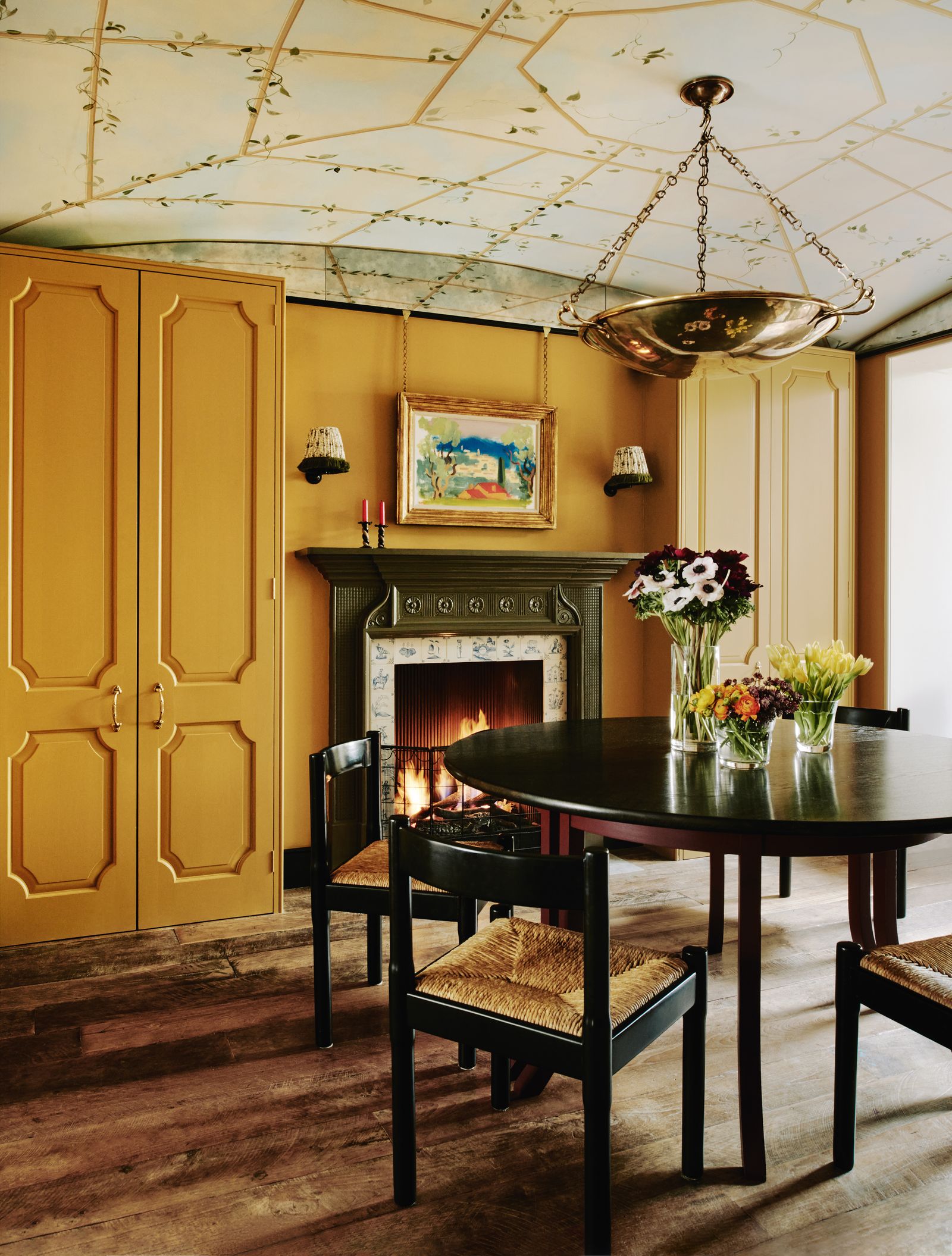
“I love the writer Natalie Goldberg’s idea of a compost heap of ideas," says Sibyl Colefax & John Fowler Design Director Lucy Hammond Giles. “The idea that beauty, and usefulness, can be found in the least likely of places, often those considered ugly. Keep your eyes peeled. Look up. Look round. Look out.” It's a useful call to action at a time when many of us are glued to Instagram or Pinterest for decorating inspiration, seeing the same images and the same trends as millions of people around the world. Algorithms can be helpful things, but if we want to be truly creative and not all end up with the same sitting rooms, we need to cast the net a little wider.
“Don’t be a sheep,” advises Lucy's colleague Wendy Nicholls, who has amassed a wealth of inspiration over the course of a lifetime of decorating. “It’s both alluring and easy to look at magazines and social media and to fall into following the prevailing zeitgeist. Be an individual. Find your own taste by exposing yourself to museums, galleries, art books, decoration books and as many houses both old and modern as you can get into – then express it. It doesn’t have to be what is regarded as ‘good taste’.” Wendy herself built up her own expertise by, as she says, visiting as many houses as possible. “'Every weekend, without fail, our gang of chums visited country houses. We went to every single one in England – National Trust and other historic houses. We got ourselves into everything. We even bunked each other up through the windows of condemned houses, and had tremendous laughs and larks.”

Interior designer James Thurstan Waterworth agrees on the importance of English country houses: “As a family, we visit Stourhead, with its Palladian house and beautiful gardens, on Sundays before lunch. I was fortunate that my father shared an interest in historic country properties and one I was at very recently for the Gormley show which I loved was Holkham Hall, with its sweeping gardens and classical architecture, another personal favourite. It’s not just the buildings themselves that inspire me, but also the way follies, gardens, and surrounding spaces interact. The interplay between structures and their environments is often underappreciated, yet I believe it’s essential to understanding spatial composition.”

And of course, houses further afield provide a wealth of inspiration, especially for those of steeped in English country house style already. Taking the opportunity to visit houses that have been preserved as museums whether at home or abroad is always a helpful thing to do while travelling. It's something Scott Maddux and Jo leGleud of Maddux Creative always make time for. “Some of our recent favourites have been Maison Hannon in Brussels, Mount Stuart and Bute and the Teien Metropolitan Museum of Art in Tokyo. Even in London we are surrounded by wonderful house museums, such as the Charles Jencks Foundation Cosmic House, where we took a team trip at the end of last year. Charles Jencks’ Cosmic House serves as a physical manifestation of architectural language and symbolism. Each element is meticulously designed to contribute to a cohesive philosophical narrative, prompting a bold and meaningful approach to interior aesthetics.”

Quite small details and compositions in other houses can provoke brilliant ideas, even if the style of the house is completely different from your own. Decorator Benedict Foley mentions that “I’ve been working on a project in London where we were inspired by the particular way a collection of Safavid tiles were displayed in a house in Cairo. You wouldn’t really read the concept in a photo as they are on a staircase and there is a jumble of ancient fire fighting equipment hanging around, but transported to England and the wall colour changed for a dark one - suddenly the dramatic possibilities turn right up.” Daniel Slowik, meanwhile, neatly explains how inspiration can strike in less tangible ways. “I’ve been working on a project in Rome, an apartment in a palazzo in the old Ghetto, and I had this idea that I wanted the walls to be something between the look of old vellum bound books I saw in a tiny chain library over the porch of Wimborne Minster and the sort of light that filters off the shaded back canals in Venice in the summer. The rooms are very high and needed a sense of movement and depth that only a specialist paint finish could create.”

Travel, which necessarily opens our eyes to new things, and makes us more observant than we would be in our home countries, is an essential way to garner inspiration. “My inspiration comes from many different places when I travel, including the architecture found in different countries,” says interior designer Henriette von Stockhausen. “From a very early age our parents trawled us through churches, palaces and any other places of architectural and historical interest which certainly left a strong impression on me. But it’s not just that. Inspiration comes to me in many ways such as the colour combinations of delicious food, Moroccan tile combinations or just plain nature.” Many designers will agree on this point. “Travel is a constant in my life, both personally and professionally, whether for sourcing or for projects abroad,” says James Thurstan Waterworth. “We often travel to the South of France for sourcing, as well as to Italy and Morocco. One place that especially moved me was Japan, with its emphasis on design across all realms, far beyond what we might imagine in Europe. The architecture, museums, details, landscapes, and cultural nuances of these places seep into my subconscious, often resurfacing in projects years later.”
.jpg)
Colour is an area where it can be especially helpful to look around you and see how nature and artifice have created beautiful combinations. Lucy speaks of finding such ideas everywhere she goes: “on the city streets or in parks – the livid green of an oxidised copper roof next to the rusted orange red of a railing. The depths and mountains of the country and their houses. The feathers of a bird as well as a vivid berry found amongst their shit (good luck with that one). In paintings and drawings by masters and children.” Looking at art is equally fascinating – who can have a better eye for colour, after all? Wendy Nicholls remarks that “when it comes to colour, I find books of old icons inspiring.” Paint expert and interior designer Edward Bulmer, understandably, gets technical when hunting for new ideas: "I like to read the descriptions of old accounts and colourman’s catalogues and mix the colours in the heads using the pigments mentioned.”

For Tiffany Duggan, founder of Studio Duggan, it was the theatre that proved particularly inspiring, as it has for many others. "I started my career working as a scenic artist – painting sets and backcloths for theatre. Theatre has certainly helped to influence my work, I think this must be where my penchant for the dramatic comes from! I think the biggest inspiration is the need to create a ‘mise en scene’ - an immersive experience. We love to go into a lot of detail in our design projects…we choose scents, flowers, glassware and crockery (when permitted!) - all carefully selected to feed the narrative of the project and reflect the personalities of our clients. We’ve even been know to make playlists!” In this crossover from theatre to interior design, she joins some of the great 20th-century personalities in the design world, figures like Oliver Messel and Renzo Mongiardino, who famously used theatrical effects such as trompe l'oeil and faux architectural features in their decorative work.

The collector's instinct, which many interior designers share, is a great way to keep your mind and eyes open, whether it's by scouring markets or car boot sales or visiting decorative fairs and art galleries with the intent to gather your own archive of inspiration. Textile designer and decorator Flora Soames wrote her book The One Day Box on this subject. “When I was younger, I felt a close connection between collecting and my strong nostalgic bent. I am from a line of women who hoard – and that tendency morphed into an expression of my longing for home, even when I was there. My favourite hunting ground was the local car boot sale, a love I inherited from one of my grandmothers. We’d go together in pursuit of the beautiful, not unlike gold panners in our commitment and fervour.” This activity, which bonded Flora to other women in her family, also formed the basis for a collection that inspired her business and her own interiors. “I still own every chipped saucer and faded tablecloth we found. As I grew older, my taste developed, but my appetite for collecting never waned. I became interested in antique textiles, finding them irresistible. Scraps of wallpaper, remnants of upholstery, an old kimono – they resonate because they remind me of something or someone I love.”
Fashion can also have much to offer in the way of a fresh perspective, as Scott and Jo explain. “Fashion is great for textile inspiration. What I like about fashion is the way that the concept for the collections are manifested I the production values for the clothing and the prints, down to the merchandising and window displays – I find that aspect particularly satisfying. I think Jacquemus and Dries Van Noten do that very well, and when you see their window displays in department stores, the design of their concessions and boutiques in other spaces, they are particularly creative. This is something we are always thinking about.”

And of course, interior designers who are constantly finding themselves in new houses take their inspiration from the buildings themselves. “I feel very strongly that I should be led by the history and architecture of each individual project house,” says Henriette von Stockhausen. “Each home has a very special, individual history and story to be told.” Indeed, it's possible to be quite literal about this, at least from an imaginative point of view. We love how Sasha Sarokin, whose house we featured on the website last year, explained her interpretation of her house's history: “Our house is 1920s and it has some lovely period details, but it also has a modern, clean-lined extension. I imagined that we were in the 1960s, and a woman had inherited the house from her aunt, who was a great art collector who had been filling her house with art since the 1920s.” These ideas informed the decoration of the house, in which lots of beautiful mid-century pieces sit happily next to more Art Deco ideas.
“Nothing is completely original,” concludes Lucy Hammond Giles, “but each room or house we work on is unique, each client different. Our work comes from viewing them both through our lens of memories, bringing together suitable references and inspiration from that compost heap in the right place at the right time.”


