
The art of plasterwork and why it's having a renaissance

For a humble material, plaster has a long and impressive story in the history of decorative arts. An unassuming mix of mineral dust and water, it is capable of being shaped into highly elaborate forms of decoration, and is remarkable for being both fragile and durable at the same time. There are examples of plasterwork surviving 4000 years on the walls of Egyptian temples, yet if you were to try and eat supper off a plaster table, it would quite likely collapse beneath you.
Not that its fragility has stopped people trying to build with it. We may be most familiar with plaster from its use in decorative mouldings or carved reliefs, which reached an apogee of ornament in the eighteenth century, but it has always had its more functional uses. When used in mouldings or for complex decoration on a wall, plaster must be cast in a mould, where its ability to expand, harden, and then contract slightly make it eminently suitable for the technique. But plaster can also be applied by hand to a frame or model, a considerably looser approach to the material that yields rougher, more organic forms. It's an aesthetic that most viewers would instinctively link with the artist Alberto Giacometti, who regularly created both figurative sculpture and functional pieces of lighting and furniture in plaster. It was a necessary intermediate material for the process of casting in bronze, but Giacometti loved the material for itself. He wasn't alone; his contemporary Serge Roche produced fanciful lighting and furniture and plaster for his family's gallery in Paris in the middle of the twentieth century, inspired by eighteenth-century designs but with a surreal twist.
Part of the appeal of plaster lies in the liminal status that Giacometti and Roche both recognised: is it a material that should be used for art, for decoration, or for functional objects? Many of the iconic figures who redefined the limits of plaster over the course of the twentieth century, such as Giacometti and Serge Roche, refused to define whether they were artists or makers. Firmly in this tradition is Philippe Anthonioz, who describes himself as a sculptor who makes furniture; whether in plaster or bronze he finds no distinction between figurative sculpture and the making of more functional pieces. Partly it is the delicacy and challenging nature of plaster that lends itself to this perspective. As the New York-based craftsman Stephen Antonson puts it, “plaster blurs the line – it functions and it doesn’t. Sure, I can make a chair for you, but I can’t promise it won’t break.”

Viola Lanari, whose plaster lighting can be found in many a stylish house, also remarks that she enjoys the material because “it has its own mind and its own timing. You're working with a chemical reaction, it's not like clay which can be used and used again. If you overuse it will just crumble. You have this limited amount of time before it sets, and the process is somewhat out of your control.” The process of hand application that Viola uses lends itself to organic forms, to the stems and leaves and petals that have characterised much of her work so far, and a rough, naive textural finish that proudly shows off the process that made it.
At the same time as these modernist shapes are having a resurgence in popularity, the smoother, more elaborate eighteenth-century approach to plaster remains as popular as ever, with small scale reliefs and medallions proving an accessible route into the world of classically-inspired art. The versatility of these pieces perhaps has something to do with their hue; the pristine white of images cast in plaster lends them a timeless element, however traditional they may actually be. Peter Hone, whose plaster leaves and medallions are available at Lassco and Pentreath & Hall, is perhaps the best known of these artists, and in a world where the elegant proportions of Georgian architecture still seem the epitome of grace, we can quite understand the urge to hark back.
The plaster artist Alexander Griffin, for example, looks to that mecca of eighteenth-century ornament, Sir John Soane's Museum, for inspiration. “My family, like others, have a fanatical love of the Soane Museum – it was the theatrical displays of casts there that piqued my interest in plaster casting,” he explains. There is an almost unbelievable intricacy to the best examples of that period, such as the ceiling of the Stone Hall at Houghton Hall, which was designed by William Kent and executed by the stuccadore Giuseppe Artari; Griffin calls it “mind-bending and uplifiting”. Yet even when looking back to the past, the more organic nature of plaster keeps coming back to mind. Griffin cites Elizabethan and Jacobean styles of interior plasterwork on fireplaces and ceilings as having “extraordinary detail but still a degree of imperfection and movement.”
If you want to add plaster to your own scheme, there has never been a better time to shop for it (except, perhaps, the 1700s). You can pick up one of Peter Hone's small plaster medallions from Pentreath & Hall for under £40, or one of Alexander Griffin's creations for Berdoulat for a similar cost (as well as much larger pieces for a higher cost). At the other end of the spectrum, invest in one of Viola's plaster chandeliers from Porta Romana, or find an original by John Dickinson on 1stDibs. Classical or modern, ethereal or playful, it's a material for the ages. Just don't sit on it.
 Christopher Horwood1/12
House & Garden editor Hatta Byng's library – which features in the December 2024 issue, on sale now – features plaster casts of leaves by Peter Hone. These stand out on walls in Edward Bulmer's 'Aquatic by a doorway to the pink sitting room, which was reopened during the renovations.
 Christopher Horwood2/12
It's a very small detail but in this Georgian townhouse kitchen, the plaster wall lights above the marble countertops give a more tactile feel to the elegance of the kitchen aesthetic and help to make it feel more realistic.
 Christopher Horwood3/12
In Lucy Williams' west London house, Lucy's fireside nook features a plaster shell light by Rose Uniacke, whilst the mirror was found at Brownrigg.
 Michael Sinclair4/12
Wall lights by Viola Lanari surround an artwork by Nicky Knowles in the bedroom of Pandora Taylor's house in London.


 Astrid Templier5/12
In a Herne Hill house with a country cottage feel, Pandora Taylor added a striking plaster swirl atop the mantelpiece, which introduces a unique layer of textural intrigue, becoming a focal point in this warm, inviting space.
 Astrid Templier6/12
In the same Herne Hill house, Pandora Taylor has added two plaster wall lights which add a delicate balance, drawing the eye and subtly enhancing the room’s refined, harmonious feel.
 Paul Massey7/12
Plaster casts of classical architectural features by Peter Hone cover the walls above panelling in ‘Spanish Brown’ gloss paint by Little Greene in Bridie Hall's north London house.
 Andrew Montgomery8/12
Highly decorative plasterwork from the 1920s adorns the walls at Wardington Manor in Oxfordshire.


 Andrew Montgomery9/12
On the walls of the original staircase at Wardington Manor in Oxfordshire layers of paint were removed to reveal the quality of the mid-eighteenth-century stucco work. If you have a lot of wall space (or even if you don't), implementing decorative plasterwork can be an elegant way to make your staircase a bit more showstopping.
 Paul Massey10/12
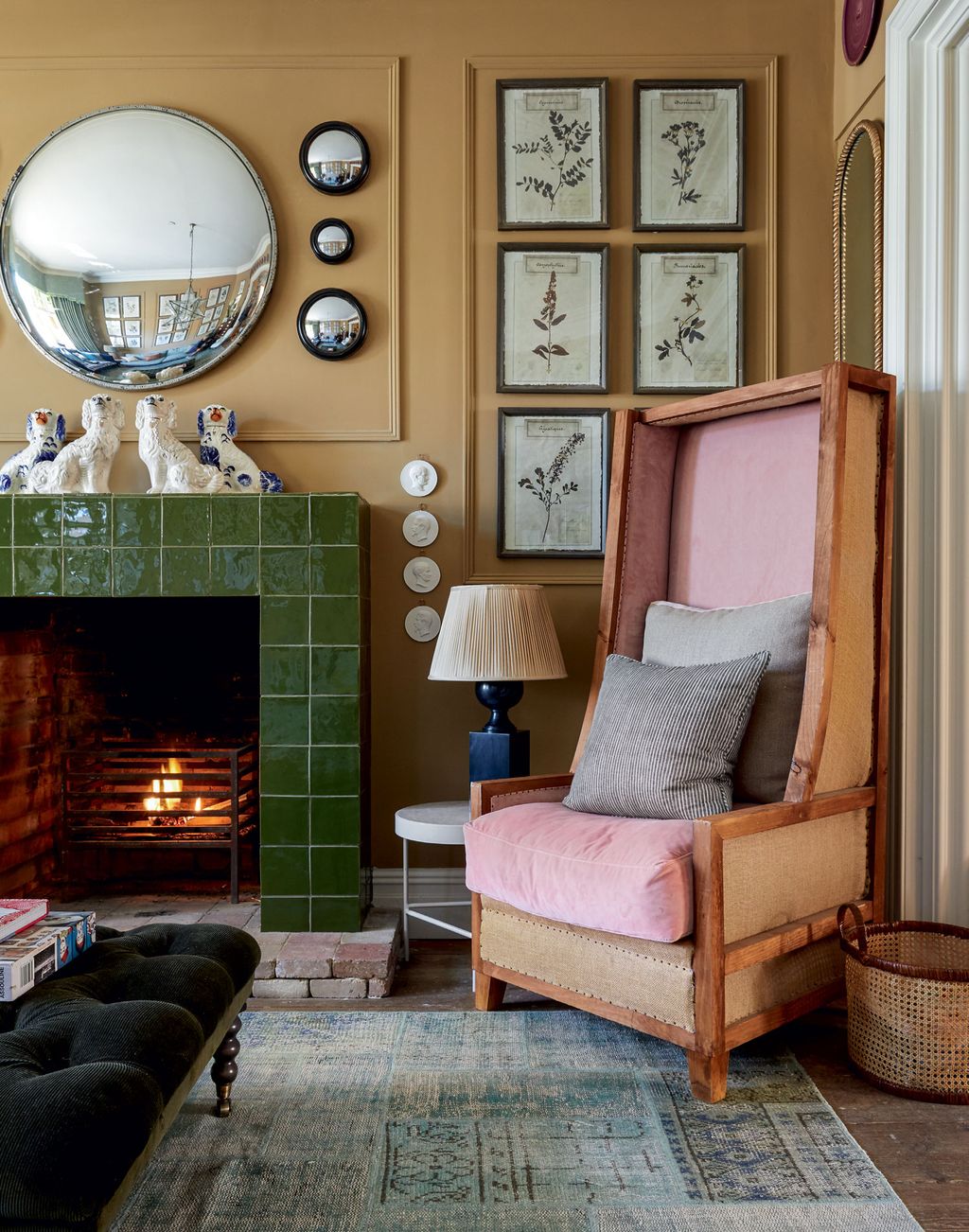
A set of plaster medallions by Peter Hone hangs beside the tiled fireplace in Sarah Corbett-Winder's London house.
 Davide Lovatti11/12
In Tara Craig's London flat, a restrained plaster chandelier custom-made by Collier Webb forms a pleasing contrast to the traditional decoration.
 Lucas Allen12/12
Plaster objects by the New York-based artist-designer, Stephen Antonson in his New York studio.


Comments
Back to Top


