
A richly decorated ex-local authority flat in Notting Hill

In Britain, social housing has a poor reputation. There has been the tragedy of Grenfell and the ensuing (and ongoing) cladding scandal; alongside, the rise in gang culture and knife crime is frequently associated with run-down ‘failing’ council estates. It is far from what the philanthropists had in mind when the modern concept was born back in the 19th century, or what the architects dreamt when local authorities took over as the main builders of social housing in the 1890s. Nor is it a reputation that is necessarily deserved; I have lived on an inner-city council estate for the past twelve years, and have loved it - to the point that I would encourage anyone with a limited budget to do the same, and consider the many merits of ex-local authority living.
My husband and I bought this two-bedroom maisonette in a low-rise on the 1965-designed Brunel Estate in Notting Hill when we were engaged, having discovered that it would afford us two or even three times the square footage than a similarly priced flat in stucco-ed terrace. There were further advantages: a huge communal garden (conceived by the landscape architect Michael Brown in 1970, it is Grade II listed), a lift (a life-saver once I started having babies), views that stretch as far as the Shard and the London Eye – and, to our delight, a community among whom we have made many friends. Collectively, we’ve watched our children grow up, graduate from crawling and toddling to dancing at Carnival, start nursery, then school, and then start walking to school without us but with each other. During the lockdowns they’d conduct science experiments outside the garages and play French cricket on the lawn. Additionally, our flat is light and well-ventilated, and the construction is such that we never hear our neighbours through the concrete walls, and they claim not to hear us – even when pursuing ballet and clarinet lessons on Zoom.

While some who have bought similar properties have decorated in a manner that fits with the style of their building, others, for instance Tamara Lancaster, associate director at Ben Pentreath, exercise their own aesthetic – the joy being that a rectangular box has endless possibilities, as illustrated by Mark Cowper’s photographs of living spaces in Ethelburga Tower in Battersea, exhibited at the Museum of the Home. Our approach was organic rather than planned, and owes much to inherited furniture, the local Portobello market, a love of colour and pattern, my husband’s experience as a set-builder (it was he who painted the jungle in the bathroom) and a slight compulsion to acquire art. We also kept the cornicing that the previous owners had put up, despite its being totally incongruous to 1960s design, simply because we like it.
While being a leaseholder means that there are certain un-alterables, my main niggle being plastic windows, there are also benefits; if the roof leaks, someone else arranges for it to be fixed. (And “I had a flat with lots of plastic windows that I painted, making them look so much better – we used standard eggshell, which held up,” says Sarah Vanrenen of Vanrenen GW Designs.
What is key, if you decide to go down the ex-local authority path, is period. The turn-of-the-century Queen Anne Revival Millbank Estate named its houses after artists, a nod to the proximity to Tate Britain; the Edwardian era generated Gothic Revival wonders such as the Caledonian Estate in Islington.
The interwar years and immediate aftermath saw superb garden estates being erected; then, from the beginning of the 50s, utopianism, purity of form and function of space, as practiced by Le Corbusier (and also known as brutalism) influenced a host of buildings, including Erno Goldfinger’s iconic West London landmark Trellick Tower. For later builds, employ caution: housing associations became involved, in too many cases the minimum was invested both in manufacture and infrastructure, and day to day responsibility for upkeep was often handed over to tenant management organisations, such as KCTMO, who were overseeing Grenfell.
MAY WE SUGGEST: A flat in London's iconic Barbican Centre transformed by Retrouvius
Also important is to examine plans for upcoming major works; friends with a flat in Trellick were billed tens of thousands of pounds for the re-tiling of communal corridors (though they can defer payment until they sell, if they sell.) When securing a mortgage, some lenders will look unfavourably on ‘deck access’ (walkways in the sky), high-rise (you’ll need an EWS1 certificate) and will often want a percentage of flats in the block to be leasehold.
That last can make the potential buyer feel uneasy; social housing is in short supply, and there is a compelling argument that the right-to-buy scheme, which put these flats on the open market, has not helped those the estates were originally intended for. Happily, local authorities have once again started to manage and commission their own housing, with some splendour - look at Matthew Lloyd’s designs for the Bourne Estate in Camden - and some councils are also buying their former flats back, if the vendor isn‘t in a hurry, and is prepared to accept a price that might be slightly below what could have been achieved if selling commercially (though probably not dissimilar once you’ve taken into account the lack of estate agent fees.)
MAY WE SUGGEST: Trellick Tower resident, interior designer, former-Vogue stylist: Bella Huddart's fascinating life
I’d love to be able to tell you that my social conscience is such that the council was my first call when we realised the children had sadly - but inevitably - outgrown their shared bedroom, but that wouldn’t be the truth. Rather, contacting them stemmed from an unwillingness to sell to an overseas buy-to-let landlord. It’s achingly hard to leave somewhere you have been so happy, knowing that, because of the long-term residents, there is a worth beyond the sale price. “It felt like we were one big family,” recounts Tamara Lancaster, of her own experience. It’s community that makes an estate - a realisation that can leave you with utopian ideals of your own.
 Andrew Steel1/9
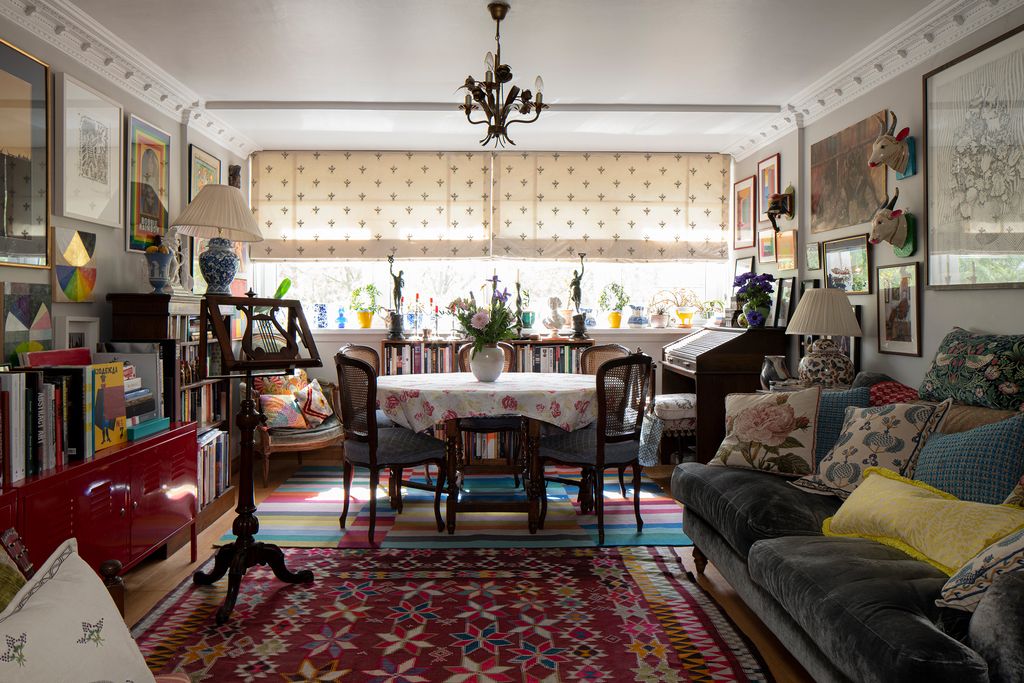
The blinds are Chelsea Textiles' 'Wisteria', and several of the cushions on the sofa are also from Chelsea Textiles. The sofa is from sofa.com. The star-covered rug was bought on our honeymoon in Algeria, the rainbow rug is from Ikea, the table, chairs, hanging light and roll-top desk were all Portobello market finds. The music stand and bookshelves were inherited.
 Andrew Steel2/9
The lampbase and shade are both from John Lewis, the two cushions at the front of the chair are from Missoni Home and the Raj Tent Club, behind is one embroidered by my Grandmother. The art-deco figure was bought at auction. On the wall are works by Domenica Brockman, Peter Blake, Stephen Snoddy, Matthew Collings and Charlie Schaffer.
 Andrew Steel3/9
The previous owners put in the cornicing. We kept it. The walls are painted in Farrow & Ball's 'Cornforth White', the barley twist side table is from Portobello Market, the cushions on the sofa are from Chelsea Textiles, Mourne Textiles, and Yolke. The sacred cows heads are both from Molly Mahon. The floral drawing is by Francesca Lowe, and the portrait of Josef Albers is by Matthew Collings.
 Andrew Steel4/9
Sholto and Esmeralda researching interior design on the sofa.


 Andrew Steel5/9
The kitchen is Ikea, my husband installed it himself. The plates hanging on the wall are from Anthropologie, and by Gavin Houghton. The floor tiles are 'Scintilla Sapphire Star' from Tiles Direct. The bookshelf is painted in Farrow & Ball's 'Calke Green'.
 Andrew Steel6/9
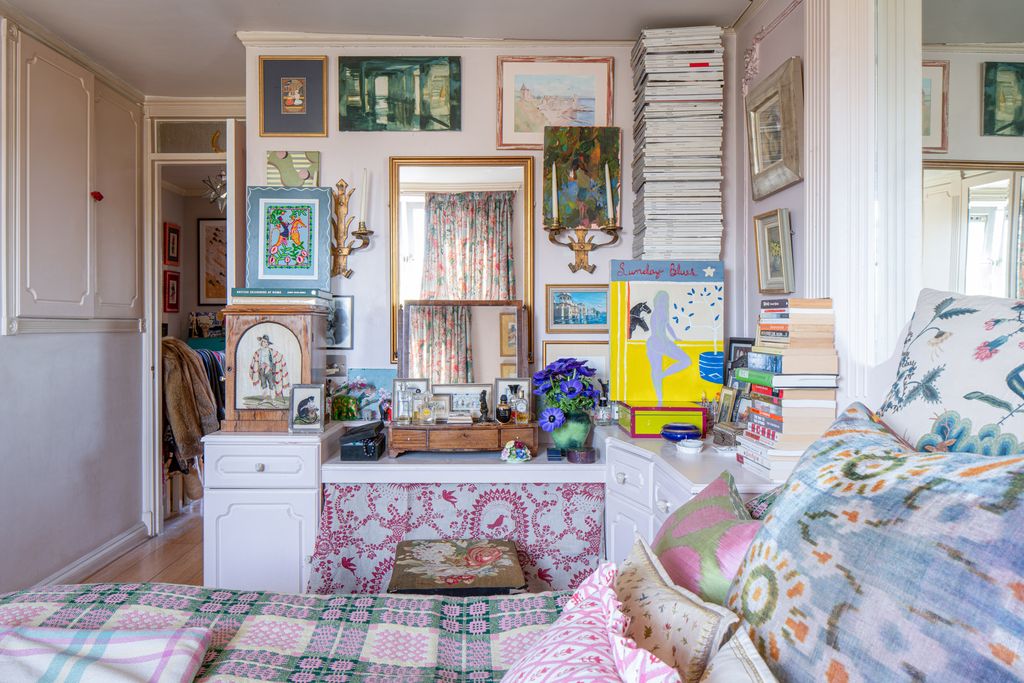
I found the Welsh blanket in the main bedroom on Ebay. The dressing table mirror, cabinet and tapestry stool were all inherited, the dressing table curtain is Celia Birtwell. The cushions on the bed are variously Molly Mahon, Susan Deliss, Chelsea Textiles and Yastik by Rifat Ozbek. The paintings are by Douglas Cantor, Elaine Speirs, Tom Hoar, Julian Brown, and there’s also an embroidery by The Fabled Thread that I did during lockdown 3.
 Andrew Steel7/9
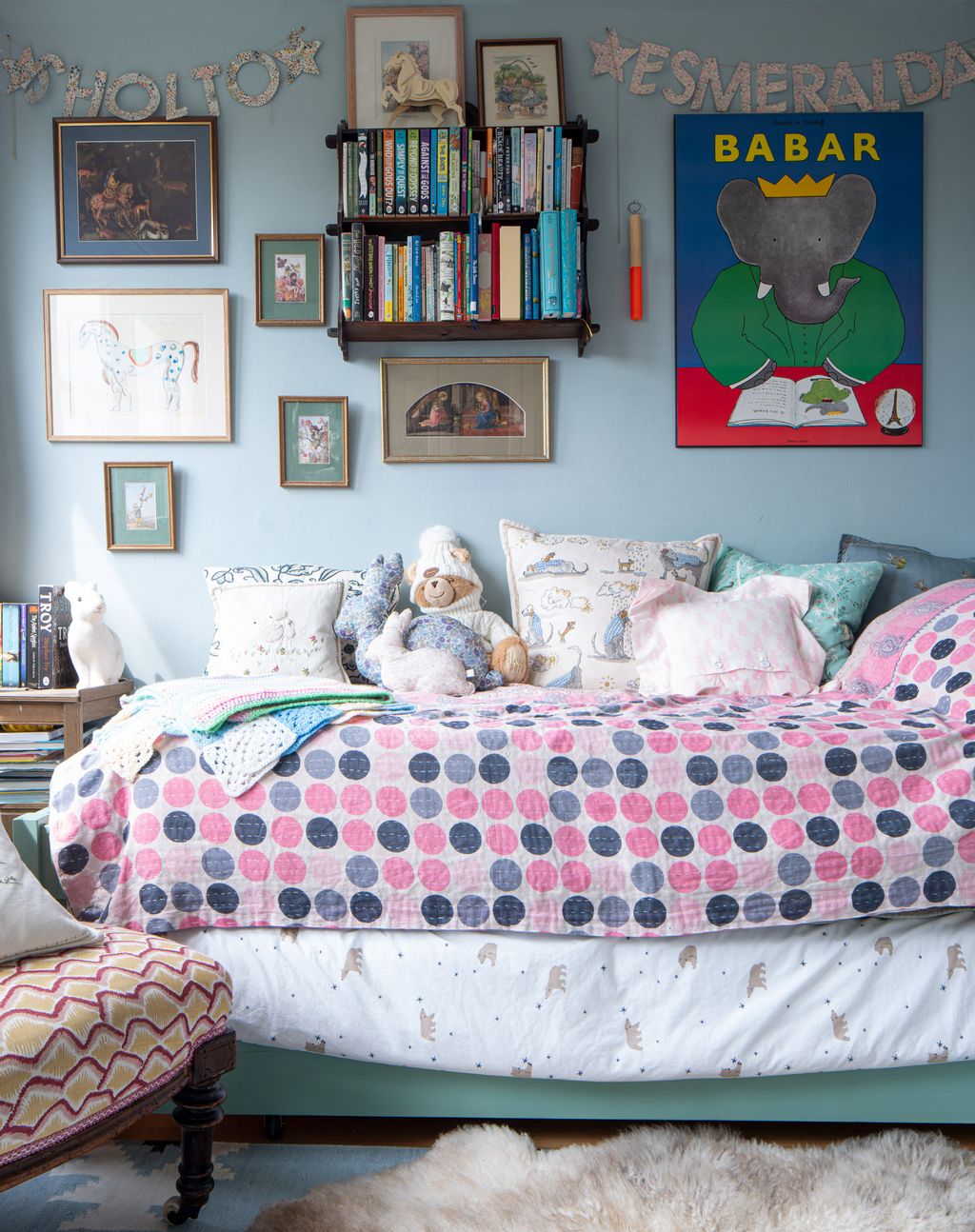
The walls are painted in Farrow & Ball's 'Parma Grey', and the bed, which is a trundle bed, is painted in Farrow & Ball's 'Breakfast Room Green'. The (inherited) nursing chair, just seen, is upholstered in a Celia Birtwell fabric. The cushions are predominantly from Chelsea Textiles. The bookshelf hanging on the wall was inherited.
 Andrew Steel8/9
A view of part of the brutalist communal garden, designed by Michael Brown in 1975.


 Andrew Steel9/9
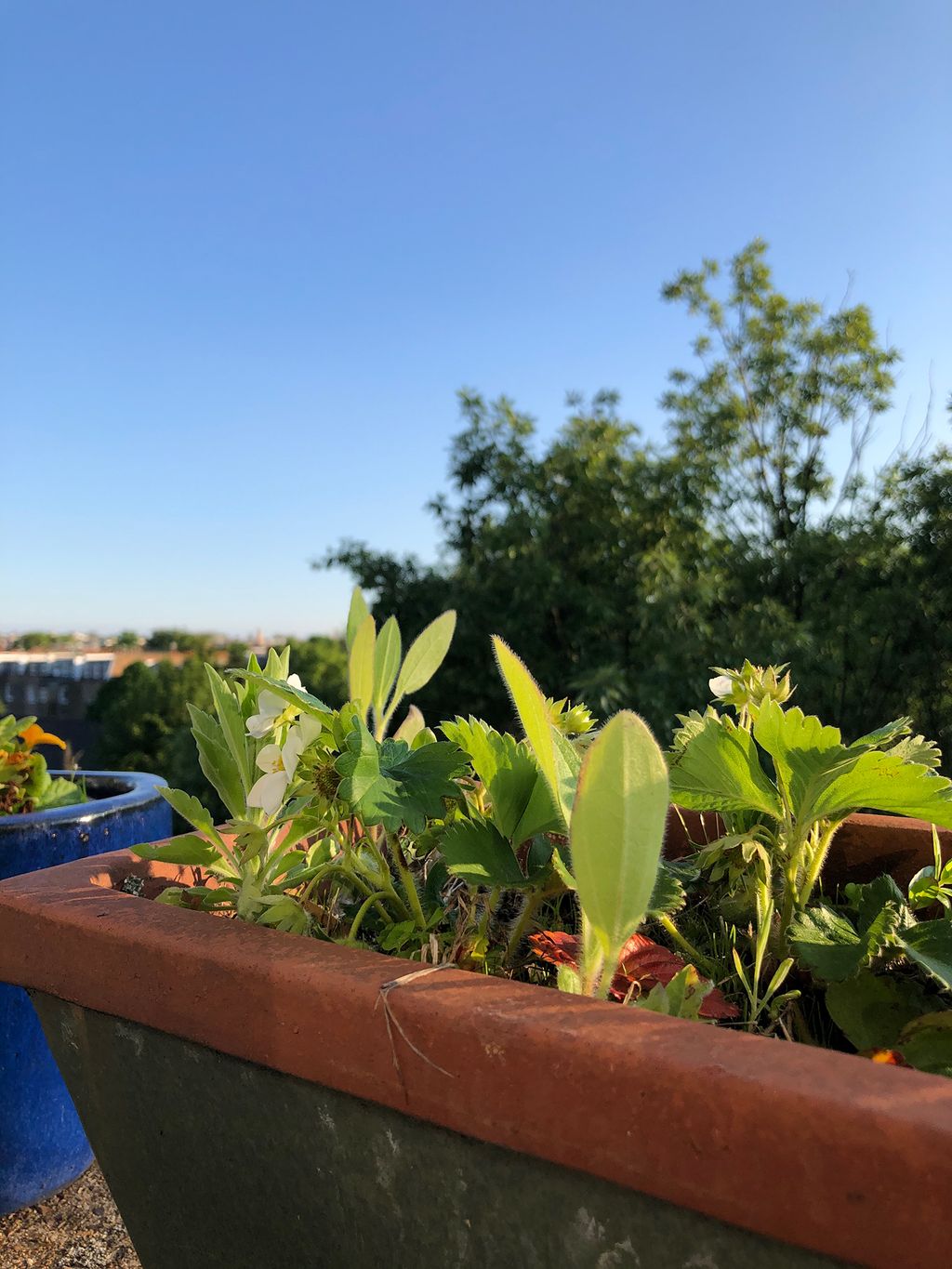
Herbs on the balcony.


