
From the archive: a Regency house in Norfolk by George Carter (2013)

George Carter might well be interior design's best-kept secret. His garden-design skills are certainly well known - he has won seven gold medals at Chelsea - as is his work for exhibitions, which include The Queen's Coronation 1953 at Buckingham Palace. In the field of interior design, however, he is still slightly under the decorative radar.
This could be because his type of design and decoration does not immediately call attention to itself: flamboyant is a word that could never be applied to either George or his design style. Rather, it is subtle; it is thoughtful, yet imbued with taste and intelligence; and it is respectful, rather than reverential, towards the history of a house.
This particular Norfolk village house, restored and decorated by George for its owners Alan and Sarah Wilson, is late Regency. 'It's a good date,' says George. 'The Regency style went on longer in counties such as Norfolk, which was far from the metropolis and difficult to get to; so it could be old-fashioned in such things as clothes and architectural styles.' George found the house for the Wtlsons: it was one that he had long admired. 'It was the agent's house at a time when this was an estate village,' he says. 'It had always interested me as having almost everything that a larger country house might have - a stable block and servants' quarters for a maid and a groom, as well as a walled garden - only all on a small scale. It's the sort of house in which Jane Austen might have placed one of her genteel-but-in-reduced circumstances characters.'
MAY WE SUGGEST: Maria Speake of Retrouvius fills a London house with reclaimed treasures and vintage finds
As far as Sarah was concerned, George was the only person they could possibly have considered to work on the house. 'He combines such great architectural and design expertise with the best of personalities,' she says. 'He's the ultimate problem solver and so generous with his time and thoughts - and he doesn't have that offputting ego that some other decorators have.'
The scale of the house and the proportions of the rooms are perfectly matched. Unusually, it has two front doors, set at right angles to each other - one into the main house and the other directly into the agent's office, where tenants and agent could go about their business undisturbed. The whole house is typical of George's approach to design, in that it looks almost untouched, just well cared for. Inside the main front door- still with its original steel lock - the flagged hall leads to the staircase at the far end of the house. To the right is the drawing room, with its original, satisfyingly deep sash windows that overlook the length of the village street; on this side there is also a library with the same beautiful windows. The rooms were separate, but George made an opening between them, framing it with bookcases on the library side. To the left of the hall, what were once the agent's office and anteroom are now Alan's study.
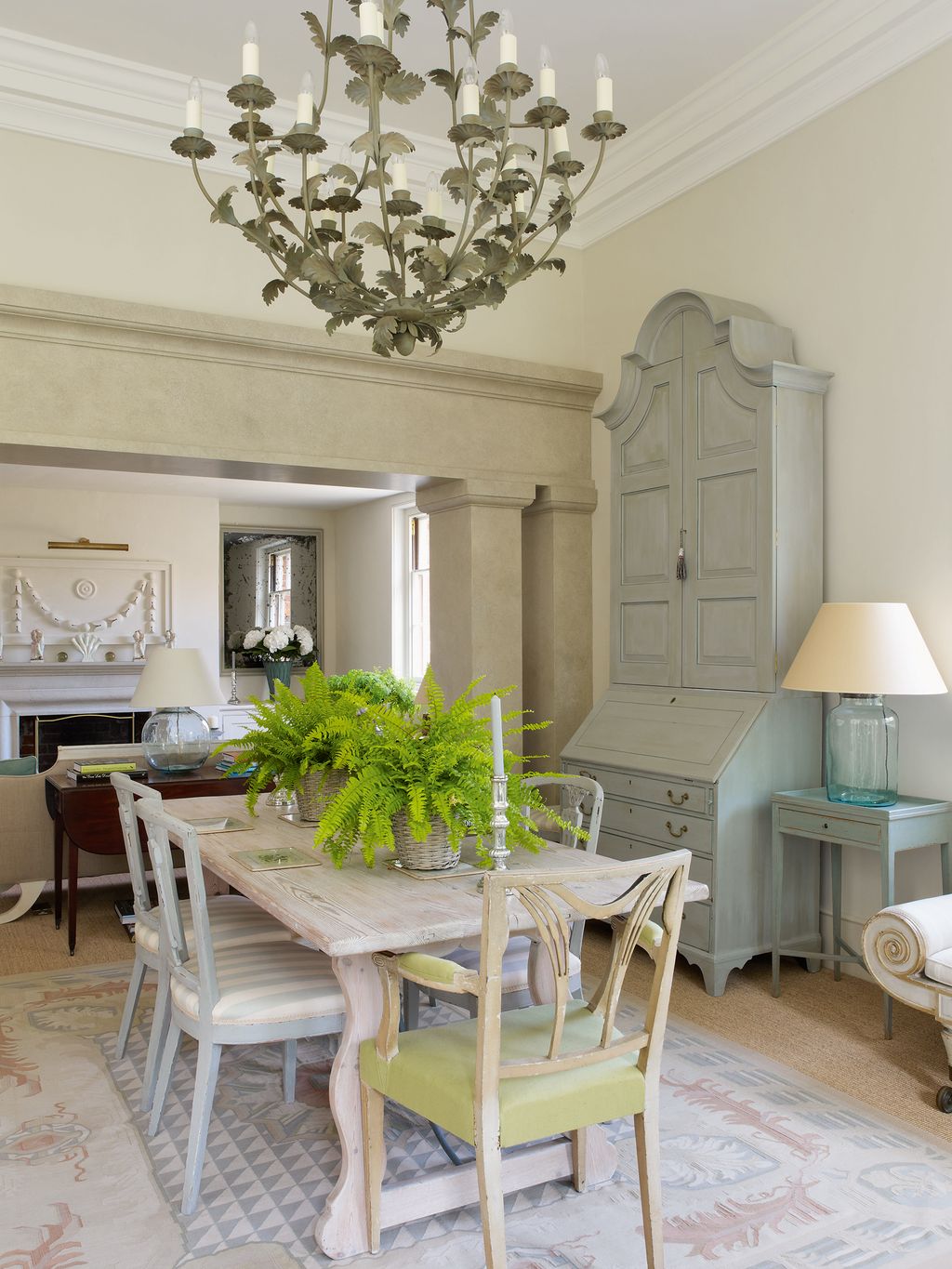
Thoughtful Carter touches abound. He designed a mirror in the hall of the correct proportions and a plaster festoon over the garden-room chimneypiece to add height. The tall painted bureau in the garden room was 'cobbled together' by him using different pieces, and many of the walls are finished in limewash. 'It has a much nicer texture than emulsion and is perfect for this period of house,' he explains. Everything George does is informed by an understanding of proportion and scale - something else that Sarah admires. 'If you start from a classical standpoint, strangely enough it gives you enormous freedom within that,' she says. 'His sense of scale is immaculate - he goes bigger where I would go smaller and, of course, he is always right.'
Upstairs, there are three bedrooms, two bathrooms and a dressing room, all appointed simply but comfortably; again, with the exception of the modern convenience of electricity, one is sure that Miss Austen might have felt quite at home. The only really major change was in the old kitchen wing, to the left of the central staircase, which originally consisted of a kitchen, a scullery and, beyond these, a groom's room. Alan and Sarah wanted to have a sitting room that led directly into the garden, which George was also charged with transforming. The self-evident solution was to rationalise and enlarge this rather scrappy set of rooms and connect the whole area directly to the outdoors.

George has opened up the space between the kitchen and scullery to make a generous kitchen. From there, a door opens into a fine, light room, incorporating a fireplace, a sitting area and an eating area - the original groom's room, which has been extended outwards and now culminates in a bowed end wall with french windows that lead on to a terrace and the garden beyond. Such is George's skill that, from the garden, it is hard to see that the outer wall and french windows are not contemporary with the original house.
The walled garden, now such an important part of the property, was not ever thus. When the Wilsons bought the house, it was, says Sarah, 'all coal bunkers and outhouses'. Now, though, it is classic Carter. Approached through a gate from the gravelled courtyard, the broad terrace leads down shallow steps to a formal garden of lawn and box-edged beds, filled with clipped domes of George's favourite hebe, 'Pewter Dome'. The beds are bisected by a generous gravel path, which runs the length of the garden, from a painted baroque bench against one wall to an eyecatcher in the form of an urn on a plinth beyond a foliage arch at the other. Colours are quiet, and order and symmetry reign.
It really is a most charming house: pleasant, agreeable and extremely fit for purpose. Had Miss Austen made a visit, not only could she have put it into a novel, but she might well have wished to take up residence on the spot.
George Carter Garden Design: georgecartergardens.co.uk
 Sarah Hogan1/15
Classical-inspired touches in the garden room include the painted wooden festoon over the chimneypiece and a settee from Myriad in Notting Hill (below).
 Sarah Hogan2/15
 Sarah Hogan3/15
 Sarah Hogan4/15
George 'cobbled together' the tall painted bureau in the garden room; it was painted by Paola Cumiskey, who did all the paintwork in the house.


 Sarah Hogan5/15
The kitchen units were all custom designed by George and made by Scope Joinery of Beeston.
 Sarah Hogan6/15
A book-lined annexe to the kitchen leads to the hall and library.
 Sarah Hogan7/15
Red table lamps from Besselink & Jones draw the eye to the custom-designed mirror in the entrance hall.
 Sarah Hogan8/15
The library is linked to the drawing room by new pocket doors.


 Sarah Hogan9/15
Curtains in a Colefax and Fowler chintz create a pretty effect in a spare room, as does the French-style cane headboard.
 Sarah Hogan10/15
A painted headboard by Paola Cumiskey adds elegance to the main bedroom.
 Sarah Hogan11/15
An etched glass door set into a new panelled wall leads to an en-suite bathroom and storage space, from the main bedroom.
 Sarah Hogan12/15
Botanical prints enliven the main bathroom.


 Sarah Hogan13/15
 Sarah Hogan14/15
The redesign included the addition of the bowed end wall and french windows to the rear of the house.
 Sarah Hogan15/15
A gravel path leads from a baroque bench to an urn on a plinth in the walled garden.


