
Behind the scenes at Glyndebourne

Anyone who has been to Glyndebourne will know that there is something magical about it. For the past 90 years, it has been a glamorous fixture of the summer season, with opera lovers making an annual pilgrimage in their finery to enjoy the phenomenal performances and fancy picnics within 12 acres of enchanting gardens. At the centre of things, living in the old manor house with its 19th-century red-brick façade, are the executive chairman Gus Christie, his wife, the soprano Danielle de Niese, and their two young children – eight-year-old Bacchus and three-year-old Sheherazade – plus their three much loved dogs. The distinctive state-of-the-art opera house, commissioned by Gus’s father George and designed by the late architect Michael Hopkins, stands next door.

For Gus, living at Glyndebourne and running the opera house comes naturally – it is what his family has always done. The Christies have lived here since 1833, but it was not until Gus’s opera-loving grandfather John asked Edmond Warre to design a 24-metre-long organ room in 1920 that its musical credentials took off. In 1930, John experienced a coup de foudre for soprano Audrey Mildmay when she came to sing. They subsequently married, and founded the festival in 1934. Gus and Danni’s romance has echoes of his grandfather’s, as Danni also came to perform here – in 2005’s critically acclaimed production of Giulio Cesare – which is how the couple first met.

Gus and his three siblings Hector, Ptolemy and Louise enjoyed an idyllic childhood at Glyndebourne, filled with a constant stream of talented visitors staying in the 20 guest bedrooms. ‘We’d have up to 30 people living in the house over the festival, so we got used to having strangers around,’ he says. ‘There were Italians, Germans, French, Russians, Bulgarians or Czechs, depending on whichever opera was being performed.’ The children would befriend the guests. ‘There was a wonderful conductor called Calvin Simmons who had very long fingers. We used to drag him to the piano upstairs and he’d play Scott Joplin songs,’ recalls Gus.

Gus and Danni, who married in 2009, still have the creative team for each opera staying over the season. ‘It was definitely something I had to adjust to,’ admits Danni with a laugh. She was used to the more solitary life of a performer and was mindful about running into people from the business unexpectedly – ‘in my pyjamas!’. Ten years ago, the couple created a private garden at the front of the house, replacing the old coach park. ‘We felt a bit like goldfish,’ observes Gus. ‘It has made a huge difference.’ They need to be accessible during the season, but some-times feel the need to escape.‘Gus will say, “Pack a bag – we are going away for the weekend,”’ explains Danni.
Gus says his mother, Lady Mary Christie, used to ‘take us round to wish good luck to all the singers before the performances – a tradition we carry on with our children’. In fact, Bacchus made his debut at Glyndebourne last year, playing a fairy in Benjamin Britten’s A Midsummer Night’s Dream. ‘It was really meaningful for me, as someone who has experienced so much here, for him to go on the same boards and be bitten by the same bug,’ says Danni.

Danni was something of a child prodigy. By the age of nine, she had won first prize in nine sections of the Australian District Eisteddfods (based on the Welsh system of classical singing competitions) in her home state of Victoria, in all age groups under 18 years. She was living in Melbourne at the time with her Sri Lankan parents but, when she was 10, the family moved to Los Angeles, where the multi-talented Danni flourished and made her opera debut aged 15 with the LA Opera. And she was the youngest singer, at just 19, to participate in the Young Artist Studio at the Metropolitan Opera in 1998. The role that changed her life, however, was playing Cleopatra in David McVicar’s production of Handel’s Giulio Cesare at Glyndebourne in 2005 and again in 2006. This was groundbreaking, not only for its exceptional singing but also for its Bollywood-style choreography – it set the opera world on fire.

Gus did not always know that he would take the reins. There is an apocryphal story that he and his older brother, Hector, tossed a coin about it. ‘It’s not true,’ Gus insists. ‘Hector had no intention of taking over.’ When Gus was 19, his father suggested that ‘he might be quite good’ at running Glyndebourne: ‘I remember it vividly and brought it up with him in one of our last conversations, and he recalled the moment as well.’ Gus did not make his mind up then, but joined the board in his mid twenties. ‘I wasn’t sure whether I wanted to commit myself to it,’ he explains. ‘I was intimidated by it. It felt a massive responsibility taking over a national institution.’
After 10 years as a wildlife documentary maker, Gus took over from his father in 2000. ‘He was 65 on the last day of the millennium. We had a big party on the main stage – 500 people on New Year’s Eve. He had run it for 40 years and he was ready to pass the baton. Then he enjoyed the irresponsibility of retirement…’

Wildlife documentaries and opera might not seem to have much in common, but Gus points out the similarities, ‘It’s about getting the right ingredients in terms of creative skill sets. If it all gels and complements each other, you can create something transformative and extraordinary.’
Legacy and forward planning are very much on the agenda. One of the things Gus is most proud of is the wind turbine he had installed on the estate in 2012, making Glyndebourne the first UK art organisation to generate its own power. Sir David Attenborough spoke in support of the wind turbine at the public inquiry and was there for the launch. ‘We have signed up to the Race to Zero,’ explains Gus. ‘The theatre is 30 years old. My father built it at a time when global warming or climate change was not an issue, so we’re trying to retrofit it. I think the next generation is going to judge businesses on how they are faring environmentally as well as artistically.’
Gus and Glyndebourne’s artistic director Stephen Langridge come up with the annual programmes, which tend to feature five or six operas, four years in advance. There is always a mix of the traditional and conservative and the more contemporary, sometimes including new commissions, such as Brett Dean’s highly successful Hamlet in 2017. For this year’s 90th anniversary, there is a popular programme of favourites, including a revival of David McVicar’s Giulio Cesare, and new productions of The Merry Widow (in which Danni is singing) and Carmen.

Glyndebourne also has an award-winning engagement and learning programme: the Glyndebourne Academy is a classical singing development scheme for talented singers aged 16 to 26 from across the UK, who come to be taught by industry professionals on an intensive five-day residential course. Other projects include Good Company, which takes professional singers into care homes to engage with dementia sufferers, and One Voice, a festive concert that offers schoolchildren the chance to sing on stage with the Glyndebourne Chorus and players from the Glyndebourne Sinfonia. Danni is also a patron of Pegasus Opera Company, which is committed to giving performance opportunities to people from diverse backgrounds. ‘Pegasus has access to all these incredible things that Glyndebourne has to offer,’ she says. ‘I’ve given masterclasses and it’s wonderful to see so much diverse talent, as I was definitely the only person who looked like me in the opera world when I was young.’
Collaborating with artists is something that has always happened here – David Hockney visited last year to see the revival of his 1970s sets for the production of The Rake’s Progress. And Turner Prize-winning artist Lubaina Himid had an exhibition at Glyndebourne last summer inspired by the six operas being performed at the festival. The art for the cover of the annual festival programme book is always commissioned from a prominent artist – previous names have included Peter Doig, Grayson Perry, Fiona Rae and Anish Kapoor – and the sculptures in the garden this year are new works by Conrad Shawcross. What the Christies have done over the past 90 years is to establish a temple to the arts that celebrates not only opera, but also creativity in many forms – from the beautiful gardens to the music, the costumes and the sets. As Danni and Gus attest, it is truly a family institution, which is also ‘a deeply rewarding labour of love’.
Glyndebourne’s 2024 festival takes place May 16-August 25; public booking opens on March 3: glyndebourne.com
 Tom Griffiths1/9
Danni helps their daughter Sheherazade at the grand piano in the great hall. The curtains are in GP & J Baker’s ‘California’ linen, chosen by Gus from GF Sinclair in Lewes.
 Tom Griffiths2/9
Oak panelling and bookshelves, and colourful antique rugs create a comfortably grand backdrop for formal entertaining and special family occasions in the dining area of the great hall.
 Tom Griffiths3/9
Gus in his study with canine companion Caesar.
 Tom Griffiths4/9
Danni in the couple’s bedroom, the interior of which was designed by Willie Nickerson.


 Tom Griffiths5/9
 Tom Griffiths6/9
 Tom Griffiths7/9
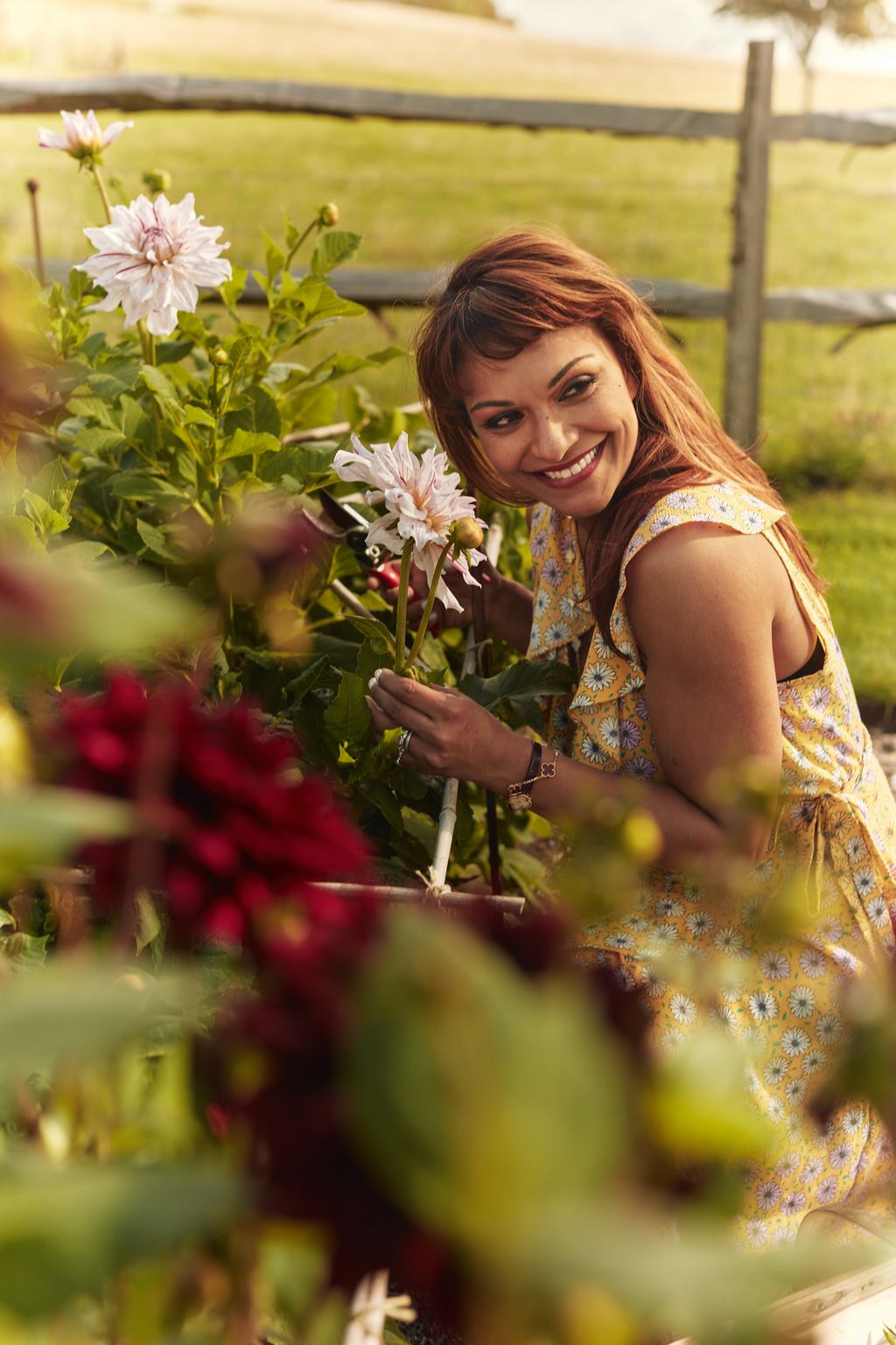
Danni picking dahlias in the vegetable and flower garden.
 Tom Griffiths8/9
Danni with head gardener Kevin Martin, who has worked at Glyndebourne for over 30 years. The grounds are managed sustainably and organically.


 Tom Griffiths9/9
Senior prop maker Rose Beale has worked at Glyndebourne since 1988.


