
The centuries-old craft of dry-stone walling

Working alone, high on a bleak Weardale hillside, Jonny Lloyd is rebuilding a 150-year-old dry-stone wall. The plaintive call of a buzzard is intermittently cancelled out by blasts of icy wind, while the repetitive sound of metal chipping away on stone is carried away in flurries of sleet. This is winter in the Pennines. It is a harsh, unforgiving environment, but old walls are in constant need of repair so the work of a dry-stone waller does not stop with the seasons.
In this part of the northern Pennines, there are apparently more dry-stone walls than anywhere else in the country, snaking across moorland, hill and dale for mile upon mile, most dating back to the mid 19th century, when the Enclosure Acts precipitated an accelerated acquisition of land by farmers and estate owners. So the work of a good waller is much in demand.
Born and bred in Northumberland, Jonny studied countryside management at Newcastle University and went on to do a master’s and PhD in sociology, specialising in the traditional music of rural Northumberland and its association with the landscape. ‘I’ve always had rather romantic notions about landscape and the countryside, probably as a result of reading too much Thomas Hardy,’ he says with a laugh. ‘After my PhD, I just wanted to be outside working on the land, so I moved up to the west coast of Scotland to learn traditional skills – tree surgery, livestock husbandry, joinery, fencing and dry-stone walling.’
MAY WE SUGGEST: What to do in your garden in January
After four or five years living the life of a crofter, he returned to the north east. He had been introduced to dry-stone walling in Scotland and decided that he would like to learn the craft properly, so he applied for a bursary programme run by the Dry Stone Walling Association. Having earned an Advanced Level 3 certificate, he is now working towards his Master Craftsman certificate and, in 2018, set up his own business, Northumbrian Stonework.
The principles of building a dry-stone wall are largely the same throughout the country, although the geology of the land below ground dictates the colours and stone shape of walls in every region. ‘Each wall should have a batter, which is the sloping angle, narrowing from the base to the top,’ explains Jonny. ‘From the footings, you start with the biggest stones and then build what is called the first lift. On top of this are the through stones, big flat stones that reach right through the width of the wall to give it stability. Then you have the second lift and finally the coping stones, which stand upright on the top of the wall. The whole wall needs to be well packed with hearting – small stones or rubble that fill out the centre of the wall and keep everything tight from the inside.’
Working by eye with the help of a simple string line and batter frame (a wooden frame or metal pins, which help to build the wall to the right batter angle), Jonny works with the natural shape of the stone to construct the wall. Field walls are rough and ready – with randomly shaped stone that has come straight out of the ground – but garden walls made from quarried stone require more intricate shaping with hammers and chisels.
Working with different types of stone is crucial to a waller’s experience and it is interesting to note the regional differences. The volcanic rock found in western Scotland or Snowdonia results in more random-looking walls, sometimes with large boulders incorporated into the structure, whereas in sandstone areas, the longer, flatter stone produces walls that are more regular. You can also find subtle variations dictated by the stone types, with varying batter angles, double or triple layers of through stones and the distinctive coping stones on top. In different areas, you may find lunkies, smoots and cripple holes (openings for sheep or wildlife) or squeezers, creepers and snickets (narrow gaps or stiles for humans to squeeze through).
MAY WE SUGGEST: Basket maker Annemarie O'Sullivan and her historic craft
The language is part of the history of these fascinating walls, reflecting a tradition that goes back thousands of years. Once a dying craft, dry-stone walling is in revival with the recent surge in environmental concern. With a low carbon footprint, the walls are popular for their sustainability, their natural aesthetic and, not least, for their ability to support wildlife. Old walls become like miniature gardens, covered with lichen and moss. Their nooks and crannies provide shelter and habitats for myriad insects, birds and mammals, from frogs and newts to mice, voles and hedgehogs. ‘One of the aims of the Association is to promote dry-stone walls as wildlife corridors and show how much biodiversity they can host,’ says Jonny. ‘When you take down an old wall, it’s literally crawling with life.’
Well versed in literature and history and often to be found listening to Radio 4 as he works, Jonny may seem an unusual dry-stone waller, but he is passionate about his work. ‘The fundaments of building a wall have been the same for centuries,’ he reflects. ‘I often think about the people who built these old walls, what their lives were like. I put their work back together, and maybe someone else will do the same with my walls in 100 years’ time’.
Northumbrian Stonework: northumbrian-stonework.co.uk
 Andrew Montgomery1/10
Jonny works with Andrew Atkinson to rebuild a field wall on a farm in Weardale.
 Andrew Montgomery2/10
Tools such as a Pennine hammer are used to shape and dress the stone.
 Andrew Montgomery3/10
Small stones or rubble, known as heartings, fill out the centre of each wall.
 Andrew Montgomery4/10
Jonny works in all seasons, having previously lived as a crofter on Scotland’s west coast before returning to his native Northumberland.


 Andrew Montgomery5/10
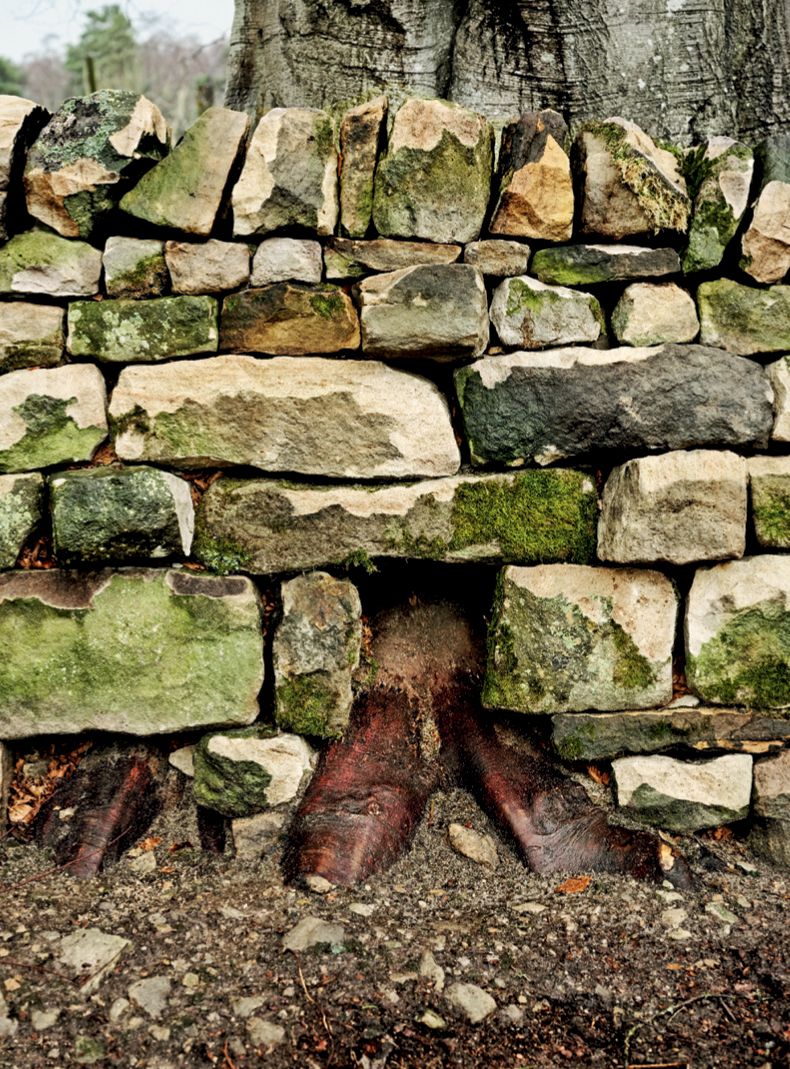
The wall’s stability comes from large, flat through stones in the middle while, underneath, it has been built to accommodate tree roots.
 Andrew Montgomery6/10
Each wall is topped with a row of upright coping stones.
 Andrew Montgomery7/10
An old wall, covered in moss, is an excellent habitat for wildlife.
 Andrew Montgomery8/10
A traditionally constructed dry-stone wall on a steep hillside.


 Andrew Montgomery9/10
A lunky hole (rectangular opening) built into an old wall allows a stream to flow through.
 Andrew Montgomery10/10
Jonny rebuilt this quarried stone wall located on the edge of a beech wood near Rothbury in Northumberland


