
The enviable country idyll of the couple behind Bonfield Block printers

'Meet one family who decided to opt out of high-style London living, throw up their careers, and pack up home and twins to start a new and very different life down on Nettlebed Farm.' So reads the introduction to a story about Cameron Short's parents in the August 1979 issue of a magazine called Good Life. Thirty years later, Cameron followed suit, relinquishing a lucrative career in advertising and relocating from London to Dorset, not far from where his parents retired to. 'It is so strange the way history has repeated itself. I treasure my copy of that article and I am sure my children will treasure this story in House & Garden in the same way,' muses Cameron.
Asked why he was drawn back to rural life, he says, 'I suppose I was spoilt by my wild childhood. The farm was in a beautiful part of Hampshire and we kept horses, chickens and geese. It was a very gentle upbringing.' As well as being close to his parents, Cameron lives just 15 miles from his twin brother. 'Ben is a woodsman on a big estate. He makes charcoal and supplies logs, but also paints and is working on a book. It is a very simple, quiet existence compared to the chaos of a family,' says Cameron, who has three daughters, Ethel, nine, Zola, seven, and Nell, four, with his wife Janet, plus a young English bull terrier named Queenie. However, the brothers and their father come together on a regular basis, thanks to a shared passion for gig rowing - racing at sea in six-oared rowing boats. 'Dad got us involved. He joined the Lyme Regis gig club when it started in 2007 and absolutely evangelised about it. Now we are hooked,' says Cameron.
The physical demands of gig rowing and the connection it provides with the landscape encapsulate what Cameron missed when he lived in London. 'Over the 15 years I was making adverts, the job became much more desk-based. Other people didn't seem to be bothered, but I felt like a caged animal and in the end it affected my health.' Janet had also grown disillusioned. 'As a New Zealander, I felt quite hemmed in by London and began to crave green, open space. We are not anti-London - it has so many wonderful things to offer - we just wanted something different,' she says. Cameron continues, 'We chose west Dorset because we needed the emotional support of family. It was a massive decision to quit my career and home, with no job to go to and a family to support.'
MAY WE SUGGEST: Pukka Fabre's first block-printed fabric collection brings 18th-century fabrics to life in Jaipur
For six years, they rented a tiny flint-and-brick cottage built in 1834 and attached to a farm. 'It was the perfect antidote to city life and we immediately began to feel ourselves shifting,' says Cameron. He found a job working as a labourer on a building site and began carving wood and lino blocks to make prints. 'Long before we moved, I read an article on Marthe Armitage, who makes wallpapers from hand-carved lino blocks, and it sparked something in me. I thought: "Wow, I would love to do that."' He was lucky enough to make contact with Marthe, who became his unofficial mentor. 'She is just amazing. Although she's in her eighties, she is still an absolutely ferocious force of creativity.'
Cameron then heard about the Queen Elizabeth Scholarship Trust, which supports traditional British crafts, and successfully applied for a grant that enabled him to spend two days a week developing a body of work. The other three days he spent hedge-laying under the tutelage of local farmer Roger Vickery. 'It was the perfect balance, physically and creatively,' says Cameron. 'I felt inspired and energised by being in nature.'
The images he created tell stories of the rural life he has re-embraced. 'My work draws on the memories and magic of my childhood, my feel for the land and its inhabitants, and on rural myths and folklore,' he explains. He used these to make limited-edition prints, wallpaper and fabrics, which are sold through The New Craftsmen.
But after those six years in their cottage, a new problem arose: lack of space. Janet and Cameron now had two young daughters, a baby and a burgeoning printing business, and their two-bedroom cottage was nowhere near big enough. 'When I printed a roll of wallpaper, we all had to go out for the day so it wouldn't get damaged while it dried. It was ridiculous,' recalls Cameron. 'Our dream was an old house with character, and ideally room for a workspace, but we never thought it would happen,' says Janet. Incredibly, at exactly the right time, a Grade II-listed Georgian house in Thorncombe came up for auction at an unusually low price. 'It was in terrible condition, with fire damage, rotting floorboards, machinery everywhere. You needed hard hats to go inside,' says Cameron. 'But there was lots of scope for improvement. There was also a shop called Bonfield attached that had ceased trading in the Seventies, and which we could turn into a workshop-cum-showpiece.'
The couple bought the house at auction, and Cameron downed tools to work on it day and night, seven days a week, for two years. The first job was to strip the house back to its bones. It was exhausting. But the building rewarded him with an abundance of original features, and treasures ranging from eighteenth-century toys and antique door fittings, to vintage tables and even the original Bonfield shop sign, all of which he saved and restored. 'In a way, we were lucky that the house was neglected for so long, because it actually protected much that might have been lost through modernisation,' says Cameron.
Beyond stripping back, there was no grand plan. 'Key to the endeavour were: my dad, who ran a business specialising in the restoration of period properties and is a very capable builder with a fantastic eye; Gary Balman, a stonemason and lime-plasterer; and Nick Simco, a carpenter,' says Cameron. 'Together, the four of us listened to the building and worked intuitively. It was a genuinely artistic process.' Their approach paid off, creating a house with real beauty and presence.
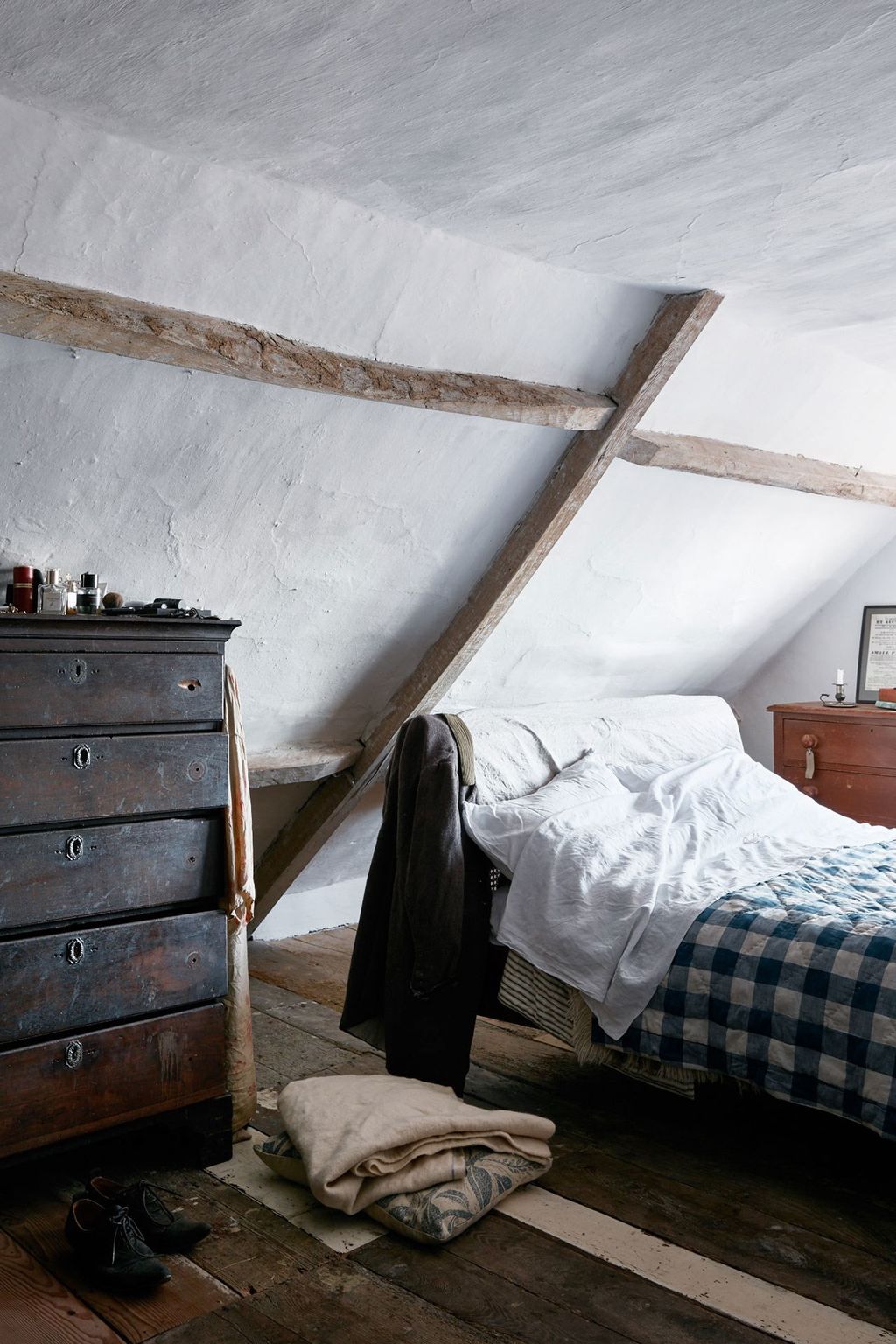
It feels welcoming and comfortable, but it also intrigues, thanks in part to the unconventional, split-level layout. The front door opens into the day room and kitchen. Next door is the shop and behind this, separated by a corridor, is a spare room, a utility area and stairs to the cellar. On the first floor is the bathroom, and on the second floor are the children's rooms and the drawing room, with a balcony overlooking the garden. Cameron and Janet's bedroom is in the attic.
When the inspector from buildings conservation visited, she wept tears of joy - the state of the building had been a cause for concern for many years - and asked if Cameron would be willing to offer his advice and expertise to owners of other listed buildings in the area. High praise indeed, but Cameron is keen to point out: 'We always had an eye on the past, but we didn't want a pastiche. It had to be a practical, family house.'
When furnishing the house, the couple opted for solid, country pieces, with the right feel and atmosphere, rather than items specifically from the Georgian period. Many, such as the nineteenth-century French harvest table in the day room, came from the antiques quarter of nearby Bridport, which is where Cameron struck up a friendship with David Gordon. 'David is an avid collector who dabbles in dealing,' says Cameron. 'We see beauty in the same things, but I can't compare myself; he is much more erudite. He has been a goldmine for the house.'
Although there is work to be done on the outbuildings and garden, the main house was finished last year. Since then, the couple have channelled their energies into the business and Janet, a talented printmaker in her own right, has returned to cutting blocks. 'I want us to have equal creative input,' says Cameron. 'Janet has been mired in motherhood for nine years, with little time to cultivate that side of herself, so it is an exciting time.'
Bonfield Block-Printers announces itself today with a splendid sign copied from the nineteenth-century original. On Fridays and Saturdays, visitors are welcomed to meet Cameron and Janet, see how the work is produced and, if they like, buy a print, lampshade or cushion, or discuss a commission. Beyond the workshop, there is a collaboration with upholsterer Peta Inglesent, who is covering antique chairs in Bonfield fabrics. Once a month, the doors are opened to students on block-printing day courses. It is an inspiring achievement, born of Cameron and Janet's flair, hard work and enthusiasm, plus a sprinkling of good fortune.
Bonfield Block-Printers: 01460-30268; bonfieldblockprinters.com | The New Craftsmen: thenewcraftsmen.com
 Lucas Allen1/17
The hall leads to the back office with the workshop on the left.
 Lucas Allen2/17
Cameron sitting in the wooden window seat.
 Lucas Allen3/17
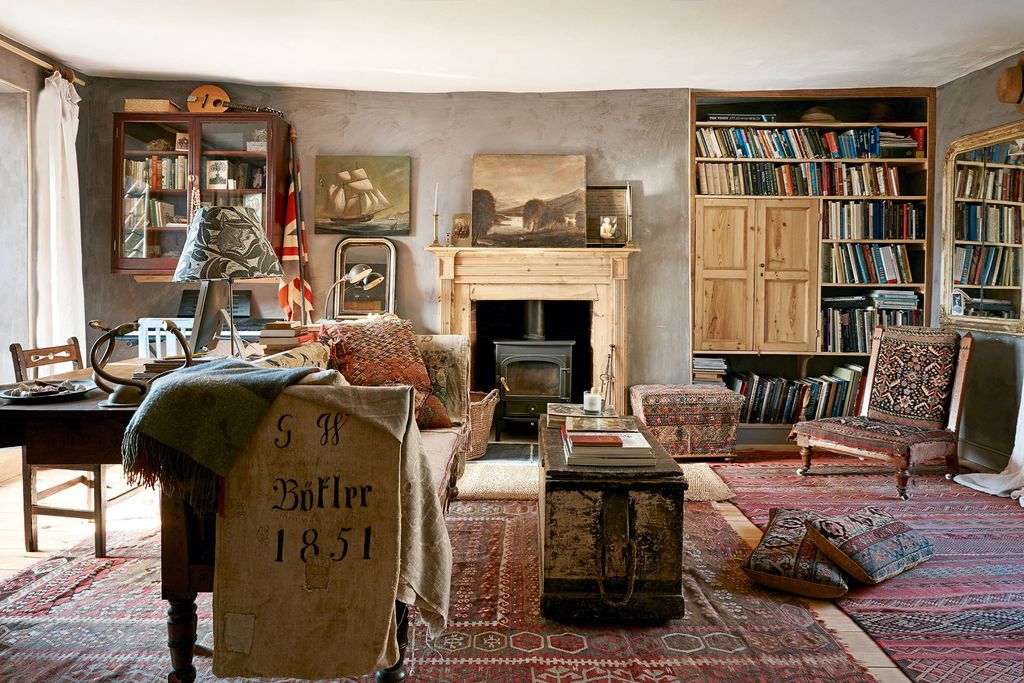
In the drawing room, a lamp with a 'Varx' shade made by Cameron sits on a restored eighteenth-century oak table, which was unearthed in a barn adjoining the house; the carpet-covered ottoman and chair were auction buys.
 Lucas Allen4/17
Janet in the day room.


 Lucas Allen5/17
The end of the children's bed is full of teddies and toys. Pretty dresses hung up on a line are a witty alternative to bunting.
 Lucas Allen6/17
Detail of a keyboard and glass panelled, wooden framed cupboard.
 Lucas Allen7/17
Antique toys, family photographs and vintage story books decorate the shelves in the children's bedroom.
 Lucas Allen8/17
The drawing room.


 Lucas Allen9/17
The bathroom is fitted with a worn wooden vanity and brass taps.
 Lucas Allen10/17
The attic bedroom.
 Lucas Allen11/17
Janet in the midst of the printing process.
 Lucas Allen12/17
Terrace Decking | Georgian Country House | Real Homes | Interior Design Inspiration
The decking has wrought iron garden furniture and a beautiful view of the garden.


 Lucas Allen13/17
The family walking at Coney's Castle, Lyme Bay in the background.
 Lucas Allen14/17
Cameron and his brother Ben in the west-Yorkshire countryside.
 Lucas Allen15/17
The Bonfield shop front.
 Lucas Allen16/17
Cameron creating a print in the Bonfield workshop, converted from the former village shop.


 Lucas Allen17/17
Antique dealer David Gordon's workshop houses myriad treasures, including period ironmongery.


