
Design ideas for Wes Anderson inspired interiors
It's rare to be able to look at a still from a film and immediately identify the director, but such is the distinctiveness of Wes Anderson's visual style that most people with a passable understanding of pop culture could manage it. Both his costumes and his sets, including the interiors, have been highly influential, blending saturated colour, vintage style and a wry, whimsical mood. Anderson is well-known for meticulously constructing every frame of his films, so no visual cue should be ignored. His interest in interiors has also extended to designing them in real life; you can visit Bar Luce at the Fondazione Prada in Milan, a 1950s style cafe that Anderson created in 2015, and last year he revealed a carriage aboard the luxury British Pullman Belmond train, complete with swan-shaped champagne coolers and plenty of intricate marquetry.
The sets of The Royal Tenenbaums, with its red rooms (including Margot’s iconic Scalamandré ‘Zebras’ wallpapered bedroom), and The Grand Budapest Hotel, with its candy-pink exterior and grand red interiors, have been highly influential. Should you wish to decorate your house like a Wes Anderson movie (we're on the fence about whether this is a good idea), colour is most certainly the place to start. Go bold and saturated, with either a tonal or a totally contrasting scheme (think red and purple in Budapest). Pink may be the colour most associated with Anderson, but red is a constantly recurring theme, from Chas Tenenbaum's red tracksuits to Steve Zissou's red beanies, and most other strong shades have had their moments across the films. The blue and red/ochre colour scheme that predominates in The Life Aquatic, though it doesn't come up in interiors specifically, is a great basis for a decoration scheme (see Lucy Williams’ sitting room in her London house).
Once you've settled on a memorable colour scheme, it's time to attend to the finer details. Anderson's films always make a heavy appeal to a retro aesthetics, with the styles of the 1970s usually appearing somewhere. 2021's The French Dispatch is set in 1975, and the offices of the fictional magazine are a wonderful world of yellow and brown, brilliantly evoking the decade. Symmetry and geometry are also crucial; doubling of architectural features or decorative elements often occur, along with highly harmonious arrangements of objects. Bill Murray's amazing ‘Issue in Progress’ pinboard in The French Dispatch is something all magazine editors should surely aspire to.
So is the style of Wes Anderson something you can realistically emulate at home? Well, we might not go all the way down his perfectly constructed rabbit hole, but a little touch of his distinctive aesthetic might well spread some joy, just as his films do.
 Owen Gale1/10
The Grand Budapest Hotel unleashed a sea of pink upon the world, with its candy coloured imagining of the exterior of the building. Farrow & Ball's 'Nancy's Blushes' is the perfect sweet pink in this room by Beata Heuman, matched with Pierre Frey's ‘Lasso’ fabric on the footstool, and a charmingly frilly armchair.
 Simon Upton2/10
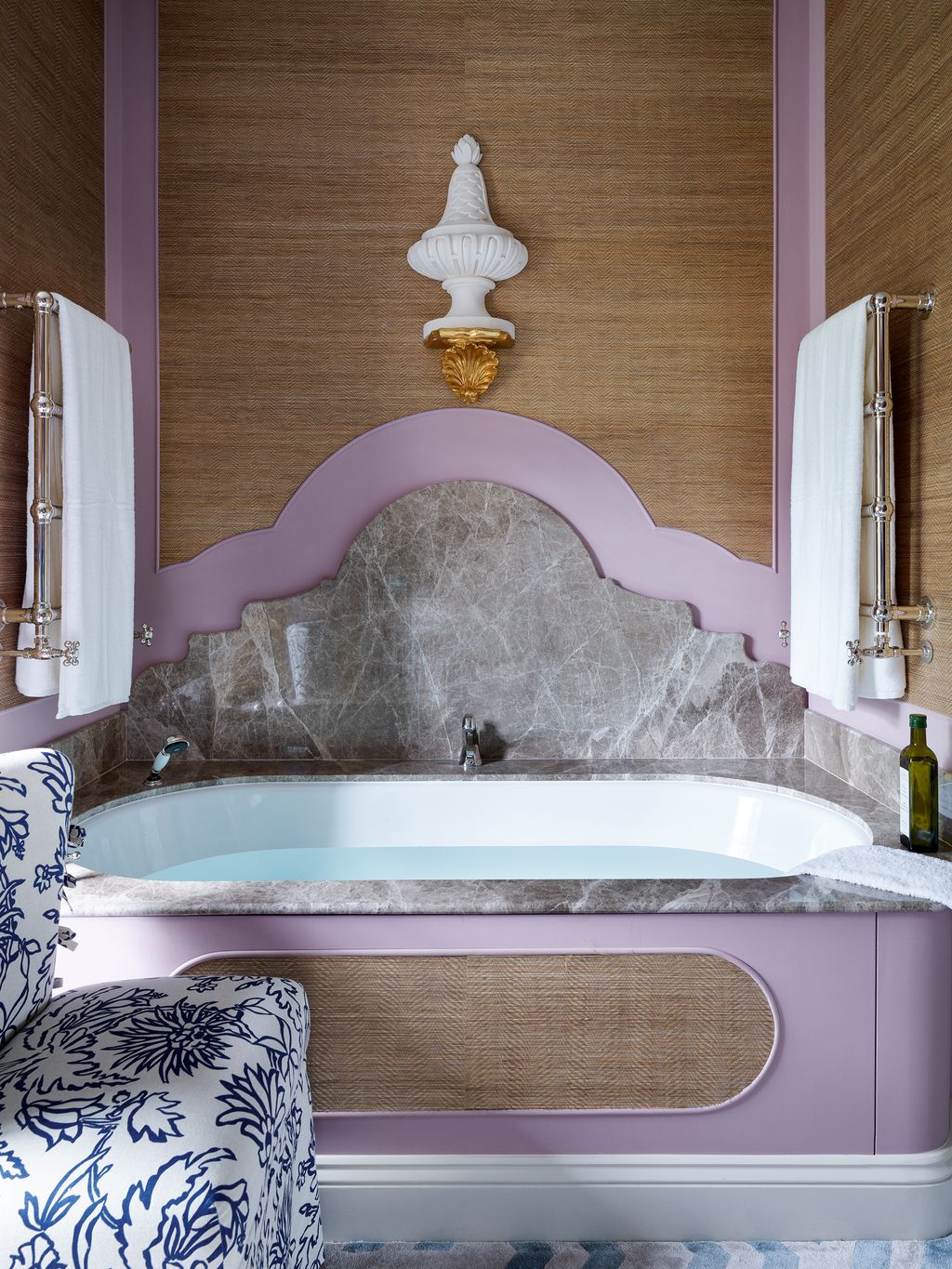
Nicky Haslam's peculiarly English brand of eccentricity bears a distant relation to that of Wes Anderson. This pale purple colour in the bathroom of a house Nicky designed with Studio QD feels rather on brand for a director who brought all-pink decorating into the mainstream, while the symmetrical curves of the bath splashback could belong to a modern day Grand Budapest Hotel. The bath panels are paintd in ‘Lavender’ by Edward Bulmer Natural Paint, framing a seagrass wallcovering and ‘Light Emperador’ marble from SPC. The chair is in ‘Strange Blooms Mono’ in tom’s blue by Bird in the Hand from Justin Van Breda.
 Michael Sinclair3/10
With a blend of pieces from different periods and a pastel palette, this bedroom in a London house designed by Rachel Chudley has the retro vibe of many of Anderson's interiors. The Forties-style headboard in the bedroom was designed by Rachel’s studio to line up with the strips of diagonal moulding that delineate the path of the morning sun. A Woodstock landscape photograph taken by Lucy hangs over an art deco fireplace from a reclamation yard.
 Christopher Horwood4/10
In a jewel-box cottage in Wiltshire, interior designer Emma Ainscough has created this rather fantastic bedroom, adding a new wall with a bespoke arch detail to create a bed nook within wallpapered area, with dividing curtains that close and a cosy tented ceiling. The wallpaper is the ‘Folies Bergère’ pattern by Howe at 36 Bourne Street in blue ribbon, and there are matching blinds out of shot. The headboard and cushions were bespoke, and the wall lights and star pendant are both by Vaughan.


 Christopher Horwood5/10
The colour scheme in Lucy Williams' sitting room is pure Steve Zissou, with an ochre Maker & Son sofa providing a counter to the bright blue walls, painted in archive Farrow & Ball colour Yonder.
 Francisco Nogueira6/10
‘This is a house with good vibes,’ declares the Portuguese interior designer Gracinha Viterbo of her own home near Lisbon. Here, bright walls in Farrow & Ball’s ‘Yellowcake’ with artworks framed by panels of Dedar’s ‘Alumnus’ fabric recall Natalie Portman’s bedroom in Hotel Chevalier.
 Simon Brown7/10
Beata Heuman's sense of fun and whimsy has a distinctly Anderson-ish vibe at times; this 70s-inspired wood-clad library in an expansive London apartment is a case in point. A Beata Heuman Cub chair sits in the corner, perfect for curling up in with a book.
 Mariell Lind Hansen8/10
When Louis Hagen Hall was asked to reinvent the home of two musicians in Primrose Hill, the trio’s enthusiasm for 1970s LA architecture dovetailed perfectly. With its wooden cladding and velvet upholstery, the sitting room would be a great spot for Margot Tenenbaum to lounge in.


 Tom Griffiths9/10
In Melinda Stevens' London house, the blood-red bookshelves suggest the colour palette of the lobby in the Grand Budapest Hotel.
 Rachel Whiting10/10
Anderson famously used Scalamandré's ‘Zebra’ wallpaper in The Royal Tenenbaums, and Beata Heuman has deployed it to great effect in the tiny bathroom of this London house, with matching joinery in the same shade.


Comments
Back to Top


