

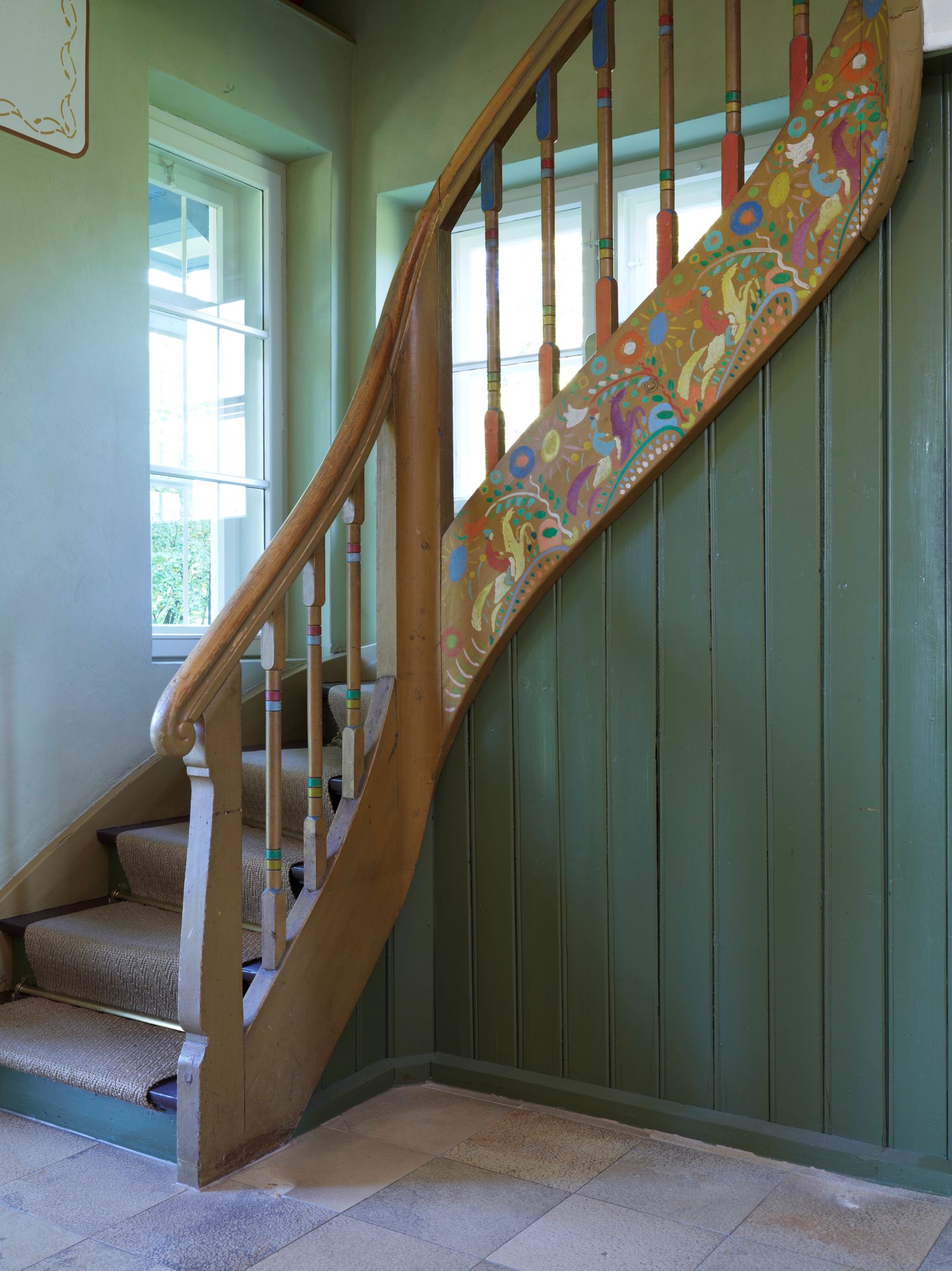
“We enter an artist’s house wondering how the inhabitants’ activities compare with our own,” observes art historian Frances Borzello in the foreword to a forthcoming book on Prospect Cottage, the late artist and filmmaker Derek’s Jarman’s Dungeness home. And it’s true; in finding common ground so we find a tangible connection, and – because interiors are autobiographical – develop a more nuanced understanding of the subject’s persona. But for the interiors enthusiast (and, indeed, interior designers) there’s more – specifically, ideas. Perhaps we too could afford ourselves a dopamine-delivering kitchen, pairing blue and white tiles with bright turquoise woodwork and copper pans, as Claude Monet did in his house in Giverny? Or maybe we could elevate a staircase by painting horses cantering up it, in homage to Wassily Kandinksy’s folk-inspired frieze at The Russian House – now known as The Münter House - in Murnau, Bavaria?
Alongside, in being in an artist’s house, we stand where they stood, and see what they saw. From Kandinsky’s bedroom window, we look out over the red roofs of Murnau and its charming, onion-domed church – and further, to the inviting beginnings of the Bavarian Alps. Via a new exhibition at Tate Modern, Expressionists: Kandinsky, Münter, and the Blue Rider (until October 20), it becomes apparent just how important that view was to Kandinsky as a vehicle for his artistic experiments - and that the house is part of a bigger story, of a group of friends who forever altered the course of art and developed European abstraction. The surfeit of painted furniture makes it tempting to compare the Münter House to Charleston Farmhouse – and certainly it’s as rich a source of interior inspiration (especially when it comes to the application of pattern) – but the tale is quite different.
The Blue Rider – or, in German, Der Blaue Reiter – was an international group of artists brought together by Kandinksy and Franz Marc, who organised exhibitions in Munich in 1911 and 1912, and published an almanac of the same name in 1912 – all to demonstrate their ideas; the artists involved shared a common desire to express spiritual truths through art. Until now, and this Tate exhibition, there’s been less emphasis on Gabriele Münter’s importance than there might have been. And yet she was one of the driving forces of The Blue Rider – and, in possession of an inheritance that made her more financially secure than her lover, Kandinsky, it was she who in 1909 bought the house in Murnau that now bears her name (it’s first title, The Russian House, referenced his heritage).
They laid out the gardens, and furnished and decorated the house together, influenced by local custom, folk tradition and their feelings about colour (Kandinsky, if you remember, is the author of an important treatise on colour theory, Concerning the Spiritual in Art) - note the panelled corner banquette in the dining room, and the hand-painted borders. It and the surrounding landscape inspired both their work, and that of other members of The Blue Rider – and they stayed and painted there until Kandinsky was forced to flee the country in 1914 when war broke out. They went first to Switzerland, together, and then Kandinsky went on to Moscow where, instead of sending for Münter – or even letting her know he was alive - he married someone else (someone younger). The fallout, when it came, was significant: he sued her for return of the paintings he’d left behind, while she counter-sued him for a broken engagement – and won the rights to most of the paintings.
During World War Two, when Expressionism was declared as degenerate by the Nazi forces, she hid those canvases with hers behind false walls in the basement in the Münter House. On her death, she left the entire collection to the Lenbachhaus in Munich – who have collaborated with Tate on this exhibition, lending an unprecedented number of exceptional works, including interior scenes of that house that became so central to the story of The Blue Rider. Both the exhibition and the house (muenter-stiftung.de) are must-visits – and, while we’re on the subject, here are ten further artist houses to add to your list, some here in Britain, some on the continent.
Farleys House & Gallery, East Sussex

A Georgian farmhouse not far from Hailsham in East Sussex, Farleys House – which became a centre for the British surrealists – is where Lee Miller, pioneering war correspondent and photographer, and Roland Penrose, artist and co-founder of the Institute of Contemporary Arts (the ICA), lived and worked from 1949 until their deaths. It’s where they hung their art collection, and where they hosted friends who included Man Ray, Joan Miró, and Picasso. The preserved rooms provide fascinating insight, as well as a wealth of interior ideas. For while the whole epitomises many aspects of English country house style, there are gloriously surreal twists: witness the Picasso tile cemented in above the Aga, Roland Penrose’s mural in the dining room, and the juxtaposition of Picasso ceramics with a plastic King Kong. We’re about to see a lot more of this house, for it was used in the filming of Lee, the forthcoming biopic that stars Kate Winslet in the titular role (maybe get your visit in now, while you can still get tickets; also, know that its opening times are seasonal; it’s open April – October)
Maison Jean Cocteau
Jean Cocteau was known as the enfant terrible of the French avant-garde, and is currently the subject of a retrospective at the Peggy Guggenheim Collection in Venice (also technically a house museum – though low on furniture; there, it’s all about the art collection.) He bought this house in Milly la Forêt, just outside Fontainebleau, with the actor Jean Marais in 1947, and he lived and worked here for17 years, writing, painting, and collecting all sorts of things, including props from his films. The house – which opens for the season in May - was decorated with his friend, the great Madeleine Castaing, so it’s got serious interior design credentials. Note the leopard print wallpaper (leopard print was one of Castaing’s signatures), and the single four poster bed – and much of it truly is as he left it, for when he died his lover and heir closed up the living room, and Cocteau’s bedroom and study, and it stayed untouched until Pierre Bergé (Yves Saint Laurent’s partner) restored it. If you like this house, put Villa Santo Sospir on the Cap Ferrat on your list, too. It’s another Cocteau-Castaing collaboration, done for the American millionaire Alec Weisweiller and his French wife Francine in the late 1940s and early 1950s; Cocteau lived there with them for a while, drawing and painting all over the walls (santosospir.com)
Claude Monet’s House and Garden at Giverny
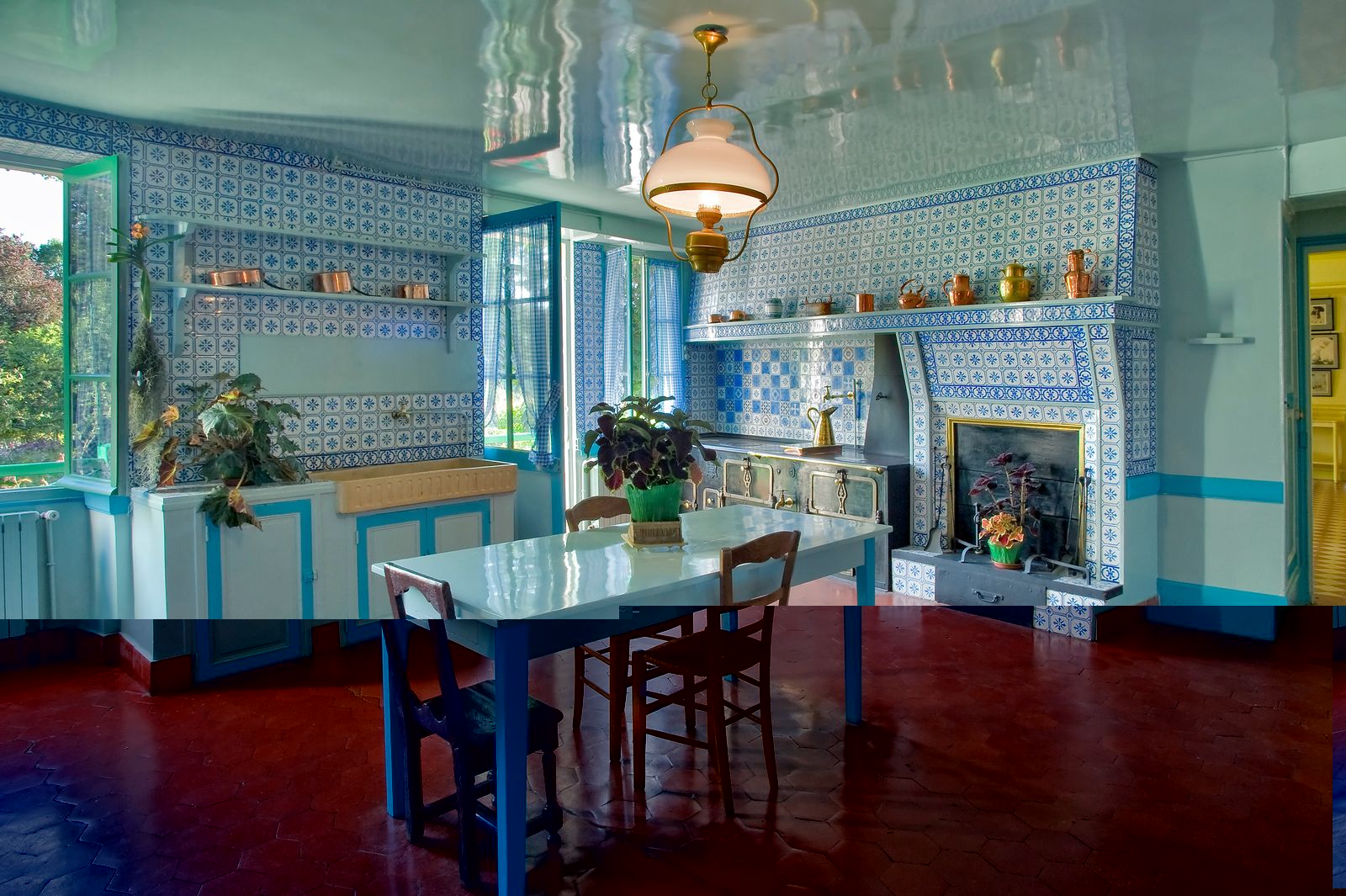
Monet’s garden at Giverny is legendary, for he painted it over and over again, and those paintings have become some of the most famous in the entire history of art. The house itself is a comparable wonder. Monet lived there for forty-three years, from 1883 to 1926, extending it, and laying it out according to his need and taste. He chose the colours himself – and the blues, yellows and greens sing in ways that are extraordinary even now, let alone then; have you ever seen a dining room to match Monet’s? Also, note the tiles in the kitchen that he sourced locally, and the Japanese woodblocks that he collected for over fifty years. This year is the 150th anniversary of the first Impressionist exhibition, so for further enticement, know that there is an associated Normandy Festival of Impressionism, and, until the end of June, the museum in Giverny has an exhibition devoted to the Impressionists’ paintings of the sea.
Leighton House
On a Kensington back street, between the High Street and Holland Park, is the extraordinary house that Lord Frederic Leighton built for himself in the 1860s. The unassuming red brick façade gives not a hint of the beauty that lies within, for his Arab Hall, with walls encased in exceptional underglazed tiles from the Near East (Iznik, Damascus and Persia) and crowned by a gilded dome, is one of those rooms that, once seen, is never forgotten (even if, unlike James Whistler and Edward Burne-Jones, you don’t accidentally walk into the shallow pool that lies at its centre.) There are other lessons here too: Leighton designed the house only to please himself - despite its size, there is only one bedroom. (It did, however, make it harder to sell – though he was dead, so it wouldn’t have worried him.) While the house contains many of Leighton’s paintings, arguably his most famous, Flaming June, is usually in the collection of a Puerto Rican museum – currently however, it is on display at the Royal Academy of Arts on Piccadilly. The other thing to know is of the concerts that take place in the house, in the large room that was once Leighton’s studio, where he too hosted concerts in his time; tickets can be booked on the website.
leightonhouse.digitickets.co.uk
Barbara Hepworth Museum and Sculpture Garden
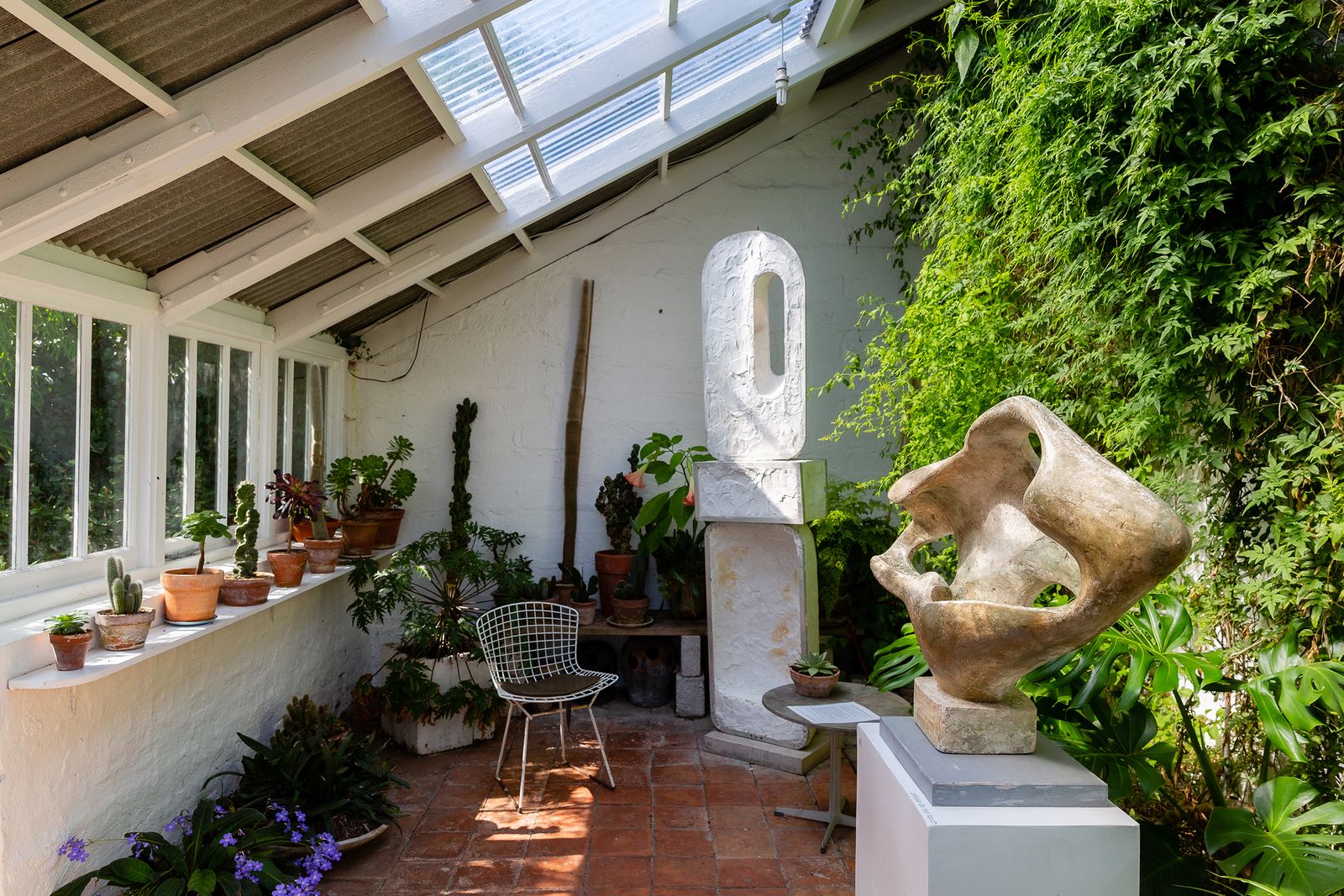
Barbara Hepworth moved to St. Ives on the eve of the Second World War, and never left. Her final home and studio on Barnoon Hill – a high-walled house on a steep, narrow street – is now looked after by Tate St. Ives. There is less to take here from the interiors, only the living room remains - though, for fans of modernism, it is another strong argument for the elegant simplicity of white walls and an uncluttered palette - but her workshop is still filled with her equipment, and the verdant garden that the composer Priaulx Rainier helped design contains not only uncut stones seemingly waiting for their turn under Hepworth’s tools, but also several of her favourite sculptures. There are few lovelier places to while away an afternoon, but do make time for a trip to the Tate before you leave St Ives, and perhaps swing by the shop at the Leach Pottery.
Casa Salvador Dali
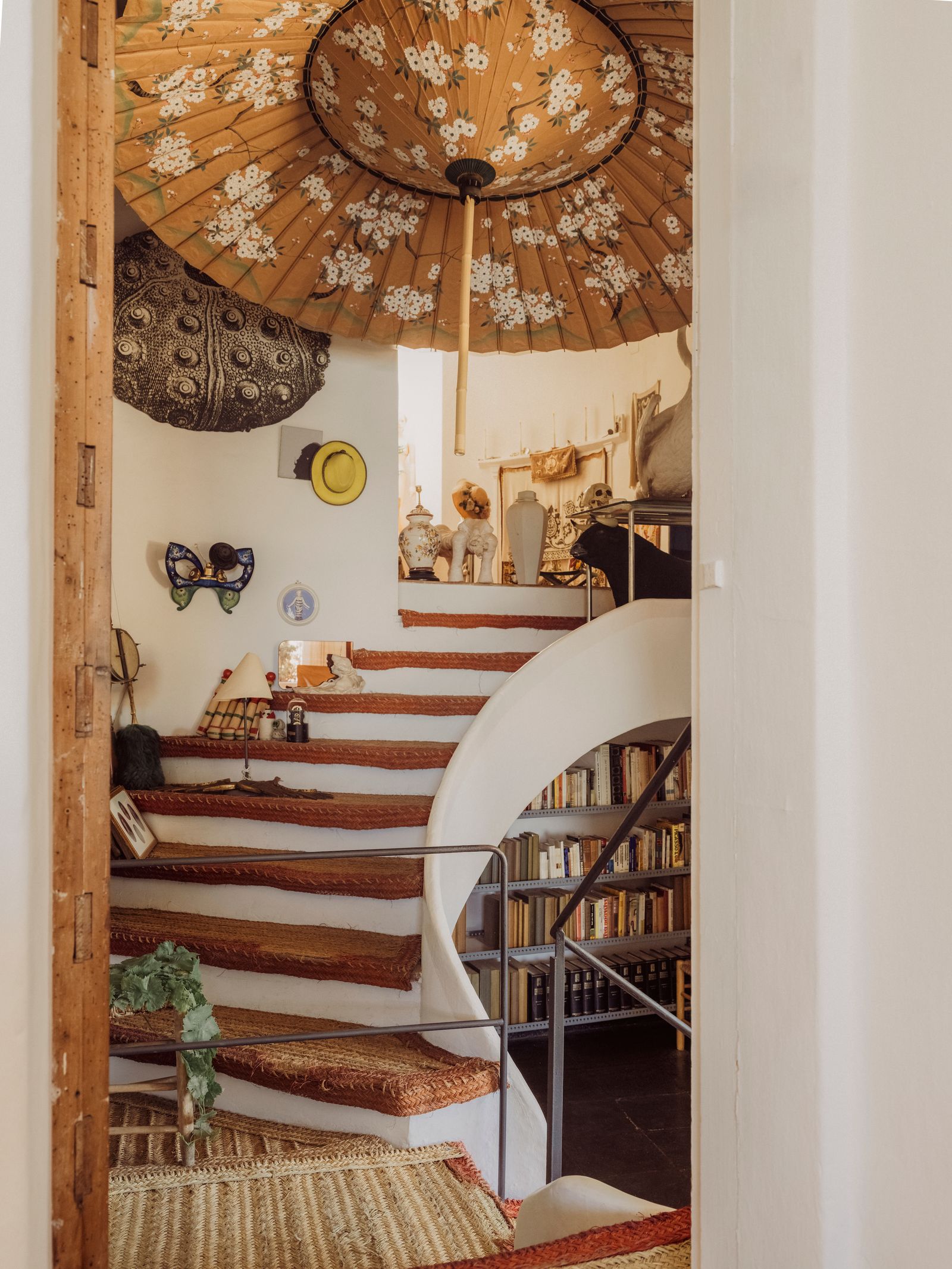
The great surrealist’s house in Portilligat, just outside Cadaqués on the west coast of Spain not a million miles from the French border, started off as a small fisherman’s hut before morphing, over the years, into a castellated warren of a villa. Dali and his wife Gala only spent summers here – and as they left each year, they’d drop off sketches for the changes they wanted made with their builder, Emilio Puignau (he later became mayor of Cadaqués) who would interpret them and get to work. There are stuffed swans on top of the library shelves, an incredibly phallic pool, and a giant egg-shaped sculpture balanced on the roof. But there are transferrable tips, too – such as the bedroom where the beds and armchair are covered in matching blue-bordered red fabric. Perhaps most of all, there’s wit, and exuberance, and fun (which, in several instances, definitely qualifies as kitsch.)
Prospect Cottage
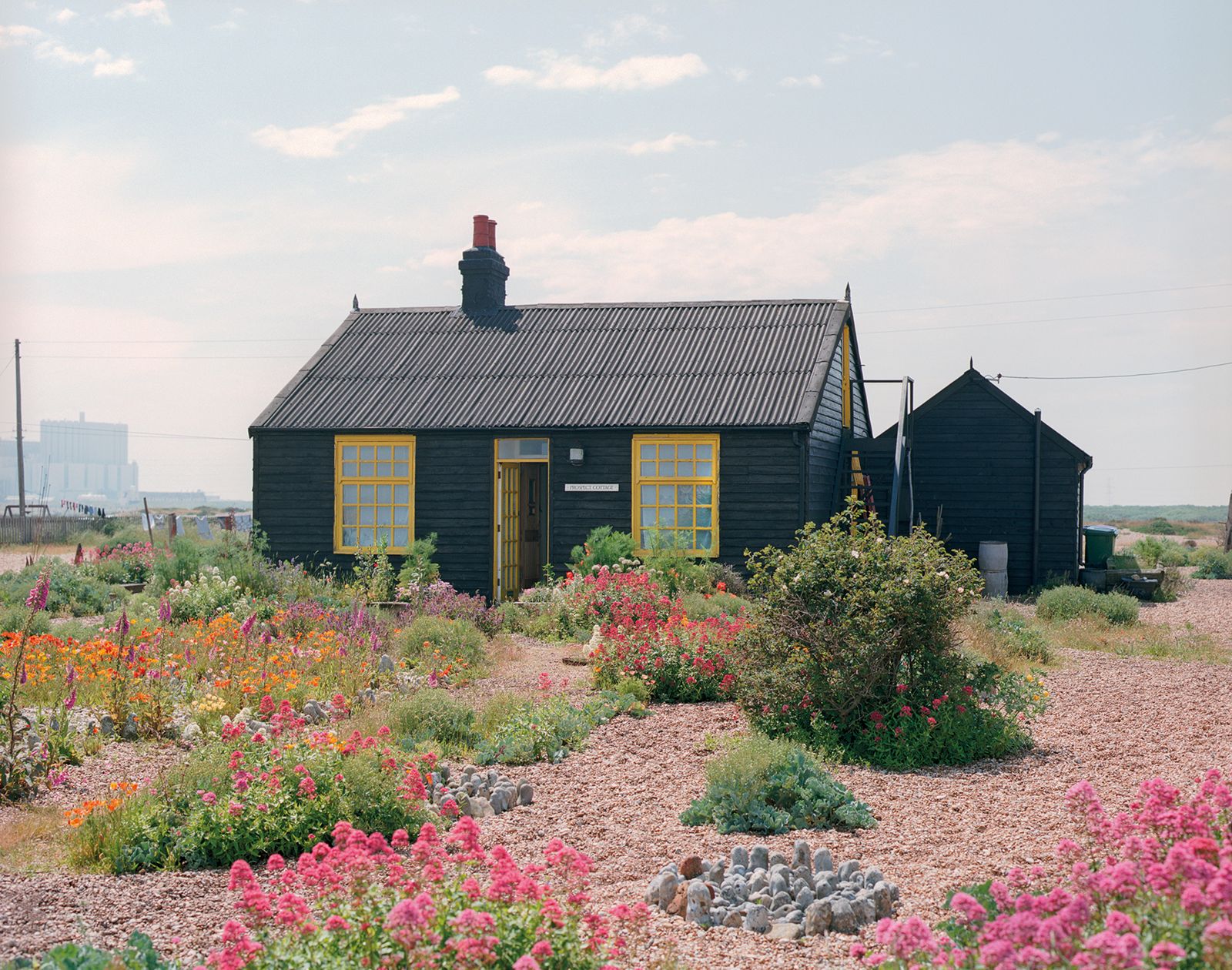
The former home of artist, writer, filmmaker, gardener and gay rights activist Derek Jarman, Prospect Cottage has become a place of quasi-pilgrimage – not least because of the garden that Jarman established. It rises, miracle-like, from the shingle; Dungeness is a desert, and those who live there do so in the shadow of a vast nuclear power station. Jarman died from AIDS-related illness in 1994, but his partner, Keith Collins, kept the garden and the house going, and when he died, Prospect Cottage was happily saved for the nation by Art Fund – which has granted us occasional access to the interiors. Tours are guided – and fascinating – telling the visitor more about Jarman’s life, and pointing out the relevance of every ornament, piece of art, and film prop. Note too the wonders that Jarman produced using driftwood and hag stones, the love letters etched in glass, and the colours.
The Venet Foundation
Forty-five minutes by car from both Nice and the beaches of St. Tropez is Le Muy – where the great French artist Bernar Venet (who, unlike the other artists mentioned so far, is very much still alive) has established a foundation with an extraordinary sculpture garden. It features the only Frank Stella chapel in existence, a Skyspace installation by James Turrell, and a slew of Bernar’s own monumental structures in Corten steel, which are juxtaposed against breathtaking views across the plains of Argens to the mountains beyond. Not on the tour yet – but keep your eyes peeled, for there are plans to make it accessible – is the main house, which contains a wall painting by Sol Le Witt, a number of Dan Flavin light sculptures, a canvas by Robert Motherwell, and furniture by Donald Judd and Bernar (who, like Judd, practices both art and design.) The whole is an extraordinary record of the salad days of the French Nouveau Realistes and the American Minimalists, with whom Bernar is and was friends, and, on occasion, shared studio space. Increasing the wonder is that much of the collection has been acquired via art swaps. There is gallery space in the garden with a roster of changing exhibitions, and visitors can also access part of the Usine (factory) where Bernar and his wife live during the summer months. The 2024 season runs from June 18 – September 28.
Charleston Farmhouse

Situated outside Firle, this house - the country outpost of the Bloomsbury Group - needs little introduction: we all know of the debt interior design owes to Vanessa Bell and Duncan Grant’s experiment in living – and loving. They moved in in 1916, and almost immediately began to paint – and not just on paper or canvas. Tables, cupboards, doors, fireplaces – all became viable surfaces for colour, pattern, and quasi-mythical scenes. The garden was designed by Roger Fry, a former lover of Vanessa’s who co-founded the Omega Workshop with her and Duncan Grant. If you are going to visit in the coming months, know that the Charleston Festival takes place May 16 – 27 – the line-up includes Olivia Laing, Grayson Perry, and more – and that there is a handy hop on-hop off Sussex Art Shuttle bus that runs every weekend between March and October, linking Charleston Farmhouse with the Charleston exhibition space in Lewes, and Towner Eastbourne (currently showing the Turner Prize exhibition – don’t miss Barbara Walker’s searingly-brilliant Burden of Proof.) If you’ve driven, be sure to visit the nearby Berwick Church too, which was decorated by Duncan Grant, Vanessa Bell, and her son Quentin Bell, during the Second World War. (Somewhat controversially, Grant used his friend and probable lover, Edward Le Bas, as the model for Christ in the crucifixion scene.)
The Villa Stuck
We’re back almost where we started - only 40 miles from Murnau - and the Villa Stuck in Munich is a triumph of self-belief. However, don’t turn up next week – it’s one to plan for the future, specifically, the end of 2025, when it re-opens after a period of restoration. It’ll be worth the wait: Franz Stuck – who married an American heiress and became Franz von Stuck after receiving the Order of Merit of the Bavarian Crown – designed and built this house as a Gesamtkunstwerk, which translates to ‘total work of art.’ His aim was that it should amalgamate life, architecture, art, music, and theatre all in one space, and he designed literally everything – furniture, furnishings, and finish. Co-founder of the Munich Secession and Professor of the Academy of Fine Arts in Munich (his pupils included Paul Klee, Wassily Kandinsky, and Josef Albers) he drew on a variety of sources, with a particular concentration on Classicism and Art Nouveau. The result is unabashedly and gloriously full-on; both exterior and interior are garlanded with classical statuary, there’s a hand-painted (by Stuck, obviously) zodiac ceiling, gold mosaic walls, antique mirrors and decorative Jugendstil motifs – and that’s before we’ve even got onto the furniture, for which Stuck won a gold medal at the 1900 Paris World Exposition.


