

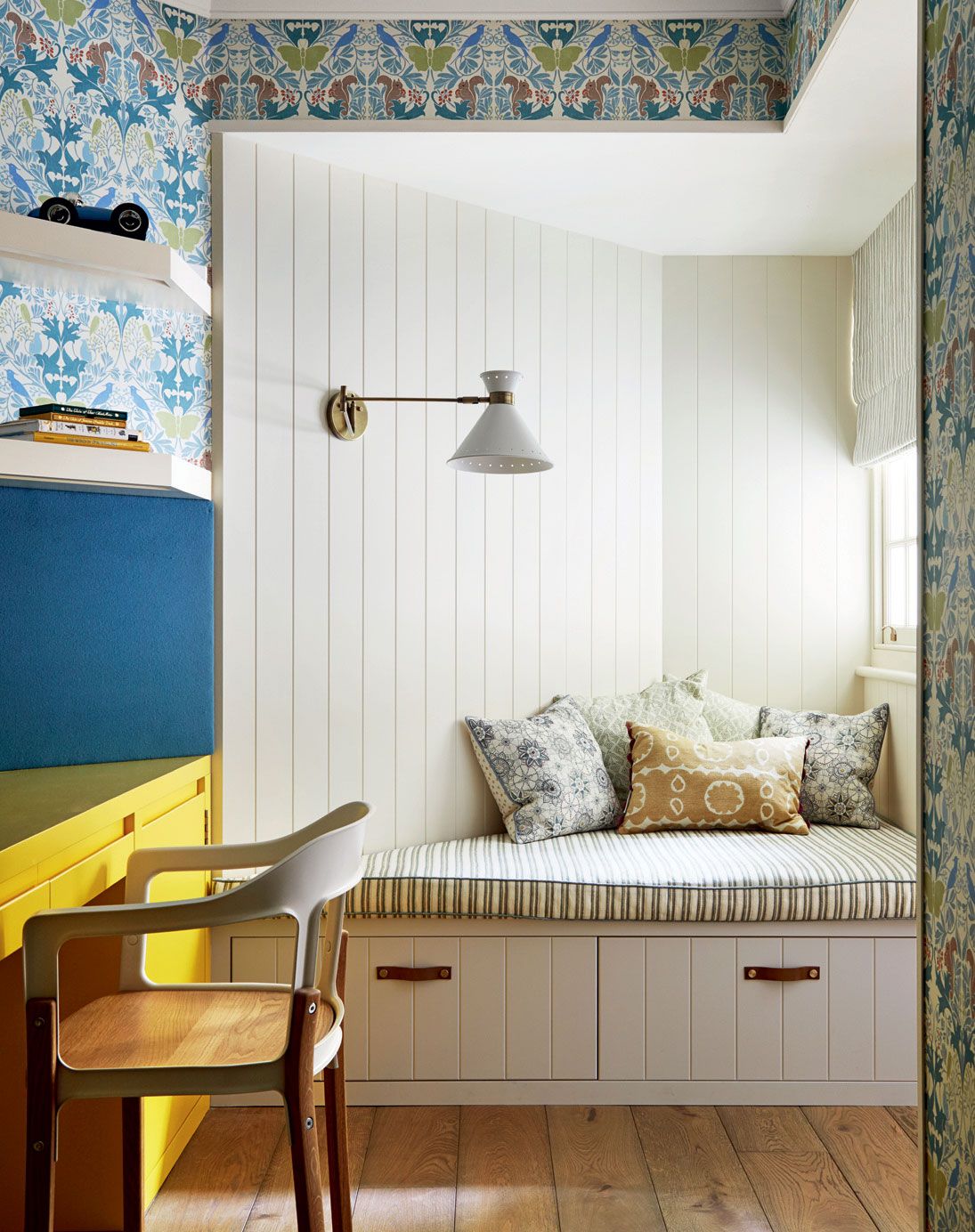
As the summer evenings shorten and our minds turn to September and a new season, so for those of us with children there’s the imminence of the return to school, which comes with the attending curse of homework. There exist children with self-drive – and children without; children who find beauty in algebraic equations – and children who don’t. We’re given tips by teachers, books, child psychologists and the internet; ‘set a routine’, ‘be a role model’, ‘encourage your child to develop a growth mindset’ (it involves saying ‘yet’ at the end of every sentence, as in “I can’t speak French fluently yet”) – and ‘have a designated homework space’. That last is something that we can help with.
Location, location, location
This is going to be informed by a variety of factors, specifically a child’s age, where they prefer to work, and how easily distracted they are. Lucy Hammond Giles of Sibyl Colefax & John Fowler has installed desks in her kitchen for her teenage children. “They don’t like working in their bedrooms because they aren’t ready to commit to the idea of sitting to do something without being able to escape to the fridge or outside or to play with the dog – and I’m sure the ability to easily flee ensures a faster return to their work,” she explains, mentioning the analogy of setting a bird free. At the same time, she has a client whose children “long to escape their noisy siblings and want their own space.” My thirteen-year-old son falls into that same camp – but I happen to know that, were I to let him work alone in his bedroom, he'd forget all about his RE essay within seconds; Henriette von Stockhausen of VSP Interiors confesses to similar issues with her (teenage) children.
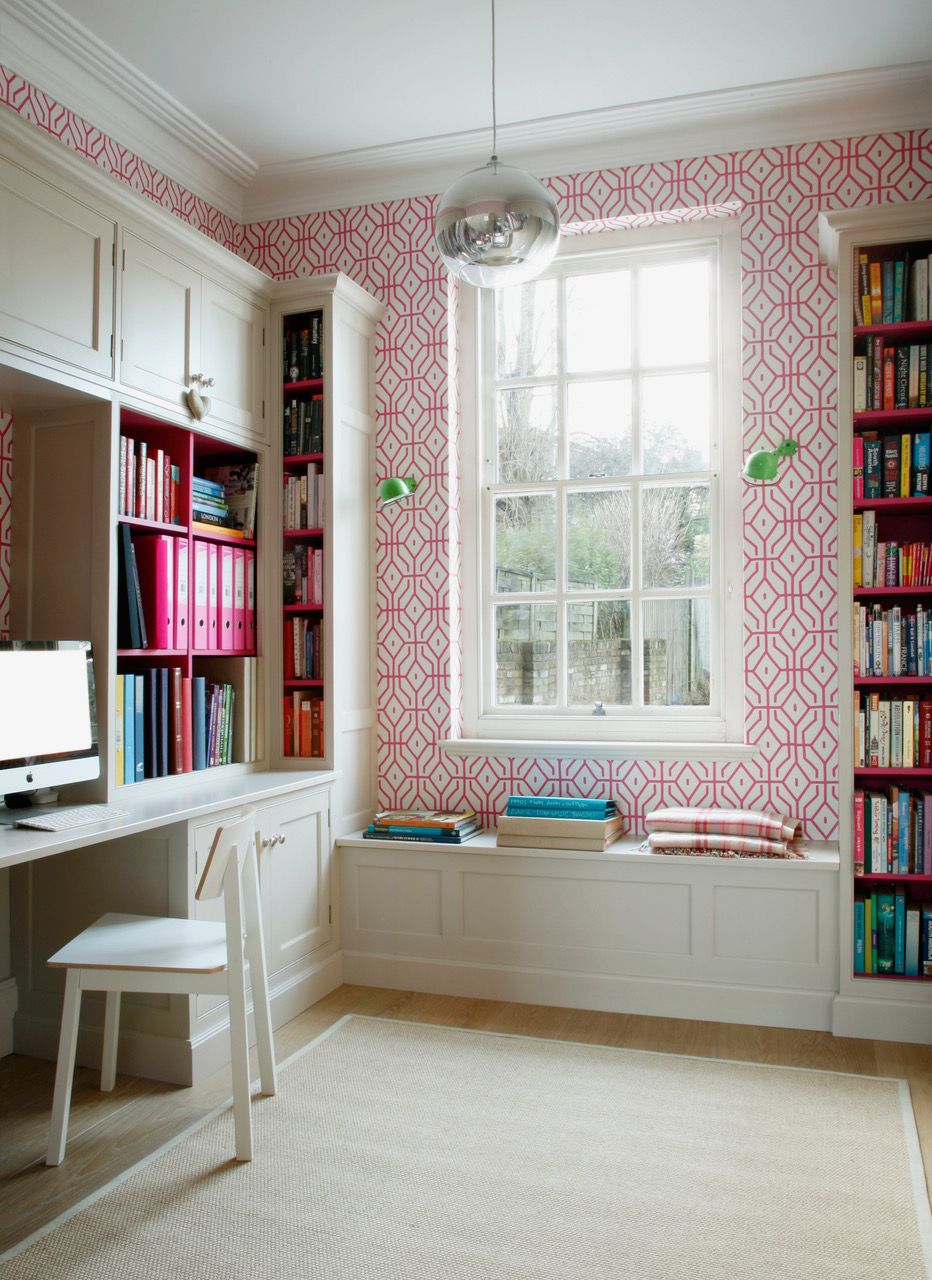
Juliette Byrne installed desks for three children in one client’s existing home office, setting them up as a single run, which looks smart and avoids the school room look. Such a solution certainly gels with the ‘be a role model’, to which end I’ve relocated my son’s desk to my husband’s study. Other areas for consideration include a landing, the space under the stairs, or an area of the sitting room.
Know that you don’t have to have a desk per se, providing sufficient storage for organisation is allocated (see the next point but one) – Cathy Nordstrom’s younger children work at the kitchen table, and my eleven-year-old daughter works in the dining room. Equally, just as some of us prefer a peripatetic approach to working from home – going from sofa to garden to armchair to desk – so some children will want to do the same. Key, if your children are at an age that requires their homework to be done on a computer, is that you should be able to see the screen if you’re in the same room, which I find a relatively good deterrent against accidental segues into endless games of Angry Bird. (In a related move, both Cathy and I have been known to remove mobile phones, ‘to aid concentration’.)
Furniture and lighting
“Aesthetic sensibilities wake early in some children, and these, if able to analyse their emotions, could testify to what suffering they have been have been subjected by the habit of sending to school-room and nurseries whatever furniture is too ugly or threadbare to be used in any other part of the house,” wrote Edith Wharton in The Decoration of Houses in 1897 – and the same applies now, particularly as the furniture is unlikely to be in a schoolroom, but needs to work with wherever it’s placed. The desks Lucy Hammond Giles has installed in her kitchen are “beautifully smart, the fitted desktops are formed in timber and painted in darkest Farrow & Ball Railings blue – edged with pine they feel very deliberate (as well as echoing our kitchen shelves.)”
Alongside looks comes comfort – to which end, please think about what your child is going to be sitting on; Lucy recommends an adjustable chair from either Triptrap or Eames, as suits your budget. Cushions can also help effect height, but perhaps aren’t a long-term solution. Child-sized furniture can appeal to younger children and is attractive, and Chelsea Textiles’s mid-century style modular desks (which can be designed with the number of drawers that you want) come in both regular and junior sizes, “but once they’re teenagers their desks should be a standard size,” says Louise Wickstead of Sims Hilditch (we found my son’s Victorian leather-top desk at a local auction house – it was cheaper than anything we could have got at Ikea.) Important is that the desk or table is sturdy enough for purpose – there is nothing worse than writing on something too small that wobbles. And lighting matters too: an Anglepoise has the advantage of being directable, and John Lewis do a good more affordable version.
Storage and organisation
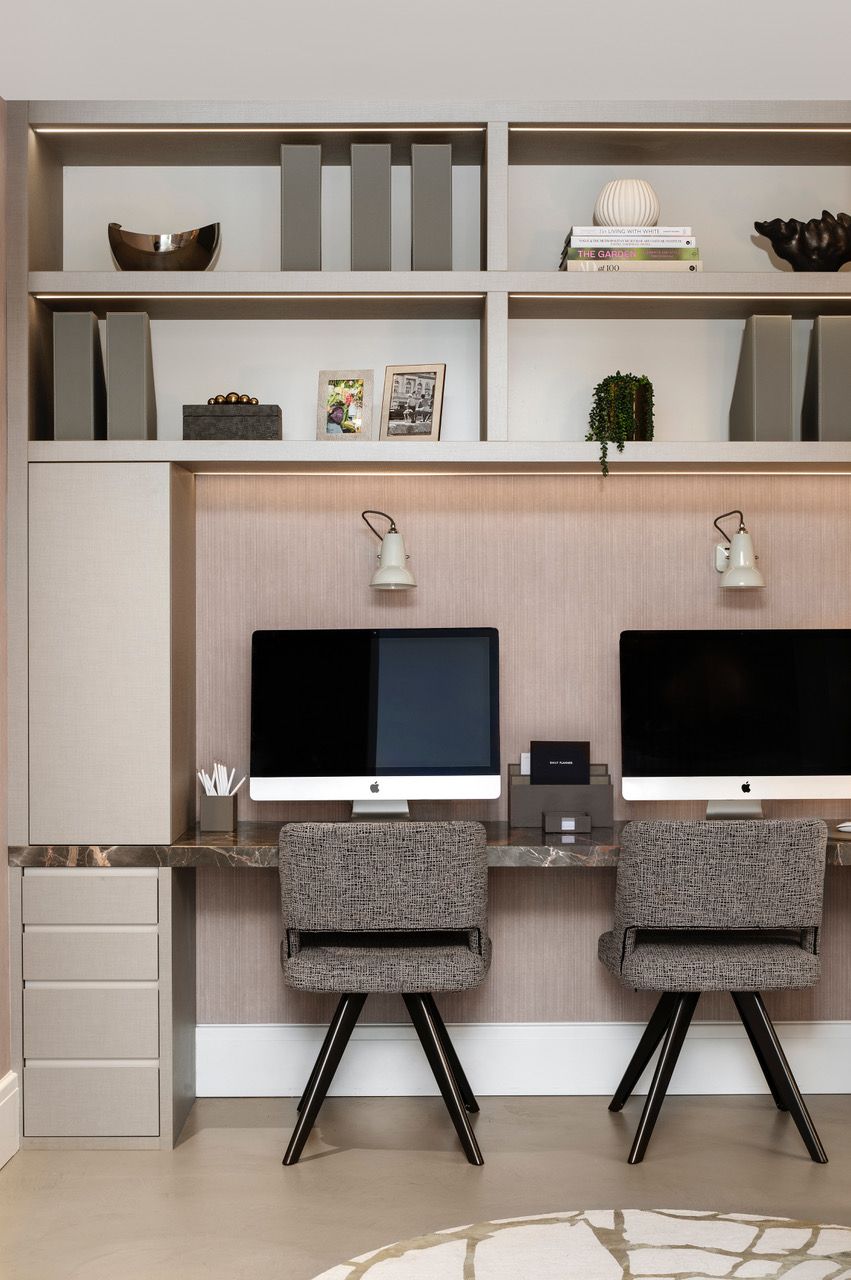
It doesn’t matter how beautiful the desk or table is, or how comfortable the chair is, if there isn’t sufficient room for organisation of files, books and other essential paraphernalia – which becomes increasingly important as the children get older. Lucy has made space underneath her children’s desks for cricket bags and given them each several shelves. If your child works at the kitchen table, then they need a cupboard or drawer where they can keep what they need in an orderly fashion, and Cathy has several Bridie Hall alphabet pots filled with “pens, erasers, sharpeners and pencils.” What might also benefit workers of no fixed abode is a basket that they can keep everything in.
Some children are better than others at coherent arranging; my daughter will gladly spend an afternoon colour coding a timetable – my son, on the other hand, has no concept of even keeping a single subject’s worksheets in the same place. Helping is an in-tray and a succession of box files (Molly Mahon and Nina Campbell both have lines of very beautiful stationery, which are definitely an aesthetic improvement on Ryman’s offerings.) I also make sure that a stapler and a hole-punch are to hand so that he can theoretically file as he goes. (He doesn’t – yet.)
For visual organisation, Lucy has fabric-covered insulation boards as pinboards “now covered in exam timetables”, Juliette has installed a magnetic wall for a client’s child, blackboard paint is another idea, and my daughter loves Papier’s academic diaries which can be personalised, and which she uses to keep track of what homework has been set, and when it’s due in.
Decoration and accessories
“It’s essential that a children’s workspace is clear of clutter and easy to use,” says Henriette, and studies have found that too highly decorated an environment can affect children’s ability to focus and concentrate. Similarly, Edith Wharton ordained that “walls should not be overcrowded. The importance of preserving . . . bare wall spaces of uniform tint has hitherto been little considered, but teachers are beginning to understand the value of these spaces in communicating to the child’s brain a sense of repose which diminishes mental and physical restlessness.”
At the same time, too bland, and no one is going to want to spend time in that space; Louise Wickstead suggests “adding colour through artwork will make it more engaging and interesting” and Henriette von Stockhausen suggests “an upbeat wallpaper.” The pinboard can be employed for inspiring teaching aids – the equivalent of votive works of art – and with efficient rotation it shouldn’t become too full.
Cathy Nordstrom’s fourteen-year-old son has recently started doing some work in his bedroom and “sometimes I put on classical music to help him focus,” she says. “It helps him relax and get in the right study mood.” For other children, noise-cancelling headphones might be beneficial.
Location, revisited
Don’t worry if you still struggle getting your children to knuckle down, and don’t take it personally; “my children don’t want to do their homework at all, never mind where, and I used to daydream wherever I was sitting,” recounts Henriette. Sometimes it’s worth trying it out of the house; I found that my daughter was more amenable to learning her spellings in a café with a hot chocolate, and Lulu Lytle of Soane’s teenage children prefer using local libraries, “they each have a favourite,” she says. If that is the case, know that your endeavours have not been wasted. “Flexibility is everything,” says Lucy – pointing out that “one day I might fancy using my children’s desks as sewing or collage tables.”


