


Two point five children, meat and two veg and a three-piece suite in the front room. These were once the staples of every ‘proper’ middle-class family home in Britain in the middle of the 20th century. Anything else and you might risk being considered unfashionable, or worse: ‘a hippy’. Matching furniture sets have a certain convenient appeal, especially if – as used to be the norm – you’re furnishing an entire house from scratch when you get married. What could be easier than paying a visit to the local department store (for my family it was Clements of Watford), pointing to a swish sofa-and-two-armchair set (both comfortable and formal) and installing it as the backdrop to your sherry parties?
The House & Garden team has plenty of memories of the tyranny of matching furniture, including a Chesterfield sofa in one childhood home that would have been perfectly nice on its own, less so when accompanied by two hulking armchairs also in buttoned green leather. And it’s not just about living rooms – one beloved grandmother used to have a full set of coordinated bathroom suites, each in different pastel shades (with matching tiles, towels and even, delightfully, loo roll).
As a general rule, this kind of mid-century matching style has fallen out of favour. In one of her decorating columns, Rita Konig made clear her views on matching furniture. ‘I have seen so many rooms with a classic Howard-shape sofa, a couple of matching club chairs and an ottoman floating somewhere far out of foot’s reach. Rooms can suffer terribly when everything is on the same level,’ she says. And most of the designers on our pages agree. ‘From a decorating perspective, you often want a mixture of sizes of chair and a sofa that fits the space as best possible,’ says interior decorator Daniel Slowik. ‘In a large room you might have a sofa and two armchairs of the same design but they aren’t all corralled together in a tight group. A matching suite was also a selling technique so perhaps the anti-matching movement is a resistance to showroom upselling.’

For Benedict Foley the ‘to match, or not to match’ debate also comes down to context: ‘All the furniture being “of a style” works well for a palace, but at home even in a designed interior, charm and comfort are more inviting than rigidity.’ Daniel concurs with the ‘time and place’ hypothesis. ‘I think a space that is used for a particular function can be enlivened by matching furniture, like a beach house in Palm Beach,’ he explains. ‘The sort of place where you are more occasionally than constantly. If you think of a suite of furniture made by William Kent for a house like Rousham, I think most objections would evaporate,’ adds Benedict.
Virginia White agrees: ‘If you’re decorating for a club, a hotel lounge or a modernist open-plan summer home, then going matchy can be a strong statement, especially if the suite of furniture is uncluttered and has lots of space around it. The furniture style in itself is part of the overall style. Repetition then becomes the look and is confident and not messy on the eye. Here it’s about the quality of the suite of furniture. Having matching furniture that feels tacky and cheap will be dreadful, but high-end designs in tonal colours can be a strong statement. Less is more.’ Daniel also recalls the popularity (and success) of matching furniture in a garden, where ‘the balance of human-made repetition in relation to the variety of the natural world is the charm’. So perhaps it’s not about ‘matching’ versus ‘contrasting’, but about varying your approach according to the history and function of the house itself.

Nonetheless, in most schemes, the idea of full matching does not tend to meet with approval. ‘In a private home, I don’t want the look to end up being “hotel couture”, says Virginia, ‘i.e. matching the bed valance to the blind to the scatter cushion, matching bedside lights and perfect rugs. An eclectic mix for me has more individuality – it shows off the artfulness and talent of the makers, and for the user it’s something more personal and more interesting, and that in turn makes it more comfortable and less formal. Furthermore, for me an interior space often evolves, so rarely do I buy all pieces at once. I come across them and repurpose or recover them to fit the existing space.’
It’s a sentiment echoed by most of her fellow designers. ‘We don’t tend to use matching furniture in our projects. We favour an eclectic design layered with art and antiques which results in authentic one-of-a-kind rooms for our clients,’ explains Venetia Rudebeck, co-founder of London-based Studio Vero. ‘For us it is all about curating homes full of exceptionally sourced individual items, each piece with its own exciting story, so why would you want to choose a matching set?!’ Benedict wholeheartedly agrees. ‘It seems a shame to miss the opportunity to enjoy variety,’ he says, ‘I think it can be rather fun for example to have a modernist chair alongside a Howard model at times’ And Martin Waller, founder of Andrew Martin, explains, ‘People are now looking for furniture with more individuality. Increasingly, consumers want individual and personalised pieces that are a true reflection of their personality, as this is what makes the difference between a house and a home. Out with the matching look – in with the unique pieces that add personality to your space.’

How to achieve said ‘personality’ is challenging, however. ‘Don’t be afraid to mix old and new furniture,’ Martin advises. ‘Interior design should transcend the limits of time and geography: it’s a form of escapism, a root of happiness and, most importantly, the background to your life. So, cherish your grandmother’s antique rocking chair or the Chinese wedding cabinet donated from your parents’ living room, it is these pieces that give character to your home and tell your unique story.’ Venetia concurs: ‘We love being creative and bringing together unexpected combinations and mixing mid-century antique furniture with modern craftsmanship. Sometimes there’s concern about a room being too busy when pieces don’t match but this is not the case at all. In our latest project in Notting Hill the living room exudes tranquillity but is full of mismatched pieces and an array of colour and pattern.’
Dining rooms are often an exception to the rule, even for those most allergic to coordination. ‘Clearly there are occasions when we do use matching furniture and a set of dining chairs is a really good example of this,’ says Venetia. ‘But we would never use chairs that match the table and we’d always go for a contrasting design. For more informal dining set ups we like to mix and match the same chairs with a bespoke banquette and a different table.’ In contrast, Sarah Walter Boyd hunted far and wide to find her stylish 1960s Hans Olsen dining set with elegant wooden chairs that stow away within the table sides. The mid-century piece fits perfectly within her modernist flat in London, as well as being a genuinely good solution for dining in a small space.

In bedrooms, many designers also like using matching bedside tables. ‘Whilst we don’t always use matching bedside tables, we are always on the lookout for an antique pair and this can bring a sense of symmetry and calmness to a bedroom,’ explains Venetia. For Claire Sá, director of the architecture and interior design studio De Rosee Sa, matching bedside tables are essential: ‘We often custom-design our own bedheads and position them flanked between two matching nightstands to create a focal point and draw attention to the bedhead.’
Cohesion in some form is an important quality in a room, and using sets of furniture that match in some respects can help to bring it about. ‘For me, symmetry is a big thing in creating a calm space,’ says Virgina White. ‘Take a pair of armchairs and cover them in the same fabric to create a symmetrical layout and good balance,’ she advises. ‘Matching furniture sets can be a wonderful way to control the amount of variation within a room,’ agrees Claire. ‘Typically, in the living room, there can be a great deal of competing furniture pieces so a matching set ensures the room appears more considered and curated and allows you to focus on more creative expression through additional soft furnishings, accessories, rugs, and art. Matching furniture also needs to make a statement,’ she emphasises. Flora Soames agrees: ‘I think with the word “suite”, you’re immediately starting on the back foot, and one conjures up an image of velour (often reclining) easy seating. But, in fact, who doesn’t love a bit of matching?!’ On the matter of how to do it best, Flora explains that the key is to ‘create enough of an impact with one theme (be it a colour, pattern or furniture style) but with enough of a contrast, too.’

In fact, many designers find themselves sitting on the fence, blending matching and contrasting pieces for effect. ‘For me, a sitting room is always made up of pairs, albeit stools or armchairs or a small set of slipper chairs,’ explains Flora. ‘Here is your opportunity to ramp up the matchiness whilst counterbalancing it with the unexpected.’ Benedict likes to strike a similar balance. ‘I think it could be rather fun to have the same model of furniture in different colours,’ suggests Benedict. ‘We made a series of stools for my WOW!house room earlier this year that were the same model but in different colourways of the same fabric. Quite often you did have long suites of stateroom furniture covered in two different fabrics, so it was a playful riff on that – a wink at grandeur but with a touch of nightclub joviality.’ Studio Vero agrees that ‘finding similar tones and colours, but in contrasting shapes and designs’ can be very aesthetically pleasing, something they’ve done with the wood and deep blue and turquoise tones in the kitchen of their Notting Hill property. Studio Buchanan’s own range of furniture is showcased in their living room, where the sofa and armchair match in style and pattern, but one is in pastel pink and the other in a more vibrant red, which avoids the ‘matchy-matchy’ look.
Coordinating patterns between the furniture and the wider room can also be a fun way to make a scheme feel playful. In Max Hurd’s living room, for example, the curtains and chairs are in the same green print. In his bedroom, too, his dramatic canopy headboard and ruffled curtains are both in Sibyl Colefax & John Fowler’s ‘Squiggle’ linen in aqua, creating a theatrical look that somehow nods to the ‘three-piece suite’ while also disobeying through the clashing flamboyance of the rest of the house.
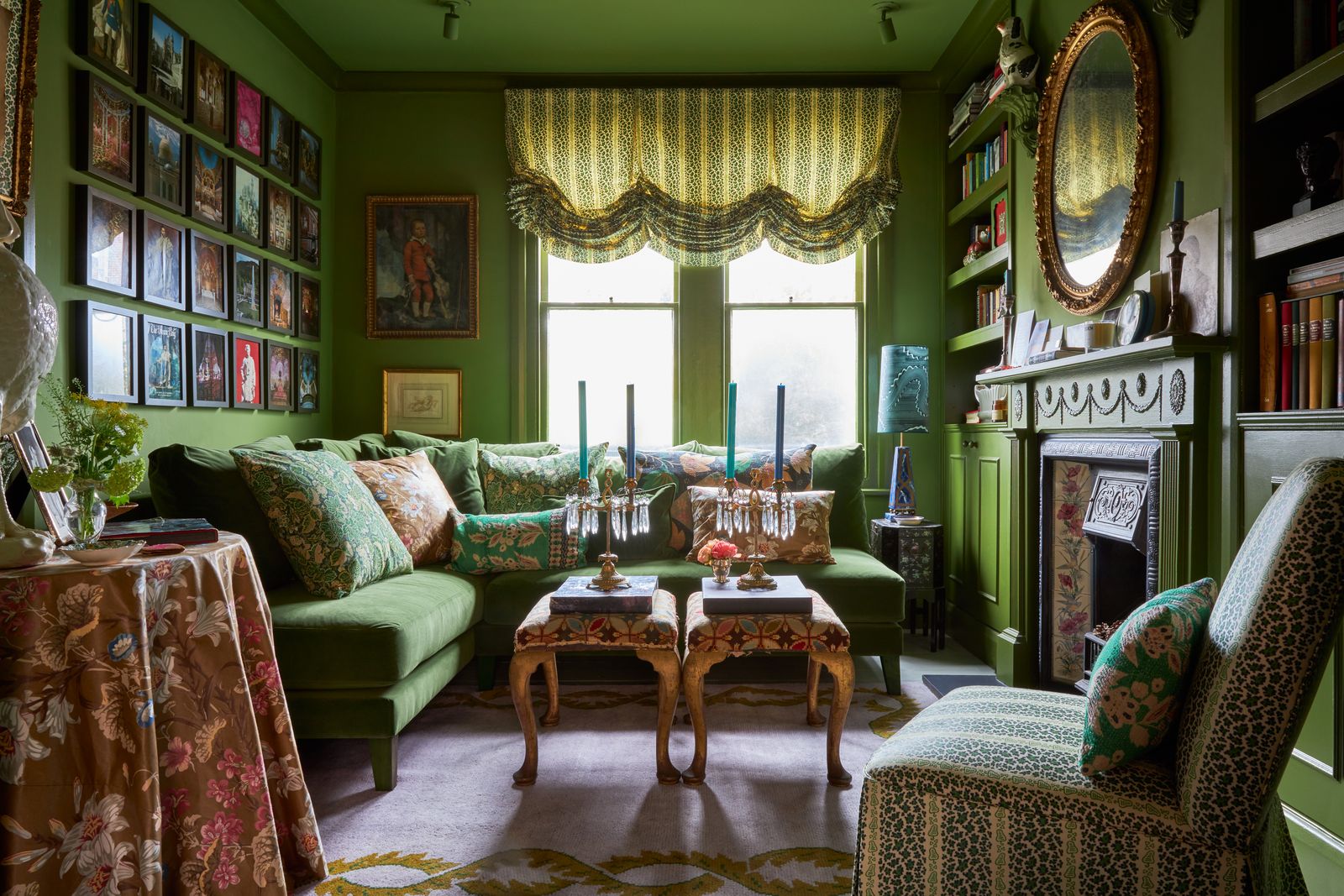
Despite some designers waxing lyrical about coordinating sets, and others vehemently rejecting the idea, it seems that all the experts agree that a compromise is best. Ultimately it comes down to finding pieces and patterns that make you excited, and not being afraid to combine unlikely prints or eras of furniture. While you might chose symmetry and cohesion when you’re trying to create a calm space for the eye to rest, with matching bedside tables for example, you might lean into clashing colours and styles in areas that can handle a bit of levity, and choosing a colour palette that will tie everything together is a wonderful way to achieve cohesion without monotony.


