
Beyond minimalism: why we should be looking to Scandinavia for maximalist inspiration

The Swedish word 'lagom'", says the designer Liza Laserow, the co-founder of rug company Nordic Knots, "reflects something very important about Swedish design. It means "not too much, not too little, just right." This sense of moderation and restraint is central to ideas of the 'Scandi interior', which revolve, to outsiders at least, around an image of wooden floors, neutral fabrics, white walls and clean forms. There are good reasons why the world has been drawn towards this kind of Scandinavian design: it's airy, simple and comfortable, and it's a look that can be replicated with any kind of budget. Yet there is another side to the region's heritage, one that dovetails neatly with a more maximalist aesthetic, and it seems to be having a moment.
Perhaps the most obvious point of reference is the design legacy of Josef Frank, the Austrian designer who fled to Sweden in the 1930s and became involved with the now-iconic homewares shop Svenskt Tenn not long after its inception. He designed an extensive collection of fabrics with an instantly recognisable combination of eclectic colour schemes and bold floral prints. Rebelling against the understated, clean-lines that characterised modern design in the 1930s, Frank's patterns were revolutionary for their time, but not at all were well-received by the design press in Sweden.
Nevertheless, Frank's patterns, one-off though they may be, have a huge following, and are much-beloved in the design world to this day. The interior designer Martin Brudnizki sees Frank as part of an essentially Swedish tradition, despite their singularity. "It's a distinctly Swedish thing to take classical motifs and abstract them to create more modern and simple lines. You can see this in how Josef Frank re-interpreted botanical patterns," he explains. The patterns seem to be having a particular moment these days; we love how American designer Meta Coleman often makes use of the lively textiles and wallpapers, and Beata Heuman cites Frank as perhaps her most important design influence.
Instagram content
Another prominent fan of Frank is Tina Seidenfaden Busck, the founder of shop-cum-gallery The Apartment in Cophenagen, and a brilliant exponent of the modern Scandinavian maximalist look. With a discerning eye and an illustrious career at galleries and auction houses behind her, Seidenfaden Busck founded The Apartment in 2011, with a 'shop the home’ concept that has been much emulated worldwide. Using a base of white painted floorboards and white woodwork, Tina fills the space with a rotating selection of wallpapers, fabrics (often from Svenskt Tenn), interesting furniture and striking artwork. While there is much of Scandinavian origin in the space, Tina also embraces a wide range of heritages, making use of her extensive vintage American quilt collection and the flags created by the Fante communities of Ghana. The sum of all these parts manages to feel at once clean, crisp and airy in true Scandi style, but also visually interesting and deeply comfortable.
Sweden has a rich design history that extends far beyond Frank and Svenskt Tenn, however, and other periods and styles are increasingly coming to the forefront of the wider design consciousness. The eighteenth century saw some heavily decorated styles influenced by France, as a boom in Swedish prosperity allowed the sweeping curves and elaborate carving of the rococo style to take their place in royal and aristocratic households. The relatively understated style of the Swedish rococo chair, with its characteristic pale painted finish, is still immensely popular today. The same combination of intricate detail with soft, washed out colours characterised the Gustavian style of the later eighteenth century, as King Gustav III looked to his contemporary Louis XVI in France and absorbed much of his neoclassical style. We tend not to think of these styles as maximalist, given the paleness of the typical colour palette and the homespun, country aesthetic that eventually emerged out of them, yet in modern interiors they can feel intensely decorative and visually interesting.

If you're looking for the next big thing, we'd lay our money on the Swedish Grace movement, which has been an acknowledged inspiration behind part of Martin Brudnizki's 'And Objects' collection, and has also inspired an 'Art Deco' collection at Nordic Knots. Much prized by those in the know, the furniture of this short-lived period in the 1920s has nonetheless gone relatively unnoticed in the wider world. "It’s a sort of bricolage of many of my favourite styles that come together in a very subtle and elegant way," explains Martin Brudnizki. "Firstly you have the neo-classical – felt in the often monumental scale of the architecture or the use of the Greek key. Then you have a touch of art deco, which you can see in the elegant and slimline forms in the furniture and the interesting use and combination of materials. Lastly you often have a feeling of Swedish folk patterns, of ancient designs from Scandinavian history reinterpreted through a modern lens. The greatest example of all these aspects coming together has to be the Swedish National Pavilion at the 1925 World Fair in Paris designed by distinguished architect Carl Bergsten – a Greek temple full of svelte modern furniture and folky patterns." It was the British journalist Philip Morton Shand (the grandfather of Queen Camilla, who christened this style with the 'Swedish Grace' moniker, after seeing the pavilion, which featured furniture by Gunnar Asplund, Carl Malmsten, Carl Hörvik and Uno Åhrén.

The folk-style patterns embraced by the designers of the Swedish Grace period may be better known in their Eastern European incarnations; painted marriage chests and cabinets from Romania, Hungary and Poland are seeing something of a surge in popularity in the UK. Folk designs native to rural Sweden are just as beautiful; the kurbits tradition of the county of Dalarna emerged from local imitations of the Dutch Golden Age painted decoration which was fashionable in wealthy households in the seventeenth century. "Some of these pieces are extremely pretty, with their deep blood red and green-blue colours," says Liza. "I think these could be quite trendy soon." With distinctive motifs like flower urns and tumbling flowers and leaves, the look is closely related to other folk traditions, from Americana to the highly decorated Transylvanian furniture of Țara Călatei, yet feels familiarly Scandinavian - just one more layer in the region's complex, layered heritage.
Scroll down to see ten of our favourite Scandi-maximalist interiors from the House & Garden archive.
 Line T. Klein1/10
When Karl Erik Halldén and his young family moved to Sweden’s Öland, they inherited a wooden 1920s gem of a house, full of decorative potential. The wallpaper in the sitting room is ‘Aurora’ by Svenskt Tenn, designed by Josef Frank. “We picked it because it has a lot of the flowers that we have in the garden,” says Erik, “so during the long winters we look at it as a reminder that there will be a spring.”
 Paul Massey2/10
Marie-Louise Sjögren’s historic house on the Stockholm archipelago was built as a summer retreat, but her family now enjoy the tranquil location in comfort all year round–especially at Christmas. While the house has an undeniably Scandinavian feel, it is far from predictable. Arts and Crafts references appear throughout: from the scenic mural in the sitting room by artist Pontus Karlsson, which is based on the summer view from this room and takes its stylistic reference from the work of Swedish painter Carl Larsson, to the Svenskt Tenn fabrics and furniture. This includes the Josef Frank-designed sofas in this room – among the few new pieces bought by Marie-Louise – covered in William Morris’s ‘Pink & Rose’ print.
 Anne Nyblaeus3/10
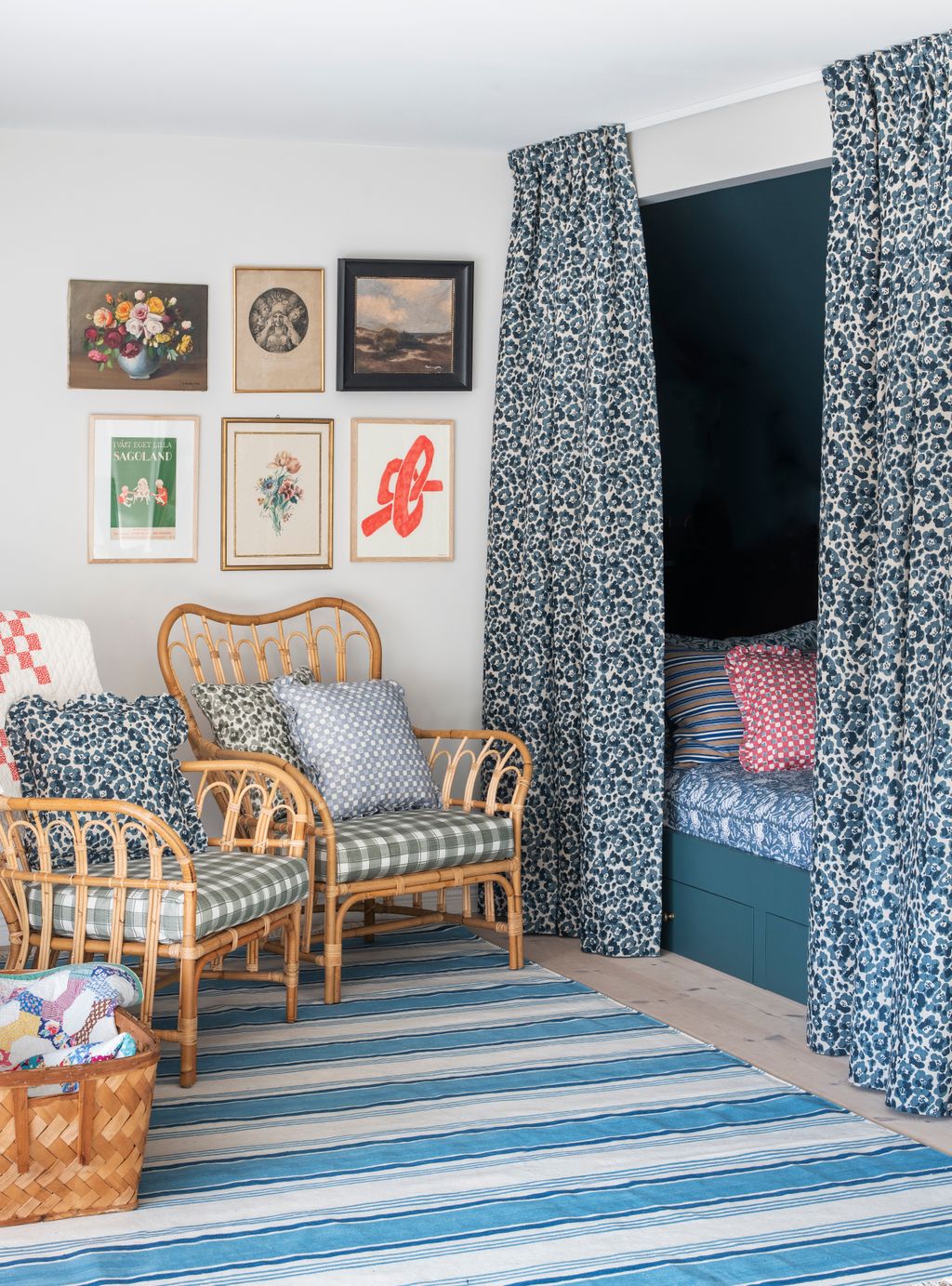
Cathy Nordström’s sommarstuga or summer cabin is a spacious and family-friendly getaway bursting with colour and pattern – with many of its fabrics designed by Cathy herself. Cathy names the Swedish textile artists and weavers Märta Måås-Fjetterström and Marianne Richter as major influences, but while she notes that “the DNA of my brand is Swedish”, her design is far from parochial. She collects vintage American quilts, and they adorn many of the beds and sofas of the house. Flat-weave rugs that she designed herself for the floors – “the measurements were so specific” – were woven for her in Jaipur. And elsewhere, she talks about the influence of English cottages in the décor of the sommarstuga. The curtains and cushions here are all Cathy Nordström. An Indian Kantha quilt acts as a bedspread. The other quilts are from Cathy’s collection of antique American quilts.
 Simon Bergström4/10
Sebastian Bergström's tiny flat in Stockholm is a masterclass in combining colours while retaining a fresh, airy feel. The cabinet in the living room is painted in Farrow & Ball's ‘Oval Room Blue’, which Sebastian calls the perfect backdrop for his tomato-red chairs, which are painted in ‘Heat’ by Little Greene.


 Rachel Whiting5/10
In the living room of this London house, designer Stephan Eicker has incorporated various periods of Swedish design to great effect. "The sofa and chairs are some serious pieces of Gustavian design, which we covered in a plain Ottoman fabric and a striped ticking, both from Claremont. The ticking is complemented by the Robert Kime ikat lampshades and the two striped cushions appliquéd with Elizabethan floral embroidery from Howe. The carpet is the "Vit Botten" flatweave, from the workshop of Märta Måås-Fjetterström, which is one of the most enduringly celebrated weaving houses in Sweden. The design dates back to the Sixties and its soft, graphic pattern works here as a great foil to the florals."
 James McDonald6/10
The owners of this London house - collectors of Swedish art - were happy to let designer Stephan Eicker be bold with his schemes for its rooms, which set off their collection of modern art. A pair of Gustavian chairs covered in a striped fabric from Claremont have been placed in front of the door to the hall, where the wall is hung with Joan Miró lithographs
 7/10
7/10In Beata Heuman's London house, the kitchen’s glass ceiling was inspired by patisserie ceilings from the turn of the last century in Stockholm and Copenhagen. The blue cabinet hides the refrigerator, and all the cabinetry handles were designed for the room and made by hand in Florence.
 Meta Coleman8/10
Josef Frank's 'Klöverblad' wallpaper makes for a fresh, spring-like backdrop to the bathroom in this Utah cottage designed by Meta Coleman.


 Meta Coleman9/10
Meta has also used Josef Frank's 'Under Ekvatorn' pattern for the sofa in the same Utah cottage.
 Miguel Flores-Vianna10/10
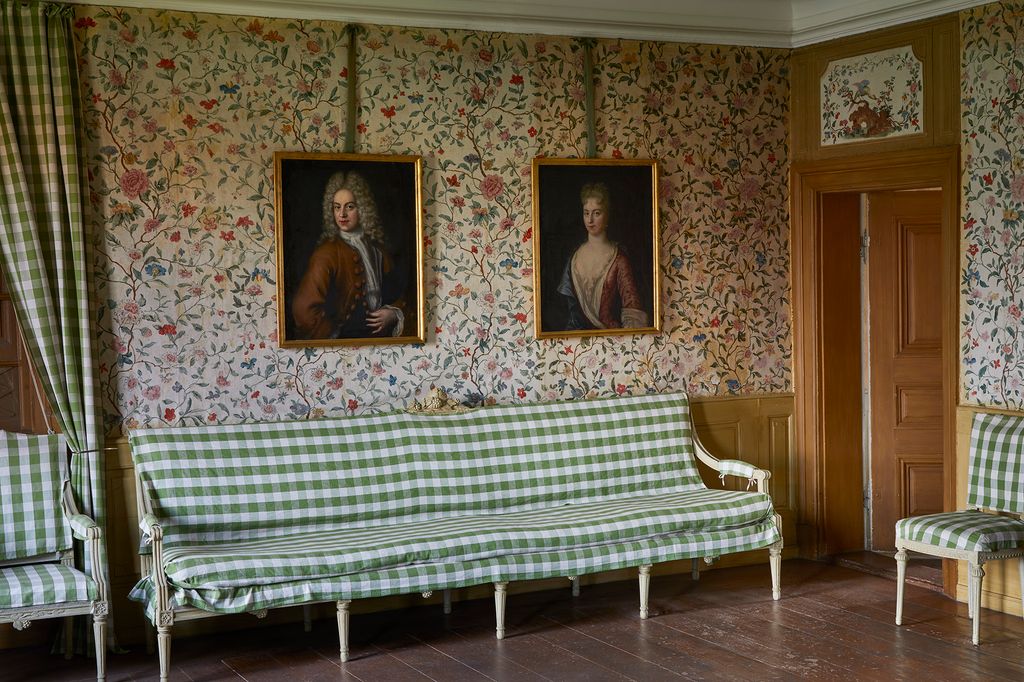
The eighteenth-century French-inspired Rococo manor house Svindersvik combines exuberant Chinoiserie, contemporary rococo designs, and humble, rustic fabrics in its interiors. In the master bedroom, the lively floral Chinese wallpaper is charmingly offset by cotton gingham upholstery and curtains.


