


The resurgence of brown started as a low hum a few years ago, building to a crescendo where we’re feeling emboldened to choose brown paint, wallpaper, area rugs and upholstery. So where does that leave once-ubiquitous grey? It would be foolish to assume that everyone has merrily hopped aboard the brown bandwagon and rejected all steely, cool tones. Every colour has its fanbase, and for many, grey will never fall out of favour, but for a period in time, it became a byword for neutral, and homes were decorated in grey on top of grey on top of grey. Its reputation as cold and uninspiring made it a colour to avoid. So, in 2025, is grey still relevant? We say yes, but it’s all about moderation and getting the specific tone just right. When there’s a will, there’s a way (and a grey).
Grey paint in particular has fallen out of favour as the go-to wall colour. Historical paint expert Patrick Baty of Papers and Paints says, “Thankfully, the almost-universal use of grey seems to be on the wane. When we first noticed the rise of grey, we produced our range of ‘Pure Greys’ in response, and while they are still useful, they have been overdone of late”. Alex Glover, founder of fine decorating business Austin James, agrees, “We’re having a bit of a hiatus from grey, and whites with a grey undertone”.
Is grey paint still a good choice?
It’s true that grey paint was oversubscribed for a time, and the wrong shade can make a room feel soulless and fridge-like in its coolness, but there’s always a place for grey; it’s about choosing the right tone. Designer Christian Bense suggests ‘Slate’ by Paint and Paper Library ‘always looks good, then “Slate I” has the crispness of white without the flat coldness, so that’s the ideal choice for ceilings, skirting, architraves and doors. ‘Slate II’ and ‘Slate III’ are perfect everyday shades of grey-leaning white for walls’.
To avoid an energy-sapping grey, you could try a grey wall with a more painterly and textured finish, such as Bauwerk’s limewash paint, or a neutral with a grey undertone, such as Bone, Shell & Quill by Atelier Ellis. See Farrow & Ball, Coat paints, Edward Bulmer, Atelier Ellis, Paint and Paper Library, and Mylands for soft, grey-based paint options that will look anything but flat.
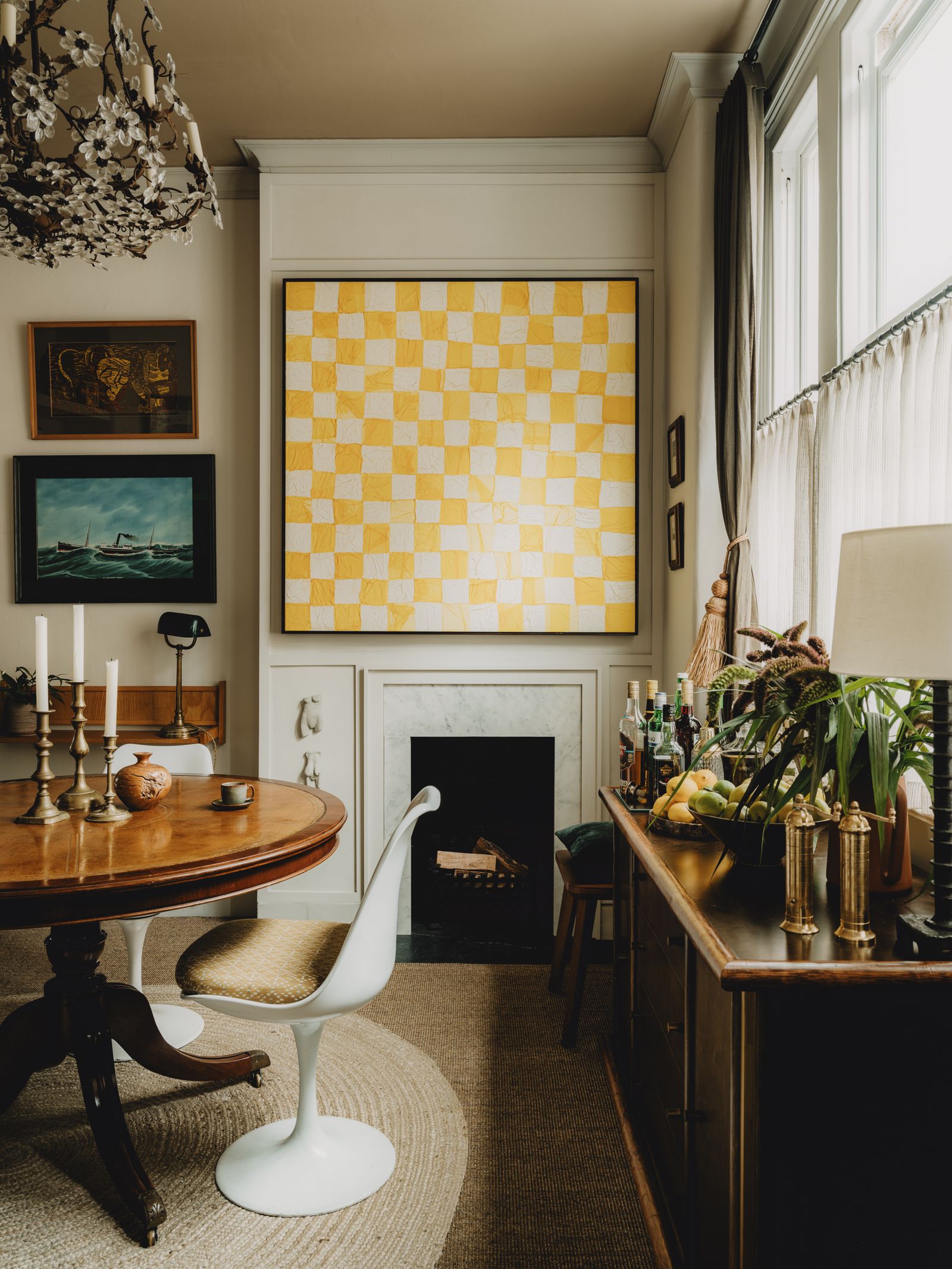
The best grey paints aren’t necessarily what you’d think of as grey
Grey doesn’t have to mean the colour of raw concrete, the skin of an elephant, or clouds on a gloomy day. A one-dimensional, pure pale grey feels as though it’s lowering the temperature in the room by a degree or two, but you’ll likely find that versatile, gap-bridging shades are easier and more dynamic to live with. Experiment with a blue-grey, brown-grey, or green-grey, and the complexity can change the impression of grey entirely. In Daniel Slowik and Benedict Foley’s tiny London flat, Shaded White by Farrow & Ball is a pale but warm grey-white, and it feels like the ideal neutral.
Paul West describes the not-quite-grey he’s used in his restored East London townhouse, ‘Grey can feel cold and flat, a little too man-made or industrial. But it can work beautifully when handled with care. The key is tonal depth. Introduce earthy undertones: soft greens, muted stone – and the grey gains warmth, humanity, and calm. It stops feeling distant or clinical and becomes a colour that soothes the eye’. The design consultant mentions Farrow & Ball’s ‘Light Gray’ and ‘Old White’ as two examples of his favourite green-greys. ‘Light Gray has subtle warmth and depth, while Old White is a muted, stony grey that changes with the light – both create a backdrop that allows a home to breathe’, he adds.

You can’t go wrong with textiles
Paint trends come and go, and grey isn’t the current colour du jour, but grey upholstery and soft furnishings are safer bets as they’re easier to layer and they tend to look good with other colours – even contrasting tones. The key to getting it right is to sidestep a silver-grey or drab, cold hues and instead, look to green-grey, greige (grey-beige) or darker charcoal tones.
When choosing grey textiles, think about texture, because tactility adds warmth. Charcoal can look beautiful as an upholstery or curtain fabric in relaxed slubby linen, and many interior designers, such as Vincent Van Duysen and Rose Uniacke, choose dark grey sofas and armchairs to ground their schemes. Charcoal or elephant-grey velvet gives textural depth, and wool works brilliantly too – especially in a chunky knit or luxurious cashmere for cushions or throw blankets. Plush grey shearling is especially good, with bonus points if it’s curly Gotland sheepskin. As much texture as possible will always bring richness and life to a colour that can sometimes read as cold.
Step away from the grey carpet
Wall-to-wall carpet is where texture and shades of grey don’t necessarily support one another. In fact, flooring is where grey hits a nerve for this writer. If you’ve had a browsing session on Rightmove recently (we all have our hobbies), and you’ve scrolled through image galleries of recently renovated flats or houses, there’s a strong chance you’ve encountered miles of glossy grey carpet. Often in a cold and lifeless shade of silver-grey, its deep cut pile and shiny finish leave tracks where a vacuum has brushed it in a particular direction.
This specific type of carpet is loved by developers and buy-to-let landlords, and it’s often paired with grey walls and grey kitchen units, with the well-meaning renovator misguidedly believing the overall look will be a blank canvas. Alas, a glossy grey carpet is surprisingly restrictive, and this is when people find themselves backed into a corner, with few obvious options besides complementing grey with black, white, or more grey. What was supposed to be a neutral floor can be the trigger for a greyscale home lacking in warmth or character. If you really have your heart set on a grey carpet, choose a matte finish in a looped wool, or a grey-toned sisal or jute.
Which grey flooring works best?
If you know a grey floor is going to make your scheme sing, there are several alternative options to carpet that look great and they’re versatile. For starters, few floors look more chic than smooth, light-reflecting poured concrete. Done well and used within the right architectural setting, a shiny concrete floor makes a striking backdrop for interesting furniture and beautiful rugs, and it reflects light in spaces that need to feel brighter. You could also experiment with a poured resin or rubber floor for a similar contemporary effect (what the latter loses in reflectiveness, it gains in slip prevention).

Hannah Yeomans retained the previous owner’s concrete floor and thick slate kitchen worktops in her Cornish barn conversion, combining the cool grey surface with tactile beechwood and antique furniture. The designer says, ‘Grey can be very dominant and this is possibly why it’s gone out of favour, but when used in combination with softer colours and textures, it can give an edge to a scheme and bring it to life, and I really enjoy the relationship between the two’.
If you love the idea of grey flooring but don’t want a solid colour, this is where you could try grey and white marble tiles in a chequerboard design, or patterned tiles. For grey-toned wooden floors, you could sand and then stain existing floors to achieve this if the boards are solid and in good condition, or choose engineered wood for a bathroom or kitchen, since they’re more practical for potential leaks or spillages.
Speaking of kitchens and bathrooms; a grey slate or limestone floor will always transcend trends and they’ll never feel dated. You could also try grey marble, granite or soapstone in a bathroom. It’s the timelessness of natural materials that means they’re always beautiful, tactile and interesting to look at. These types of stone will also look classic and relevant when used for tables, sinks, kitchen surfaces, and fireplace surrounds, regardless of how popular grey is (or isn’t) at the time.
How to use grey in small doses?
Handmade grey ceramics will always look great on a dining table or grouped neatly on open kitchen shelving. Stoneware (especially in very dark charcoal tones) also makes for a perfect oversized lamp base. The colour and material will give the lamp a literal and visual weight, so it’s a grounding object that gives a space presence.
The same principle also applies to small accessories and furniture, such as decorative objects or artwork. Where black would feel too harsh, colour too vibrant and a natural material like wood too easily camouflaged, try adding contrasting objects in grey, such as a small zinc side table, a knotted grey wool rug, a pewter vase, or a painting in various shades of grey.
Do as the interior designers do
An intentional contrast of warm and cool tones seems like it shouldn’t work, but choose complementary hues and it does. Designers such as Ilse Crawford effectively introduce elements of grey to schemes that might otherwise sit on the warm side of the spectrum. For inspiration, look to hotels such as Heckfield Place and Ett Hem – in both places, grey is combined with natural leathers, woods, seagrass and linen in shades of beige and brown, to wondrous effect. In his London flat, designer Brandon Schubert has complemented his brown linen walls and brass fireplace insert with cool grey marble, grey upholstery and pewter candle sconces. It creates just the right amount of tension and balance.
Interior designer Tom Morris agrees, ‘There is occasionally still the argument for grey, especially if it’s in the warm, dark realm as opposed to the flat, light-ish grey so beloved by footballers' wives. There is still something very handsome about a ‘Manor House Grey’against oak wood. The greener end of things (‘Flanders Grey’ by Mylands) is a great base for a nice Lowlands colour palette in a home. When used as a backdrop, grey still has its uses; it’s only when it’s the main event that things can get a bit grim’.

Which colours look good with grey?
Don’t feel trapped by grey if you’ve already invested in expensive flooring, made-to-measure curtains, swathes of limestone or a sofa, only to worry that you’re not sure about it as a colour now. You can make grey work for you, not against you, and it can look rich and interesting as a partner to other shades.
If you have the confidence to experiment beyond greyscale, complement your existing grey with purples, deep reds, greens or even brightly pigmented blue to keep them feeling interesting and contemporary. Grey can handle the occasional shock of a much brighter colour, and in this grand Hampshire house, designer Max Rollit has combined dark ‘Handel House Grey’ by Papers and Paints with a voluminous bed canopy of golden silk. The secondary colour doesn’t have to be introduced via wall paint – it could be through curtains, a rug, an upholstered bed or a statement piece of painted furniture.
Co-founder of Ette Colour, Despina Curtis, says, ‘Grey can still look really timeless if used in the right way, but choose a grey with a warm undertone, so it’s not corporate-looking. For pale greys, pair them with softer, more muted colours such as Wedgwood blue and sage green, as well as colours found in minerals and stone. This will give a combination steeped in nature and less synthetic in feel. For deep, dark greys, accents of olive greens or purple-browns will complement it beautifully’.


