


When, in 1897, Edith Wharton published the interior design equivalent of the King James Bible, The Decoration of Houses, she made clear her loathing of oppressive Victoriana. She derided unnecessary window dressings, tables “so littered with knick-knacks” that there wasn’t room for books, upholstery so padded and puffed as to resemble “the furniture of a lunatic’s cell”, and a palette of so many colours that they give “the same effect of a number of voices talking at the same time.” She advocated for comfort, unity – she suggested using the same fabric used for curtains and chair coverings – and a feeling of spaciousness. By and large, for the 120 or so years that followed, we upheld her decorating values.
And yet, here we now are in 2023; we’ve reached a happy state of (almost) anything goes, are gladly rehabilitating items once considered the height of naff, and practising both maximalism and maximalist collecting to an extent that would have horrified strict adherents to Wharton’s rules. Alongside, elaborate window dressings are being revisited, and Ben Pentreath has recently re-coloured a selection of Morris & Co patterns (which, in truth, have never entirely gone out of fashion.) Sambourne House, once home of the illustrator Linley Sambourne, and located off High Street Kensington, has just re opened to the public, allowing us to inspect a good Victorian interior in real life, “and bits of it are rather lovely,” enthuses Susan Deliss. Essentially, it’s an ideal moment to re-examine the interiors of the second half of the 19th century, and ask ourselves what might be redeemable–and what we need to avoid. After all, Victorian houses outnumber almost any other era when it comes to housing stock across Britain – wouldn’t it be nice to have multiple options when it comes to creating a decorative link to the time our house was built?

Firstly, however, we need to ascertain exactly what Victorian interiors are. It’s easy to picture them as dark and cluttered, “with a sense of claustrophobia,” agrees Susan. But it’s unfair to tar them all with the same brush. The length of Queen Victoria’s rule was second only to the late Queen Elizabeth IIs – 1837 to 1901 - and saw numerous socio-economic and cultural changes. A major impact was the industrial revolution, which produced a new middle class, increased the size of cities, and heralded new manufacturing processes. Certainly, an interior that features only machine-made furniture and man-made textiles of the same period is always going to look a bit catalogue, even if the catalogue dates from 1840. And, says Susan, “some of that furniture was quite muscular,” while Brandon Schubert points out that examples that followed the Gothic Revival “can look like they really belong in a church.”
But there was also the advent and accessibility of foreign travel – which meant exquisite plates and tiles were brought back from the Near East and beyond, giving us Orientalist delights such as Leighton House, “which is exquisite,” says Susan - who herself deals in antique ceramics and textiles, and often sources them – as Lord Leighton did – in Istanbul. It led on to Arts and Crafts, which flourished from about 1880, is seen as the root of modernism, and was strongly anti-industrial in its orientation. William Morris was one of the driving forces, and Ben identifies the “sense of comfort and happiness” in those patterns, “which could not be more relevant today.” (Proving his point, he uses them with an unerring frequency.) The Aesthetic movement came next, and the belief that utilitarian domestic life should be beautiful and that the home should be like a work of art. “It is one of my favourite periods for furniture and accessories,” says Brandon. “I love the influence of eastern motifs and the enthusiasm for embellishment for its own sake. Ebonised furniture was also popular during this time, and almost every room can benefit from a bit of black.”
The hitch, in the 19th century, was that many interiors simply embraced all of it, an approach which we can see only too well at Sambourne House, where there is Morris & Co wallpaper, stained glass windows designed by Linley – and a density of objects that, in 1877 when an inventory was made, included over 50 vases, 70 chairs, and 700 framed pictures. We don’t know the statistics for side tables and photographs, but walking across the morning room, which is thought to have been decorated by Linley’s wife, Marion, is akin to playing a game of Buzz Wire but with higher stakes. If you mess up and trip over something, you’d hear the traumatic tinkle of breaking glass, accompanied – if you’re unlucky - by the crash of falling marble and ensuing splintering of wood. Your chances aren’t helped by low visibility, caused by the previously mentioned stained glass windows, and further aided by heavy, fringed curtains and pelmet. There are lamps everywhere too – and you have to wonder just how bad the London smog was that there was no attempt to increase – or even necessarily enable – the flow of natural daylight between rooms. The darkness was a common factor in houses at the time, “and it just brings a pervasive gloom,” points out Susan. It also makes everything seem brown.
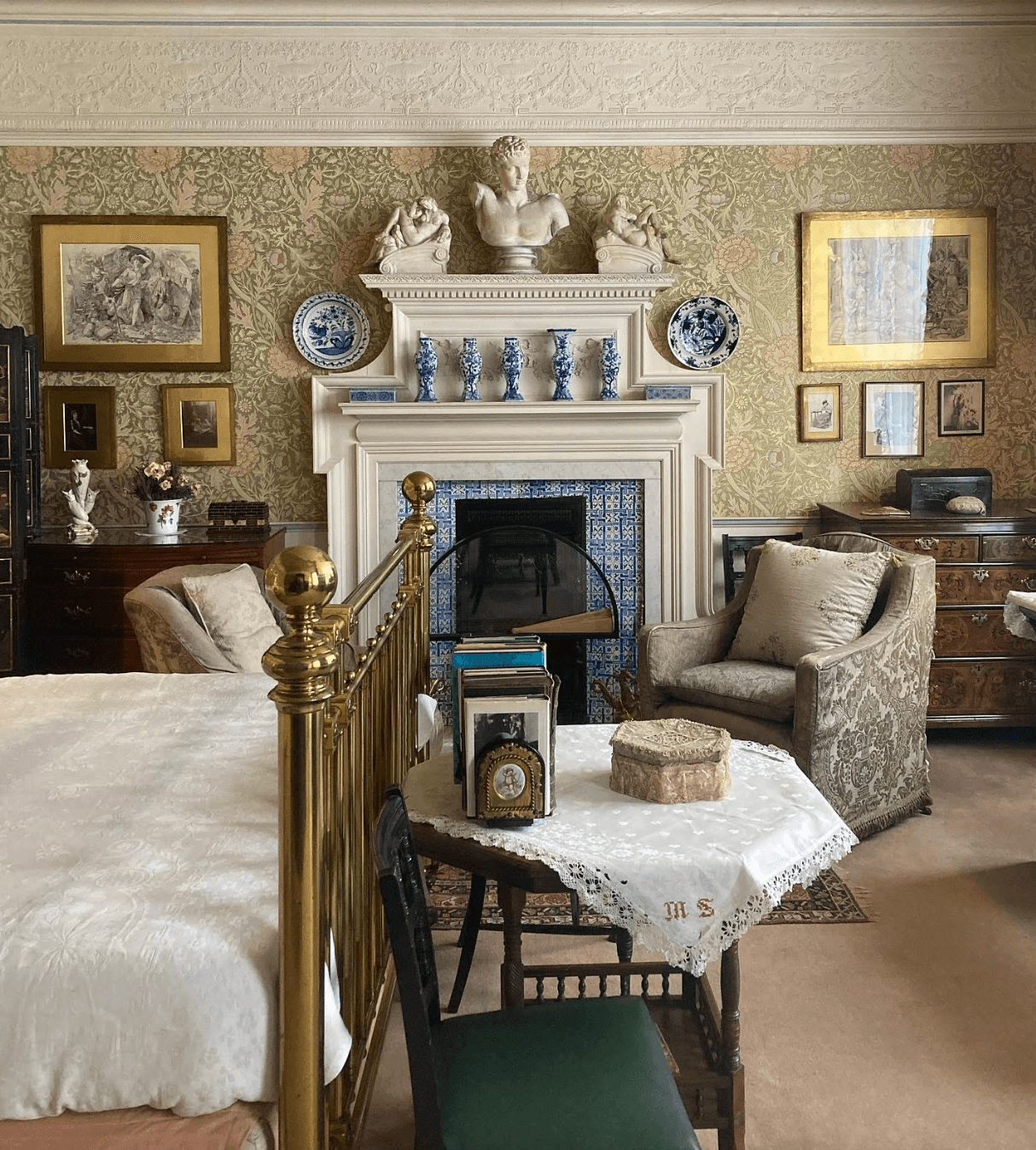
But the bedrooms at Sambourne House are quite different – lighter (literally) and airier. They main bedroom (and indeed the maid’s bedroom) are less densely hung, and while there’s pattern and ornament there’s room for it to breathe, which even the most maximalist of collectors, namely Benedict Foley, sees as necessary, explaining “the most valuable thing in our cottage is the space between things.” There are also patterned wall- to-wall carpets, which Susan professes an affection for, “as long as it’s not in red, and so doesn’t look a pub.” She’s got company: Martin Brudnizki has had one put down at the Berkeley Square nightclub, Annabel’s, and “I’ve always been a great fan of patterned wall- to-wall carpet,” says Daniel Slowik. “It adds another dimension of pattern in a room, and you shouldn’t be frightened of placing further rugs on top of it,” he continues, adding that it’s a great insulator for both heat and sound. Then Susan goes into rhapsodies over Victorian tiles – which are something else that, like Morris’s patterns, have never really gone out of fashion; even High Street tiling shops have a good selection of reproduction examples. And Daniel swoops to the defence of even less desired Victorian furniture, saying “I have stuck by Nancy Lancaster’s rule that you always need ‘something a little bit ugly’ in a room. Victorians often added that little bit too much ornament which makes their furniture perfect for the purpose."

It's that same hotchpotch of style and ornament that makes a Victorian house “so very decorate-able,” identifies Susan – remarking on their ability to hold neo-classical and neo- Gothic mouldings, as well, often, as a fair dose of neo-who knows what. “Plus, they’ve got decently proportioned rooms; you can throw just about anything at them, and they’ll absorb it.” Within that ‘anything’, however, it’s worth heeding the singularity in Nancy Lancaster’s approach – and Daniel’s mirroring of it; only one thing needs to be ugly. “The key to using highly stylised antique furniture is to use it in moderation,” emphasises Brandon. “One Aesthetic movement side table can be just what a room needs, but a whole dining room suite might be too much.” Finally, please, let the light in.


